Object-Oriented Design Interview Guide: Framework, UML, and Common Questions
Quick Overview
Prepare for an object-oriented design interview with a practical six-step framework for clarifying scope, defining use cases, assigning responsibilities, modeling UML relationships, designing public APIs, and handling follow-up changes. Includes a notification-router example, common OOD questions, mistakes to avoid, and a focused seven-day plan.
An object-oriented design interview can look deceptively simple: design a parking lot, elevator, vending machine, or notification system. The difficulty is not naming a dozen classes. It is deciding what each object owns, which relationships are stable, and how the design should change when the interviewer adds one more requirement.
The strongest answers are not UML art projects or catalogs of design patterns. They are small, traceable models that connect requirements to responsibilities, public behavior, and testable state changes.
Start with PracHub's real interview questions with written solutions, then use company-specific interview prep to see which design formats appear in your target loop. This guide gives you a reusable framework for practicing those questions instead of memorizing one polished diagram.
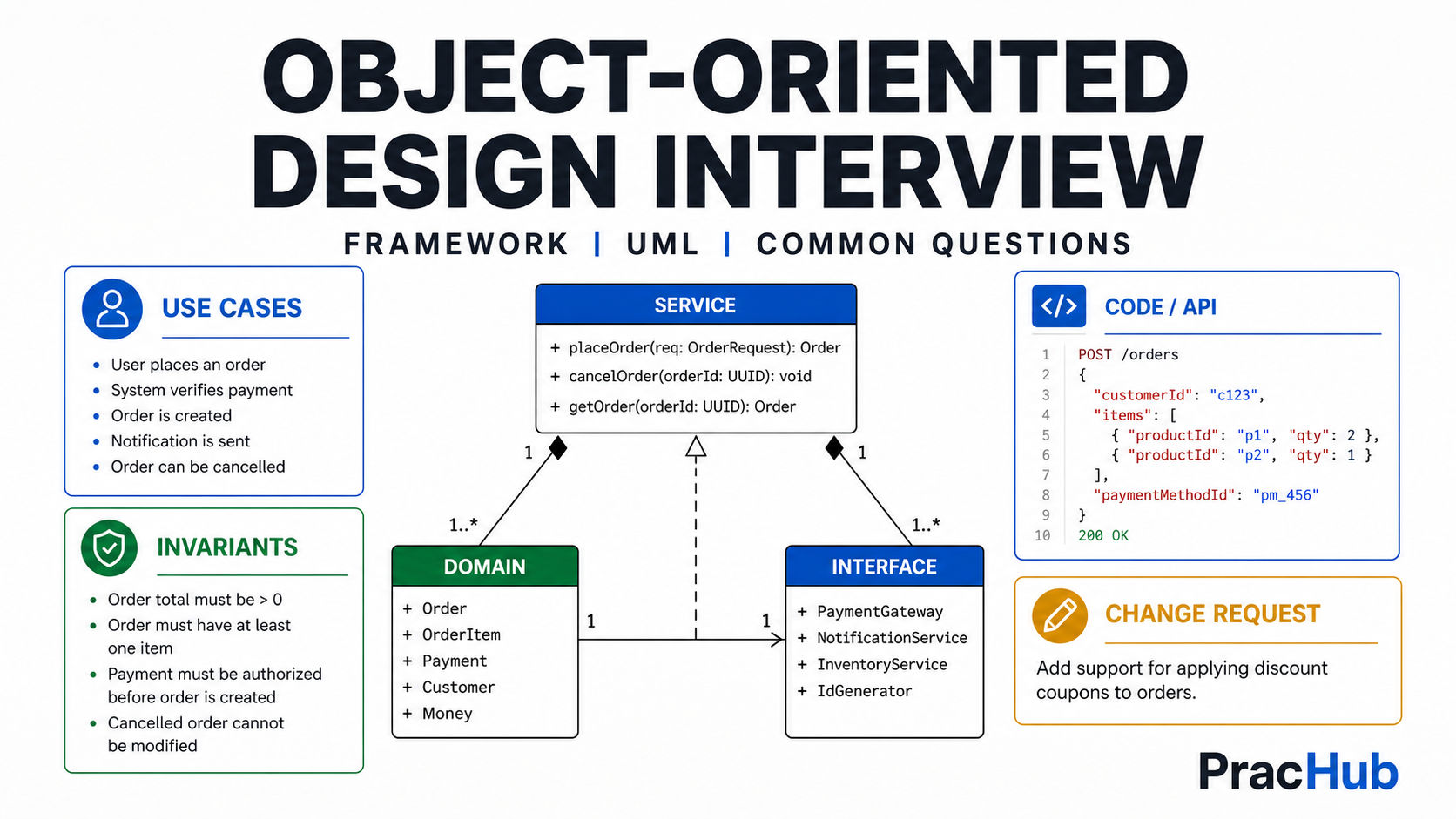
A strong OOD answer connects the prompt to responsibilities, relationships, APIs, and change-ready code.
Quick Answer: How Should You Approach an OOD Interview?
Use six steps: clarify scope, define use cases, assign responsibilities, model relationships, expose a small public API, and stress-test the design with a change. Draw only enough UML to make ownership and collaboration clear. Then walk through one concrete scenario so the interviewer can see the objects working together.
Amazon's current software development interview topics explicitly include object-oriented design, while also saying interviewers care about applying knowledge rather than memorizing details. That is the right preparation mindset: practice making defensible decisions under ambiguity.
OOD vs. LLD, System Design, and Machine Coding
| Format | Primary output | Main question |
|---|---|---|
| Object-oriented design | Objects, responsibilities, relationships, interfaces, and behavior | How should this domain be modeled? |
| Low-level design | Detailed components, classes, APIs, and extensibility decisions | How will this component be structured? |
| System design | Services, data stores, APIs, scale, reliability, and trade-offs | How will the system operate at scale? |
| Machine coding | Runnable, testable implementation | Can you turn the design into working code? |
OOD and LLD are often used interchangeably in recruiting language, so ask what deliverable is expected. Our Low-Level Design Interview guide covers the broader LLD format. The Machine Coding Round Guide focuses on executing a design under a coding deadline.
What Interviewers Can Evaluate
A useful OOD answer makes five signals observable: requirement judgment, responsibility assignment, controlled coupling, clear communication, and adaptability. The interviewer should be able to trace a use case through the model and see where a new rule would belong.
This is not a universal scorecard. Different companies, levels, and languages emphasize different details. Treat your recruiter's instructions as the source of truth, especially on whether the round expects UML, pseudocode, compilable code, or a whiteboard discussion.
A Six-Step Object-Oriented Design Interview Framework
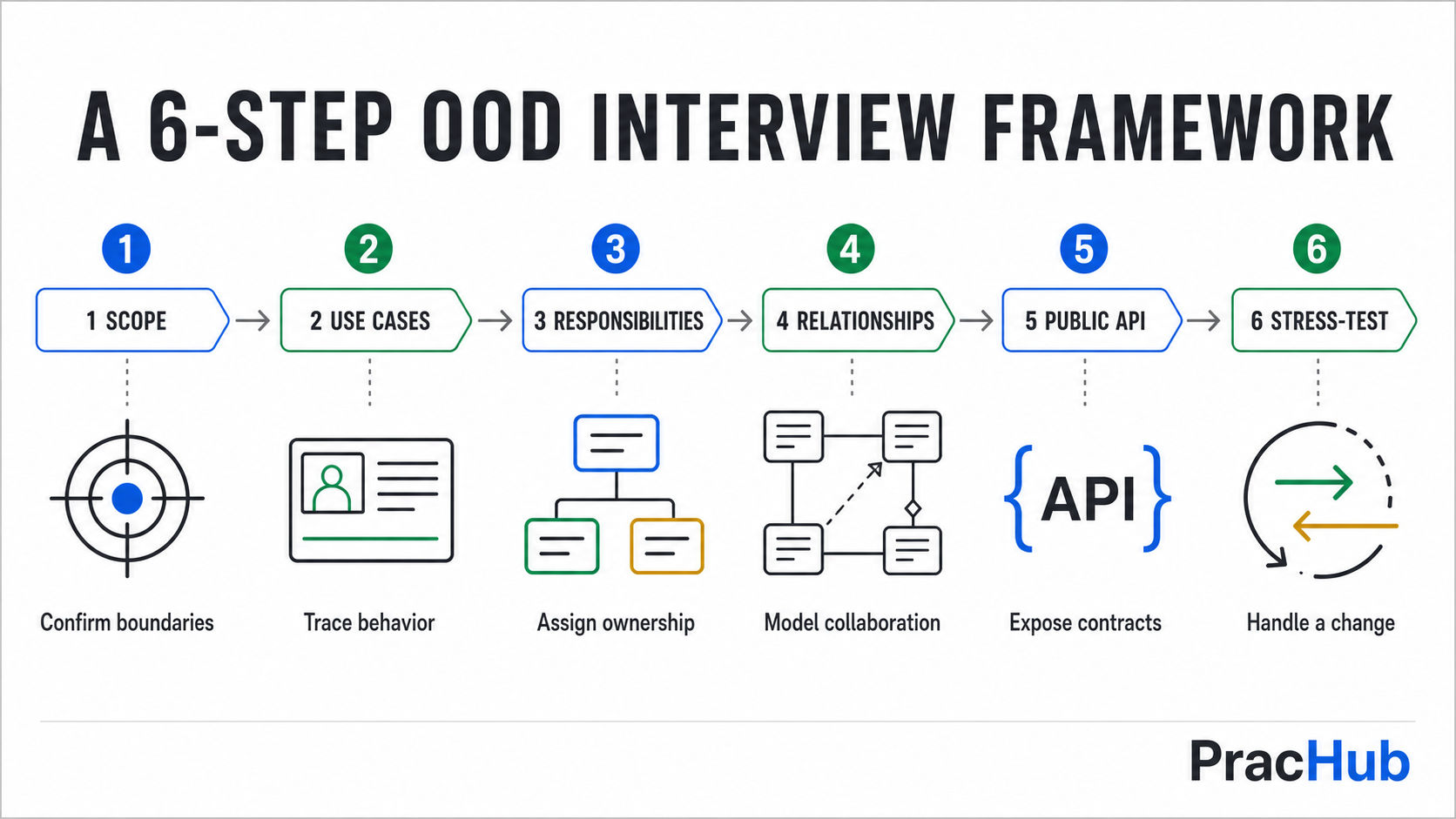
Move from scope to a change-tested model; do not begin with a class list.
1. Clarify the Scope
Restate the product outcome, actors, core operations, constraints, and non-goals. For a notification system, ask which channels exist, whether delivery is synchronous, whether preferences matter, and whether retries are in scope. Confirm the smallest complete version before designing it.
2. Turn Requirements into Use Cases and Invariants
Write two or three concrete flows, such as "send an order update through the user's enabled channels." Then identify rules that must always hold: a disabled channel cannot be selected, an invalid address cannot be used, and one channel failure must not silently change another channel's result.
3. Assign Responsibilities
Do not convert every noun into a class. Ask which object has the information needed to make each decision. Keep domain rules near the state they protect, and give orchestration to a service rather than turning one entity into a manager of the entire system.
4. Model Relationships and Boundaries
Choose composition when one object's lifetime is truly owned by another. Use an interface when multiple behaviors must be interchangeable. Use inheritance only for a stable "is-a" relationship with a meaningful shared contract, not merely to reuse a few fields.
5. Define the Public API and State Transitions
Show the methods that support the agreed use cases and hide incidental implementation details. Name inputs, outputs, errors, and state changes. Then walk through one request from the caller to the responsible objects so the diagram proves behavior rather than just structure.
6. Stress-Test the Design
Invite a change: add WhatsApp, quiet hours, priority delivery, or a retry policy. Point to the smallest area that should change. If the requirement forces edits across unrelated classes, improve the boundary before adding another pattern.
The UML You Actually Need in an Interview
UML is a standardized modeling language, and the full OMG specification is extensive. An interview rarely requires every diagram type or perfect notation. A compact class diagram is usually enough to communicate classes, key state, public behavior, relationships, and multiplicity.
| Relationship | What it communicates | Use it when |
|---|---|---|
| Association | Objects know about or collaborate with each other | The lifetimes are independent |
| Composition | A whole strongly owns a part | The part should not outlive its owner |
| Generalization | A subtype extends a base abstraction | The "is-a" contract is stable and substitutable |
| Interface realization | A type fulfills a behavior contract | Implementations need to vary independently |
| Multiplicity | How many instances participate | Cardinality affects rules or ownership |
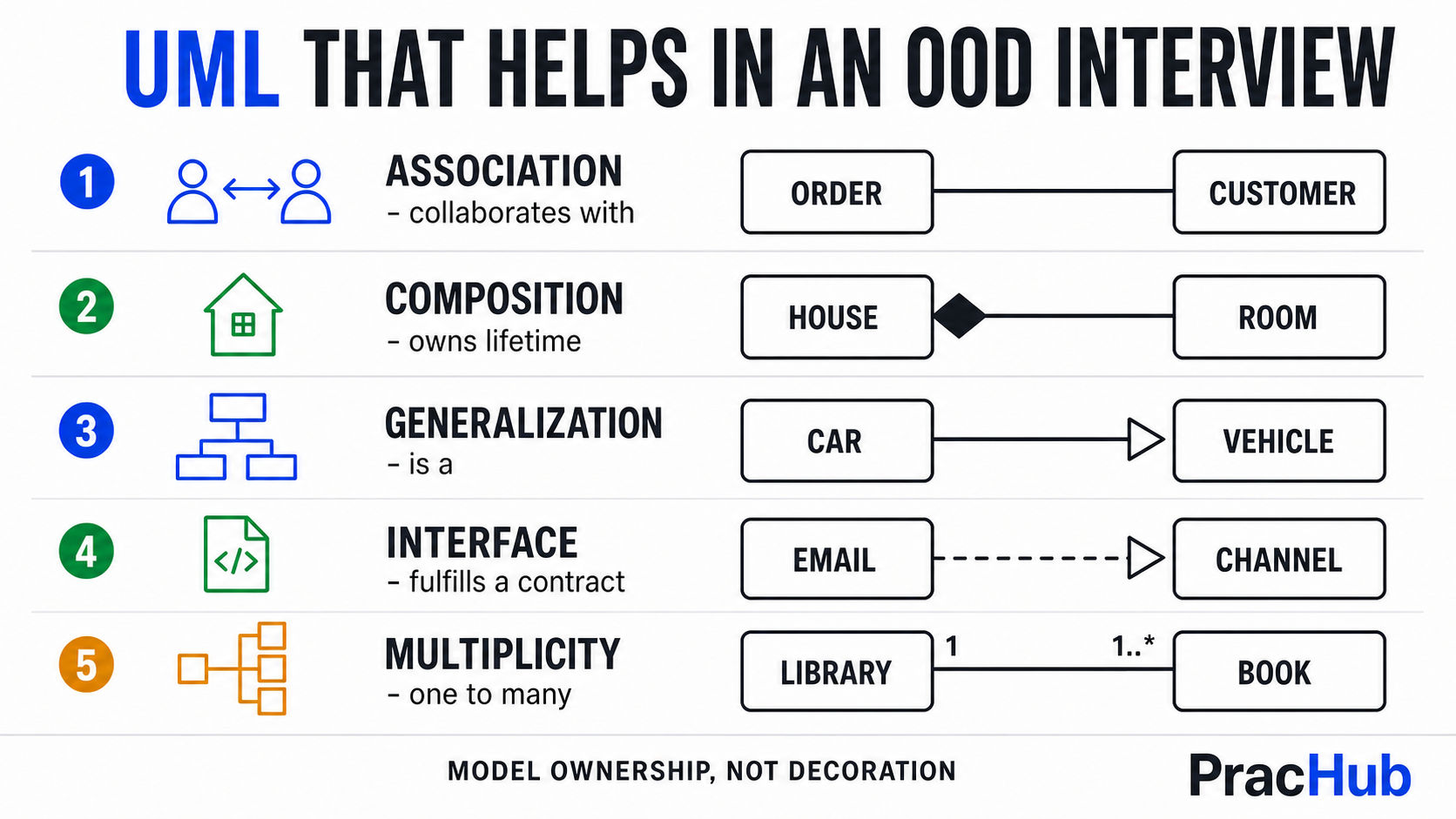
Use notation to remove ambiguity, not to decorate the answer.
Write only key fields and methods. Label relationships that matter, such as 1, 0..1, or 1..*. If you forget a formal arrowhead, state the relationship in words and keep reasoning. Clear ownership is more valuable than silently drawing a technically perfect but unexplained symbol.
Worked Example: Design a Notification Router
Scope the first version to email, SMS, and push. A user has channel preferences, a notification has content and type, and the system attempts each eligible channel. Persistence, queues, and provider-specific scaling stay out of scope unless the interviewer asks for system design.
NotificationService coordinates the use case. Recipient owns addresses and preferences. DeliveryChannel defines a send contract, with EmailChannel, SmsChannel, and PushChannel as implementations. A DeliveryResult records the outcome without making the channel mutate unrelated state.
Now walk through "send an order update." The service asks the recipient which channels are eligible, selects registered channel implementations, and returns a result for each attempt. If the interviewer adds WhatsApp, one new implementation and registration change should be enough. If quiet hours are added, place that policy near channel eligibility instead of scattering time checks through every sender.
Common Object-Oriented Design Interview Questions
| Practice prompt | Main design pressure | Useful follow-up |
|---|---|---|
| Parking lot | Allocation, pricing, and vehicle rules | Add reservations or electric charging |
| Elevator system | State, requests, and scheduling policy | Add maintenance mode |
| Vending machine | State transitions, payment, and inventory | Add refunds or multiple payment methods |
| Library system | Identity, loans, and policy objects | Add holds and overdue rules |
| File system | Hierarchies, composition, and permissions | Add symbolic links |
| Cache | Policy interfaces and data ownership | Switch LRU to LFU |
| Logger | Levels, sinks, filtering, and extension | Add asynchronous output |
| Meeting scheduler | Conflicts, availability, and recurrence | Add room capacity constraints |
These are practice prompts, not claims about a specific company's current question bank. Use them to rehearse responsibility and change management, then return to PracHub for current, company-filtered interview questions.
How to Handle Follow-Up Questions
When the interviewer changes a requirement, pause before editing the diagram. Restate the change, identify the rule it affects, and explain which class or interface should absorb it. Make the smallest coherent change and replay one use case.
A strong answer can also admit pressure in the original model: "This second scheduling policy shows that the conditional belongs behind an interface." That is better than pretending every extension was predicted. The goal is disciplined evolution, not clairvoyance.
Common OOD Interview Mistakes
Noun mining creates classes without responsibilities. Pattern collecting adds factories, builders, and observers before variation exists. Deep inheritance couples behavior to a brittle hierarchy. God objects centralize every rule and make follow-ups expensive.
Other weak answers never demonstrate a use case, expose every field publicly, ignore errors and invalid states, or drift into databases and distributed systems before the object model works. Keep the discussion at the level the interviewer requested.
A Focused Seven-Day OOD Prep Plan
Days 1-2: review encapsulation, abstraction, interfaces, composition, inheritance, polymorphism, and the five UML relationships above. Redraw two small models from memory and explain every line.
Days 3-4: solve four classic prompts with the six-step framework. Spend 35 minutes per prompt, then add one follow-up and record where your model resisted change.
Days 5-6: implement the core flow for two designs in your interview language. This exposes vague APIs and missing ownership. Use the machine coding guide when the round expects runnable code.
Day 7: run a mock aloud. Practice clarifying scope, drawing a minimal diagram, tracing a use case, and adapting to a requirement change without restarting the solution.
Frequently Asked Questions
Is OOD the same as low-level design?
They overlap heavily, and companies may use the labels interchangeably. OOD emphasizes modeling objects, responsibilities, relationships, and behavior. LLD can be broader, including component APIs, patterns, concurrency, persistence boundaries, and implementation details. Ask your recruiter what output and coding depth the round expects.
Do I need perfect UML notation?
Usually not. You should be able to communicate classes, key methods, association, composition, inheritance or interface realization, and multiplicity. If notation becomes uncertain, state the relationship clearly in words. Correct responsibility and ownership decisions matter more than diagram polish.
Should I use SOLID principles in every answer?
Use SOLID as a diagnostic lens, not a checklist to recite. Apply a principle when it fixes an observable problem such as mixed responsibilities, rigid dependencies, or an interface that forces irrelevant methods. Explain the trade-off instead of merely naming the acronym.
Will I have to write code in an OOD interview?
It depends on the company and round. Some interviews stop at discussion and UML; others ask for method signatures, pseudocode, or a runnable implementation. Confirm the expected deliverable, choose your strongest approved language, and practice translating each diagram into a small executable flow.
Final Takeaway
A strong object-oriented design interview answer is a chain of reasoning: requirements become use cases, use cases become responsibilities, responsibilities become relationships and APIs, and follow-ups test whether the model can evolve.
Use PracHub's real interview question library to practice that chain with current prompts and written solutions. Draw less, explain ownership clearly, and make every class earn its place.
Sources and Methodology
This guide uses Amazon's current software development interview topics to verify that object-oriented design remains an explicit preparation area and that application matters more than memorization. The OMG UML 2.5.1 specification anchors the notation discussion. Oracle's object-oriented programming concepts and Microsoft's object-oriented techniques documentation were used to cross-check terminology. The six-step framework, worked example, question list, and seven-day plan are PracHub recommendations, not a universal company rubric.
Related Articles
Software Engineer Project Deep Dive Interview Guide: Architecture, Impact, and Follow-Ups
Prepare for a software engineer project deep dive interview: choose the right project, explain architecture, prove impact, and handle technical follow-ups.
NeetCode Pro Review 2026: Is the Paid Upgrade Worth It?
NeetCode Pro review for 2026: compare free vs paid features, $119 annual and $297 lifetime pricing, courses, company tags, AI tools, and alternatives.
AlgoMaster.io Review 2026: DSA Patterns, System Design, and AI Mocks
AlgoMaster.io review for 2026: compare DSA patterns, system design, AI mocks, current pricing, limitations, and a practice-first PracHub workflow for engineers.
Mobile System Design Interview Guide 2026: iOS, Android, Offline Sync, and Trade-Offs
Prepare for a mobile system design interview in 2026: iOS and Android architecture, offline sync, conflicts, background work, and practical trade-offs.
Comments (0)