Machine Coding Round Guide 2026: Requirements, Architecture, Tests, and Working Code
Quick Overview
Prepare for a machine coding round in 2026 with a practical workflow for clarifying requirements, scoping an MVP, designing testable architecture, shipping working code early, writing useful tests, managing a 90-minute session, handling follow-up changes, and adapting preparation for backend or frontend interviews.
A clean class diagram will not rescue a program that cannot run. In a machine coding round, the interviewer can usually execute your solution, enter a new test case, change a requirement, and see whether your design survives contact with real code.
That changes the preparation strategy. You need enough architecture to keep the code understandable, but not so much abstraction that the core flow remains unfinished. The strongest submission is usually a small, working, testable solution with explicit trade-offs.
Start with PracHub's real interview questions with written solutions to practice implementation under time pressure. Then pair those sessions with our Low-Level Design Interview guide so your code has clear responsibilities without becoming a pattern showcase.
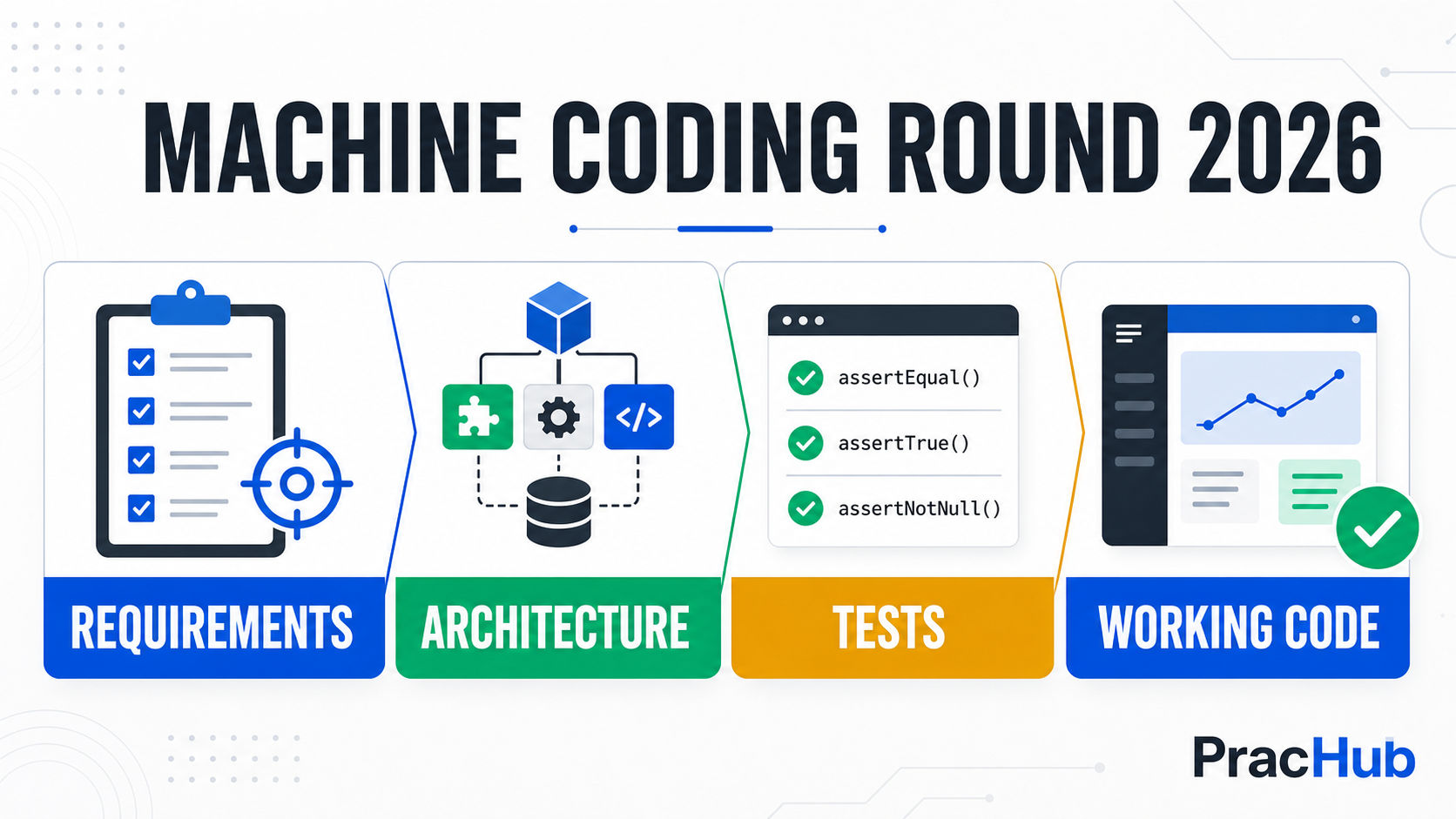
A machine coding round connects four deliverables: clear requirements, focused architecture, useful tests, and working code.
Quick Answer: What Is a Machine Coding Round?
A machine coding round is a hands-on interview in which you turn a product-style prompt into executable, demonstrable code within a fixed window. The prompt may describe an in-memory backend service, command-line application, small frontend feature, game, scheduler, or existing repository that needs a change.
There is no universal industry format. Flipkart's published SDE guide, for example, describes a 120-minute round with 15 minutes of clarification, 90 minutes of coding, and 15 minutes for a demo and interviewer-entered test cases. Current frontend guidance from GreatFrontEnd describes many UI rounds as 60–90 minutes. Your invitation and recruiter instructions override every generic guide.
Machine Coding vs. LLD, DSA, and Take-Home Work
| Interview format | Primary output | Main pressure |
|---|---|---|
| DSA coding | A correct function with appropriate complexity | Finding and implementing an algorithm |
| Low-level design | Objects, interfaces, relationships, and design trade-offs | Maintainability and extensibility, sometimes without full implementation |
| Machine coding | A runnable feature or small application that can be tested and reviewed | Balancing scope, design, correctness, and time |
| Take-home assignment | A larger repository submitted after independent work | Depth, documentation, polish, and a later review |
The boundaries can overlap. A machine coding prompt may test object-oriented design, and a take-home may be time-boxed. The practical distinction is whether the interviewer expects a working implementation during the scheduled round.
What Interviewers Can Evaluate
| Signal | Observable evidence |
|---|---|
| Requirements | You identify the core flow, constraints, invalid cases, and what is explicitly out of scope. |
| Architecture | Responsibilities are separated enough that a change stays local and the code remains easy to trace. |
| Correctness | The program runs, the main path works end to end, and failures are handled deliberately. |
| Testing | Tests or a deterministic driver prove important behavior, boundaries, and state transitions. |
| Judgment | You prioritize the highest-value behavior, explain trade-offs, and avoid speculative complexity. |
This is a preparation model, not a universal company scorecard. Flipkart's public guide explicitly emphasizes executable, functionally correct, modular, readable code, separation of concerns, and accommodating new requirements with minimal changes. Other companies and levels may weight the signals differently.
Clarify Requirements Before Designing
Begin by restating the user-visible outcome and naming the smallest complete flow. Then ask focused questions about input and output, required operations, validation, persistence, concurrency, ordering, error behavior, allowed libraries, and the command the interviewer will use to run the solution.
Separate must-have behavior from extensions. If the prompt is an expense splitter, the first slice might create users, record one expense, calculate balances, and display them. Settlement history, currency conversion, and a web API can wait unless the prompt makes them essential.
Close the clarification phase with a contract: “I will first implement these three operations in memory, reject invalid input, and provide a runnable driver plus tests. If time remains, I will add the alternate allocation policy.” This gives the interviewer a chance to correct your scope before code makes the misunderstanding expensive.
Design the Smallest Testable Architecture
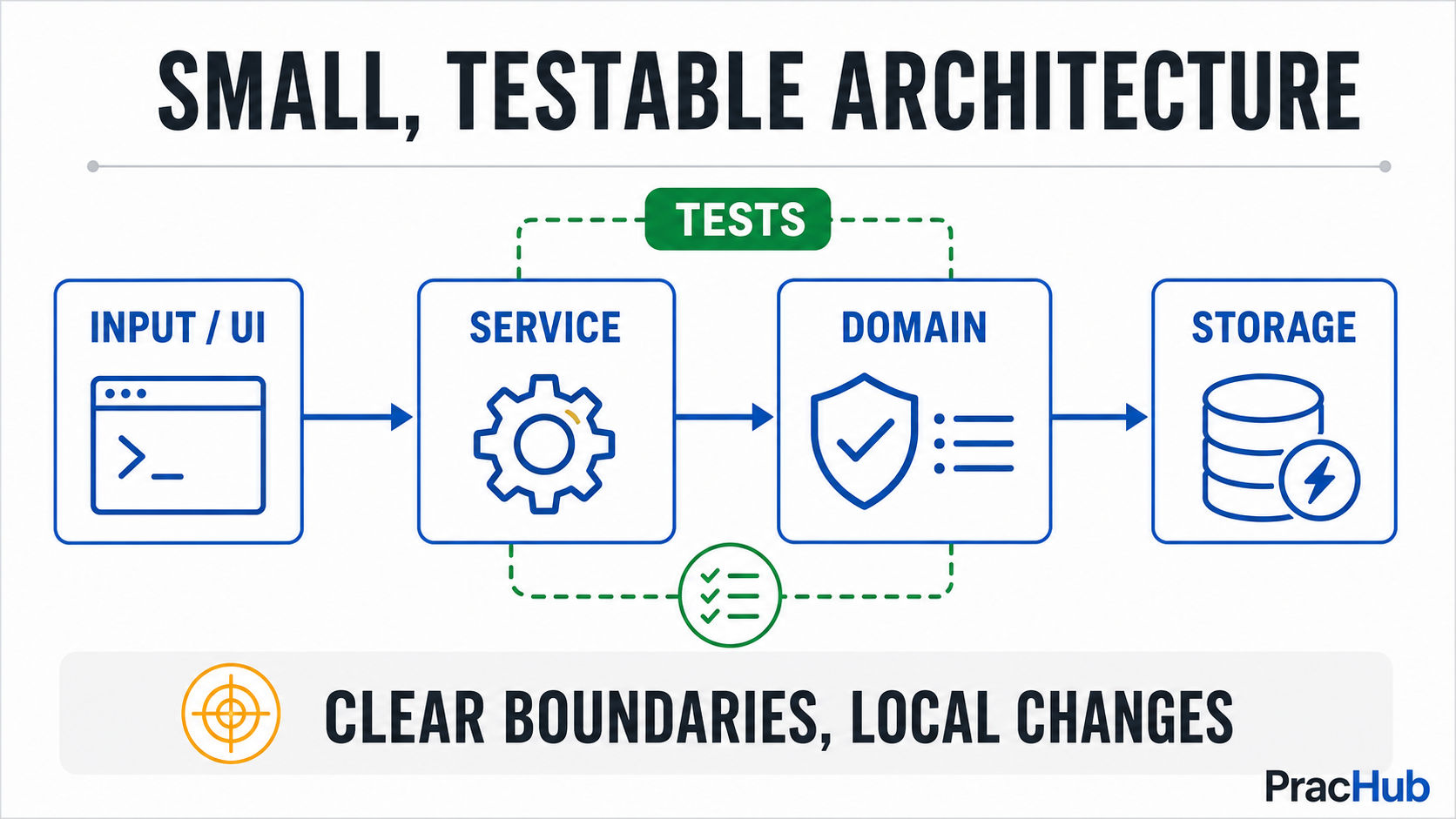
Keep boundaries visible: input, application flow, domain rules, storage, and tests.
A reliable structure has a thin boundary for CLI, API, or UI input; an application service that coordinates use cases; domain objects that protect important rules; and a replaceable in-memory repository. Pure policies or strategies are useful when the prompt genuinely requires interchangeable behavior.
Do not create an interface for every class. Add a boundary when it isolates volatility, makes testing easier, or supports a stated extension. A factory, strategy, or observer pattern is valuable only when it removes a real conditional or dependency from the core flow.
Sketch names and dependencies for two or three minutes, then implement. If the diagram needs a legend before any code exists, the design is already too expensive for the round.
Get to Working Code Early
Build one vertical slice through the entire system: accept input, execute one use case, update state, return output, and run it. A thin working path exposes setup, wiring, and data-model problems while there is still time to change them.
Keep the program runnable after each meaningful addition. Compile or execute frequently instead of writing forty minutes of code and discovering a broken constructor graph at the end. When the core flow works, add validation, a second operation, and the highest-risk edge case.
If time becomes tight, protect the demo. A complete core requirement with two tests is easier to evaluate than six half-connected classes and a README describing what would have worked.
Write Tests That Prove the Design
Tests are not decoration at the end. They are the fastest way to prove that domain behavior survives refactoring and follow-up requirements. Start with one happy-path test as soon as the first slice runs.
Then cover the most important boundary, invalid input, and state transition. A scheduler might test ordering ties and expired jobs; a parking lot might test full capacity and duplicate exit; an autocomplete might test empty results, loading, and a stale response. Use deterministic inputs so the interviewer can rerun the suite without waiting, randomness, or external services.
If the environment makes a full test framework impractical, write a clear driver with assertions and visible expected output. Explain the compromise. Silent manual clicking is weaker because it is hard to repeat after a change.
A 90-Minute Execution Plan
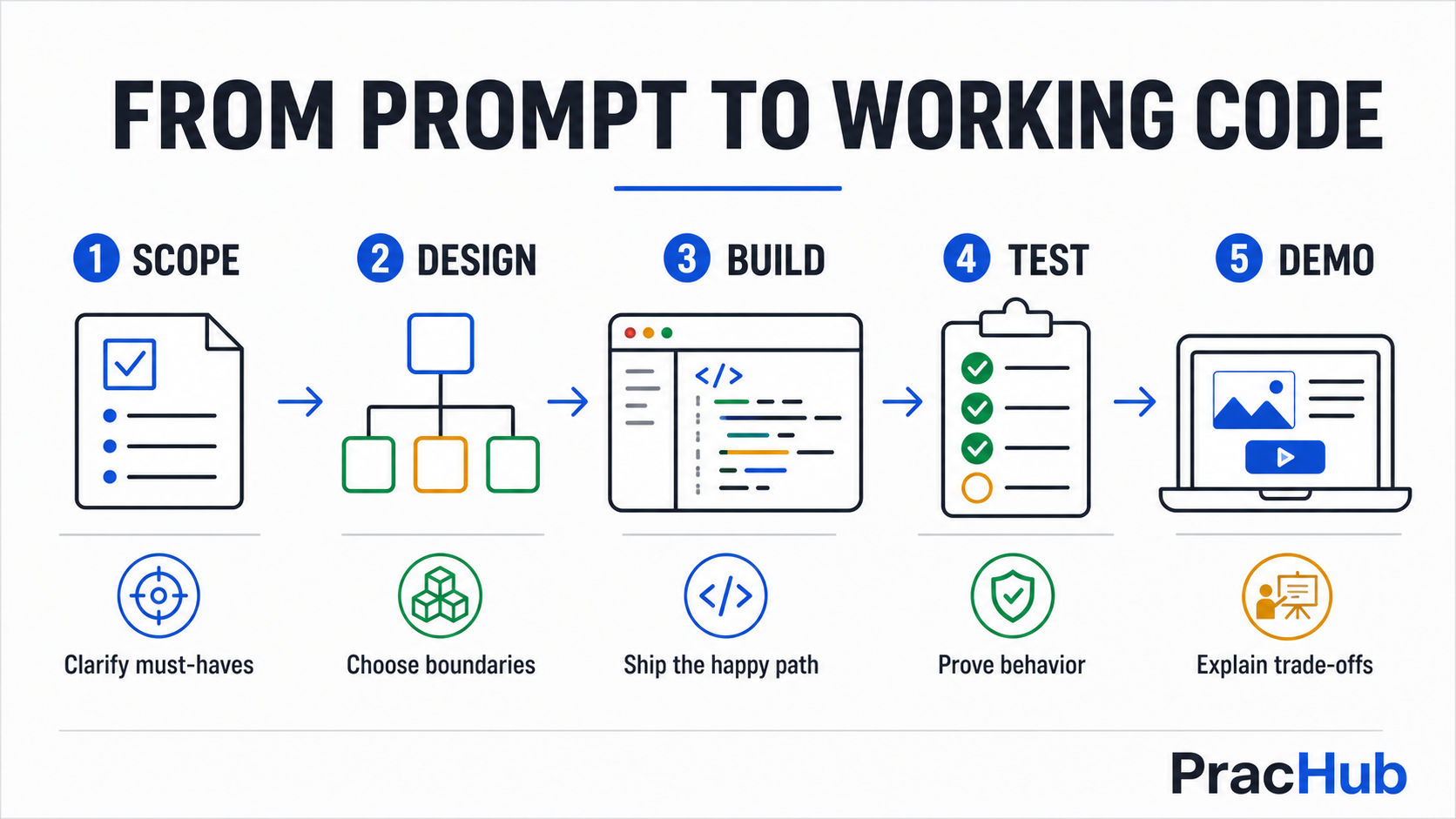
Move from scope to design to an executable slice, then use the remaining time for tests and the demo.
| Time | Deliverable |
|---|---|
| 0–10 min | Clarified requirements, priorities, constraints, and explicit non-goals |
| 10–18 min | Small component or class map, interfaces, data model, and run strategy |
| 18–55 min | Working vertical slice followed by the remaining core operations |
| 55–75 min | Validation, important edge cases, focused tests, and a small readability pass |
| 75–90 min | Clean run, demo script, architecture explanation, trade-offs, and next extension |
This is a PracHub practice schedule, not an official rubric. Scale the proportions to your actual window. A 120-minute session can spend more time on implementation and interviewer checkpoints; a 60-minute frontend task may need a smaller MVP and less polish.
Handle a New Requirement Without Rewriting Everything
Interviewers may add a payment method, ranking policy, vehicle type, user role, or state transition after the core demo. First restate the change and identify the rule or boundary it affects. Then explain whether the current design can absorb it locally.
If the change exposes a weak abstraction, say so and make the smallest safe refactor before adding behavior. Do not pretend the original design predicted every future. The useful signal is that you can recognize pressure, preserve working behavior with tests, and improve the design deliberately.
Our Code Review Interview Guide is useful practice for this post-coding discussion.
Backend and Frontend Machine Coding Are Different
Backend-oriented rounds often emphasize domain models, service boundaries, in-memory storage, validation, concurrency, and extension policies. Frontend rounds emphasize component composition, state, events, asynchronous requests, loading and error states, accessibility, and a usable demo.
Practice in the environment your role will use. A Java or Kotlin candidate should be fluent with project setup, collections, tests, and build commands. A React candidate should be able to create the app, model state, debug browser behavior, and add accessible interactions without searching for basic syntax.
The shared principle is the same: implement the core product behavior first, then make it readable and resilient. Do not add a database, distributed architecture, global state library, or elaborate design system unless the requirements justify it.
Machine Coding Problems Worth Practicing
For backend practice, use compact domains such as a parking lot, expense splitter, job scheduler, inventory service, food ordering workflow, rate limiter, board game, or notification dispatcher. For frontend practice, use autocomplete, data table, file explorer, modal, carousel, todo workflow, or progress tracker.
Do not collect fifty unfinished repositories. Complete six to eight problems deeply, and for each one add a follow-up requirement, tests, and a five-minute review. Rotate the failure mode: validation in one session, concurrency in another, async state in another, and extension design in the next.
Use PracHub's Pair Programming Interview Guide when the interviewer collaborates during implementation, and our Take-Home Assignment Guide when the work happens asynchronously.
Common Mistakes
Coding before the scope is stable produces the wrong feature quickly. Over-designing before the first run spends the execution budget on abstractions. Testing only at the end turns every refactor into a risk.
Ignoring the run command leaves the interviewer debugging your setup. Hiding unfinished behavior damages trust; state what works, demonstrate it, and name the next step. Finally, optimizing for pattern count creates code that is harder to trace than the problem requires.
Frequently Asked Questions
How long is a machine coding round?
It varies. Public examples range from roughly 60–90 minutes for many frontend tasks to a 120-minute structure in Flipkart's published SDE guide. Follow the duration, environment, and deliverables in your invitation.
Is machine coding the same as low-level design?
No, although they overlap. LLD emphasizes responsibilities, interfaces, and extensibility. Machine coding requires those decisions to survive in executable code that can be demonstrated and tested within the session.
Do I need design patterns?
Know common patterns, but use one only when the problem creates the need. A simple conditional may be clearer than a strategy hierarchy if no alternate policy is required. Interviewers can evaluate maintainability without counting patterns.
How many tests should I write?
There is no magic number. Cover the core flow, the highest-risk boundary, invalid input, and one meaningful state transition. Prefer a few deterministic tests that support your demo and refactoring over broad low-value coverage.
What if I cannot finish every requirement?
Keep the core path runnable, explain what is complete, and show the remaining work in priority order. A transparent, tested MVP with sound boundaries usually communicates more engineering judgment than partially implementing every feature.
Final Takeaway
The machine coding round is an execution test with design consequences. Clarify the contract, scope a credible MVP, build one runnable slice, add tests around the risky behavior, and leave time to demonstrate how the design handles change.
Practice that entire loop with PracHub's real interview question library. Reading architecture is useful, but only timed implementation reveals whether your requirements, code structure, tests, and demo can work together.
Sources and Methodology
This guide uses Flipkart's published SDE interview preparation document for its explicit pre-coding, coding, post-coding, executability, modularity, test-case, and extensibility expectations. A current Flipkart Architect interview guide and GreatFrontEnd's 2026 frontend machine coding guide were used to check role and time-format variation. The 90-minute plan, architecture model, practice prompts, and test priorities are PracHub recommendations rather than a universal company rubric.
Related Articles
NeetCode Pro Review 2026: Is the Paid Upgrade Worth It?
NeetCode Pro review for 2026: compare free vs paid features, $119 annual and $297 lifetime pricing, courses, company tags, AI tools, and alternatives.
AlgoMaster.io Review 2026: DSA Patterns, System Design, and AI Mocks
AlgoMaster.io review for 2026: compare DSA patterns, system design, AI mocks, current pricing, limitations, and a practice-first PracHub workflow for engineers.
Mobile System Design Interview Guide 2026: iOS, Android, Offline Sync, and Trade-Offs
Prepare for a mobile system design interview in 2026: iOS and Android architecture, offline sync, conflicts, background work, and practical trade-offs.
Object-Oriented Design Interview Guide: Framework, UML, and Common Questions
Prepare for an object-oriented design interview with a six-step framework, practical UML, common OOD questions, follow-ups, and a focused practice plan.
Comments (0)