Software Engineer Take-Home Assignment Guide 2026: Scope, Tests, and Submission
Quick Overview
Software engineering take-home assignments test more than whether code works. This 2026 guide shows candidates how to control scope, budget time, choose meaningful tests, write a reviewer-friendly README, follow AI policies, submit correctly, and prepare for the follow-up review.
The fastest way to weaken a software engineer take-home assignment is often to build too much. Extra features cannot rescue missing requirements, unclear setup, weak tests, or a project the reviewer cannot run.
In 2026, take-homes range from a timed browser project with hidden tests to a repository, pull request, deployed app, or uploaded archive. Before starting, review real software engineer interview questions on PracHub and map the entire loop. The follow-up may test how well you explain the project.
Quick Answer
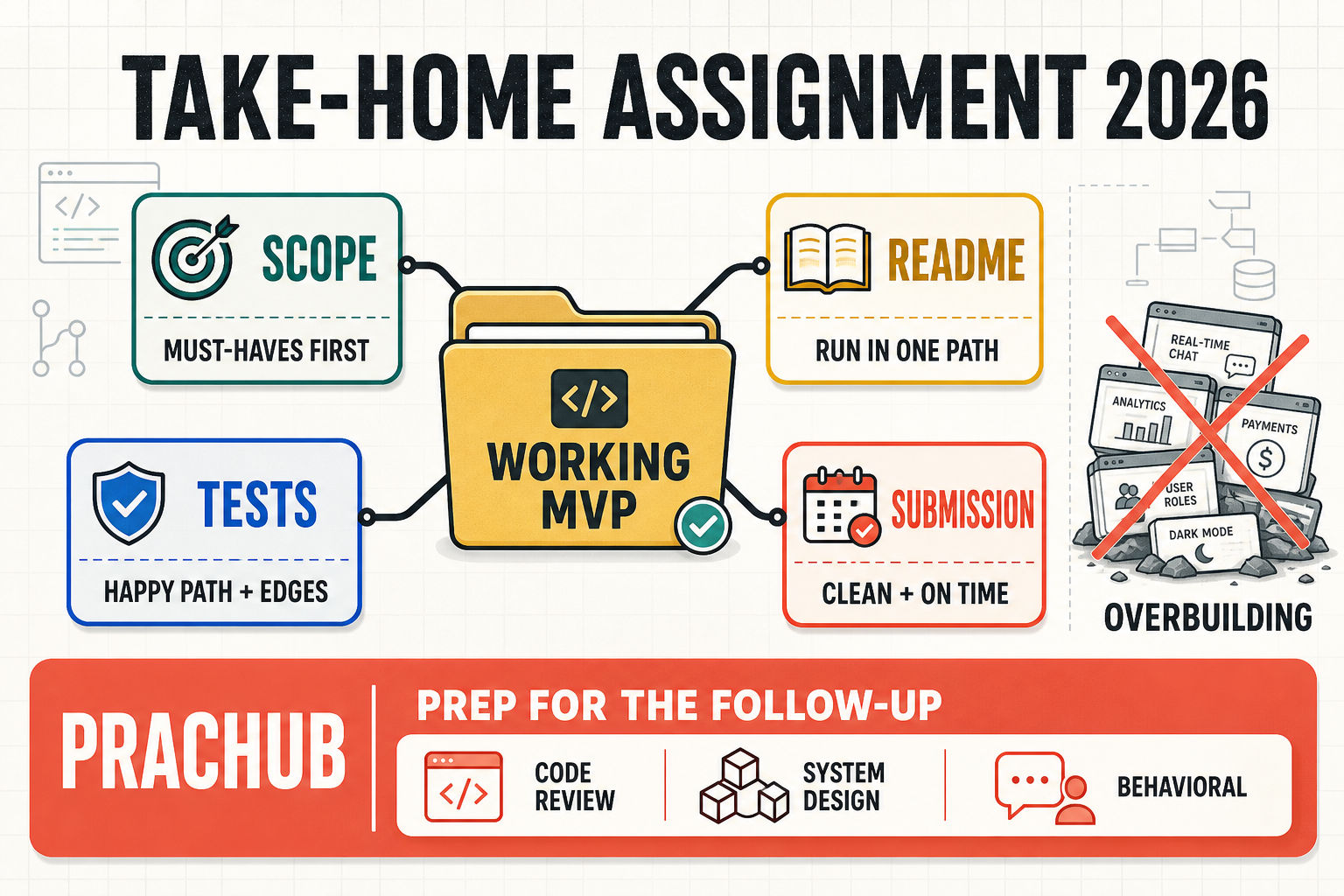
A strong take-home submission is complete, easy to run, deliberately tested, and honest about trade-offs. It meets every must-have requirement before adding polish, shows how failures and edge cases were considered, and gives the reviewer a short path from clone to verification.
Use a three-layer scope: Must-have, Quality, Stretch. Finish the must-have behavior first. Spend the next block on tests, error handling, readability, and documentation. Attempt stretch work only when a clean checkout can already install, run, and test successfully.
What a Software Engineer Take-Home Actually Tests
A take-home gives the company a sample of how you inspect a codebase, choose an approach, manage time, and communicate asynchronously.
CoderPad describes asynchronous projects with time limits, automated or hidden tests, final output, and session playback. Greenhouse supports direct uploads or employer-defined submission instructions, followed by grader scorecards. A repository challenge may instead be reviewed like a pull request.
Expect five signals: requirements, correctness, engineering judgment, verification, and communication. JetBrains' 2026 hiring guide says its task resembles realistic work and warns that overengineering can backfire when core instructions are missed.
Before You Start: Clarify the Contract
Read the brief twice and turn every requirement into a checkbox. Separate words such as "must," "should," and "optional" instead of treating all requests as equal.
If anything is unclear, ask before the clock starts. Confirm the expected time, deadline and time zone, permitted stack, submission method, deployment expectations, and AI or reference policy.
Platform capability does not define company policy. CoderPad supports AI assistance when a recruiter enables it, while JetBrains may ask how AI was used. If the brief is silent, ask.
Control Scope With Must-Have, Quality, and Stretch
Must-have: make the required path work
Build the smallest end-to-end path that satisfies the brief. For an API, that may be valid request, correct response, persistence, and required errors. For a frontend task, it may be the main flow, state changes, and specified responsive behavior.
Avoid services, design systems, abstractions, or infrastructure the task does not need. Familiar technology leaves more time for correctness and is easier to review.
Quality: make the solution trustworthy
Once the primary flow works, add readable names, bounded modules, input validation, meaningful tests, deterministic setup, and concise documentation. This layer usually creates more interview value than a second optional feature.
Stretch: add only defensible extras
A stretch feature should solve an adjacent problem and remain small enough to test, such as one accessibility fix, targeted performance work, or lightweight deployment when the brief values usability.
If the extra changes the architecture, adds fragile dependencies, or reduces test time, write it under "What I would do next" instead of building it.
A Practical Time Budget
For a four-hour assignment, start with 25 minutes for requirements and setup, 2 hours 10 minutes for must-haves, 50 minutes for tests and failures, and 35 minutes for documentation and verification. Adjust the proportions, not the deadline.
Stop feature work at least 30 minutes before submission. Run the documented commands from a clean environment, inspect the diff, remove secrets and generated files, and confirm the final link or archive.
If the scope exceeds the stated limit, ask which requirements to prioritize or state the time box you will follow. Do not silently turn a short assessment into a weekend project.
Design the Repository for a Reviewer
Keep entry points visible, avoid unrelated scaffolding, and do not reorganize starter files without a reason.
Use small, focused commits when history is preserved. GitHub recommends focused change groups and clear, imperative messages. Setup, core behavior, tests, and documentation are enough; do not manufacture a performance.
A simple structure usually wins:
README.md
src/             application code
tests/           behavior-focused tests
.env.example     required variable names, never secrets
package file     locked dependencies and scripts
Add Docker or CI only when it reduces friction or the brief asks for it. A broken workflow is worse than one reliable local command.
Which Tests Should You Write?
Tests should prove important behavior, not chase a coverage percentage. CoderPad notes that employers may use hidden cases, so test boundaries implied by the contract.
Start with the critical happy path. Prove the main requirement with realistic input and observable output.
Add one boundary case per important rule. Empty collections, duplicates, limits, ordering, missing fields, or zero values often expose assumptions.
Add failure behavior. Cover invalid input, missing records, absent authorization, or a failed dependency. Assert observable behavior, not private details.
Use integration tests selectively. One test across a route, database, or UI flow can beat many mocked tests. Avoid external networks and real clocks unless required.
Name tests by behavior and run the full suite with the command documented in the README.
Write a README That Answers the Reviewer's Questions
GitHub surfaces a root README prominently. In a take-home, it also makes invisible decisions reviewable.
Use this compact structure:
WHAT I BUILT
One paragraph describing the completed scope.

HOW TO RUN
Prerequisites, install command, environment setup, run command.

HOW TO TEST
One command, plus any important test assumptions.

DECISIONS AND TRADE-OFFS
Two or three choices, alternatives considered, and why.

KNOWN LIMITATIONS AND NEXT STEPS
What remains and the order you would address it.
Follow the README as a new teammate would. Document versions, ports, seed data, and environment variables. Never make the reviewer guess why the app starts but appears empty.
AI Tools, Attribution, and Ownership
AI policy varies by employer. Some assessments allow integrated assistance; others restrict it or expect disclosure. Get an explicit answer.
When AI is allowed, remain responsible for every dependency and line. Remove generated noise, verify licenses where relevant, run the tests yourself, and disclose material use when requested.
If you cannot explain, debug, and modify the submission without the tool, it is not ready.
Final Submission Workflow
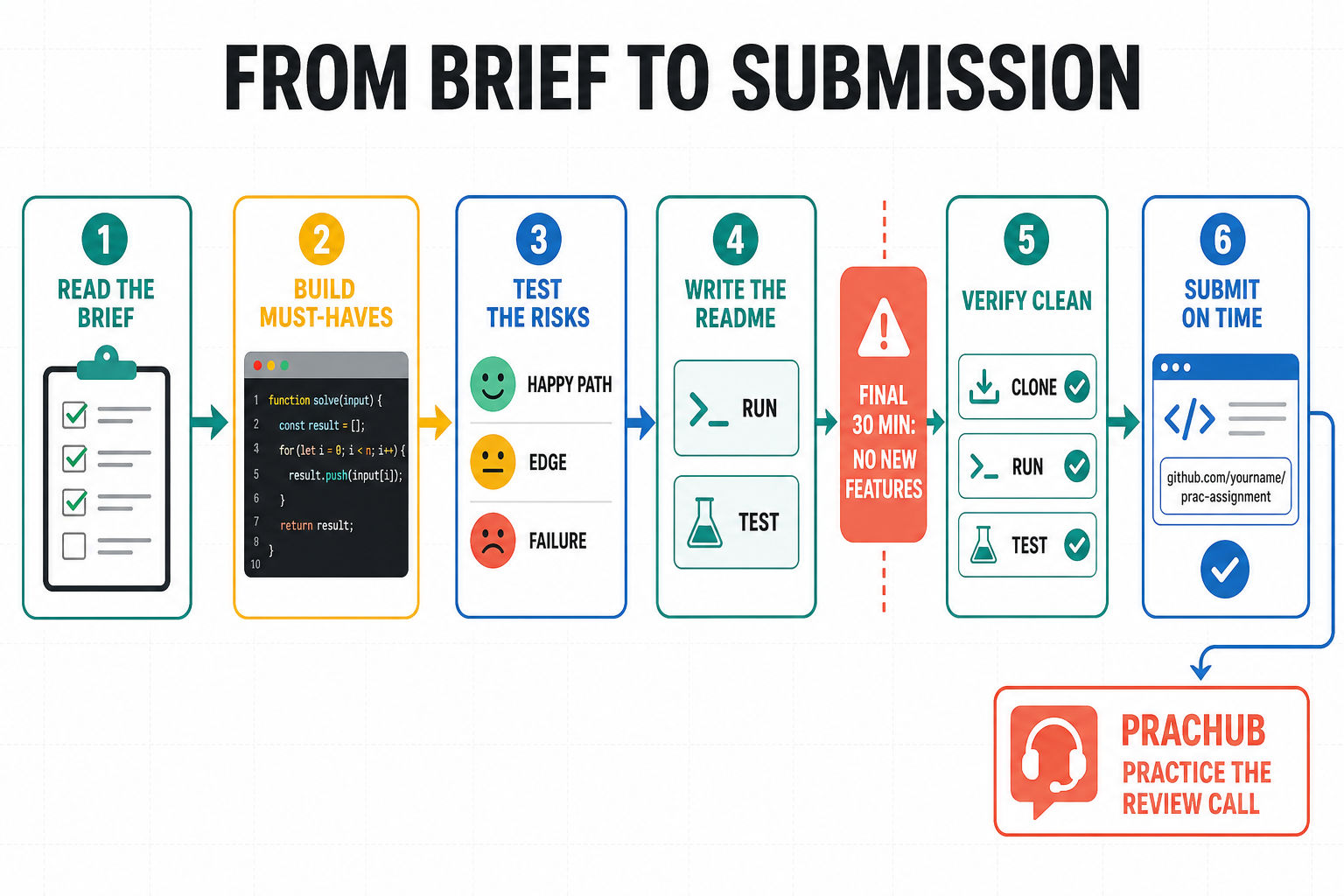
- Re-read the original brief. Match each must-have requirement to code, a test, or an explicit note.
- Verify from a clean state. Clone or unpack the project elsewhere, install dependencies, run the app, and execute the documented tests.
- Inspect the deliverable. Remove credentials, personal files, build output, oversized assets, debug logging, and unused packages.
- Submit exactly as requested. Use the required branch, pull request, upload form, archive format, or private link. Check permissions in a signed-out window when appropriate.
- Save confirmation. Keep the submitted commit hash, link, upload receipt, and deadline confirmation. Do not continue changing the submission unless the company invites updates.
Greenhouse's official workflow illustrates why the last step matters: some employers collect a direct upload, while others provide their own instructions. A perfect repository submitted through the wrong channel can still create avoidable friction.
Prepare for the Review Conversation
Treat the project as the first half of an interview. JetBrains says its review discussion covers decisions, trade-offs, how the solution would evolve, and AI usage. Prepare concise answers before the call.
Be ready to describe the priority, one rejected alternative, the hardest failure case, and the first changes you would make with more time. Practice modifying the design instead of defending every choice.
Use PracHub's company-specific interview prep to identify what may follow the take-home. Continue coding and algorithms practice, but also prepare system design questions, behavioral and leadership questions, and a structured code review discussion.
Frequently Asked Questions
How long should I spend on a take-home assignment?
Follow the stated time limit. If no limit is given, ask for an expected range before starting. Stop adding features early enough to test from a clean environment, write the README, and verify the actual submission method.
Should I deploy the project?
Deploy when it is requested or clearly lowers evaluation friction. Otherwise, a deterministic local setup may be enough. Do not trade required tests or documentation for fragile hosting that the reviewer did not ask for.
How many tests are enough?
There is no universal number. Cover the critical path, important boundaries, and meaningful failure behavior. A small suite that documents the product contract is stronger than many shallow tests coupled to implementation details.
What if I cannot finish every requirement?
Keep the strongest working vertical slice, state what is incomplete, and explain the next steps. Do not conceal broken behavior behind optional polish. If the scope conflicts with the stated time box, ask for prioritization before the deadline.
Can I use ChatGPT, Claude, or Codex?
Only under the employer's assessment policy. Ask when the instructions are silent, disclose usage when requested, and remain able to explain and modify every part of the submitted work.
Final Takeaway
A software engineer take-home assignment is a compact demonstration of how you ship when no interviewer is guiding each step. The strongest submission is rarely the largest. It is the one that follows the brief, protects the main path, tests the right risks, and makes its decisions easy to review.
Finish the must-have scope, add the quality layer, and stop before stretch work threatens reliability. Then use PracHub's real interview questions with written solutions to prepare for the live coding, design, code review, and behavioral rounds that often come next.
Sources
- CoderPad Take-Home Projects
- CoderPad Candidate Preparation Guides
- Greenhouse Take Home Tests Overview
- JetBrains Engineering Hiring Process Guide
- GitHub Documentation: About READMEs
- GitHub Documentation: Continuous Integration
Research checked August 5, 2026. Assessment formats, AI policies, time limits, and submission rules vary by employer; follow the instructions supplied for your specific interview.
Related Articles
AlgoMap Review 2026: Free DSA Roadmap or Paid Bootcamp?
AlgoMap review 2026: compare the free 100-problem DSA roadmap with $4K-$15K paid plans, who each option fits, and a 14-day test before paying for prep.
CodeSubmit vs CoderPad Screen: Which Take-Home Format Should You Expect?
CodeSubmit vs CoderPad Screen explained for 2026: compare repo setup, browser IDEs, timing, review signals, and how to prepare for either take-home test.
Big Interview Review 2026: Is AI Video Practice Useful for Technical Candidates?
Big Interview review for technical candidates: see 2026 pricing, VideoAI limits, where it helps, and how to pair it with real technical interview practice.
Grind 75 vs Blind 75 vs NeetCode 150: Which List Should You Finish?
Compare Grind 75 vs Blind 75 vs NeetCode 150 by difficulty, timeline, and coverage. Pick the right list and know when to start real interview practice.
Comments (0)