Pair Programming Interview Guide: What Interviewers Score Beyond Correct Code
Quick Overview
Learn what interviewers evaluate in a pair programming interview beyond correct code. This practical guide covers collaboration, problem framing, communication, code quality, testing, debugging, feedback, seniority expectations, common mistakes, and a PracHub self-scoring workflow.
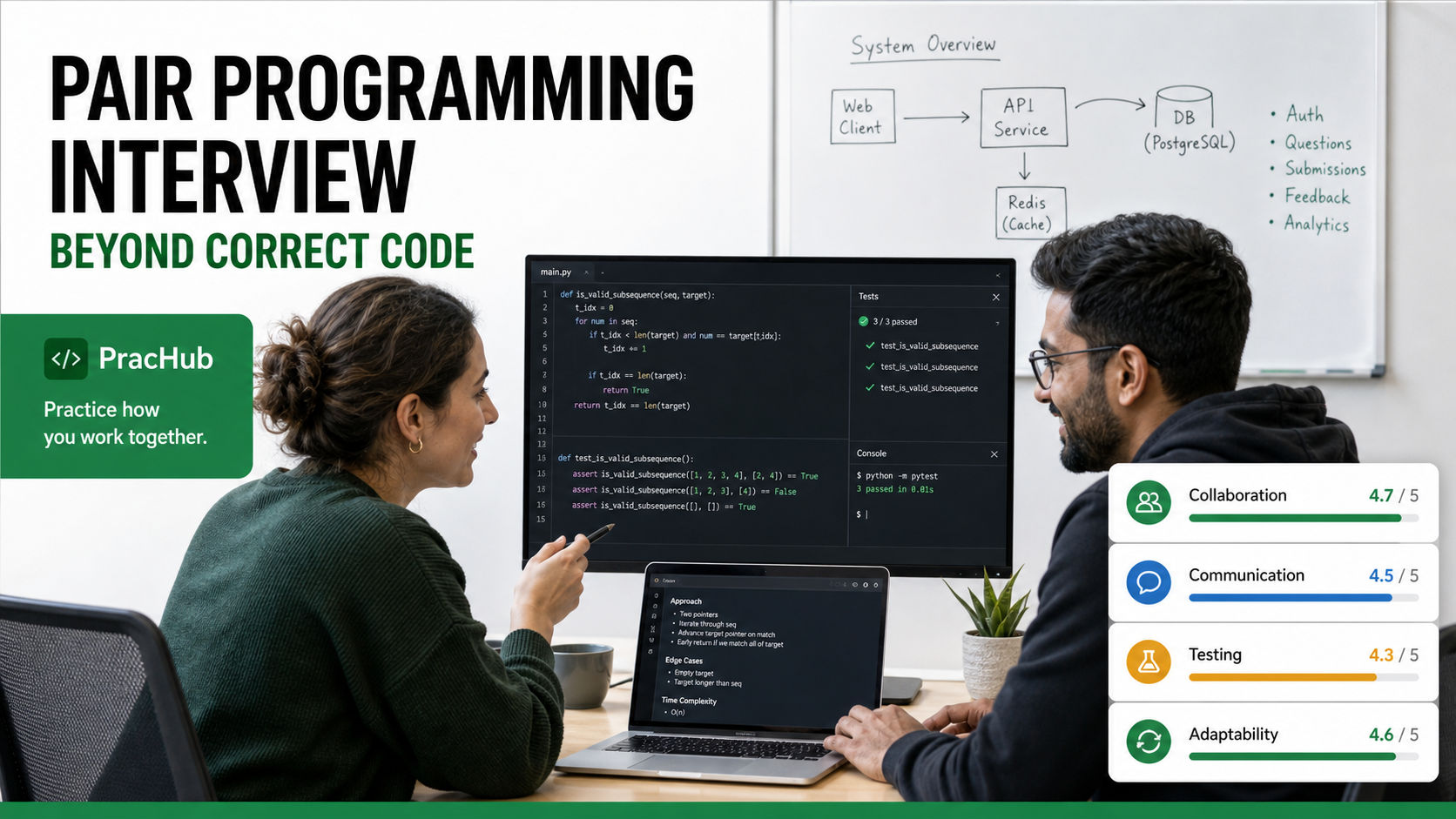
Your code passes every test, yet the interviewer still hesitates. Why? In a pair programming interview, the output is only part of the evidence. The interviewer also watched whether you clarified the task, created alignment, invited feedback, debugged methodically, and made the shared session easier or harder.
That makes pair programming different from a silent coding assessment. You are demonstrating how you work with another engineer, not merely how fast you can type alone.
Start with real interview questions with written solutions on PracHub. Practice them aloud with a partner, then score both the code and the collaboration using the rubric below.
Quick Verdict
Interviewers usually care about correct code, but they may also score problem framing, collaboration, communication, code quality, testing, adaptability, and response to feedback. The exact rubric varies by company and level.
A strong candidate leads the work without shutting out the interviewer. They make decisions visible, check alignment at useful moments, incorporate new information, and leave behind code that another engineer could understand.
What Is a Pair Programming Interview?
A pair programming interview is a live technical session in a shared IDE, repository, or screen. CoderPad lets both participants type and run code, while GitLab uses a live session to evaluate knowledge, communication, and collaboration around a merge request.
The task may be an algorithm, bug fix, unfamiliar codebase, small feature, or evolving prompt. Ask the recruiter about the environment and task style because there is no universal format.
What Interviewers Score Beyond Correct Code
| Competency | Strong evidence | Weak evidence |
|---|---|---|
| Problem framing | Clarifies behavior, constraints, and success criteria before coding. | Starts typing immediately and discovers requirements through failures. |
| Collaboration | Proposes a plan, checks alignment, and treats input as useful information. | Either waits for instructions or ignores the partner entirely. |
| Communication | Explains decisions, uncertainty, and changes at useful checkpoints. | Works silently or narrates every keystroke without adding insight. |
| Engineering quality | Uses readable structure, small changes, and appropriate abstractions. | Produces a fragile patch that only satisfies the visible example. |
| Testing and debugging | Chooses meaningful cases, forms hypotheses, and verifies fixes. | Runs random inputs or edits several things without isolating the cause. |
| Adaptability | Understands feedback, revises the model, and explains the new direction. | Defends a failing approach or follows hints without understanding them. |
How to Show Strong Pair Programming Signals
Frame the Problem Together
Restate the outcome, then confirm inputs, outputs, constraints, error behavior, and scope. In a repository, identify the relevant entry point and conventions before proposing changes.
Then offer a short plan and invite correction: “I’ll trace the request path, reproduce the bug with a focused test, and make the smallest safe change. Does that match what you want to evaluate?” That sentence shows structure without turning the interviewer into your manager.
Communicate Decisions, Not Keystrokes
Useful communication makes your reasoning inspectable. Explain why you chose a data structure, where an invariant lives, or what a failing test suggests. Pause after meaningful milestones so the interviewer can respond.
Avoid nonstop narration such as “now I am typing a loop.” Also avoid long silent stretches. A good rhythm is: state the next decision, implement a small slice, run it, interpret the result, and update the plan.
Treat Feedback as New Data
A hint is not automatically a failing signal. Interviewers can learn a great deal from how you respond. First confirm what you heard, connect it to your current model, and decide what changes.
For example: “You’re right that this cache can return stale permissions. I’ll move authorization before the cache lookup and add a test for revoked access.” This is stronger than saying “okay” and copying the suggested change.
Code Quality Still Matters
Interviewers still observe correctness, complexity, naming, decomposition, and maintainability. In a repository, they may notice whether you reuse helpers, preserve conventions, and avoid unrelated refactoring.
Work in reviewable increments. State the intended behavior, make one coherent change, and run the narrowest useful test. When something fails, describe your hypothesis before editing. That creates evidence of debugging skill instead of trial and error.
If the prompt expands into architecture, use PracHub’s system design questions to practice explaining boundaries and trade-offs without losing the collaborative rhythm.
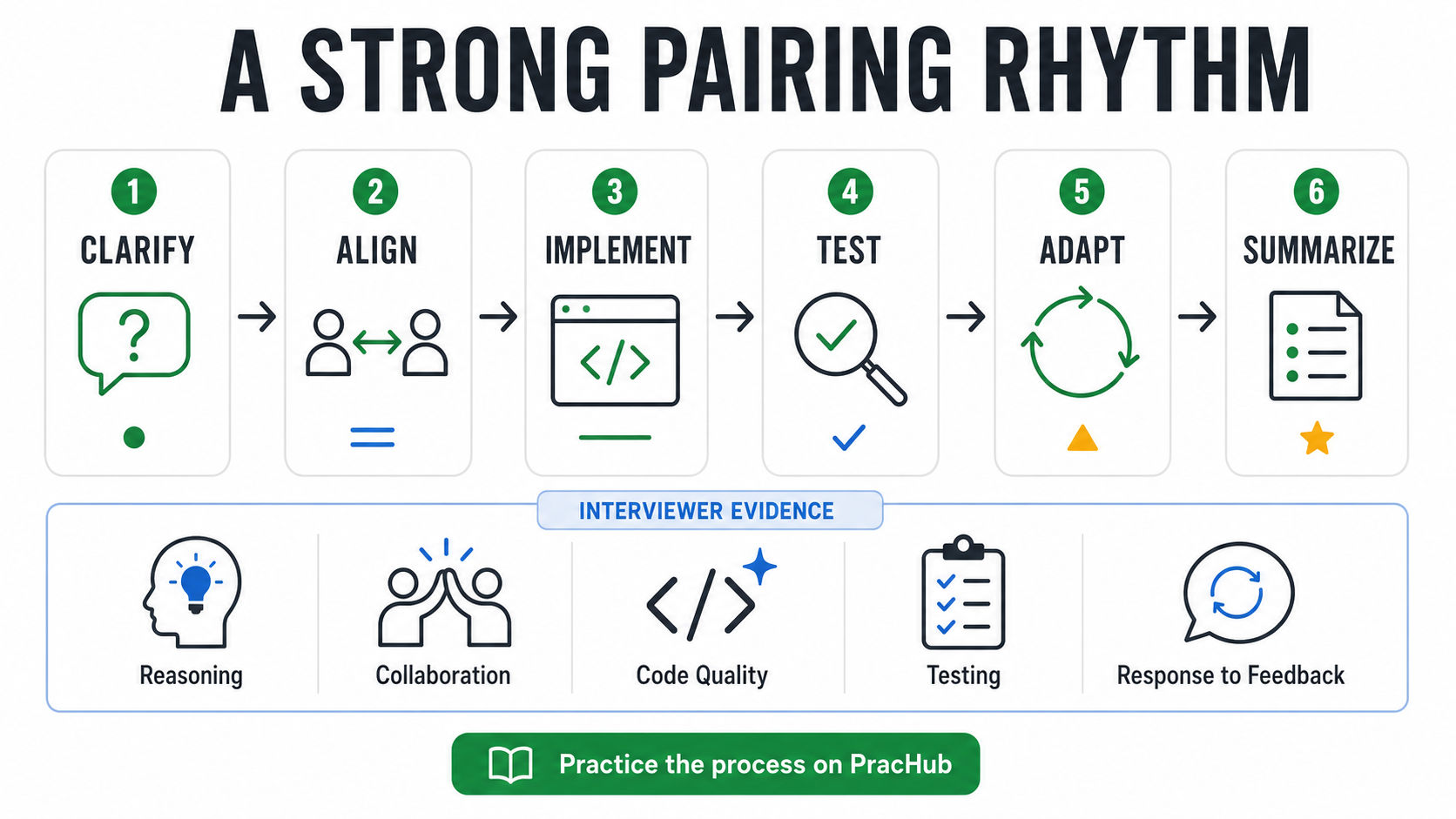
A strong pairing session repeatedly creates alignment before and after implementation.
A Strong Pairing Rhythm
- Clarify: confirm the goal, constraints, and definition of done.
- Align: propose a plan and ask whether the interviewer sees a missing risk.
- Implement: make a small, coherent change with readable code.
- Test: use normal, boundary, and failure cases to challenge the work.
- Adapt: incorporate feedback and explain why the plan changed.
- Summarize: state what works, what remains, and the next production step.
This rhythm gives the interviewer repeated evidence that you can move a shared problem forward.
How Expectations Change by Seniority
Junior candidates can score well by clarifying the task, writing correct code, testing carefully, and responding productively to guidance. Mid-level engineers are expected to structure the work more independently and notice common integration risks.
Senior and staff candidates should create clarity under ambiguity. Their signal includes prioritizing risks, protecting system boundaries, explaining trade-offs, and helping the pair converge without dominating. Review the likely loop through company-specific interview prep before deciding which signals deserve the most practice.
A Candidate Self-Scoring Rubric
After practice, score observable behavior and write one example for every rating.
| Level | Collaboration | Technical execution | Response to feedback |
|---|---|---|---|
| 1: Needs evidence | No shared plan; passive or closed off. | Incomplete work with little testing. | Misses or resists new information. |
| 2: Developing | Explains some steps but alignment is inconsistent. | Partial solution with avoidable quality gaps. | Uses hints but cannot explain the correction. |
| 3: Strong | Leads clearly, listens, and checks alignment. | Correct, readable code with deliberate tests. | Connects feedback to the model and recovers. |
| 4: Interview-ready | Makes the partner’s input improve the outcome. | Balances speed, quality, risk, and scope. | Adapts independently and validates the new direction. |
Common Pair Programming Interview Mistakes
Waiting to be directed. Collaboration is not passivity. Propose the next step, then invite input.
Performing a solo coding monologue. If the interviewer cannot influence the work, you have not demonstrated pairing.
Optimizing before aligning. A clever solution to the wrong requirement is still the wrong solution.
Treating hints as commands. Explain what the hint changes and verify that the revised approach works.
Stopping when tests pass. Summarize assumptions, remaining risks, and what you would do next in production.
A 30-Minute Practice Plan
Use a realistic prompt and add one new requirement halfway through. Spend five minutes planning, fifteen implementing, five testing, and five summarizing.
Afterward, compare your approach with the written solution and score the session. Practice one weak behavior again immediately. For communication and ownership examples outside coding, add PracHub’s behavioral and leadership questions.
What If AI Tools Are Allowed?
Follow the company’s rules. When AI is allowed, keep usage visible and remain accountable for the result. Explain the intent of a prompt, inspect generated code, test it, and correct weak output. CoderPad recommends collaborative formats and follow-up questions because reasoning, adaptability, and verification remain observable even when tools assist implementation.
FAQ
Should I talk the entire time?
No. Communicate decisions and checkpoints, not every keystroke. Brief focus time is normal; tell the interviewer what you are considering, then return with a clear next step.
Does asking questions make me look unprepared?
Relevant questions usually strengthen the signal. They show that you recognize ambiguity and care about building the right behavior. Avoid asking the interviewer to choose your entire approach.
What if I disagree with the interviewer?
State the trade-off calmly, ask what constraint matters most, and align on an experiment or test. Strong collaboration does not require automatic agreement; it requires a productive path forward.
Practice the Work, Not Just the Answer
A pair programming interview asks a practical question: would another engineer want to solve a difficult problem with you? Correct code helps, but the strongest evidence comes from a process that is clear, testable, adaptable, and collaborative.
Use PracHub to practice real interview questions with written solutions, then rerun each prompt with a partner and this rubric. Your goal is not to sound collaborative. It is to make collaboration visibly improve the technical result.
Comments (0)