Product Marketing Manager Interview Questions for Technical Products: Positioning, Launches, and Evidence
Quick Overview
A fictional managed-webhook launch connects audience, alternatives, evidence-bounded technical claims, launch dependencies and activation denominators in PMM answers.
Product Marketing Manager interview questions for technical products test whether you can connect a customer problem to a credible product claim and a useful launch decision. Explain who the product serves, what alternative they use today, why the difference matters, and which evidence supports the message. Show the customer decision before listing launch channels.
This guide uses official role and product documentation plus an original fictional webhook-service launch. The answers, claim review, and funnel numbers are educational examples, not a real campaign or a company’s interview questions. Use PracHub’s Product Design & Strategy questions to rehearse the decisions behind your positioning, including the evidence that would make you change it.
What does product marketing own in a technical launch?
GitLab’s official Product Marketing Manager role description connects customer needs, messaging, cross-functional programs, and adoption. It provides an employer-specific example of the role. It does not establish a universal boundary between product management, developer relations, growth, and product marketing, or predict your interview format.
In an answer, name the work you owned and how it connected to the other functions. Product may define capability and availability; engineering can establish implementation behavior; technical writers explain usage; sales needs a defensible conversation; marketing chooses the audience and message. The exact split should be agreed rather than inferred from a title.
Prepare one case that connects the customer problem, claim, launch dependency, and adoption signal. Be ready to explain a positioning choice, the research behind it, a technical claim you narrowed, a launch dependency, and the adoption signal you used. You do not need to pretend you personally built the product or caused every outcome associated with the launch.
How would you position a developer product?
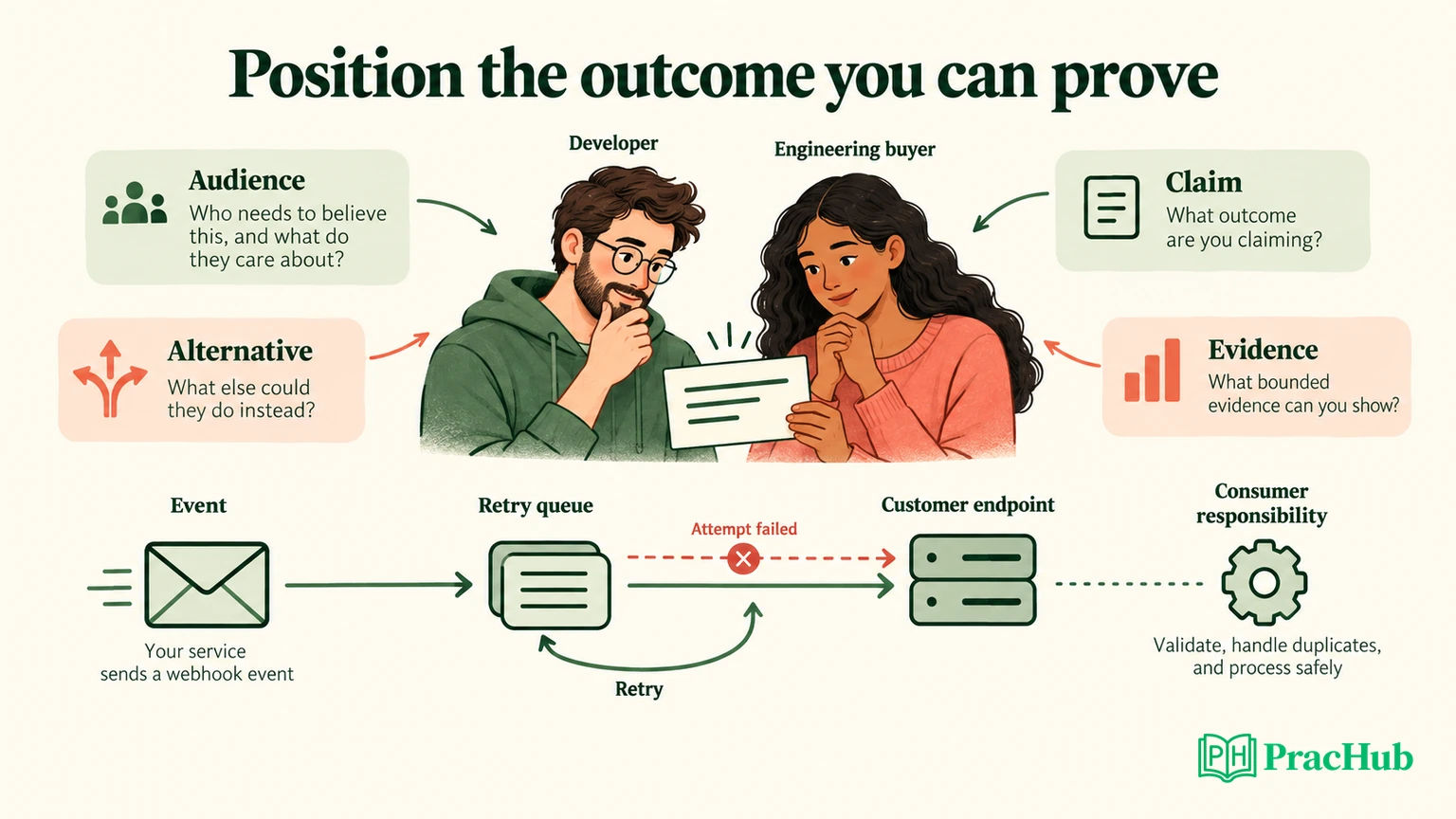
Consider an original fictional managed-webhook service. The proposed audience is a small platform team maintaining several outbound integrations. Its current alternative is a collection of homegrown retry scripts and ad hoc logs. The recurring problem is understanding failed delivery and recovering safely, not simply sending an HTTP request.
A candidate positioning answer could be: “For platform teams spending engineering time investigating outbound event failures, this service offers a shared view of delivery attempts and a controlled recovery workflow. We would compare it with their current scripts and logs, then validate whether the workflow reduces the effort needed to diagnose and replay a failed delivery.” This is a proposed position, not validated market demand.
Explain the exclusions. A team with a mature internal delivery platform may see little advantage. A customer requiring a capability the service lacks should not be pulled into the same message. A broad claim such as “the best webhook platform for every developer” removes the context that makes the comparison meaningful.
GitLab’s public messaging guidance offers an example of connecting messaging to customer concerns and use cases. Use a framework to clarify the audience, alternative, difference, and value. Test whether customers understand and believe the position; completing the document does not answer that question.
How would you research the buyer and the user?
In the fictional case, the developer uses the delivery log, an engineering manager may approve the purchase, and a security reviewer may assess data handling and access. One interview with a developer cannot answer all three perspectives. Start with the decision each person must make and the evidence they need.
For developers, investigate the last failed integration: how they detected it, what information was missing, and how they recovered. For the manager, examine the operational burden and competing priorities. For security, ask which payloads may enter the service, retention expectations, and review requirements. These are proposed research questions, not findings from customer interviews conducted for this article.
Use actual alternatives rather than only named competitors. Doing nothing, improving internal scripts, buying another service, or changing the integration architecture may all compete for the same budget. Explain why you would prioritize a segment and which evidence could disprove the choice. Avoid treating enthusiastic feedback on a demo as proof of willingness to adopt or pay.
How do you keep technical messaging credible?
Build a short claim record before producing the launch copy. For each claim, retain the exact wording, the capability it refers to, the evidence, the conditions, and the reviewer. Distinguish a documented behavior from a benchmark, a customer observation, and an aspiration. Ask the product expert for the documentation, observation, or test that supports the exact claim.
For the fictional service, “view delivery attempts and initiate a replay” could be a capability claim once product behavior is confirmed. “Integrate twice as fast” requires a defined task, comparison, participant or workload conditions, and measurement. “Exactly-once business processing” reaches beyond a retry feature and requires evidence about the full consumer behavior. None of those claims was tested for this article.
As official technical context, Stripe’s webhook documentation says deliveries may be duplicated and are not guaranteed to arrive in generation order. Those are Stripe-specific documented behaviors. They illustrate why a technical marketer should examine delivery semantics; they do not establish the contract of the fictional service or every webhook provider.
A useful response to an interviewer is: “I would ask engineering to separate transport behavior from the customer’s business effect. Then I would publish the narrow capability we can support and explain the consumer responsibilities.” If a replay causes the same event to reach a handler twice, a message about recovery should not imply that duplicate business actions are impossible.
Keep limitations next to the claim they qualify. A footnote hidden below a strong headline may leave the audience with the wrong conclusion. If latency, retention, payload size, or supported environments matter to the promise, the customer should be able to find those conditions before committing to an evaluation.
What would your launch plan prioritize?
Start with a customer action and the dependencies needed to support it. In the fictional case, the first useful action is configuring an endpoint, seeing an intentional test failure, and recovering through the documented workflow. A campaign that sends developers to an incomplete quickstart may create traffic while preventing that action.
The launch preparation should therefore include availability and entitlement, a working onboarding path, clear technical documentation, a support route, a defensible demo, approved claims, and measurement definitions. Assign owners to the unresolved dependencies. Product marketing can coordinate the launch narrative without declaring engineering readiness on behalf of the release owner.
Atlassian’s official product-launch guidance connects audience, positioning, coordination, and post-launch learning. That is general vendor guidance, not evidence that a particular channel mix will work for this developer audience. Choose distribution based on where the target teams already investigate integration problems.
For this example, a focused technical walkthrough and a failure-recovery guide may be more useful than a broad announcement alone. Sales enablement should explain who is a fit, what the demo proves, and which questions require escalation. A limited rollout can help expose onboarding gaps before broader promotion, but the rollout criteria should be defined by the team rather than invented as a universal launch schedule.
Which launch metrics would you use?
Define the unit and the customer action before choosing a metric. Page views measure exposure to content. An account created may indicate interest. A configured endpoint may indicate progress. A successfully completed recovery task may show a more relevant early experience for this particular position. None automatically proves retained value or revenue.
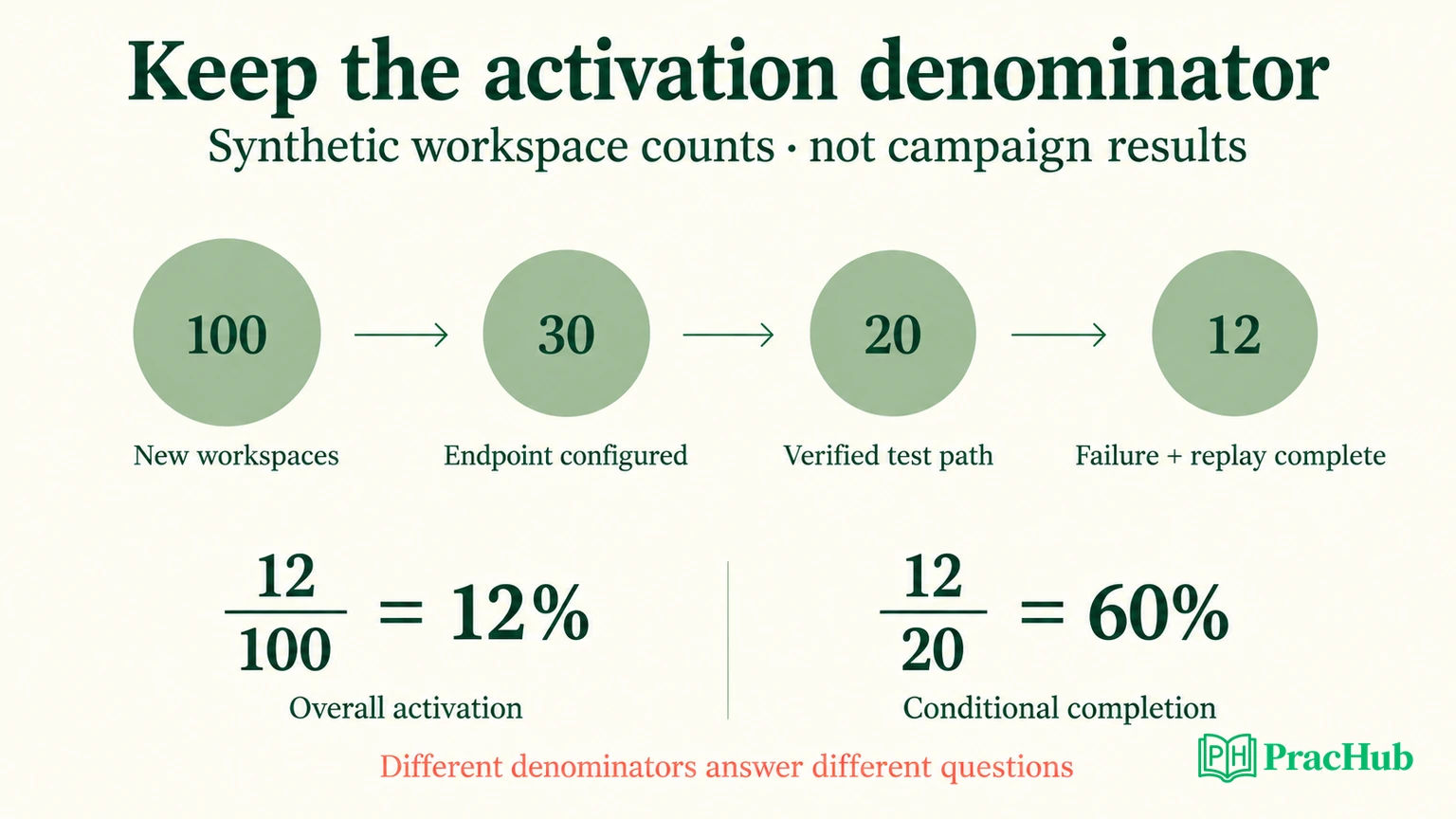
Consider an original synthetic funnel: 100 newly created workspaces, thirty configuring an endpoint, twenty completing a verified test-event path, and twelve completing the planned failure-and-replay task. These are invented counts for reasoning, not a campaign result. The proposed activation rate is twelve of 100 eligible new workspaces, or 12%, if that is the agreed definition.
Twelve of twenty is 60%, but it answers a different question: completion among workspaces that already reached the verified test path. Reporting the larger percentage as overall activation would conceal earlier drop-off. Retain the denominator, cohort window, and eligibility rules. Deduplicate repeated test events so one enthusiastic workspace does not become several activated customers.
A follow-up question might ask what you would do if traffic rose while activation fell. Investigate audience mix, onboarding failures, measurement changes, and time-to-completion before declaring that the position failed. More low-intent traffic can lower a rate even while the target segment improves. Check whether the event definition changed before comparing the dashboard’s launch cohorts.
For later value, examine whether suitable teams continue using the recovery workflow and whether it addresses their original problem. Keep proposed measurements separate from observed results. To claim that messaging caused an improvement, you need an appropriate comparison and analysis, not just a before-and-after chart.
What if sales asks for a stronger claim?
Suppose an account team wants “never lose a webhook” in the launch deck. Ask what the customer needs that phrase to mean and compare it with the supported contract. Does it refer to acceptance, durable storage, delivery attempts, receiver acknowledgement, or the final business action? A phrase that collapses those states can promise more than the product can establish.
A strong answer preserves the customer concern while narrowing the wording: “We can demonstrate the documented delivery history and recovery workflow under these conditions. We have not established an unconditional guarantee about every receiver or downstream action.” Then offer the evidence and involve the right product or engineering owner for unresolved requirements.
Frame the disagreement around the customer decision and the evidence needed. The shared problem is helping a customer make an informed decision. Record the approved wording and its conditions so a rejected claim does not reappear in a webinar, partner slide, or sales email. If the required capability is absent, qualification may be the right outcome.
How should you discuss a past launch?
Choose a launch you can explain from the customer problem through the actual result. State your responsibility, the positioning decision, the evidence used, the launch dependencies, and what happened after release. Separate your own work from the team’s product changes, sales execution, and distribution support.
Include a point where evidence changed the plan. Perhaps a message attracted developers who wanted an unsupported inbound use case, or a test showed that the quickstart omitted a recovery step. Explain the observation and your response without inventing a dramatic turnaround. For a launch that missed its goal, explain the evidence behind your diagnosis and the decision that followed.
If results are unavailable or confidential, say what you can substantiate: the approved position, the enablement asset, a resolved technical ambiguity, or a proposed measurement plan. Do not fill the gap with a hypothetical result presented as fact. The interviewer should be able to distinguish what you shipped, what customers did, and what you inferred.
Practice positioning, launches, and evidence
These PracHub questions are adjacent product-management and technical-product cases. They support transferable practice; they are not a dedicated PMM hiring syllabus or a prediction of your interview. Adapt the answer to the marketing responsibility rather than claiming ownership of product decisions you did not make.
| PracHub question | Technical-product marketing follow-up |
|---|---|
| Market positioning strategy for NVIDIA's Cosmos world foundation models | Separate the target audience, alternative, differentiated capability, and evidence. |
| Go-to-market plan and launch deck for Google's web analytics product | Connect the launch message to a useful first customer action. |
| Leading Stakeholders Through a New Product's Go-to-Market Launch | Name readiness dependencies and their owners. |
| Count Your Product Launches and Break Down the Hardest One You Ran | Describe your contribution and a decision changed by evidence. |
| Defining Activation and Success Metrics for Coinbase's Sign-Up and Verification Flow | Preserve the cohort, unit, denominator, and customer action. |
Choose one technical product and draft a position with one claim you can support. Rehearse a follow-up from the Product Design & Strategy collection, then identify the missing evidence and the owner who could provide it. That produces a more defensible interview answer than memorizing a launch checklist without a customer decision.
Comments (0)