Software Engineer Interview Difficulty Index 2027: 50 Companies Ranked by Rounds and Time Pressure
Quick Overview
A transparent 2027 index ranking 50 software engineering interview processes by evaluative stages, time pressure, format breadth, and extra gates.
Citadel, OpenAI, Anthropic, Jane Street, and Hudson River Trading sit at the top of the 2027 PracHub Software Engineer Interview Difficulty Index. What puts them there is not a claim that every question is objectively harder. Their processes combine more evaluative stages, tighter time pressure, broader technical formats, and more opportunities for a candidate to be filtered out.
This is a process-load index, not an official company ranking or a prediction of your offer odds. A five-stage loop can feel easier than a three-stage loop when the role matches your strengths. Team, level, location, and recruiting season can also change the format.
Use the PracHub company interview question index to inspect company and role records behind the broad patterns. Then use this ranking to decide whether you need a one-format coding plan or a multi-week plan that also covers systems, debugging, domain depth, and behavioral judgment.
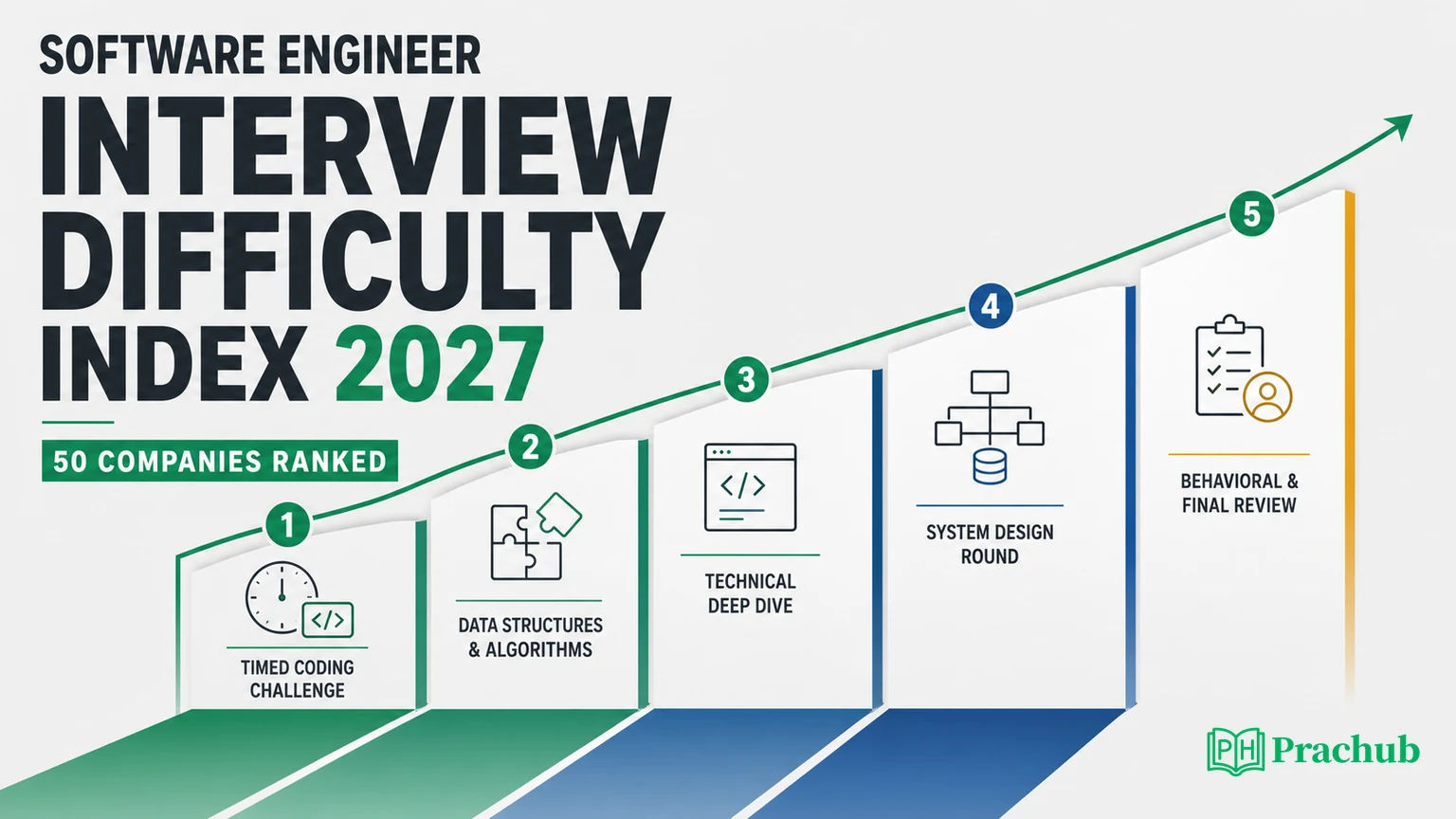
Quick answer: Which software engineering interviews have the heaviest process load?
The highest 2027 process-load scores in this dataset are Citadel / Citadel Securities at 100, OpenAI at 98, Anthropic at 97, Jane Street at 94, and Hudson River Trading at 93. Palantir, Databricks, Stripe, Roblox, and Meta complete the top ten.
Those employers do not all test the same skills. Citadel and trading firms concentrate pressure into repeated technical conversations. OpenAI and Anthropic add practical engineering and systems depth. Databricks publishes a panel that can include four to six one-hour interviews after its technical screen. Roblox adds a distinctive multi-part assessment before later interviews.
The practical conclusion is more useful than the exact order: scores within three points belong in the same preparation band. Do not spend time debating whether an 83 is meaningfully harder than an 81. Prepare for the number of transitions, the timer, and the range of formats you may face.
How the PracHub difficulty index works
The index covers 50 frequently researched software engineering employers as of August 27, 2026. It combines current official interview documentation, PracHub company and round records, and corroborated candidate reports when an employer does not publish a fixed process.
Recruiter introductions, scheduling calls, references, internal hiring committees, and offer discussions are excluded unless the candidate must complete an evaluated exercise or interview. Stage counts are ranges because one team may add a domain interview, while another may skip it.
Stage points use the typical documented or corroborated core process, not automatically the highest optional value in a range. An employer shown as 5-7 stages can therefore remain in the five-stage band when the sixth and seventh conversations are conditional team matches rather than standard requirements.
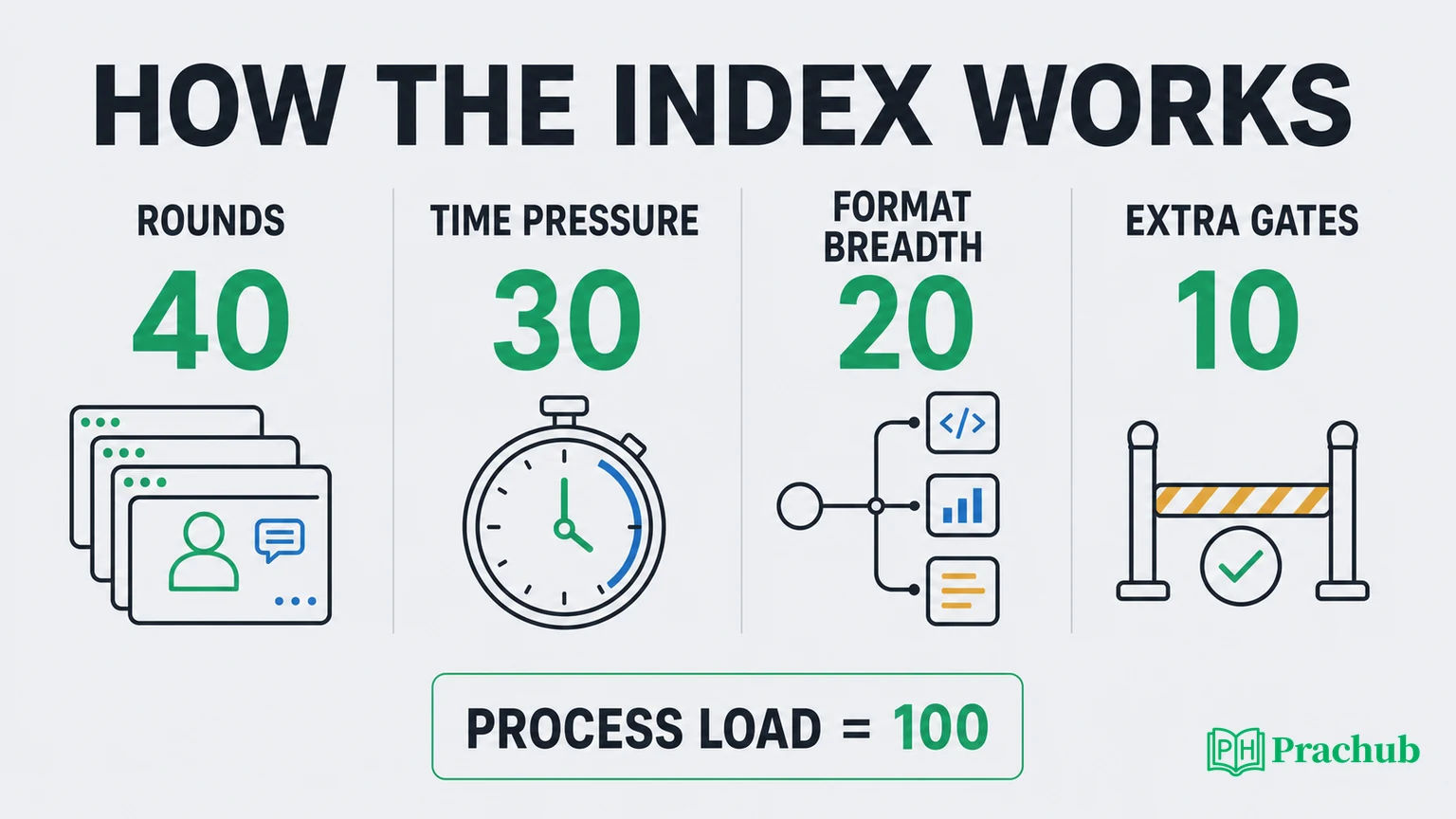
| Component | Weight | What raises the score |
|---|---|---|
| Evaluative stages | 40 points | More coding screens, technical panels, manager interviews, or scored exercises |
| Time pressure | 30 points | Timed OAs, short coding rounds, back-to-back sessions, or dense implementation work |
| Format breadth | 20 points | A mix of algorithms, production coding, debugging, systems, domain depth, and behavioral judgment |
| Extra gates and variability | 10 points | Games, work-style tests, team matching, leadership gates, or large team-to-team variation |
The formula intentionally gives 70% of the score to rounds and time pressure, matching the title and the parts candidates can plan around most directly. Format breadth and extra gates explain why two processes with the same number of interviews can demand very different preparation.
Confidence labels matter. High means current official documentation describes important stages or durations. Medium means multiple current reports and PracHub records align. Limited means public evidence is sparse or the process is unusually team-dependent. A Limited row is more uncertain than a High row even when their scores are close.
Full ranking: 50 software engineering interview processes
| Rank | Company | Score | Estimated evaluative stages | Main source of pressure | Confidence |
|---|---|---|---|---|---|
| 1 | Citadel / Citadel Securities | 100 | 5-7 | Four-interview core plus possible team and leadership matching | High |
| 2 | OpenAI | 98 | 5-7 | Long multi-format loop with coding, design, and role-depth evaluation | Medium |
| 3 | Anthropic | 97 | 5-7 | Practical coding and system work with intensive follow-ups | Medium |
| 4 | Jane Street | 94 | 5-6 | Repeated collaborative coding under tight interviewer feedback | High |
| 5 | Hudson River Trading | 93 | 5-6 | Fast coding, systems, and quantitative reasoning across several stages | Medium |
| 6 | Palantir | 90 | 5-6 | Learning, decomposition, coding, and hiring-manager gates | Medium |
| 7 | Databricks | 89 | 5-7 | Technical screen plus a four-to-six interview technical panel | High |
| 8 | Stripe | 88 | 5-6 | Implementation-heavy coding, integration, design, and collaboration | Medium |
| 9 | Roblox | 87 | 5-6 | Multi-part assessment before coding and behavioral interviews | High |
| 10 | Meta | 86 | 5 | Multiple coding conversations plus design and behavioral evaluation | High |
| 11 | 85 | 5 | Back-to-back coding with design or domain depth and team matching | High | |
| 12 | Amazon | 84 | 5 | Long online assessment followed by four 55-minute interviews | High |
| 13 | Netflix | 84 | 5 | Senior-level technical depth, system judgment, and culture evaluation | Medium |
| 14 | Snowflake | 83 | 5 | Coding, systems, database depth, and behavioral interviews | Medium |
| 15 | Figma | 83 | 5 | Product engineering, coding, architecture, and collaboration breadth | Medium |
| 16 | Two Sigma | 82 | 5 | Multiple technical rounds with coding, systems, and quantitative depth | Medium |
| 17 | Bloomberg | 82 | 5 | Repeated coding screens plus system and manager evaluation | Medium |
| 18 | Airbnb | 81 | 5 | Coding, architecture, values, and cross-functional judgment | Medium |
| 19 | TikTok | 81 | 4-5 | Fast coding stages, technical breadth, and resume re-screening | Medium |
| 20 | DoorDash | 80 | 4-5 | Coding, debugging or code craft, systems, and behavioral evaluation | Medium |
| 21 | Rippling | 79 | 4-5 | Implementation speed, practical systems work, and role-specific depth | Medium |
| 22 | Uber | 78 | 4-5 | Timed coding followed by architecture and behavioral rounds | Medium |
| 23 | 77 | 4-5 | Coding, system design, communication, and team evaluation | Medium | |
| 24 | Cloudflare | 76 | 4-5 | Coding plus networking, distributed systems, and practical debugging | Medium |
| 25 | NVIDIA | 76 | 4-5 | Team-specific coding with C++, systems, or GPU depth | Medium |
| 26 | Apple | 76 | 4-5 | Team-dependent coding, project depth, and repeated technical screens | Medium |
| 27 | Atlassian | 75 | 4-5 | Two coding dimensions, 60-minute design, manager, and values | High |
| 28 | xAI | 75 | 4-6 | Role-variable technical depth and fast-moving team interviews | Limited |
| 29 | Anduril | 74 | 4-5 | Coding, systems, mission fit, and product trade-offs | Medium |
| 30 | Plaid | 73 | 4-5 | API implementation, coding, system design, and collaboration | Medium |
| 31 | Brex | 73 | 4-5 | Coding, product judgment, architecture, and behavioral depth | Medium |
| 32 | Coinbase | 72 | 4-5 | Timed coding, cultural assessment, and technical loop | Medium |
| 33 | 71 | 4-5 | Coding, product-focused systems, and collaboration | Medium | |
| 34 | Snapchat | 71 | 4-5 | Coding, design, and team-specific technical evaluation | Medium |
| 35 | Robinhood | 70 | 4-5 | CodeSignal or coding screen followed by systems and values | Medium |
| 36 | Datadog | 70 | 4-5 | Coding, debugging, system design, and product reliability | Medium |
| 37 | Dropbox | 69 | 4-5 | Coding, practical design, and collaboration across a compact loop | Medium |
| 38 | MongoDB | 69 | 4-5 | Coding, database systems, and team-matching depth | Medium |
| 39 | Microsoft | 68 | 4 | Several short 45-minute rounds covering coding, design, and testing | High |
| 40 | Salesforce | 68 | 4 | Coding, architecture, behavioral, and role-specific evaluation | Medium |
| 41 | Shopify | 67 | 4 | Practical coding, pair programming, and values assessment | Medium |
| 42 | Instacart | 66 | 4 | Coding, product systems, and collaboration in a compact loop | Medium |
| 43 | Spotify | 65 | 4 | Team-specific coding, architecture, and values interviews | Limited |
| 44 | Lyft | 64 | 4 | Coding, practical design, and behavioral evaluation | Medium |
| 45 | Oracle | 63 | 4 | Coding, fundamentals, and team-specific technical interviews | Medium |
| 46 | Adobe | 62 | 3-4 | Timed coding plus project, technical, and manager discussions | Medium |
| 47 | PayPal | 61 | 3-4 | Coding assessment with technical and behavioral follow-ups | Medium |
| 48 | Capital One | 60 | 3-4 | Assessment plus Power Day-style technical and behavioral evaluation | Medium |
| 49 | JPMorgan Chase | 59 | 3-4 | HackerRank, HireVue or explanation, and final interviews | Medium |
| 50 | Goldman Sachs | 58 | 3-4 | Timed assessment followed by technical and behavioral interviews | Medium |
What the highest-scoring processes have in common
They make candidates change modes repeatedly
At the top of the index, success rarely means solving the same kind of algorithm problem five times. Candidates may move from timed coding to practical implementation, architecture, debugging, domain depth, and behavioral judgment. The transition itself creates difficulty because each format rewards a different pace and communication style.
Databricks is a useful official example. Its published back-end process includes a one-hour technical screen and a panel of four to six one-hour interviews selected from coding, algorithms, system programming, architecture, domain deep dive, and cross-functional evaluation. A candidate prepared only for LeetCode-style problems has a large coverage gap even with strong algorithms.
Time pressure compounds across a loop
A single 45-minute interview is manageable. Four or five short rounds in one day create cumulative pressure: understand the prompt, ask useful questions, implement, test, explain trade-offs, reset, and repeat. Microsoft's official guidance explicitly highlights time management in short 45-minute technical rounds. Amazon documents four 55-minute interviews after its online assessment.
Extra gates increase uncertainty
Roblox's early-career process is a clear example. Its official assessment combines coding and algorithmic reasoning with other problem-solving and workplace signals. Palantir can add learning, decomposition, and hiring-manager stages. Apple, NVIDIA, xAI, and Spotify can vary substantially by team. These gates do not automatically make questions harder, but they increase the number of ways the process can diverge from a generic preparation plan.
How to use the score without overfitting
Treat the scores as four preparation bands:
| Score band | Preparation implication |
|---|---|
| 90-100 | Build a multi-week plan for repeated technical interviews, systems depth, and recovery between rounds. |
| 80-89 | Prepare at least three formats and run a realistic half-day or full-loop simulation. |
| 70-79 | Combine timed coding with one practical or design format plus behavioral stories. |
| 58-69 | Expect a more compact process, but verify the role because team-specific rounds can still be demanding. |
Do not use a lower score as permission to underprepare. The index measures process load, not selectivity. A compact three-stage interview can ask unusually difficult questions, and a long loop can be structured to let candidates demonstrate strengths gradually.
Your job level also changes the burden. New-grad candidates may receive more standardized coding and assessment stages. Senior candidates may skip an OA but face deeper system design, project review, leadership, and cross-functional interviews. Recalculate the preparation emphasis even when the company score stays the same.
Practice across the formats that create the score
These PracHub question-bank records are practice material, not predictions of your exact assessment or interview. Each complete title in the first column links directly to the question and solution.
| PracHub question | Company and format | Why it belongs in an index-based plan |
|---|---|---|
| Find the Earliest Pair with a Target Sum | Amazon, coding | Trains a precise tie-break, linear-time reasoning, and fast edge-case testing. |
| Design a Concurrent Image Processing Service | Anthropic, system design | Practices concurrency, idempotency, retries, cancellation, and scale trade-offs. |
| Implement a Set with Readable Snapshots | OpenAI, implementation | Combines data-structure design, API clarity, complexity, and follow-up depth. |
| Compute a Depth-Weighted Sum of a Nested List | Google, coding | Builds recursive and iterative reasoning under an onsite-style time limit. |
| Design an Alert Notification Service for Downstream Consumers | DoorDash, system design | Trains delivery semantics, backpressure, retries, and downstream isolation. |
A preparation plan based on your target band
Start by writing down the expected stages from your recruiter or invitation. Mark each as coding, implementation, debugging, design, domain, or behavioral. Then compare the list with the index rather than memorizing the company rank.
For a 90-plus target, complete two timed coding sessions on separate days, one production-style implementation, one system design, and one full loop with short breaks. For an 80-89 target, run at least one three-format simulation. For a 70-79 target, pair timed coding with the company's most distinctive second format. For a lower-band target, invest the saved breadth time in role-specific fundamentals and communication.
After every simulation, record three things: where you lost time, which requirement you failed to clarify, and which test or trade-off you explained too late. Those observations are more actionable than trying to raise a vague sense of confidence.
Frequently asked questions
Which company has the hardest software engineering interview in 2027?
Citadel / Citadel Securities ranks first in this process-load index because its official engineering process includes a 45-minute first round, three 45-minute second-round interviews, and possible team or leadership interviews. That does not prove every Citadel question is harder than every question elsewhere; it means the documented process combines many evaluative conversations with substantial time pressure.
Why are OpenAI and Anthropic near the top?
Current evidence points to long, multi-format loops that can test practical implementation, coding, system design, role depth, and judgment. Their exact processes vary by team, so both carry Medium rather than High confidence despite their high scores.
Does a lower score mean the company is easier to get into?
No. The score does not measure selectivity, applicant quality, headcount, or offer rate. It measures the preparation and endurance burden created by stages, timers, format changes, and extra gates. A lower-ranked process may still be extremely selective.
How accurate are the round counts?
They are stage ranges, not promises. High-confidence rows use current official documentation where available. Medium and Limited rows rely more on corroborated candidate reports and PracHub records. Your recruiter and invitation remain the source of truth for your role.
How often should this index be updated?
At least once per major recruiting season, and sooner when a company introduces a new assessment, AI-assisted task, team-matching gate, or redesigned loop. The underlying CSV and formula make changes auditable instead of silently moving companies around.
Final takeaway
The useful finding is not that one employer owns a permanent title of “hardest interview.” It is that the heaviest 2027 software engineering processes combine five or more evaluative stages with time pressure, multiple technical formats, and extra gates. That combination changes how you should prepare.
Use the score to estimate breadth and endurance, then verify the exact role. Practice company and format-specific questions through PracHub's company interview index, simulate the transitions you will actually face, and treat any score within three points as the same practical band.
Sources and Further Reading
- Citadel: Our Engineering Interview Process
- Databricks: Engineering Interview Preparation
- Amazon: SDE II Interview Preparation
- Atlassian: Engineering Interview Handbook
- Atlassian: Early Careers Interview Guide
- Microsoft: Technical Interviewing
- Roblox: Early Careers Assessment
- Roblox: Interviewing at Roblox
- Meta: Preparing for Your Full Loop Interview
- Jane Street: Preparing for a Software Engineering Interview
- Google: Technical Virtual Interview Candidate Guide
- PracHub: Company Interview Questions
- FAANGPlus: Interview Process Directory
- Technical Interview Preparation Research
Research note: This index was checked on August 27, 2026. Interview stages, timers, and evaluation formats vary by role, level, location, requisition, and recruiting season. Official employer material and your own invitation take priority over this ranking.
Related Articles
AI-Assisted Coding Assessments in 2027: Companies, Platforms, Rules, and Scoring
Learn which 2027 coding assessments allow AI, how HackerRank, CoderPad, and CodeSignal differ, what employers can review, and how scoring works.
Repository-Based OAs in 2027: Companies Replacing LeetCode with Debugging Tasks
See which 2027 employers use repository-based OAs, where LeetCode remains, how Amazon and IBM formats vary, and how to prepare for both assessment styles.
Online Assessment Proctoring by Company 2027: Webcam, Screen Recording, and Tab-Switching Rules
Compare 2027 OA proctoring rules by company, including webcam, screen recording, tab switching, desktop apps, evidence grades, and setup checks.
Which Companies Resume-Screen Before vs After the OA? 2027 Candidate Data
See which companies review resumes before or after the OA in 2027, with employer scope, evidence grades, candidate data, and practical next steps.
Comments (0)