AI-Assisted Coding Assessments in 2027: Companies, Platforms, Rules, and Scoring
Quick Overview
A current 2027 guide to AI-assisted coding assessments, including verified platform capabilities, company evidence, permission boundaries, reporting signals, and scoring.
AI-assisted coding assessments are becoming a real part of technical hiring in 2027, but there is no universal format or rule set. Some employers intentionally provide a built-in assistant and evaluate how candidates direct, verify, and improve its work. Other assessments, including CodeSignal's standard General Coding Assessment, still prohibit AI entirely.
The safest rule is therefore simple: use AI only when your own invitation or assessment interface explicitly permits it. A platform's ability to offer an AI assistant does not mean your employer enabled it, and permission to use a built-in assistant does not automatically authorize ChatGPT, Copilot, Cursor, or another external tool.
Use PracHub's AI coding interview questions to practice repository navigation, AI-output review, debugging, and decision defense. This guide focuses on a different search intent: which company processes have current evidence, how HackerRank, CoderPad, and CodeSignal differ, what activity can be reviewed, and what may contribute to the result.
Quick answer: What changes in an AI-assisted assessment?
An AI-assisted coding assessment is a technical evaluation in which the employer intentionally allows an AI tool as part of the approved environment. The candidate still owns the result and is expected to test, inspect, correct, and explain the generated work.
The clearest current large-company OA evidence is for selected Amazon SDE hiring processes. Recent candidates report a traditional coding problem followed by an AI-assisted repository task, although other Amazon candidates in the same season received two conventional coding questions. Figma has current reports of an AI-assisted CoderPad stage, but public evidence is not consistent enough to call it a universal OA.
Atlassian, Microsoft, and DoorDash illustrate the wider trend, but their reported AI-enabled stages are live interviews or engineering sessions rather than confirmed asynchronous OAs. This distinction matters because a live interviewer can directly score communication and judgment, while an OA relies more on tests, recorded activity, reports, and later human review.
| Evidence grade | What it means in this guide |
|---|---|
| A - Official | A company or platform publicly documents the named format and rule. |
| B - Corroborated report | Multiple current candidate reports align with documented platform capability. |
| C - Limited | A current report exists, but the stage, configuration, or consistency is unclear. |
| Adjacent | The evidence concerns a live interview, not an asynchronous OA. |
2027 company tracker: confirmed OA, reported screen, or live interview?
| Company and scope | Reported stage and AI access | What appears to be evaluated | Confidence |
|---|---|---|---|
| Amazon SDE and selected Intern/New Grad 2027 processes | OA with a built-in AI assistant for an existing repository; some candidates receive a traditional-only version | Functional tests, debugging, code changes, broader OA sections, and possibly recorded AI interaction | B |
| Figma Winter SWE Intern 2027 | Candidate-reported CoderPad AI stage; participants disagree about whether it is an OA or interview | Product-oriented implementation and how the candidate works with the assistant | C |
| Atlassian selected engineering roles | AI-enabled repository work in a live interview | Scoping, prompting, engineering decisions, validation, and verbal defense | Adjacent |
| Microsoft selected SDE roles | Candidate-reported AI-assisted live coding | Tool use, implementation, testing, and explanation | Adjacent |
| DoorDash selected candidates | Live AI Code Craft or debugging session | Working in unfamiliar code, prioritization, tests, and communication | Adjacent |
This is a dated evidence tracker, not a promise about any requisition. Employers can run pilots, change platforms, or send different versions by location, role, and application batch.
Amazon is the strongest current OA example
Recent Amazon candidates report a coding problem, an AI-assisted code repository section, Work Simulation, and Work Style. Other current reports describe a VS Code-like environment, a selectable backend stack, failing tests, and a built-in assistant used to inspect the project and help diagnose bugs.
The reported outcomes also show why there is no reliable public cutoff. Candidates discuss visible results such as 15/15 for a conventional problem or 6/6 for a repository section, yet a perfect visible test count does not guarantee advancement. The final hiring decision can also include Work Style, Work Simulation, resume review, integrity review, headcount, and employer-specific thresholds that are not public.
Variation is substantial. One candidate expected an AI repository round but received two traditional questions, while others report one DSA task and one repository task. Prepare for the invitation you receive rather than treating any online post as a fixed template.
What HackerRank, CoderPad, and CodeSignal actually support
| Platform | Current documented AI-assisted capability | Review and scoring signals | Critical rule boundary |
|---|---|---|---|
| HackerRank | AI Assistant for coding, project, repository, database, and data-science questions when enabled | Tests, code quality, detailed reports, assistant transcript, IDE activity, and optional AI Fluency | Employer configuration controls whether AI is available; outside tools are not automatically allowed. |
| CoderPad Screen | AI Assistant in custom project questions and AI-assisted review of candidate conversations | Automatic tests, manual criteria, project analysis, conversation analysis, comparative scores, and code playback | A CoderPad invitation does not prove AI Assist is enabled for that test. |
| CodeSignal | Separate agentic full-stack and agentic live-interview products alongside conventional assessments | Product-specific tests or rubrics; traditional CodeSignal reports can include scores and replay | The standard GCA explicitly prohibits AI, even though CodeSignal sells separate AI-enabled products. |
HackerRank's AI-Assisted Tests documentation says candidate reports can include the full assistant transcript and optional AI Fluency. Its AI Fluency documentation says the evaluation uses assistant interactions and IDE activity and should be reviewed alongside other assessment metrics.
CoderPad's custom project documentation describes an AI assistant panel, automated or manual criteria, and conversation analysis in the candidate report. Its reporting tools can also show code playback, test runs, copy-paste activity, and time outside the browser.
CodeSignal requires the most careful distinction. Its General Coding Assessment rules explicitly say AI is not allowed. Separately, CodeSignal lists an AI-Assisted Agentic Full-Stack Assessment and offers Agentic Interviewing for live sessions. Product availability is not permission inside a different assessment.
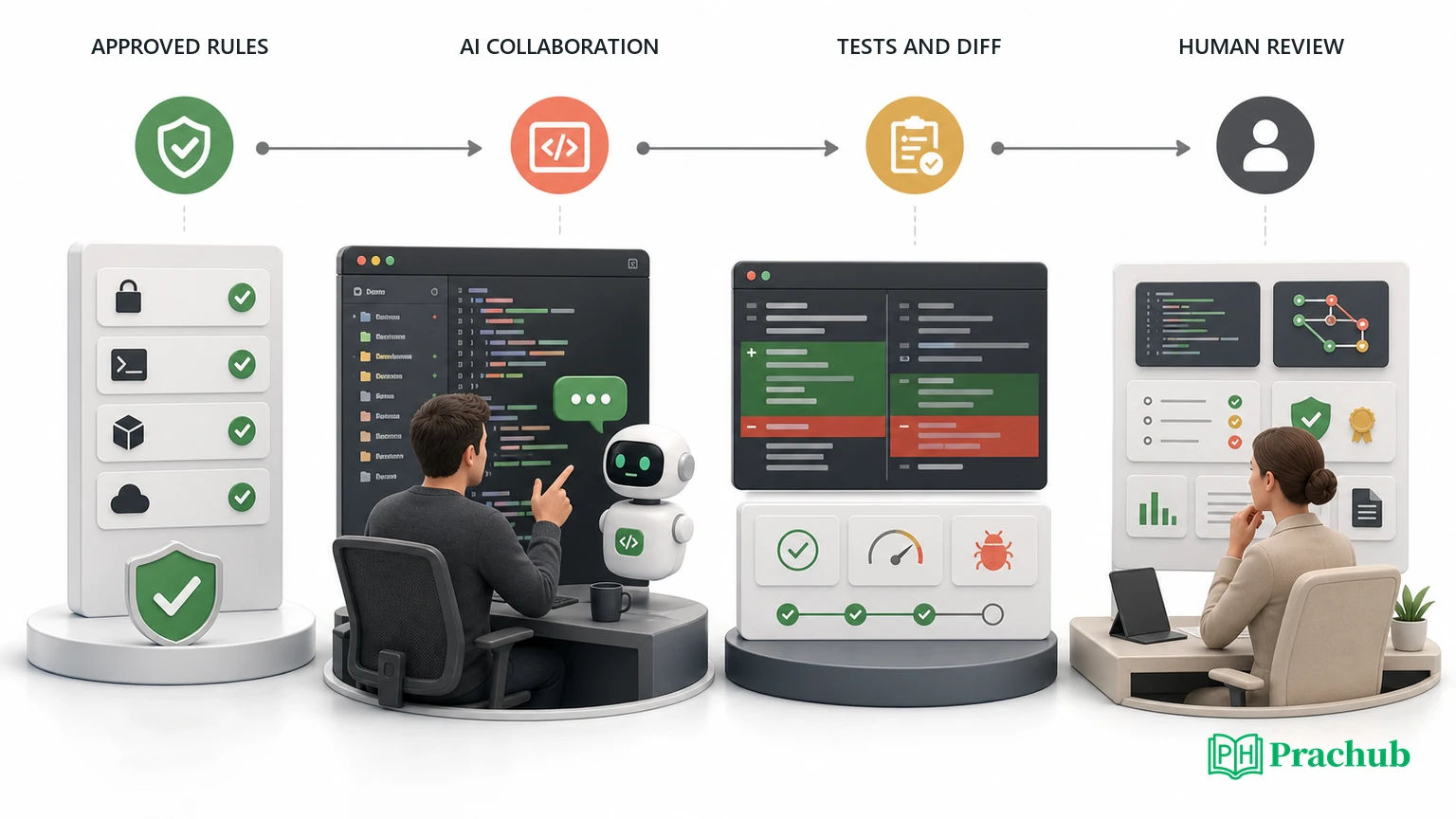
The rules: built-in AI is not the same as unrestricted AI
Start by separating four permissions that candidates often collapse into one:
- Built-in assistant access: The test itself displays an approved AI panel or agent.
- External AI access: The invitation explicitly permits another website, extension, desktop app, or CLI agent.
- Documentation access: The rules allow syntax or official documentation, which does not imply AI access.
- Repository and data handling: The environment defines what code, files, and prompts may leave the platform.
If only the first permission is present, stay inside the provided assistant. Do not paste assessment content into an external model, open an unauthorized extension, or assume that another candidate's rules apply to you. If the instructions conflict, pause before the timer when possible and ask the recruiter or platform support for a written clarification.
Prompt and activity visibility also varies. HackerRank documents full assistant transcripts and IDE-derived AI Fluency signals. CoderPad documents AI conversation analysis and process history. That does not mean every employer reads every prompt, nor does it prove that prompt quantity is rewarded. Treat the entire session as reviewable and focus on useful, job-like interaction.
How scoring works when AI is allowed
There is no universal AI-assisted score. A defensible mental model has six layers:
| Scoring layer | Observable evidence | What a strong submission demonstrates |
|---|---|---|
| Functional correctness | Visible and hidden tests | Required behavior works, including boundaries and failure cases. |
| Change quality | Final diff, structure, readability, maintainability | The patch is focused, understandable, and consistent with the repository. |
| Verification | Test runs, added tests, error investigation | The candidate checks output instead of trusting plausible code. |
| AI collaboration | Prompts, responses, accepted or rejected suggestions | The assistant is directed with context and constraints, then challenged when wrong. |
| Process | IDE activity, code playback, plan, and iteration | Progress follows a coherent hypothesis-test-fix loop. |
| Employer decision | Resume, behavioral sections, integrity review, and hiring needs | The assessment result fits the employer's broader selection process. |
HackerRank's optional AI Fluency grade is an additional signal, not a replacement for technical correctness. CoderPad lets employers combine automatic tests with manual criteria such as code structure, test quality, security, and AI conversation review. CodeSignal's conventional assessments retain their own scoring rules and should not be treated as AI-assisted unless the named product and invitation say so.
The most important implication is that more prompting is not necessarily better. A short prompt that states the failing behavior, relevant file, constraints, and required test can be stronger than repeatedly asking for a complete solution. Evaluators want evidence that you remain the engineer in control.
What strong AI-assisted performance looks like
CoderPad's 2026 hiring survey found that employers allowing AI valued catching AI mistakes, explaining trade-offs, iterating on output, handling edge cases, and considering security or privacy. Those signals align with the platform reports: the final code matters, but so does whether the candidate can establish correctness.
Use a repeatable workflow:
- Read the README, tests, and repository structure before asking for code.
- State the failing behavior and one concrete hypothesis.
- Ask the assistant to identify relevant files or explain a narrow path.
- Inspect every suggested change and keep the diff small.
- Run the most relevant test first, then the broader suite.
- Review edge cases, security, performance, and unintended contract changes.
- Be ready to explain what the assistant got wrong and why you rejected it.
This approach works even when the assistant is slow or unavailable because the reasoning remains yours.
Practice with AI-assisted PracHub questions
These PracHub question-bank records train the skills that appear in AI-enabled coding work. They are practice material, not predictions of your exact assessment. Each complete title in the first column opens the question and written solution.
| PracHub question | Practice focus | Why it helps |
|---|---|---|
| Debug Watch List Movie Operations | Repository debugging and tests | Practices tracing existing backend behavior, fixing focused defects, and protecting API contracts. |
| Implement and Defend an AI-Assisted Repository Change | Agent direction and defense | Trains scoped prompting, diff review, validation, and explanation of every accepted change. |
| Debug and Extend Cursor Queries | AI-output review and edge cases | Requires challenging plausible suggestions, tracing state, and testing a corrected implementation. |
| Validate AI-Generated Code Safely | Correctness, maintainability, and safety | Builds a concrete review checklist for generated code rather than trusting fluent output. |
| How do you use AI for coding? | Workflow and communication | Helps explain approved use, verification, privacy boundaries, and personal accountability. |
A seven-day preparation plan
| Day | Focus | Deliverable |
|---|---|---|
| Day 1 | Rules and baseline | Read one sample invitation, list allowed tools, and complete one conventional timed problem. |
| Day 2 | Repository mapping | Trace one request from entry point to tests and persistence in an unfamiliar small project. |
| Day 3 | AI-assisted diagnosis | Use an assistant only to map files and propose hypotheses, then verify each claim manually. |
| Day 4 | Focused patch | Fix one seeded defect, run targeted tests, and review the final diff for unrelated changes. |
| Day 5 | Feature extension | Add one small requirement while preserving existing behavior and adding an edge-case test. |
| Day 6 | Full simulation | Complete a coding task plus a repository task under a single timer and save your prompts. |
| Day 7 | Review and logistics | Explain your rejected AI suggestions aloud and verify browser, account, stack, and invitation rules. |
Frequently asked questions
Which companies use AI-assisted coding assessments in 2027?
Selected Amazon SDE processes have the strongest current evidence for a true AI-assisted OA. Figma has current reports of an AI-assisted CoderPad stage, but the stage and consistency remain unclear. Atlassian, Microsoft, and DoorDash reports describe related live interviews rather than confirmed asynchronous OAs.
Can I use ChatGPT or Copilot if the assessment has an AI assistant?
Not unless the rules explicitly allow those external tools. Permission to use a built-in assistant normally applies only to that approved interface. Read the invitation and setup screen, disable unauthorized extensions, and ask for clarification before starting if the wording is ambiguous.
Do employers see my prompts?
They may. HackerRank documents an AI Assistant transcript and IDE-derived AI Fluency signals. CoderPad documents conversation analysis in project reports. The employer may configure or review these features differently, so behave as though prompts, edits, tests, and final code are reviewable.
Is AI Fluency more important than passing tests?
No public universal weighting exists. HackerRank says AI Fluency complements other metrics, while CoderPad supports both automatic and manual criteria. Correct behavior, a clean change, and independent verification remain fundamental even when AI interaction becomes an additional signal.
What should I do if the built-in assistant fails?
Capture the exact error and timestamp, continue with repository inspection and tests if possible, and contact platform support or recruiting through the approved route. Do not switch to an unauthorized external tool. Your preparation should leave you capable of debugging without AI assistance.
Are AI-assisted assessments easier than LeetCode?
They are different, not automatically easier. The assistant can reduce syntax and navigation work, but the task may be broader and the evaluator can inspect whether you understood the repository, caught incorrect suggestions, preserved contracts, and validated the result under time pressure.
Final takeaway
AI-assisted coding assessments in 2027 are a growing but fragmented format. HackerRank and CoderPad now document built-in assistants and reviewable AI interactions; CodeSignal offers separate agentic products while continuing to ban AI in the standard GCA. At the company level, Amazon provides the clearest current OA evidence, while several other employers are experimenting in screens and live interviews.
Do not prepare by memorizing a magic prompt or chasing a rumored cutoff. Learn the rule boundary, inspect before editing, ask the assistant narrow questions, verify every change, and keep ownership of the final code. Practice those habits with PracHub AI-assisted interview questions, then confirm the exact tools and restrictions in your own invitation.
Sources and Further Reading
- HackerRank: AI-Assisted Tests
- HackerRank: AI Fluency Evaluation
- HackerRank: January 2026 Release Notes
- HackerRank: July 2026 Release Notes
- CoderPad: Custom Project Questions and AI Assistant
- CoderPad: Candidate Reports
- CoderPad: State of Tech Hiring 2026
- CodeSignal: General Coding Assessment Rules
- CodeSignal: AI-Assisted Agentic Full-Stack Assessment Availability
- CodeSignal: Agentic Interviewing
- Current Amazon SDE Intern 2027 OA Report
- Current Amazon AI-Assisted Repository Experience
- Amazon Traditional-Format Counterexample
- Figma Winter 2027 AI-Assisted Stage Discussion
- Atlassian AI-Enabled Live Interview Discussion
- Microsoft AI-Assisted Live Coding Discussion
- DoorDash AI Code Craft and Debugging Discussion
Research note: This guide was checked on August 27, 2026. Assessment formats, AI permissions, scoring, and monitoring can vary by employer, role, location, requisition, and recruiting batch. Your own invitation is the source of truth.
Related Articles
Software Engineer Interview Difficulty Index 2027: 50 Companies Ranked by Rounds and Time Pressure
See 50 software engineering interview processes ranked by evaluative stages, time pressure, format breadth, and extra gates in a transparent 2027 index.
Repository-Based OAs in 2027: Companies Replacing LeetCode with Debugging Tasks
See which 2027 employers use repository-based OAs, where LeetCode remains, how Amazon and IBM formats vary, and how to prepare for both assessment styles.
Online Assessment Proctoring by Company 2027: Webcam, Screen Recording, and Tab-Switching Rules
Compare 2027 OA proctoring rules by company, including webcam, screen recording, tab switching, desktop apps, evidence grades, and setup checks.
Which Companies Resume-Screen Before vs After the OA? 2027 Candidate Data
See which companies review resumes before or after the OA in 2027, with employer scope, evidence grades, candidate data, and practical next steps.
Comments (0)