Repository-Based OAs in 2027: Companies Replacing LeetCode with Debugging Tasks
Quick Overview
A verified 2027 tracker of repository-based online assessments, including current Amazon and IBM reports, platform evidence, format caveats, and a balanced preparation plan.
Repository-based online assessments are growing in 2027, but the evidence does not show a clean industry-wide replacement for LeetCode. The clearest current examples are selected Amazon and IBM internship assessments that combine a conventional coding problem with debugging or feature work inside an existing project. Other candidates at the same companies still report traditional algorithm questions.
The practical conclusion is simple: prepare for both modes. Keep enough data-structure fluency for a timed standalone problem, then learn how to map an unfamiliar repository, reproduce one failure, make a focused patch, and verify it against hidden tests. Your invitation remains the source of truth because formats vary by role, location, and batch.
Use PracHub's repository-based online assessment guide for the step-by-step debugging workflow. This article answers a different question: which companies are actually using the format, how strong the evidence is, and whether they have truly removed LeetCode-style coding.
Quick answer: Are companies replacing LeetCode in 2027?
Some employers are adding repository tasks, but most verified cases are hybrid rather than replacement formats. Current candidate reports provide the strongest evidence for selected Amazon SDE Intern and IBM Software Developer Intern assessments. In both cases, candidates have also reported conventional coding versions, so it would be inaccurate to describe either company as using one universal repository OA.
Figma candidates have reported an AI-assisted CoderPad task in one Winter 2027 process, but the evidence does not clearly confirm a multi-file repository. Atlassian, DoorDash, and Microsoft show the same direction in live interviews, not necessarily in OAs.
| Evidence level | Meaning in this tracker |
|---|---|
| A - Official company confirmation | The employer publicly describes the exact assessment for the named program. |
| B - Corroborated candidate reports | Multiple current reports align, and the named platform supports the format. |
| C - Limited or ambiguous report | A current report exists, but scope, stage, or consistency is unclear. |
| Adjacent trend | The format appears in a live interview rather than an OA. |
What counts as a repository-based OA?
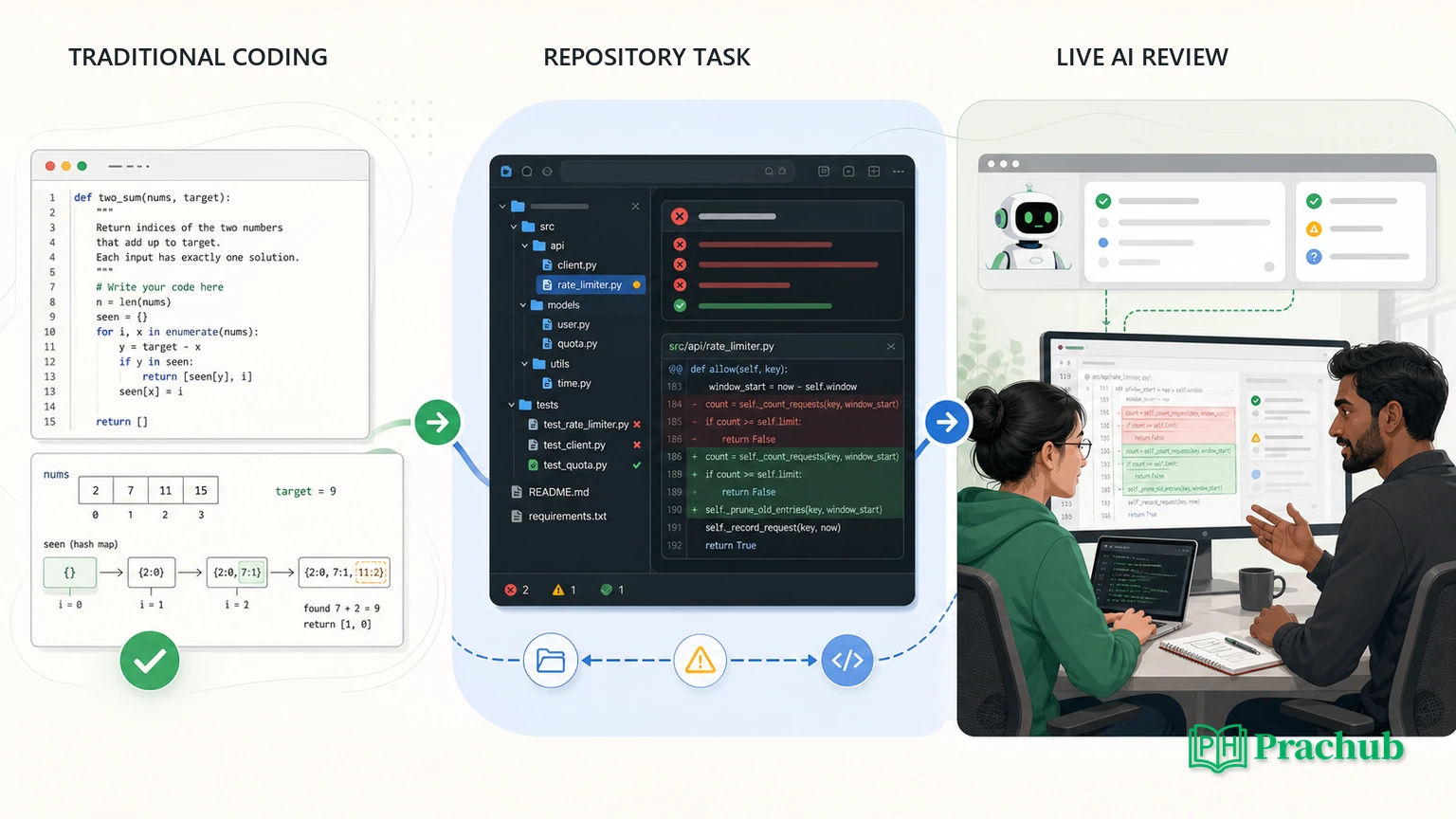
A repository-based OA starts from an existing multi-file application instead of an empty function stub. The candidate may need to diagnose failing tests, fix a defect, add validation, complete a feature, or preserve backward compatibility while changing one behavior.
That definition matters because several formats are grouped together incorrectly. A long object-oriented problem is not automatically a repository task. An AI-assisted CoderPad session is not automatically a multi-file project. A live session with starter code is an interview, not an asynchronous OA.
The platform capabilities are real. HackerRank lets employers upload a ZIP repository and create bug-fix or feature tasks across several frameworks. CodeSignal's Industry Coding Assessment uses one progressive project-style question over 90 minutes. Platform availability, however, does not prove that every customer uses it.
2027 company tracker: repository task, hybrid, or still traditional?
| Company and scope | Current reported format | Has LeetCode been replaced? | Confidence |
|---|---|---|---|
| IBM Software Developer Intern 2027, selected US backend and federal roles | One conventional coding task plus a Django, Node.js, or Spring Boot repository task | No. The strongest evidence is a hybrid. | B |
| IBM Canada 2027 counterexample | Two conventional coding questions reported by a candidate in the same recruiting wave | No. Location and requisition appear to matter. | C |
| Amazon SDE Intern 2027, selected requisitions | Coding problem, repository debugging in MERN or another framework, then Work Style | No. Repository work supplements coding. | B |
| Amazon SDE Intern 2027 counterexample | Two traditional coding questions | No. Amazon still sends multiple versions. | C |
| Figma Winter SWE Intern 2027 | Candidate-reported CoderPad AI design task, with no normal LeetCode question in one process | Possibly for that process, but a repository is not confirmed. | C |
| Atlassian, DoorDash, and Microsoft selected roles | AI-assisted repository, debugging, or starter-code work during a live session | Not an OA replacement claim. | Adjacent |
This is a dated tracker, not a promise about your invitation. Employers can change sections, timers, frameworks, and integrity settings or run a limited pilot.
IBM: the clearest hybrid repository OA signal
Recent 2027 internship discussions provide the strongest repeated evidence for an IBM change. Candidates applying to some US software, backend, and federal roles describe a coding section followed by an existing web application in Django, Node.js, or Spring Boot.
The reports emphasize finding the relevant model or route, understanding validation, preserving behavior, and passing tests that are not fully visible. Multiple discussions describe the same coding-plus-repository pattern.
IBM's official application page only says technical assessments vary by role; it does not publish a universal repository format. A Canadian candidate in the same recruiting-wave discussion reported two traditional questions. The conclusion is therefore selected IBM roles use a hybrid OA, not "IBM replaced LeetCode."
Amazon: repository debugging is real, but not universal
Selected Amazon SDE Intern 2027 candidates report one coding problem, an AI-assisted repository debugging task, and Work Style. MERN appears in several reports, while other candidates mention different web stacks. The work involves inspecting the project, reproducing problems, reviewing AI suggestions, and passing hidden tests.
Amazon's official student page still describes coding and Workstyles broadly and says country processes vary. That is another reason not to generalize one internship format to all Amazon hiring.
Some 2027 candidates expected a repository task and instead received two traditional questions. Until the invitation reveals more, maintain coding speed and practice timed repository changes in one familiar framework.
Figma and the risk of overstating a new format
A current Figma Winter 2027 discussion describes a CoderPad AI task where the candidate designed a solution and used an assistant instead of solving a normal LeetCode problem.
The discussion does not establish an existing multi-file codebase, and participants disagree about whether the stage was an OA or interview. Figma therefore remains a Grade C experiment, not a confirmed repository rollout.
Do not confuse live codebase interviews with OAs
Atlassian, DoorDash, and Microsoft candidates report navigating starter repositories, using integrated AI tools, debugging failures, or implementing a scoped feature while explaining decisions live.
The distinction affects preparation. In an asynchronous OA, tests and the final submission carry most of the signal. In a live session, the evaluator can ask why you selected a file, rejected an AI suggestion, or changed a contract. Communication becomes part of the score.
Keeping this boundary clear prevents different interview stages from becoming a false list of companies that "send repository OAs."
Why assessment platforms are investing in repository tasks
The strongest industry evidence comes from the providers. HackerRank made Code Repository questions available in Tests in late 2025, then expanded custom uploads, samples, integrity signals, diff review, and framework tasks. CodeSignal offers filesystem and unit-test types, bug-fix formats, and a project-based Industry Coding Assessment.
| Platform signal | What it enables | What it does not prove |
|---|---|---|
| HackerRank Code Repository questions | Uploaded repositories, bug fixes, features, tests, and multiple frameworks | That every HackerRank OA uses a repository |
| HackerRank project and integrity updates | More realistic scoring, hidden tests, diff review, and monitoring | A single standard format across employers |
| CodeSignal Industry Coding Assessment | One 90-minute progressive project with refactoring and compatibility | That every CodeSignal customer replaced the GCA |
| CodeSignal filesystem and bug-fix types | Multi-file work with unit tests and recovery tasks | Which company configured those question types |
Providers are reducing the cost of realistic screening, but each employer still controls the actual configuration.
What repository OAs measure that LeetCode misses
Traditional algorithm questions test decomposition, data structures, complexity, and timed implementation. Repository tasks add entry-point discovery, contract reading, root-cause analysis, scoped changes, tests, and regression protection.
Neither format is automatically better. A poor project task can overemphasize setup or framework trivia. A good hybrid shows whether a candidate can reason from first principles and make a safe change in unfamiliar code.
Practice with repository-ready PracHub questions
These PracHub question-bank records train transferable implementation, debugging, and design skills. They are practice material, not predictions of your exact 2027 assessment. Each full title in the first column opens the question and written solution.
| PracHub question | Practice focus | Why it helps |
|---|---|---|
| Diagnose why a scaled system became slow | Evidence-driven debugging | Practices forming hypotheses from symptoms, metrics, and system behavior before editing code. |
| Implement sequential and parallel URL requests | Concurrency and error handling | Builds discipline around async control flow, bounded work, failures, and testable behavior. |
| Design a trie-based URL router with wildcards | Code design and edge cases | Trains API contracts, invariants, extensibility, and focused test coverage. |
| Filter Invalid Data Events | Validation and stable behavior | Exercises requirements translation, invalid inputs, deduplication, and deterministic output. |
| Implement sliding-window rate limiter function | Stateful implementation | Tests time windows, data-structure choices, boundaries, and behavior under repeated calls. |
A balanced seven-day preparation plan
| Day | Focus | Deliverable |
|---|---|---|
| Day 1 | DSA baseline | Complete two timed medium problems and record implementation errors. |
| Day 2 | Repository map | Open an unfamiliar small service and trace one request from route to persistence. |
| Day 3 | Bug reproduction | Run one failing test, identify the first incorrect state, and write a root-cause hypothesis. |
| Day 4 | Focused patch | Fix one seeded defect without refactoring unrelated code; add a regression test. |
| Day 5 | Feature change | Add one validation rule or endpoint while preserving the existing public contract. |
| Day 6 | Hybrid simulation | Complete one standalone coding task and one repository task under a single timer. |
| Day 7 | Review and logistics | Audit the diff, explain trade-offs aloud, and verify the exact rules in your invitation. |
Choose one framework you can run and debug confidently. Know where requests enter, how data is validated, how tests run, and how to inspect errors; shallow familiarity with every named stack is unnecessary.
Frequently asked questions
Which companies send repository-based OAs in 2027?
The strongest current candidate evidence is for selected IBM Software Developer Intern and Amazon SDE Intern 2027 assessments. Both also have traditional-format counterexamples. Figma has a reported AI-assisted task, but the available discussion does not clearly confirm a multi-file repository.
Are repository tasks replacing LeetCode completely?
No broad replacement is confirmed. The best-supported pattern is hybrid: a traditional coding problem remains while a repository bug or feature task adds practical engineering signal. Some candidates at the same employer still receive two conventional questions.
Do I need to learn MERN, Django, and Spring Boot?
No. Become operationally fluent in one stack: setup, routing, validation, persistence, tests, and error tracing. The assessment invitation may constrain the framework or offer choices. Strong debugging in one ecosystem is more useful than memorizing surface syntax across three.
Can I use AI in a repository OA?
Only when the invitation and assessment interface explicitly allow it. Some current formats provide an integrated assistant and may record prompts or review the resulting diff. Do not use an outside tool merely because another candidate was allowed to use AI in a different assessment.
How are repository tasks scored?
Providers can combine visible tests, hidden tests, custom scoring, code quality, diff review, and integrity signals. The exact employer configuration is not public in most cases. Aim for correct behavior, a focused change, relevant tests, and a clean final diff rather than trying to reverse-engineer a cutoff.
Is a live debugging interview the same as a repository OA?
No. The technical skills overlap, but a live interviewer also evaluates communication, prioritization, and how you respond to new evidence. An asynchronous OA relies more heavily on submitted behavior, tests, and recorded activity.
Final takeaway
Repository-based assessments are a real 2027 hiring trend, but "companies are replacing LeetCode" is too broad. The clearest evidence points to selected hybrid Amazon and IBM OAs, a less certain Figma experiment, and related codebase work appearing in live interviews at other companies.
Prepare for the transition without abandoning fundamentals. Use PracHub interview questions with written solutions to keep coding patterns sharp, then apply the same reasoning inside a small existing service. The candidate who can solve a focused algorithm problem and ship a careful repository patch is covered whichever version arrives.
Sources and Further Reading
- HackerRank: Code Repository Questions
- HackerRank: Question Types in Tests
- HackerRank: January 2026 Release Notes
- HackerRank: April 2026 Release Notes
- CodeSignal: Industry Coding Assessment Rules
- CodeSignal: Question Library and Filesystem Formats
- Amazon: Student and New-Grad SDE Online Assessment
- IBM: Application and Technical Assessment Process
- Current IBM 2027 Repository OA Discussion
- IBM 2027 Framework and Format Discussion
- Current Amazon 2027 Hybrid OA Report
- Amazon 2027 Traditional-Format Counterexample
- Figma Winter 2027 AI-Assisted Assessment Discussion
- Atlassian AI-Enabled Interview Discussion
- DoorDash AI Code Craft and Debugging Discussion
- Microsoft AI-Assisted Coding Interview Discussion
Research note: This guide was checked on August 27, 2026. Assessment formats can vary by role, location, requisition, and recruiting batch; follow the instructions in your own invitation.
Related Articles
Software Engineer Interview Difficulty Index 2027: 50 Companies Ranked by Rounds and Time Pressure
See 50 software engineering interview processes ranked by evaluative stages, time pressure, format breadth, and extra gates in a transparent 2027 index.
AI-Assisted Coding Assessments in 2027: Companies, Platforms, Rules, and Scoring
Learn which 2027 coding assessments allow AI, how HackerRank, CoderPad, and CodeSignal differ, what employers can review, and how scoring works.
Online Assessment Proctoring by Company 2027: Webcam, Screen Recording, and Tab-Switching Rules
Compare 2027 OA proctoring rules by company, including webcam, screen recording, tab switching, desktop apps, evidence grades, and setup checks.
Which Companies Resume-Screen Before vs After the OA? 2027 Candidate Data
See which companies review resumes before or after the OA in 2027, with employer scope, evidence grades, candidate data, and practical next steps.
Comments (0)