SRE Interview Guide 2026: Coding, Troubleshooting, System Design, and Incidents
Quick Overview
A practical 2026 SRE interview guide covering coding, troubleshooting, reliability system design, incident response, scoring signals, and a 30-day practice plan.
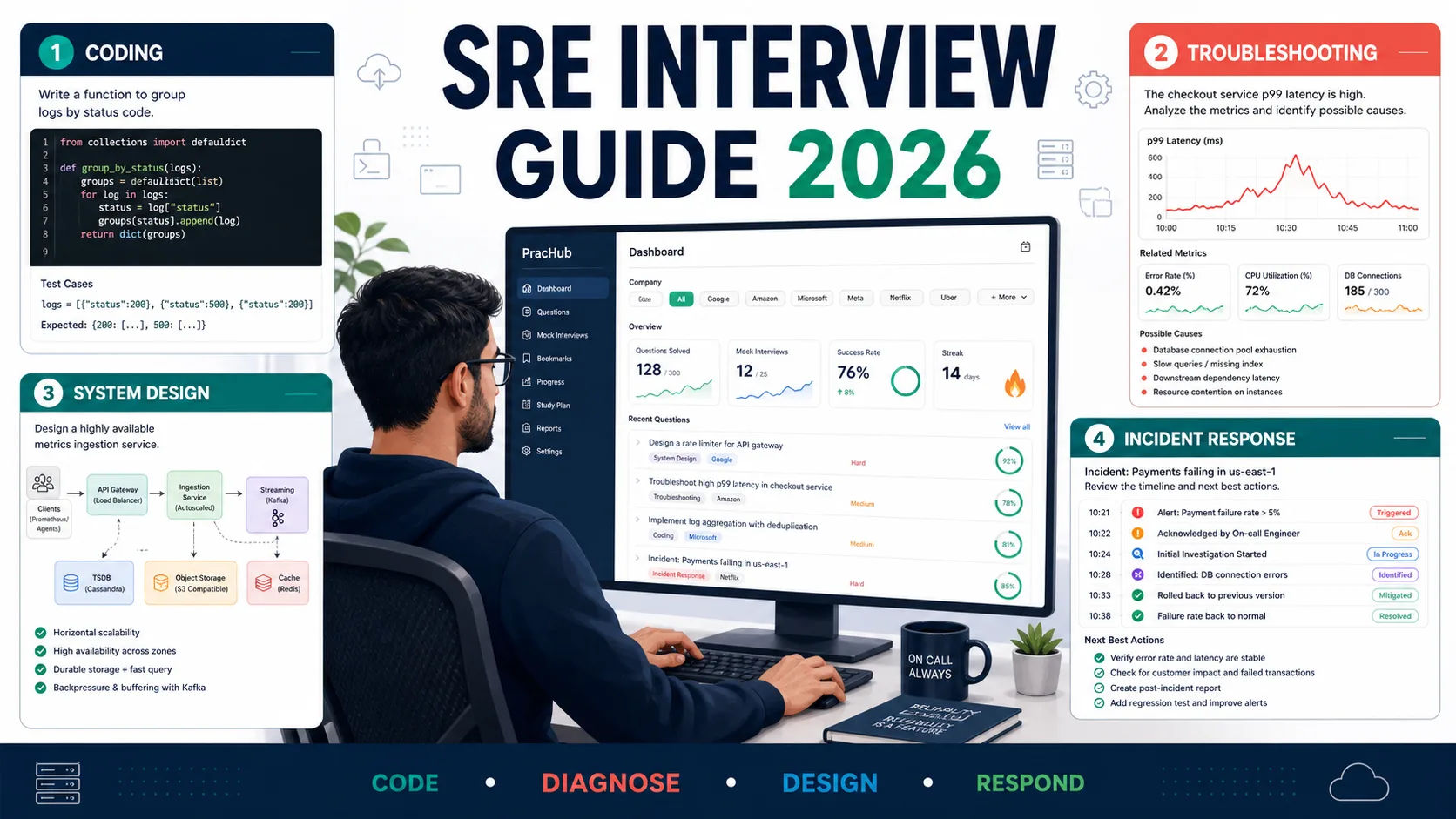
An SRE interview can feel like four interviews hiding inside one job title. In the same loop, you may need to write production-quality code, diagnose a failing service, design for reliability, and explain how you handled an incident when the evidence was incomplete.
The fastest way to prepare is not to memorize more Linux commands. First, use PracHub's real interview questions with written solutions and company-specific interview prep to map the actual loop for your target role. Then practice the four capabilities that transfer across companies: coding, troubleshooting, reliability design, and incident leadership.
This SRE interview guide uses public material from Google SRE and Atlassian to explain what strong answers look like. Interview formats vary by company and team, so treat the frameworks below as preparation tools rather than a promise of an exact round order.
Quick Verdict
Strong SRE candidates make uncertainty manageable. They clarify the user impact, build a model of the system, choose evidence that can test that model, reduce risk, and communicate what they are doing.
Do not prepare each round as an isolated subject. Your code should be operable, your design should be diagnosable, your troubleshooting should protect users, and your incident story should show engineering follow-through. That connected thinking is what separates an SRE answer from a generic software engineering answer.
What Does an SRE Interview Test?
There is no universal SRE loop. One useful public example is Atlassian's SRE Craft Interview Guide, which describes separate coding, system design, SRE craft, management, and values interviews. Its SRE craft round asks candidates to assess system health, troubleshoot a presented problem, and discuss reliability practices.
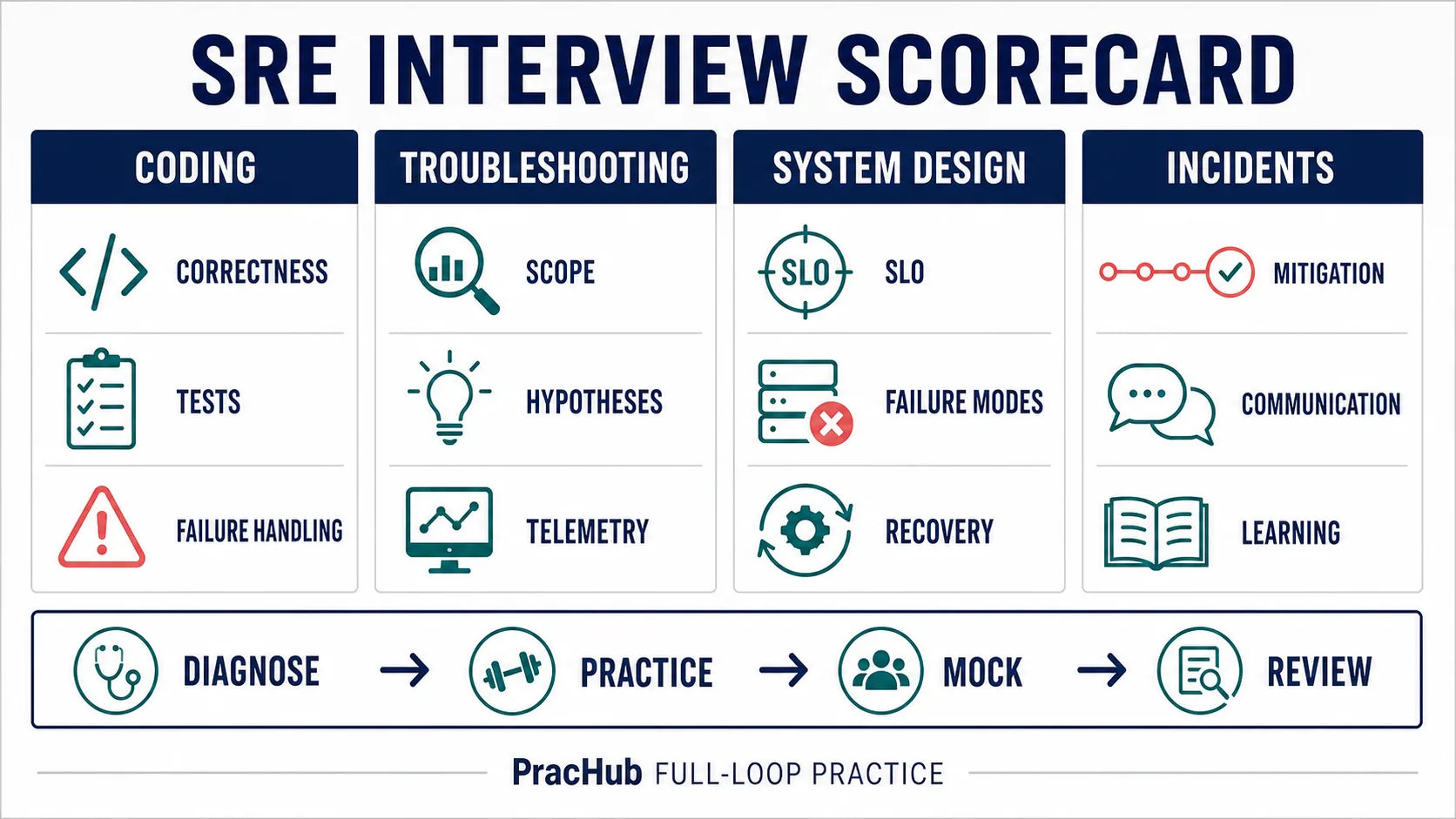
Google's public SRE roles similarly combine software development with designing, analyzing, and troubleshooting distributed systems. The labels change, but four capability areas appear repeatedly:
| Area | What you may be asked to do | Strong signal | Common weak signal |
|---|---|---|---|
| Coding and automation | Build a parser, API client, scheduler, monitor, or algorithm | Correct, testable code with clear failure handling | A clever solution that ignores malformed input or operations |
| Troubleshooting | Diagnose rising latency, errors, saturation, or partial failure | Prioritized hypotheses tied to telemetry | Listing commands without explaining what each result proves |
| System design | Design a reliable service under load and failure | User-facing SLOs, capacity math, failure modes, observability | Drawing components before clarifying reliability goals |
| Incidents and behavior | Walk through an outage or respond to a live scenario | Mitigation, role clarity, communication, and durable learning | Chasing root cause while user impact continues |
Before studying, ask the recruiter whether the coding round is algorithmic or practical, which systems domains matter, and whether incident scenarios are separate or embedded in design and behavioral rounds.
1. SRE Coding and Automation
SRE coding interviews can include traditional data structures and algorithms, but practical tasks are especially relevant: parsing logs, aggregating events, calling an API safely, detecting unhealthy hosts, or automating repetitive operations.
The interviewer is rarely scoring syntax alone. They want to see whether your program could survive contact with bad input, partial failure, retries, scale, and another engineer who must maintain it.
Use a five-step coding routine
- Clarify the input, output, scale, and failure behavior.
- State the simplest correct approach and its complexity.
- Implement one complete path before adding sophistication.
- Test empty, malformed, duplicate, delayed, and oversized inputs.
- Explain operational choices such as timeouts, idempotency, logging, and retry limits.
For example, a log aggregation task is not finished when it counts status codes. Ask whether lines can be malformed, whether the file fits in memory, whether timestamps arrive out of order, and how the program exposes skipped records.
Practice in the language you can debug fluently. Clean interfaces, small functions, meaningful tests, and calm narration usually create a stronger signal than racing toward a compressed solution.
2. The SRE Troubleshooting Interview
Troubleshooting is not a command-recitation contest. Google's Effective Troubleshooting chapter describes an iterative process: observe the system, form plausible hypotheses, and test them against telemetry or controlled changes.
Use this sequence when an interviewer says, "The API became slow after lunch":
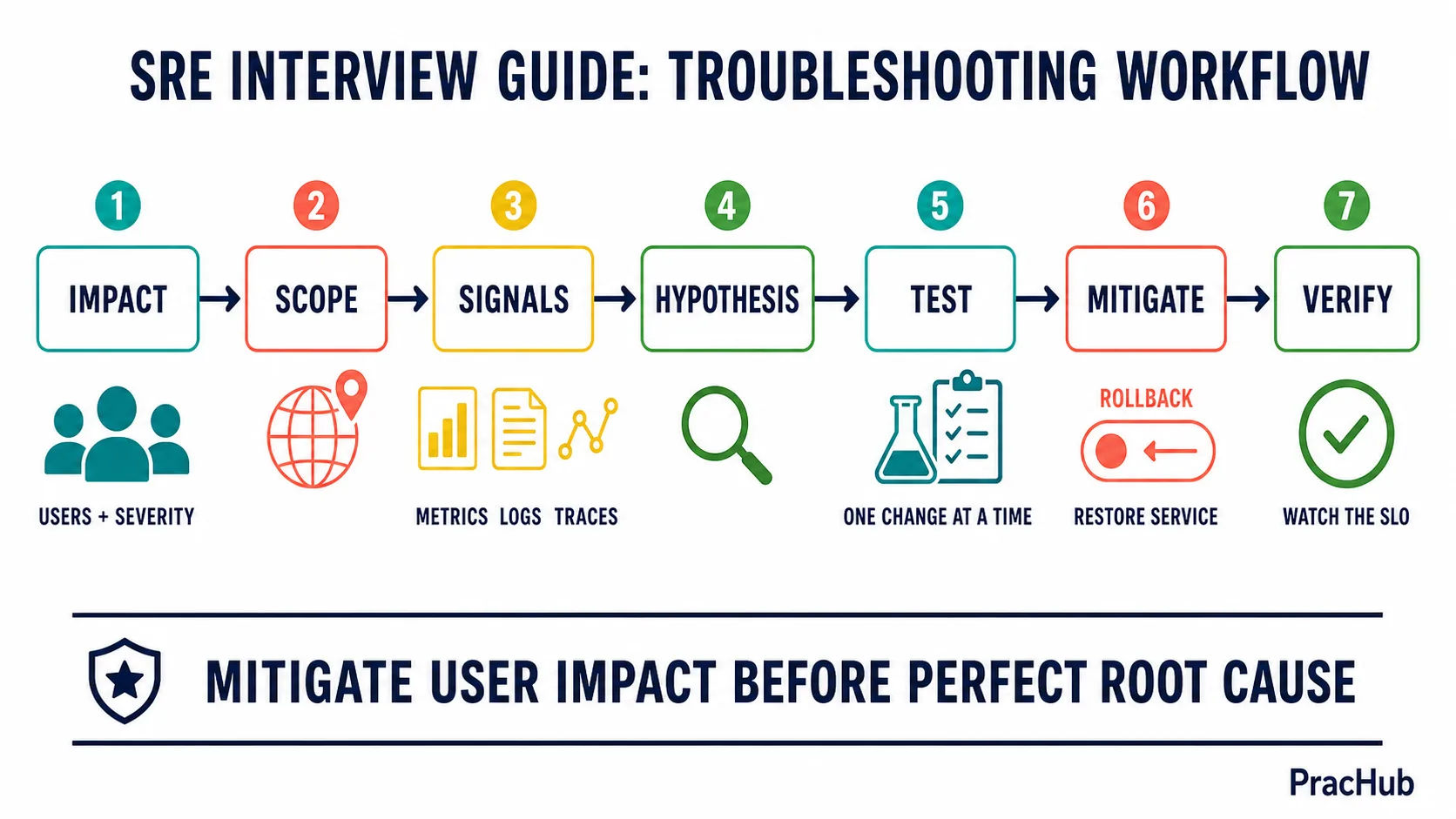
Impact -> Scope -> Recent changes -> Signals -> Hypotheses -> Test -> Mitigate -> Verify
Start with impact. Which users, regions, endpoints, and percentiles are affected? Then narrow scope and compare healthy with unhealthy paths. Check recent deploys, configuration, traffic shape, and dependency behavior before proposing exotic causes.
Say what each signal would prove
Do not say, “I would check the logs and metrics.” Name the decision each signal supports.
For rising latency, request rate and error rate establish impact; CPU, memory, queues, and connection pools expose saturation; traces locate the slow boundary; logs explain individual failures; deployment markers test a change correlation. A strong candidate updates the hypothesis after every result instead of collecting dashboards indefinitely.
During a major outage, restore acceptable service before perfecting the root cause. Google explicitly recommends stopping the bleeding through actions such as diverting traffic, shedding load, or disabling a subsystem while preserving useful evidence. In the interview, state the risk and rollback condition for every mitigation.
3. SRE System Design
An SRE design answer begins with the user experience, not the architecture diagram. Define what success means, how it will be measured, and what failure the business can tolerate.
Start with a user-facing service level indicator such as successful request rate or latency below a threshold. Then agree on the service level objective. Google's error budget guidance defines the error budget as 1 minus the SLO, creating a concrete way to balance reliability with release velocity.
Walk the design in reliability order
Move through the problem in this order: traffic and capacity, data and consistency, dependencies, failure domains, overload behavior, observability, deployment, and recovery.
For every critical dependency, ask what happens when it is slow, unavailable, or returns partial data. Discuss timeouts, bounded retries with backoff and jitter, circuit breaking, backpressure, load shedding, graceful degradation, and rollback where appropriate. Google's guidance on cascading failures warns that overload and uncontrolled retries can amplify an initial failure.
Finish with operations. What pages a human? Which symptoms create a ticket instead? Can an on-call engineer identify the failing boundary, mitigate safely, and verify recovery? Practice these decisions with PracHub's system design questions, then add an SLO, overload event, and regional failure to each prompt.
4. Incident Response and Behavioral Questions
Incident questions test judgment under pressure, not whether your outage ended perfectly. A clear answer separates mitigation, coordination, communication, and learning.
For a past incident, use this narrative:
Context and impact -> Detection -> First decision -> Mitigation -> Coordination -> Recovery verification -> Root cause -> Prevention
Quantify impact where possible and make your own role explicit. Explain what you knew at each decision point, not what became obvious afterward. If you made a wrong hypothesis, show how new evidence changed your direction.
Google's incident management guide recommends separating coordination, operations, and communication as incidents grow. In a scenario, say when you would declare an incident, assign an incident commander, establish a communication cadence, and bring in service owners.
End with durable actions: better detection, safer rollout, reduced blast radius, tested recovery, clearer ownership, or eliminated toil. A blameless postmortem should improve the system and response process, not simply identify the person closest to the change.
Prepare at least four stories through PracHub's behavioral interview practice: a major incident, an automation that reduced toil, a reliability trade-off, and a disagreement about risk or launch readiness.
Four Practice Prompts
| Capability | Timed prompt | What to demonstrate |
|---|---|---|
| Coding | Parse a large stream of service events and report the top failing endpoints every five minutes | Streaming data structures, malformed input, tests, and complexity |
| Troubleshooting | Checkout latency doubled in one region after a deploy, but aggregate error rate is flat | Scope, percentiles, change correlation, dependencies, mitigation, and verification |
| System design | Design a multi-region notification service with a 99.95% delivery SLO | Capacity, durability, retries, deduplication, observability, and degraded modes |
| Incident | A database is saturating while a launch drives record traffic | User impact, incident roles, load shedding, communication, recovery, and follow-up |
Give yourself 35 minutes for each technical prompt and 10 minutes for the incident story. Record the session. On review, count unsupported assumptions, unexplained commands, silent stretches, and mitigations without rollback criteria.
A 30-Day SRE Interview Plan
| Week | Focus | Required output |
|---|---|---|
| 1 | Diagnose the target loop and refresh coding plus Linux, networking, and distributed-systems fundamentals | Two timed coding sessions and a company-specific interview map |
| 2 | Troubleshoot latency, errors, resource saturation, dependency failure, and bad deploys | Four spoken scenarios with an evidence-based hypothesis log |
| 3 | Design around SLOs, capacity, overload, observability, and recovery | Three reliability-focused designs with explicit failure tables |
| 4 | Rehearse incidents and run mixed mock loops | Four polished stories and two full mocks under realistic timing |
Keep an error log across all four weeks. Classify each miss as knowledge, diagnosis, implementation, communication, or time management. Your study plan should follow repeated failure categories, not the resource you happen to enjoy most.
Mistakes That Cost Strong Engineers the Interview
The first is debugging before scoping impact. You can spend ten minutes deep in one host while a regional or dependency-level pattern is already visible.
The second is treating every reliability problem as “add redundancy.” Redundancy can duplicate corrupted writes, create failover complexity, or hide overload. Explain the failure being addressed and the new failure modes your mechanism introduces.
The third is using jargon without decisions. SLOs, circuit breakers, queues, and postmortems only matter when connected to thresholds, ownership, and expected behavior.
Finally, do not tell an incident story that ends at recovery. Senior SRE signal appears in what changed afterward and whether the improvement was measured.
SRE Interview FAQ
Are SRE coding interviews as hard as software engineering interviews?
It depends on the company and the SRE specialization. Some loops use standard algorithmic questions; others emphasize scripting, parsing, automation, and production-aware code. Confirm the format with the recruiter and prepare for both correctness and operability.
What Linux and networking topics should I know?
Understand processes, memory, CPU, filesystems, sockets, DNS, TCP, HTTP, load balancing, timeouts, and common observability signals well enough to reason from symptoms. Memorizing commands is less valuable than explaining where a request can fail and what evidence would isolate that boundary.
Do I need to memorize every availability number?
No. Know how to translate an SLO into an error budget and reason about measurement windows, user impact, and trade-offs. Clear assumptions and simple arithmetic matter more than reciting a table of "nines."
How should I answer an incident question if I have never been primary on-call?
Use the closest real example: a production bug, failed launch, data issue, security event, or severe test-environment outage. Be transparent about your role, then explain how you would improve detection, mitigation, coordination, and prevention.
What is the best way to practice SRE interviews?
Mix domain study with realistic retrieval. Use PracHub to find company and role-relevant questions, solve them without category hints, explain decisions aloud, and add failure or incident follow-ups. Reading creates vocabulary; timed practice reveals whether you can use it.
Final Verdict
The best SRE preparation connects software engineering with operational judgment. Write code that handles failure, troubleshoot through evidence, design from SLOs and failure modes, and tell incident stories that prioritize users while improving the system afterward.
Start by building your target-company loop on PracHub. Practice real interview questions with written solutions, add reliability follow-ups to every coding and design prompt, and use the 30-day plan to turn scattered knowledge into a repeatable interview process.
Comments (0)