Synchronous vs Asynchronous: Where the Boundary Goes in a System Design Interview
Quick Overview
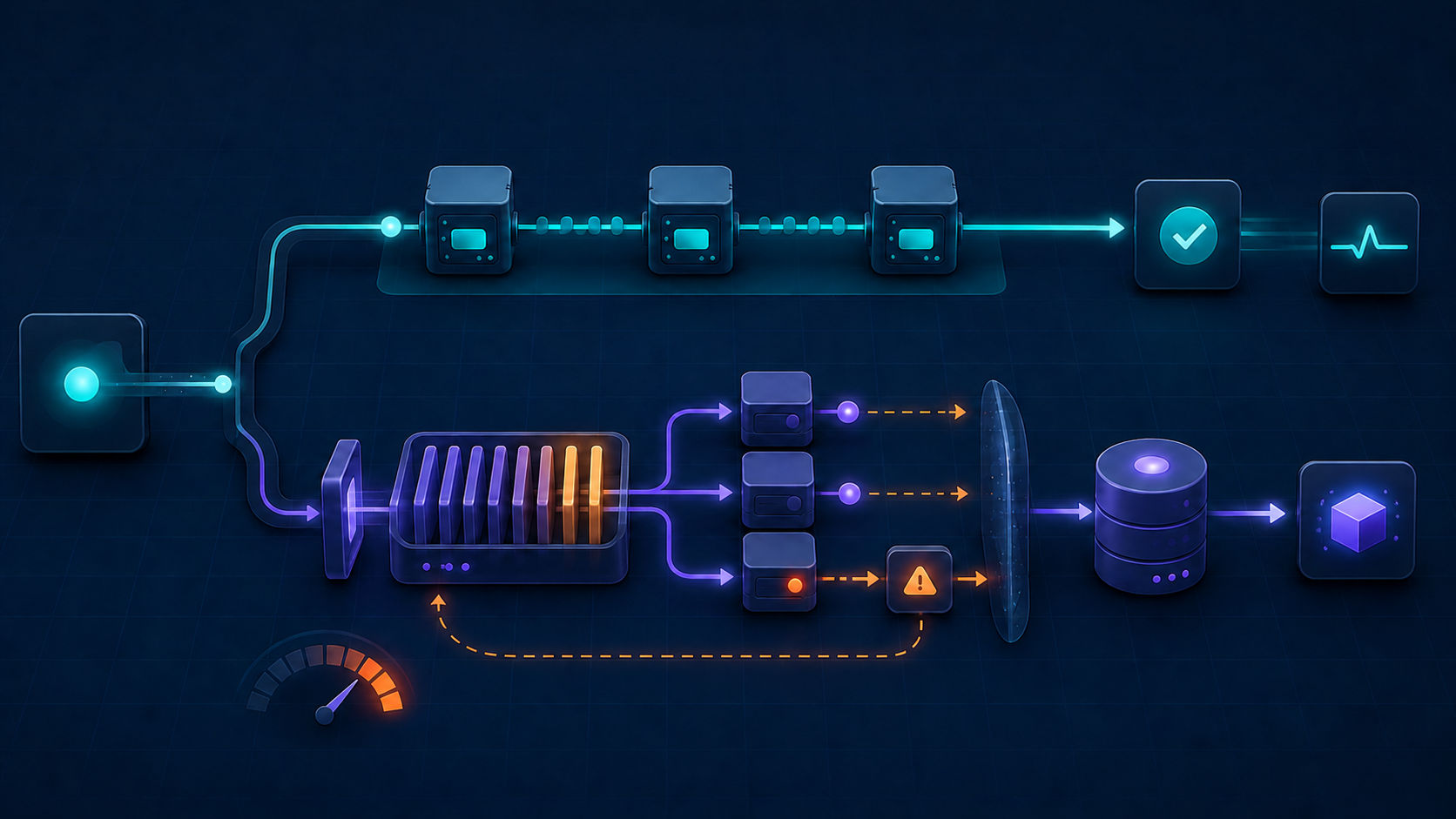
Place synchronous and asynchronous boundaries from the caller's real dependency, then price the reliability trade-offs. Covers durable handoff, retries, idempotency, ordering, backlog, status delivery, and end-to-end workflows.
Synchronous and asynchronous describe who waits for work to finish. In a synchronous call, the caller keeps a request open until it receives a result or a timeout. In an asynchronous handoff, the system accepts responsibility for the work, returns before completion, and delivers the outcome later.
For a Backend Engineer, the hard part is not defining the terms. It is placing the boundary. A good design keeps a step synchronous when the caller’s next action needs the answer, and moves work asynchronous when completion can happen later without misleading the user. Every move to a queue also creates obligations around duplicates, ordering, backlog, and recovery.
Place the boundary around a real dependency
Start with one question: what must be true before the caller can safely continue?
| Step | Does the caller need the result now? | Typical mode |
|---|---|---|
| Authenticate a request | Yes | Synchronous |
| Reserve the last item | Yes | Synchronous |
| Authorize a payment before confirmation | Yes | Synchronous |
| Send a receipt after a confirmed order | No | Asynchronous |
| Generate a report that takes minutes | No | Asynchronous job |
| Record analytics for later analysis | No | Asynchronous event |
This is a product and correctness decision before it is an infrastructure decision. Moving payment authorization behind a queue may reduce pressure on the request path, but the UI can no longer say “payment succeeded.” It must represent a pending state and handle a later decline. The queue did not remove failure; it turned an immediate error into a business workflow.
Some systems need a hybrid. A long-running export can synchronously validate the request and persist a job, then asynchronously produce the file. The initial response should communicate the contract clearly:
HTTP/1.1 202 Accepted
Location: /exports/exp_4821

{
  "operation_id": "exp_4821",
  "status": "queued"
}
The system has promised to track the operation, not to complete it immediately. That promise requires durable state and a way to retrieve or receive the result.
What a queue buys and what it costs
A queue is useful when producers and consumers should move at different rates or fail independently. It can absorb a temporary burst, isolate retries to one downstream integration, and let workers scale separately from request-serving processes.
Those benefits come with a predictable bill:
| Dimension | Synchronous call | Asynchronous handoff |
|---|---|---|
| Caller latency | Includes downstream work | Usually ends after durable acceptance |
| Failure visibility | Immediate and in-band | Deferred and visible only through status or monitoring |
| Burst behavior | Pressure propagates upstream | Backlog grows before requests must be rejected |
| Consistency | Result is known before continuation | Intermediate states are visible |
| Duplicate risk | A timed-out retry can repeat completed work | Redelivery is expected under at-least-once processing |
| Ordering | Caller naturally sequences calls | Often limited to one key or partition |
| Debugging | One request trace may be enough | Correlation must cross producer, broker, and consumer |
Two corrections prevent common design mistakes.
First, asynchronous does not mean faster. A ten-minute report still takes ten minutes. Async keeps request resources from waiting for it and makes overload visible as backlog.
Second, synchronous does not mean exactly once. If a server commits a write and its response is lost, the caller cannot tell whether the operation happened. A retry can repeat it. Idempotency matters on both sides of the boundary.
Broker choice comes after the contract. Kafka versus RabbitMQ is useful once you know whether you need work distribution, replayable events, ordering by key, or fan-out.
Build the reliability stack for each side
Synchronous and asynchronous paths fail differently, so they need different defenses.
Synchronous path
Timeout budget. Set one end-to-end deadline and spend it across downstream calls. A timeout at every hop that ignores the caller’s remaining budget can make the chain exceed its user-facing limit.
Bounded retries with jitter. Retry only when the operation is safe to repeat or has an idempotency key. Cap attempts and add jitter so many callers do not retry in lockstep. Avoid retries at every layer; nested retry loops multiply traffic during an outage.
Circuit breaker and fallback. Stop sending calls to a dependency that is predictably failing. Then make the fallback explicit. A recommendation widget may fail open by returning no recommendations. An authorization check may need to fail closed. The correct policy belongs to the business risk.
Asynchronous path
Idempotent consumer. Treat redelivery as normal. Give each logical operation a stable key, and make the deduplication record and business effect atomic where possible. One Order, Two Charges covers the failure window in detail.
Lease and retry policy. A worker should hold a time-bounded claim. If it crashes, the claim expires and another worker retries. If a slow worker outlives its lease, a fencing token or conditional write should prevent stale completion from overwriting newer state.
Dead-letter handling. After bounded attempts, move a poison message out of the main flow. Alert on the age of the oldest message as well as queue depth, and give a team an explicit replay or discard procedure.
Backpressure. A queue is finite even when its API looks unbounded. Track enqueue rate, completion rate, oldest-message age, and time-to-drain. Shed low-priority work or scale consumers before storage or freshness limits are exhausted.
Ordering scope. If events for one entity must remain ordered, route them by a stable key and serialize that key’s updates. Global ordering usually sacrifices too much parallelism.
| Failure question | Synchronous answer | Asynchronous answer |
|---|---|---|
| Dependency is slow | Deadline, breaker, load shedding | Backlog limits, worker scaling, age alerts |
| Result is uncertain | Idempotency key before retry | Deduplication and atomic effect |
| Process crashes | Caller sees error or timeout | Lease expires; message is retried |
| One input always fails | Bound retries; return an error | Dead-letter and investigate |
| Requests arrive too fast | Reject or degrade | Absorb briefly, then apply backpressure |
Walk one workflow end to end
Consider an order checkout with payment, inventory, receipt email, and analytics.
- Validate the request synchronously. Reject malformed or unauthorized input before creating work.
- Reserve inventory synchronously. Confirmation would be dishonest without knowing the item is available.
- Authorize payment synchronously. The user needs the result to continue. Attach an idempotency key so a timeout and retry cannot create a second charge.
- Commit the order and outbound events atomically. An outbox record can tie the database transaction to later publication without asking two systems to commit together.
- Return the confirmed order. The response should contain only facts already committed.
- Send email and analytics asynchronously. Each consumer owns retries and deduplication. A failed email does not roll back the paid order.
Now compare a long-running export:
- Validate the request and create an operation record.
- Enqueue its stable operation ID.
- Return
202 Acceptedwith a status URL. - Let a worker claim the job with a lease and write progress.
- Store the result, mark the operation complete, and notify the caller.
- Let the client retrieve the result by polling, server push, or webhook.
Choosing that last hop is another sync/async decision. Polling is simple and resilient for occasional jobs. Server-sent events or WebSockets fit an open application needing quick updates. Webhooks fit server-to-server delivery but require signatures, retries, and receiver idempotency. The webhook versus API guide works through those trade-offs.
A clear interview answer narrates state changes as well as components. Say which states a user can observe (queued, running, succeeded, failed), which transition is atomic, and how a stuck state is detected. That is where the reliability contract becomes testable.
FAQ
Is asynchronous communication always more scalable?
No. It can decouple request capacity from worker capacity and absorb temporary bursts, but the work still consumes compute, storage, and downstream quotas. If arrival rate stays above completion rate, backlog grows until the system applies backpressure or fails.
Does 202 Accepted mean the operation succeeded?
No. It means the server accepted responsibility for tracking the operation. The API should provide a status resource or callback and define terminal success and failure states.
Can a queue provide exactly-once execution?
Crashes make execution ambiguous: a worker may complete the side effect and die before acknowledging it. Design for at-least-once delivery with idempotent effects so observers see one logical outcome.
When is polling better than push?
Polling is often better for infrequent operations, relaxed latency, and clients that cannot keep a connection open. Push becomes attractive when updates are frequent or must arrive quickly. The broader ingest and delivery choice is covered in push versus pull architecture.
What is the shortest useful sync-versus-async explanation in an interview?
State the user dependency, choose the boundary, then price the choice. For sync, cover deadlines and uncertain retries. For async, cover durable acceptance, duplicates, ordering, backlog, and result delivery.
Comments (0)