Technical Interview Rubric: How Companies Score Coding, Design, and Communication
Quick Overview
Learn how companies use structured technical interview rubrics to score coding, system design, communication, testing, trade-offs, and collaboration. This candidate-focused guide explains observable strong signals, seniority calibration, common scoring myths, and a practical PracHub self-review workflow.
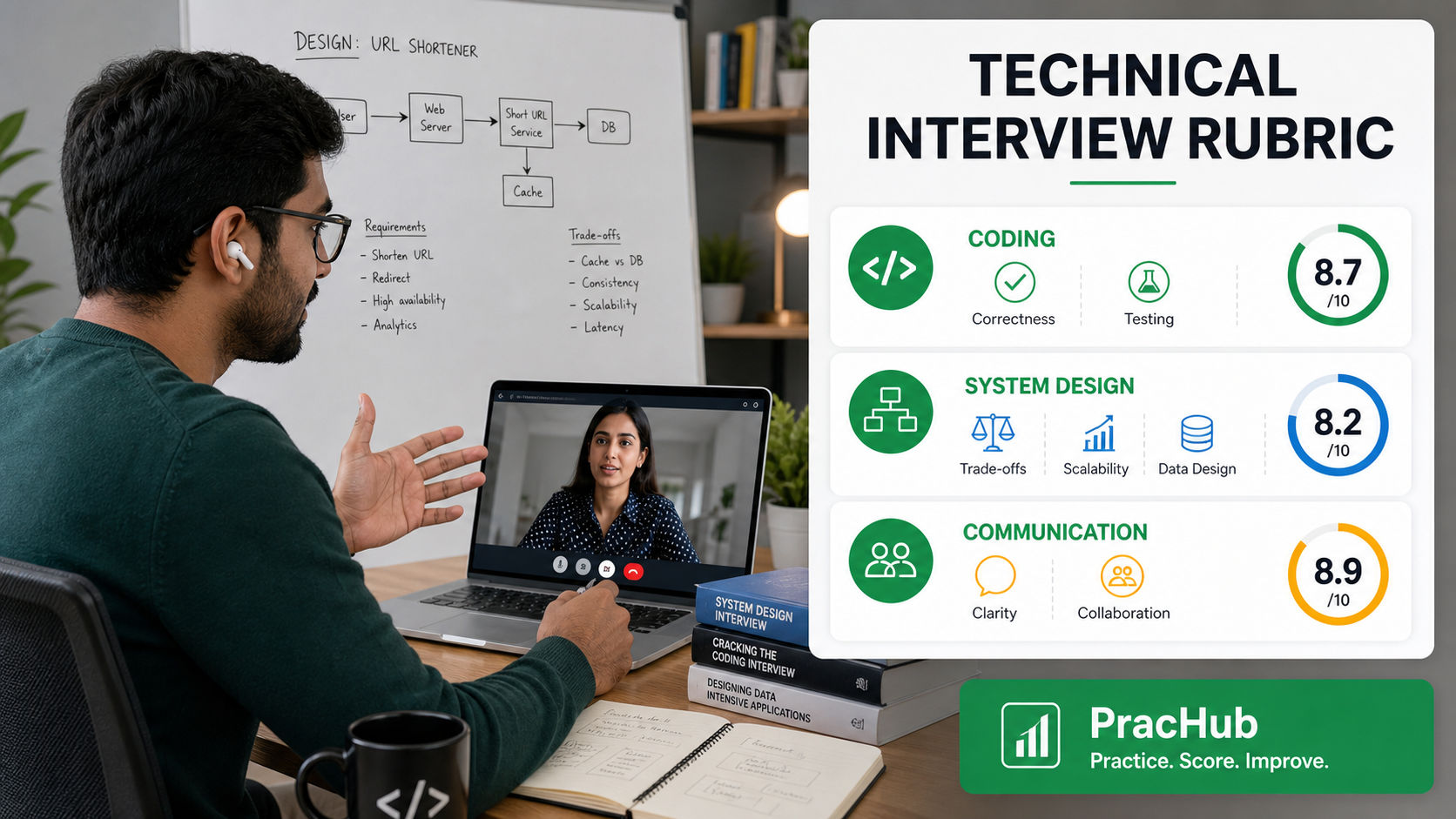
You can finish a coding problem and still receive a weak interview score. That surprises candidates because they see the final answer; the interviewer sees the evidence behind it: how you clarified the problem, chose an approach, tested edge cases, responded to feedback, and explained trade-offs.
A technical interview rubric turns those observations into ratings. The exact scorecard changes by company, role, and level, but the practical lesson is consistent: you are being evaluated on more than whether your code runs.
Start by attempting real interview questions with written solutions on PracHub. Then use the candidate-facing rubric below to score the evidence you produced, not just the answer you reached.
Quick Verdict
Most technical interviews evaluate some combination of problem solving, correctness, implementation quality, testing, system judgment, and communication. A junior coding round may emphasize a testable implementation; a senior design round may place more weight on ambiguity and trade-offs.
The best preparation is therefore not “solve more problems” in isolation. It is practice, collect evidence, score the evidence, and repair the weakest category.
What Is a Technical Interview Rubric?
A rubric combines competencies, observable behaviors, and rating levels. Instead of writing “good candidate,” an interviewer records whether the candidate clarified requirements, completed the solution, tested boundaries, or justified a decision.
Karat says rubrics should be customized to the role and translate competencies into observable actions. CoderPad lets teams align live-interview notes with their criteria and ATS scorecards. There is no universal secret scorecard, but there is a common evidence-based pattern.
| Area | Strong observable signals | Signals that weaken a score |
|---|---|---|
| Coding | Clarifies inputs, explains an approach, writes correct code, tests deliberately, and analyzes complexity. | Jumps into code, ignores constraints, patches randomly, or stops after one happy-path test. |
| System design | Scopes requirements, defines boundaries, explains data flow, and weighs realistic trade-offs. | Draws components without a workload, makes unexplained technology choices, or avoids failure modes. |
| Communication | Shares decisions at useful checkpoints, listens, incorporates hints, and makes uncertainty explicit. | Works silently, narrates every keystroke, becomes defensive, or cannot explain a decision. |
| Collaboration | Treats the interviewer as a partner, checks alignment, and adapts after new information. | Ignores feedback, waits passively for rescue, or changes direction without explaining why. |
How Companies Score Coding Interviews
Problem Framing and Approach
Before code, interviewers observe whether you understand the task. Restate the objective, confirm important constraints, test assumptions with a small example, and compare plausible approaches.
A concise framing is enough: “I will use a hash map to trade O(n) space for one pass; can the input contain duplicates?”
Correctness and Completeness
“The sample passed” is weaker than a complete argument. Interviewers look for valid control flow, appropriate data structures, requirement coverage, and correct behavior across the promised input range.
If time runs out, state the missing branch, expected behavior, and next implementation step.
Testing, Debugging, and Complexity
Testing shows whether you can challenge your work. Use a normal, boundary, and adversarial case. If one fails, form a hypothesis, isolate the fault, and fix the cause.
Match complexity analysis to the implementation. Name time and space costs, the dominant operation, and any realistic improvement.
Implementation Quality
Readable naming, sensible decomposition, and consistent invariants make reasoning verifiable. The interviewer is asking whether another engineer could safely understand and extend the work.
How Companies Score System Design Interviews
A strong system design answer is not a memorized diagram. It is a sequence of decisions tied to requirements. Begin by clarifying users, core operations, scale, latency, consistency, durability, and what is out of scope. Then propose the simplest architecture that meets those needs.
Make system boundaries and data flow explicit. Define key APIs or events, choose a storage model, locate likely pressure, and discuss failures. Use system design questions to turn broad prompts into defensible decisions.
For senior and staff candidates, the score often depends less on naming more technologies and more on judgment: which risks matter now, which complexity can wait, how the design evolves, and what operational or organizational costs a choice creates.
How Communication Changes the Score
Silence hides reasoning, but describing every keystroke wastes time. Communicate after clarifying the prompt, before choosing an approach, when a test changes your belief, and when accepting a trade-off.
A hint does not automatically mean failure. Interviewers observe whether you understand it, connect it to the problem, and recover. Say what changed in your model, then rerun the relevant case.
Active listening, calm disagreement, and ownership affect how collaborative your work feels. Practice with PracHub’s behavioral and leadership questions.
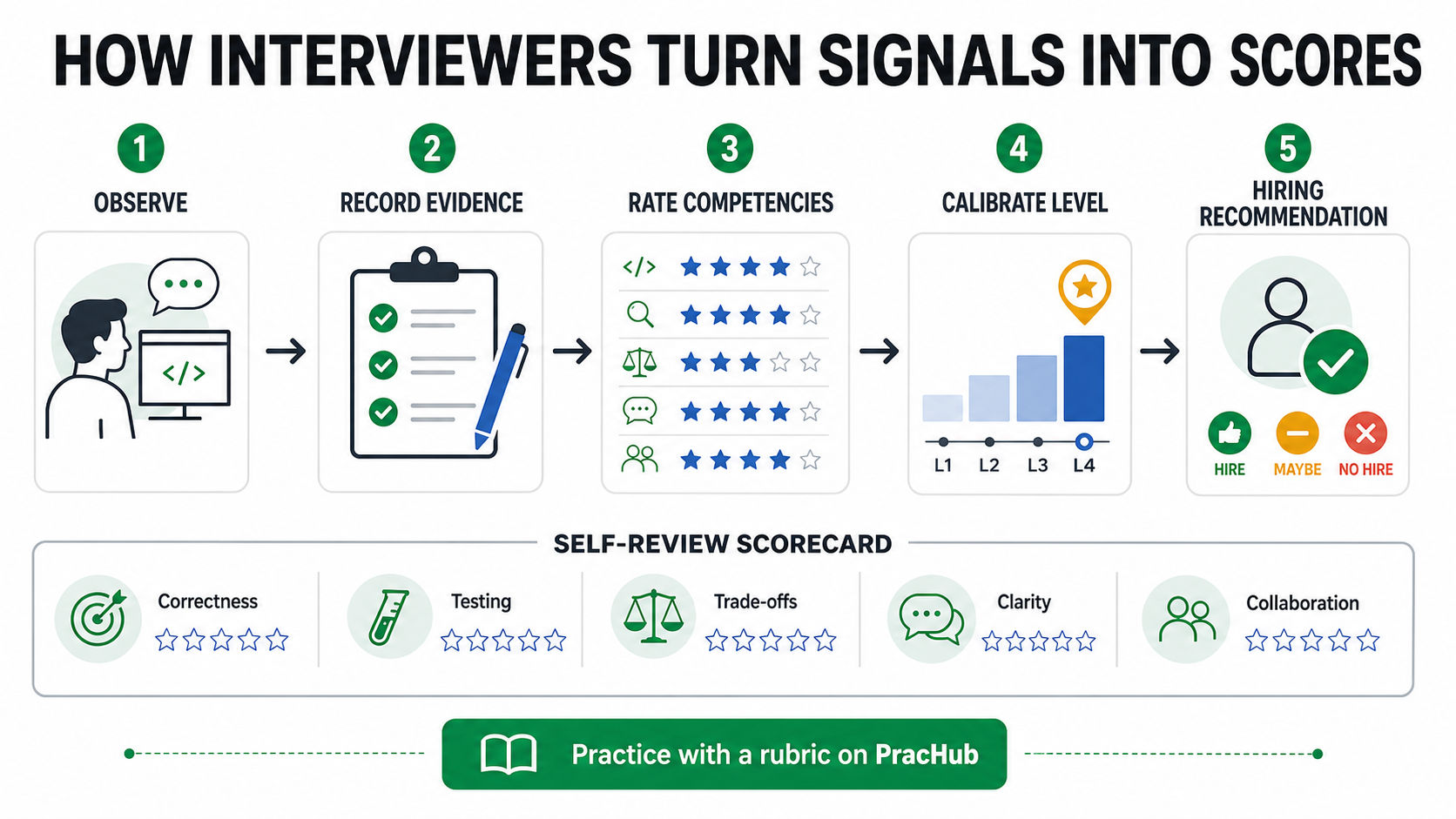
Interviewers record observable evidence before turning competencies into a hiring recommendation.
How Rubrics Change by Seniority
A junior engineer may score well with correct code, careful tests, and productive response to guidance. A mid-level engineer is expected to structure work more independently.
Senior and staff candidates must create clarity under ambiguity through requirements, cross-system risks, migration paths, and trade-offs. Research the loop through company-specific interview prep before defining “strong” for your target.
A Candidate-Facing Self-Scoring Rubric
Use this four-level scale after a timed practice. Do not score from memory several hours later. Write one concrete piece of evidence for each rating.
| Level | Coding evidence | Design evidence | Communication evidence |
|---|---|---|---|
| 1: Needs evidence | No complete approach or reliable test. | No clear requirements or architecture. | Reasoning is mostly invisible or confusing. |
| 2: Developing | Partial solution with gaps or heavy prompting. | Basic components with weak justification. | Some useful explanation, but inconsistent alignment. |
| 3: Strong | Correct solution, deliberate tests, and accurate complexity. | Scoped design with clear data flow and trade-offs. | Concise checkpoints, active listening, and productive recovery. |
| 4: Interview-ready | Handles ambiguity, alternatives, edge cases, and clean implementation. | Prioritizes risks, failures, evolution, and level-appropriate depth. | Makes collaboration improve the technical result. |
A 30-Minute Rubric Practice Loop
- Attempt for 18 minutes. Use a real prompt and speak as you would in an interview.
- Score for 4 minutes. Rate coding, design, and communication with one observed example each.
- Compare for 3 minutes. Read the written solution and identify the earliest decision that created the gap.
- Repair for 3 minutes. Practice only that behavior: requirement questions, edge-case tests, or a trade-off explanation.
- Replay for 2 minutes. Deliver the improved opening and decision path without notes.
Your next session should target the lowest-scoring competency, not simply the next problem in a list.
Four Technical Interview Scoring Myths
“If the code works, I pass.” Rubrics can separate correctness from implementation quality, debugging, and communication.
“Any hint means I failed.” Guidance can matter, but recovering thoughtfully is better than resisting help.
“I need the optimal answer first.” A correct baseline plus justified optimization often reveals more reasoning.
“I should talk nonstop.” Useful communication makes decisions inspectable. It does not turn coding into a stream of consciousness.
What About AI-Assisted Interviews?
Follow company rules exactly. When AI is allowed, newer approaches may separate final output from judgment, verification, debugging, and correction.
Explain why you use AI, validate its output, and remain accountable for the result.
FAQ
Do all companies use the same technical interview rubric?
No. Competencies and rating scales vary by company, role, interview format, and seniority. Use this guide as a preparation model, then research the target company’s loop and adjust the weights.
Can I ask the recruiter how the interview is scored?
Yes. Ask what competencies each round evaluates, what the format is, and what level of completeness is expected. Recruiters may not share the exact scorecard, but the answer can improve your practice plan.
What should I do if I do not finish?
Protect the evidence you can still create. State what works, identify what remains, test the completed portion, and explain the next step. An unfinished but well-reasoned solution can be stronger than rushed, unverified code.
Turn the Rubric into Better Practice
The hidden advantage of a rubric is that it makes improvement specific. “Get better at interviews” is vague. “Clarify constraints before coding and run one adversarial test” is trainable.
Use PracHub to practice real interview questions with written solutions, compare your approach, and repeat with company and role context. Score every attempt on coding, design, and communication. The goal is not merely to know the answer; it is to leave strong, observable evidence that you can do the job.
Comments (0)