Turn a Job Description into an Interview Plan with LandOffer and PracHub
Quick Overview
Build an interview plan from an employer posting and the résumé you submitted. A backend case maps requirements to evidence, uncertainty, and verified practice.
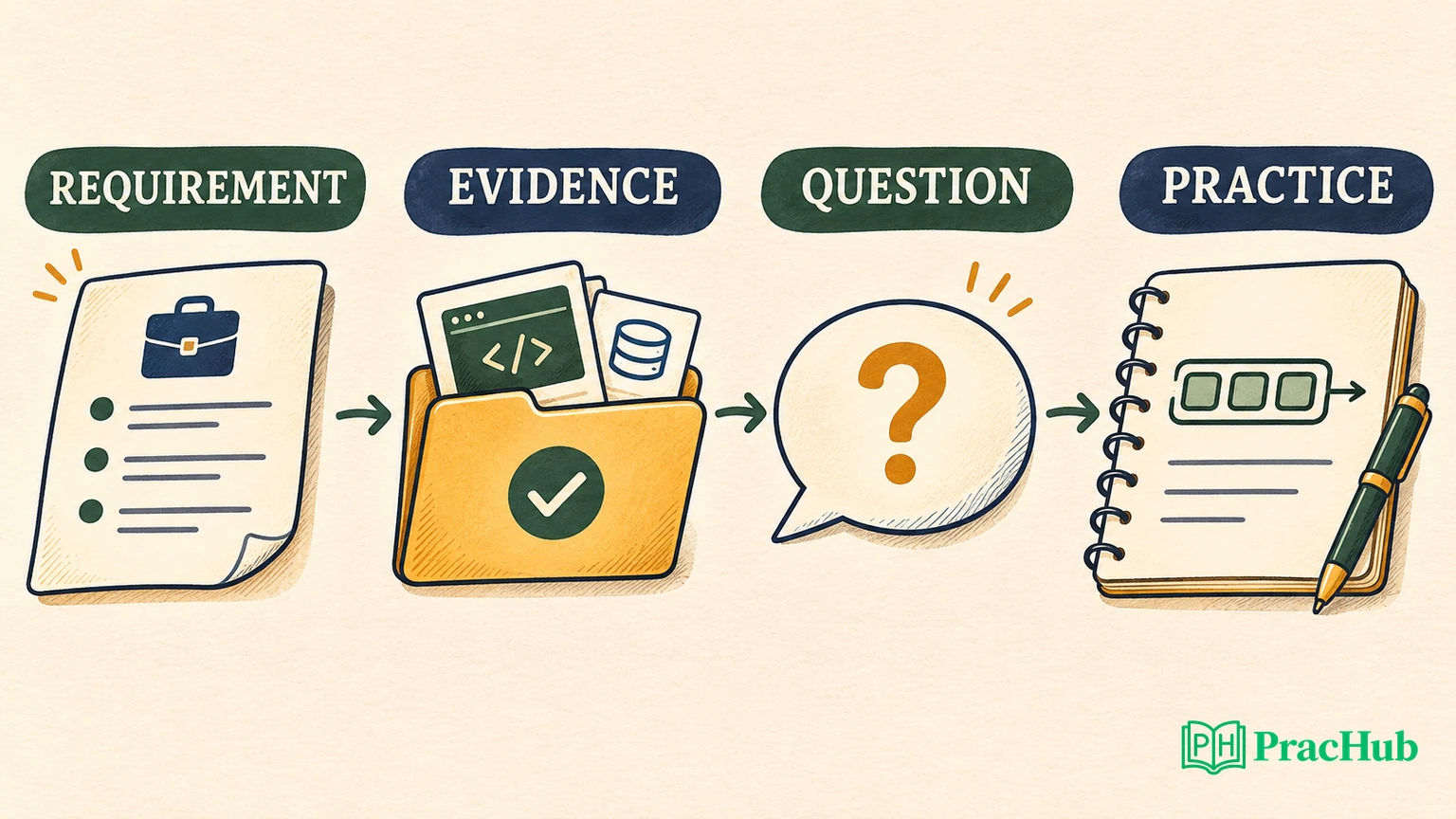
Turn a job description into an interview plan by pairing each important responsibility with evidence from the résumé you submitted, one open question, and one practice exercise. If a backend posting mentions reliable event processing, find the closest work you actually did. Then rehearse the failure case you would have to explain to another engineer. You can make progress before you know the interview format, and revise the plan when the recruiter confirms it.
Start with a role you found on LandOffer or another job board. Open the employer's version of the posting, then save the title, job ID, location, and date checked. Keep the exact résumé you sent beside it. When you need a rehearsal exercise, use a specific PracHub question such as Build a Queue Worker with Backoff and a Dead-Letter Queue. Use LandOffer to find the role and PracHub to rehearse it. Build the link between them with your own evidence.

Capture the posting and the version you applied with
The University of Denver's technical interview preparation guide recommends reviewing the position, identifying relevant technical skills, and preparing to discuss related work or coursework. Start by making the inputs concrete. Save the employer posting when available and note whether its responsibilities differ from the listing that sent you there. If the original has closed or moved, keep your dated copy and ask which requisition the conversation concerns.
Pull the résumé version actually attached to the application. Your newer copy may have stronger examples, but the interviewer can still ask about a line in the earlier one. For each experience you plan to discuss, write what you owned, what the team provided, and what you can verify. If you estimate a number, record how you got it. You may use a new example in the interview, provided you can explain where it came from and how it relates to the application.
Read the responsibilities as actions. “Operate event workers” tells you more about useful preparation than a long list containing Python, queues, cloud, SQL, and monitoring. Underline the expected outcome, then note which tools are mandatory, preferred, or simply mentioned. When the wording is unclear, label it and carry the uncertainty into your plan.
Build a workback table for a fictional backend role
Imagine Harbor Finch, a fictional retailer hiring a backend engineer for order events. The posting asks the engineer to build retryable workers, investigate delayed processing, and explain trade-offs across teams. It lists Kafka as preferred. The candidate's submitted résumé mentions an internal Python notification worker, a database constraint that prevented duplicate writes, and a dashboard for failed attempts. The candidate used a managed queue and did not choose the broker.
Make the table compact enough to revise after a recruiter call. Keep the employer's wording and the candidate's evidence in separate cells. A match can be direct, adjacent, or missing. Name what you did and what you would still need to learn. Then choose an exercise with a concrete output.
| Posting requirement | Evidence from the submitted résumé | What remains unknown | Rehearsal output |
|---|---|---|---|
| Keep order events reliable when a worker retries | Added an event ID constraint and tested repeated notifications in a managed queue | Whether the role owns delivery guarantees or only the consumer | Trace a timeout after the write. Show the stored event and what a second attempt observes. |
| Investigate delayed processing | Built a failed-attempt dashboard and helped investigate one slow batch | Whether the team expects on-call diagnosis and which signals are available | Draw a timeline with oldest message age, attempt counts, processing latency, and the last deployment. |
| Explain design trade-offs across teams | Proposed capped retries and reviewed the rollout with a teammate | How much architecture or product discussion appears in the interview | Give a two-minute project account with a rejected alternative and a measurable or observable result. |
| Preferred Kafka experience | Used a managed queue. Has no production Kafka ownership | Whether equivalent queue experience satisfies the preference | State the transferable reliability problem and ask what operating depth the team expects. |
The first row is a strong place to start because the posting asks for a responsibility and the résumé offers a specific decision. The fourth is a gap worth clarifying. A crash course could help the candidate talk about consumer groups and offsets, but would not turn their managed queue project into Kafka experience. Ask whether the team needs broker operation or experience making consumers reliable.
Rehearse the weakest part of your strongest example
For the notification-worker story, start with a failure that occurred or that you tested. Suppose the write succeeds and the worker stops before acknowledging the message. Ask what the queue can deliver again, what the database has committed, and whether any separate side effect can repeat. Put the sequence in order before reaching for a design pattern.
Amazon's standard queue delivery documentation explains that a message can be delivered more than once and recommends idempotent processing. That is a documented behavior of that service. In this fictional exercise, assume redelivery is possible and say so. A unique database constraint protects the row it covers. An email or another side effect outside that boundary needs its own plan. If the candidate never owned that part, explain who did and what they would check with that team.
Write down the input and expected state. Event 17 is committed once, the worker stops, then Event 17 is delivered again. There should still be one event row. If the same ID arrives with different payloads, ask which behavior the product wants before presenting the original test as sufficient. A duplicate delivery and a conflicting event identity may need different handling.
Now rehearse your own involvement. A useful answer might say the candidate added the constraint and wrote a replay test, while the team had already chosen the queue. Give the test result and say whether the dashboard counted attempts, unique events, or both. That detail shows what the evidence supports and prevents a casual claim that every customer received exactly one notification.
For a second trace, assume the database responds with a timeout and the worker cannot tell whether the commit happened. Give yourself two rows on paper: the committed case and the uncommitted case. In both, retry Event 17 using the same identity. In the first row, the existing record should determine what happens. In the second row, the retry can still create the missing record. If the candidate proposes emailing before checking the durable result, ask what happens when that first email goes out but the worker never sees the reply. The point is to identify which outcome the system can prove with its current evidence.
Keep the trace and the interview story on separate lines of your notes. Label it as a rehearsal if you never ran that exact fault in production. A test you ran is evidence about your implementation. A scenario you reasoned through is evidence of how you would diagnose or design a change. A clear distinction makes both answers easier to defend.
Give each practice question a job
Use the first column to open the exact prompt. The Google and Scribd records describe candidate-reported interviews. The worked Harbor Finch case is fictional, and none of the prompts predicts a question for the role you chose. What transfers is the decision you practice and can explain.
| PracHub question | What to practice before moving on |
|---|---|
| Build a Queue Worker with Backoff and a Dead-Letter Queue | Draw the attempt states and name the operation that makes retry safe. |
| Production-Ready Event Ingestion Handler: Validation, Idempotent Writes, DLQ, Metrics | Test repeated and conflicting event IDs. Explain which record survives and which signal a reviewer can inspect. |
| Debug a cache incident end-to-end | Transfer the incident method. Build a timeline and choose one observation that would disprove your initial hypothesis. |
| Project Deep Dive: Kafka Streaming, Redis Caching, and a Go Edge API Gateway | Practice naming the queue design boundary you owned and the evidence behind a technology decision. |
| Present a project deep dive | Deliver a concise version of one project and prepare a deeper explanation of testing, rollout, and limitations. |
A single exercise can cover several parts of the table if you explain both the state change and how you would observe it. Solve it aloud, keep the notes, and record the first question that stopped you. Turn that into the opening task of the next session. A list of completed question titles does not tell you whether you can defend the choice you made under a changed assumption.
Ask the recruiter about details that change your plan
Ask about format or focus so you can choose the right rehearsal. Pick one or two details that would change how you use your time.
- Which team and requisition should I prepare for if I have seen two similar postings?
- Will the upcoming conversation focus on coding, design, or a project walkthrough?
- Should I bring a project presentation, and how long should the opening be?
- Are there rules about languages, tools, documentation, or the coding environment?
- For this role, is production Kafka experience essential, or is comparable queue operating experience relevant?
The candidate can write: “I’m preparing for the Order Events conversation. Could you confirm whether it’s a coding exercise or a project discussion, and whether I should bring anything?” This asks for useful constraints without claiming the candidate knows the loop. Record the answer with a date and replace the assumption it resolves. If nobody replies before the interview, keep the plan balanced and use the latest invitation as the authority for what to bring.
Revise the next 90 minutes when you learn the format
Before any reply, our fictional candidate allocates 40 minutes to the duplicate-event exercise, 30 minutes to incident diagnosis, and 20 minutes to a short ownership story. The finish lines are a correct retry trace, one incident hypothesis with a falsifier, and a project explanation that a listener can interrupt at any point.
Suppose the recruiter says the next call is a 20-minute project discussion with no live coding. The candidate spends 45 minutes rehearsing the worker story and likely follow-ups, 25 minutes checking the test and incident evidence, and 20 minutes writing down limitations and team questions. The retry exercise still matters because it supports the explanation. The new information changes the output they practice delivering.
If the recruiter instead confirms a coding screen, prioritize one runnable worker or ingestion exercise and use the remaining time to explain the ownership boundary aloud. Either version should preserve the exact posting and résumé that started the plan. Do not erase evidence because the next stage changed.
Keep the plan to one page so you can revise it after a reply. Keep the employer link and job ID at the top, add three requirements with evidence, and give each practice exercise a finish line. Start with Build a Queue Worker with Backoff and a Dead-Letter Queue if retries are the weakest part of your example. Once you can explain the outcome of a repeated event, ask a peer to change one assumption and watch whether your reasoning still holds.
Sources and Further Reading
- LandOffer public job listings — a place to discover postings before verifying them with the employer.
- University of Denver Career & Professional Development: Technical Interview Preparation — guidance on connecting role requirements, technical skills, and project examples.
- Amazon SQS: At-least-once delivery — the official delivery behavior used to motivate the fictional retry example.
Comments (0)