Why Did I Get Rejected After a Perfect OA Score? Resume Re-Screening, Behavioral Tests, and Verification
Quick Overview
A perfect online assessment score can still lead to rejection because coding is only one hiring signal. This guide explains resume re-screening after automatic OAs, separate behavioral and work-style tests, hidden scoring, CodeSignal and HackerRank verification, integrity flags, relative ranking, and headcount. It also provides a practical diagnostic checklist and linked PracHub exercises for stronger full-funnel interview preparation.
Updated August 19, 2026.
You solve every coding question, pass every visible test, and submit with time left. The dashboard shows 600/600, 100%, or a perfect result. Then the rejection email arrives.
That outcome feels impossible because candidates naturally treat the online assessment as a final exam: earn the maximum score and advance. Most hiring funnels do not work that way. The OA usually measures one slice of the decision, while the employer may still evaluate your resume, role eligibility, behavioral results, verification status, code quality, applicant ranking, and remaining interview capacity.
Use PracHub interview questions with written solutions to prepare for the full set of signals instead of chasing one score. You can also review company-specific interview prep before applying, because a strong match to the actual role matters after the automated assessment is complete.
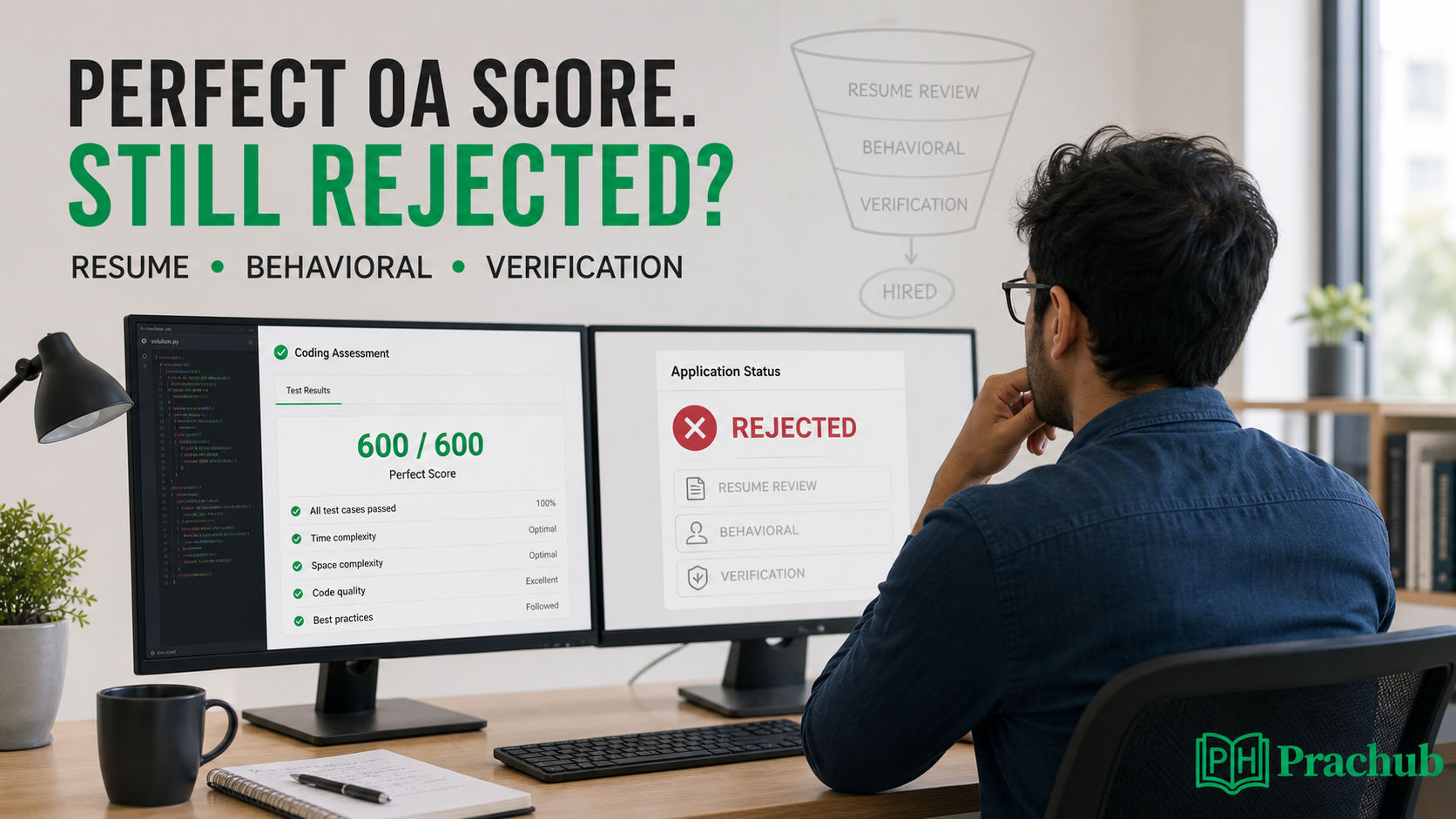
Quick answer: Why can a perfect OA score still get rejected?
A perfect OA score is evidence of strong assessment performance, not a guaranteed interview. Depending on the company and platform, the score may be only a threshold. The employer can then re-screen your resume, compare you with other passing candidates, review a separate work-style or behavioral assessment, check eligibility, or investigate verification and integrity information.
There is also a more basic possibility: what looked perfect to you was not the employer's final result. Visible sample tests can differ from hidden scoring tests, a custom assessment may use manual review, and a proctored result can be marked unverified even when the coding score itself is high.
| What a perfect score proves | What it does not prove |
|---|---|
| You performed at the top of the score shown to you. | Your resume has passed the final role-specific review. |
| Your submitted solutions satisfied that platform's scoring model. | Every hidden test, manual rubric, or integrity check is clear. |
| Your timed coding preparation worked well. | You outrank every other passing candidate. |
| The coding section is unlikely to be your obvious weakness. | A separate behavioral, work-style, or eligibility gate passed. |
| You gave the employer a strong technical signal. | The team still has interview capacity or open headcount. |
First, confirm what “perfect” actually means
A platform score is not the same as visible test cases
If the platform explicitly reports 600/600 or 100%, you have stronger evidence than “all sample tests passed.” On Codility, for example, the employer report can score both correctness and performance, including corner cases and large data sets. A solution can pass the examples you saw and still fail private cases or efficiency checks.
Custom assessments can also include hidden tests, manual review, multiple-choice sections, or employer-specific weighting. Before diagnosing the rejection, distinguish these statements:
| Candidate observation | Safe interpretation |
|---|---|
| “Every visible test passed.” | Your solution passed the tests shown during the session; hidden results may differ. |
| “My final report says 600/600 or 100%.” | You reached the maximum reported score, but other hiring signals may remain. |
| “I solved everything but cannot see a score.” | The company may use a custom report or withhold candidate-facing results. |
| “My score is perfect but verification is pending.” | The technical score exists, but the employer may wait for or require a verified result. |
A maximum CodeSignal score is still a screening signal
CodeSignal's current Assessment Score ranges from 200 to 600. Its own cut-score guide describes 600 as excellent algorithmic, problem-solving, and implementation performance. That is a meaningful achievement. CodeSignal does not say that every employer must interview every candidate who earns it.
Employers decide how to use the score. It may be a threshold, a ranking signal, or one component beside a work-style assessment. A perfect score removes one source of doubt; it does not override the rest of the hiring design.
Reason 1: The resume screen may happen after the OA
High-volume employers can send assessments automatically or after only a lightweight eligibility check. CodeSignal's Workday integration, for example, allows an employer to configure a business process that triggers assessment invitations when an application reaches a selected status. That means an OA invitation does not always prove that a recruiter has completed a detailed resume review.
After you pass, a recruiter or hiring team may compare your application with the role again. Capital One describes a similar sequence for some student roles: an automated assessment can come first, and a recruiter reviews the candidate's experience after the assessment is passed.
This creates the most common “perfect score, no interview” outcome: coding clears the technical gate, but a later review finds a weaker match in one of these areas:
-
Graduation date, degree level, location, or start-date availability
-
Work authorization or sponsorship requirements
-
Missing experience in the team's domain, language, or product area
-
Resume bullets that list tools but do not show ownership or measurable impact
-
An application submitted to a role that is technically adjacent but not well matched
Read whether everyone gets an online assessment for a deeper explanation of automatic OAs. The practical lesson is simple: prepare the resume and the assessment as two separate gates.
Reason 2: A behavioral or work-style test is a separate gate
Some online assessments deliberately combine coding with behavioral evidence. Amazon's official university SDE page says its internship OA evaluates coding, technical problem solving, and Leadership Principles, with a coding assessment and a separate Workstyles Assessment. IBM describes coding and video assessments as distinct parts of its hiring process. Capital One says its automated assessment may evaluate communication, customer focus, leadership, and problem solving.
Therefore, “I got every coding question right” may answer only half of the assessment. A work-style test can evaluate consistency, judgment, collaboration, or prioritization. You may never receive its score, making the rejection look as if the coding result was ignored.
Do not try to reverse-engineer a fake personality
Behavioral assessments often repeat a theme in different wording. Selecting whichever answer sounds most impressive can create contradictions. A better approach is to read the role and company values, answer honestly, and use a stable decision framework: protect customers, communicate risks, take ownership, seek evidence, and escalate when the cost of being wrong is material.
For interviews after the OA, prepare concrete stories through behavioral and leadership practice. A perfect technical score will not help if you cannot explain how you handled conflict, failure, ambiguity, or a difficult engineering decision.
Reason 3: Verification and integrity are separate from score
Modern assessment reports contain more than a number. CodeSignal documents integrity flags and question-level Suspicion Scores. HackerRank reports can include code quality, completion time, benchmark, and integrity issues. Codility reports can show playback, out-of-focus time, paste events, and similarity indicators.
A flag is not proof of cheating. CodeSignal explicitly tells employers that suspicious activity requires context and review. HackerRank likewise allows reviewers to examine screenshots, playback, or detailed events. But a company may pause, manually review, or reject an attempt if the result is unverified or the evidence conflicts with its assessment rules.
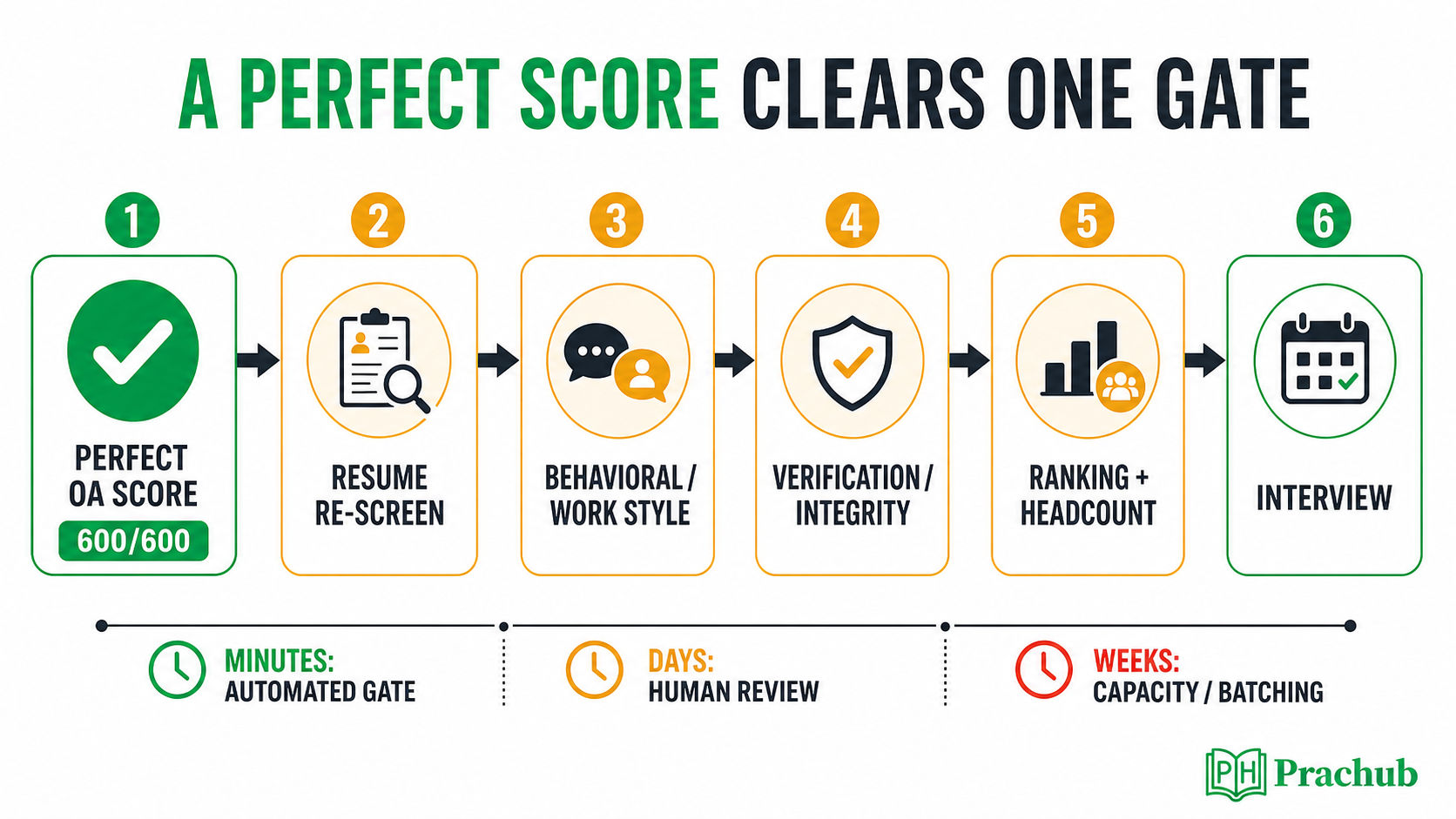
Common verification problems
A candidate can earn a strong raw score while still having an identity mismatch, missing screen share, prohibited tab or application activity, large paste events, code similarity, or a rule violation. CodeSignal's Workday integration notes that an unverified proctored result can be sent to the employer with a score of zero and a rejection reason, even though the candidate saw a technical result in CodeSignal.
Follow the exact rules shown in your invitation. Do not rely on what another company allowed on the same platform. If you had a genuine technical problem, save screenshots or timestamps and contact platform support promptly. A concise factual report is more useful than an accusation that an automated system “must have failed.”
Reason 4: Employers rank passing candidates against one another
An OA can be both a threshold and a ranking tool. HackerRank's Candidate Benchmark, for example, gives recruiters a percentile based on candidates who attempted the same questions. The raw score remains unchanged, but the employer gets additional context about relative performance.
Even when many candidates reach the maximum, interview capacity remains finite. The company may then use resume relevance, completion time, code quality, geography, referral source, or team demand to decide whom to advance. This is especially visible in current 2027 internship discussions: candidates report 600/600 results followed by rejection, while other candidates with lower scores remain under review.
Do not turn those anecdotes into a universal cutoff. Two candidates can have the same score and still be applying to different teams, locations, job IDs, or hiring windows.
Reason 5: Timing and headcount can beat a perfect result
Rolling recruiting is not a tournament where every applicant is scored before decisions begin. Teams can interview while the posting is open, leaving later applicants with fewer slots, changed headcount, or a strong pool already in progress.
The same assessment performance can therefore produce different outcomes at different points in the funnel. Apply early, meet the deadline, and keep other applications moving while you wait.
Use the rejection timing to diagnose the likely gate
| When rejection arrives | More plausible explanations | Best next check |
|---|---|---|
| Minutes after submission | Automatic cutoff, incomplete section, eligibility rule, or assessment status | Confirm every section was submitted and the final result is verified. |
| After verification completes | Integrity review, ATS rule, or immediate resume re-screen | Check the verification status and any platform message; save evidence of technical issues. |
| Several days later | Recruiter resume review, behavioral result, applicant ranking, or capacity | Re-read the exact job requirements and audit resume fit. |
| Weeks later | Batch review, team matching, headcount change, or closed interview slate | Send one concise follow-up if a recruiter invited contact, then continue applying. |
Timing is only a clue, not proof of the company's internal reason.
Practice the signals that a score does not cover
The following PracHub questions address the four gaps that commonly remain after a strong OA: hidden-test discipline, code quality, resume communication, and behavioral evidence. Each full title in the first column links directly to the question and written solution.
| PracHub question | Signal to strengthen | Why it helps |
|---|---|---|
| Solve Five OA Coding Tasks | Hidden tests and implementation | Builds defensive handling of parsing, boundary cases, and independently scored tasks. |
| How Do You Conduct a Code Review Exercise? | Code quality and judgment | Trains a repeatable review order covering correctness, tests, security, performance, and communication. |
| Describe Background and Resume Highlights | Resume and role fit | Turns a list of tools into a concise narrative about ownership, technical decisions, and measurable impact. |
| Answer Common Behavioral Questions for New Grad | Behavioral readiness | Prepares structured evidence for prioritization, teamwork, growth, failure, and self-awareness. |
What to do after a perfect-score rejection
1. Preserve the result and check verification
Save the result page, completion email, score, date, and verification status. If the assessment had a technical issue, document the exact time and what happened. Do not create multiple accounts or attempt an unauthorized retake.
2. Audit the application against the exact job
Highlight every basic and preferred qualification, then locate the resume evidence for it. Fix unclear graduation dates, missing work authorization context, generic project bullets, and unexplained technical claims. The next recruiter should not have to infer why you fit.
3. Review every non-coding section
List the work-style, situational judgment, video, multiple-choice, or role-knowledge sections that accompanied the coding test. If one felt inconsistent or rushed, prepare that skill before the next assessment instead of solving another hundred algorithm problems.
4. Send one calm follow-up when appropriate
If you have a recruiter contact, ask whether the result was received and verified, then request any feedback the company is able to share. Keep the message brief. Most employers will not disclose a detailed cutoff or integrity model, but a verification mismatch or administrative error can sometimes be corrected.
5. Keep the score, improve the rest of the funnel
If the result is shareable, review how CodeSignal score sharing and retakes work before choosing a new attempt. A perfect verified score usually calls for stronger applications, project explanations, behavioral stories, and company-specific practice—not more DSA volume.
Frequently asked questions
Does a perfect OA score guarantee an interview?
No. It can clear a technical threshold, but employers may still evaluate resume fit, eligibility, behavioral results, verification, ranking, and interview capacity.
Can I be rejected because of hidden tests even if every visible test passed?
Yes. Visible examples are not proof of a perfect final score. Hidden tests can evaluate edge cases, correctness at scale, performance, and repository behavior. Read the platform's final report rather than inferring the score from visible tests.
Can a 600/600 CodeSignal result be rejected?
Yes. A current 600 confirms top performance under CodeSignal's score range, but the employer controls its hiring process. The result may still be subject to verification, and the company can apply later resume, behavioral, eligibility, or capacity gates.
Did the recruiter ignore my score?
Usually that conclusion is too strong. The recruiter may have used the score as intended—as one qualifying signal—then rejected the application for another reason. Without employer feedback, you cannot know whether the score was ignored.
Should I ask why I was rejected?
If you have a recruiter contact, one polite request is reasonable. Ask whether the result was received and verified and whether any feedback can be shared. Do not expect detailed internal scoring information, and avoid repeated follow-ups.
Can a behavioral assessment outweigh a coding score?
It can be a separate pass requirement. Employers design their own funnels, and official processes from companies such as Amazon and Capital One show that coding is not always the only competency measured online.
Is rejection after a perfect OA just random?
Some uncertainty is unavoidable, especially when headcount changes or many candidates qualify. But “random” is not the most useful diagnosis. Check score completeness, verification, resume fit, eligibility, behavioral sections, timing, and role selection in that order.
Final verdict
A perfect OA score is worth being proud of. It shows that your timed technical preparation delivered. The mistake is treating that result as a complete hiring decision when it may be only the first credible signal in a crowded funnel.
Keep the technical strength and widen the preparation. Practice interview questions with written solutions, strengthen the resume evidence behind the role, and rehearse the behavioral and project stories that no coding score can communicate. That is how a perfect OA becomes an interview-ready application instead of an isolated number.
Sources and further reading
-
Current candidate discussion: perfect 2027 OA score followed by rejection
-
Current candidate discussion: rejection after a reported 100% OA
Research note: Assessment configurations and hiring policies vary by company, role, location, and cycle. Candidate reports are anecdotal and are used to illustrate search intent, not to state employer policy.
Related Articles
Lodely Review 2026: Are 4,000+ Company Interview Questions Worth $49 a Month?
Lodely review 2026: compare its 4,000+ question claim, $49 monthly plan, free tier, strengths, limitations, and interview-prep alternatives.
Software Engineer Interview Difficulty Index 2027: 50 Companies Ranked by Rounds and Time Pressure
See 50 software engineering interview processes ranked by evaluative stages, time pressure, format breadth, and extra gates in a transparent 2027 index.
AI-Assisted Coding Assessments in 2027: Companies, Platforms, Rules, and Scoring
Learn which 2027 coding assessments allow AI, how HackerRank, CoderPad, and CodeSignal differ, what employers can review, and how scoring works.
Repository-Based OAs in 2027: Companies Replacing LeetCode with Debugging Tasks
See which 2027 employers use repository-based OAs, where LeetCode remains, how Amazon and IBM formats vary, and how to prepare for both assessment styles.
Comments (0)