WorkUp Review: Guided Interview Practice, Free Limits, and Premium Boundaries
Quick Overview
WorkUp Eva guided practice review and free interview limits
WorkUp advertises guided interview rehearsal alongside resume tools and a broader career program. The pricing page linked from its product site says the Eva AI interviewer is included on Starter, with a fair-use cap of 50 AI interviews a month. It separately offers human coaching and other services on a custom-priced VIP plan. The public materials explain what the company offers. The signed-out visit reaches the account entry, so the review uses an independent two-take exercise to show what improvement you can measure, followed by five PracHub questions to try next.
Which WorkUp page answers which question
The WorkUp product site describes a Guided Interview feature. It says the system uses voice and facial analysis to deliver insights and help users track progress. The header's pricing link takes the reader to the WorkUp plan page, which calls the AI interviewer Eva. These linked pages provide two kinds of first-party evidence. One describes the advertised experience. The other lists plan terms and fair-use limits. The linked sign-in route presents Email and Phone tabs and an account entry for people who need to start.
The guest review stopped at that gate. It did not run a video or audio mock, check a recording setting, measure an analysis result or spend an interview credit. The provider's description does not show which signals are reported on a particular device or which feedback is retained for later. In particular, voice or facial analysis language does not provide an independent measure of communication quality or hiring outcomes. If the feedback you care about is a pace or structure note, see whether the tool can point to a specific part of your answer that you can inspect yourself.
WorkUp also markets job listings, document tools and a career program. Some public marketing references placement results. Those are provider claims about a wider offering. The reviewed materials do not substantiate links between candidate practice, an individual progress signal and employment. A coach and an automated session carry different access and evidence. When comparing them, focus on what is actually delivered to an account and what can inform the next attempt.
How the free and premium boundaries work on the public pages
The pricing page lists Starter at zero dollars per month, with AI interview preparation and unlimited monthly credits marked as subject to fair use. In the fair-use section, the provider says users can conduct up to 50 AI interviews per month with Eva. That section is the specific public limit to use when budgeting sessions. It is possible for the broader credit line and the more specific interview ceiling to appear on the same offer. The observed product entry required an account. The review did not consume a credit, so the displayed policy is the source for the cap.
The same pricing page shows an optional one-time Donor contribution of five dollars or more with the listed AI preparation access, and a custom-priced VIP tier. VIP includes items such as a personal career coach, curated behavioral and technical preparation, and expert resume review. The product home also advertises a WorkUp Premium program and links to an application page. Read what each paid offer actually includes before treating coaching, curated materials or interview volume as interchangeable. The public prices on these pages provide no delivered session length or cancellation terms for an individual coach.
If you plan to do three short takes of one answer, the displayed Starter allowance already gives you a reason to begin there. The deciding factor is whether you can get a usable record of each take. With a coach, useful evidence could be a diagnosis and a follow-up question that matches the role. With guided practice, it could be a time marker and language from your answer. Both are observable. A larger allowance alone tells you little about the quality of a single review.
A two-take test for a guided interview
Use a fictional support-operations example. A product launch inadvertently routed several requests to the wrong owner. You coordinated a correction, wrote the clarification and worked with an engineer to verify that the new routing rule handled a different request type correctly. Ask, “Tell me about a time you discovered that your own instructions had contributed to a team mistake.” Build a first answer that acknowledges your part and explains what changed. Decide which details can be described truthfully if you adapt this to a real example.
| Part of the answer | Observable evidence |
|---|---|
| Acknowledge the original error | State which routing instruction was ambiguous and what it caused. |
| Describe your action | Explain that you confirmed the active rule and communicated a correction to the people using it. |
| Show the new check | Name the request type that previously went to the wrong owner and the expected destination. |
| Close with an outcome | Explain what the team could check after the correction, using only results you know. |
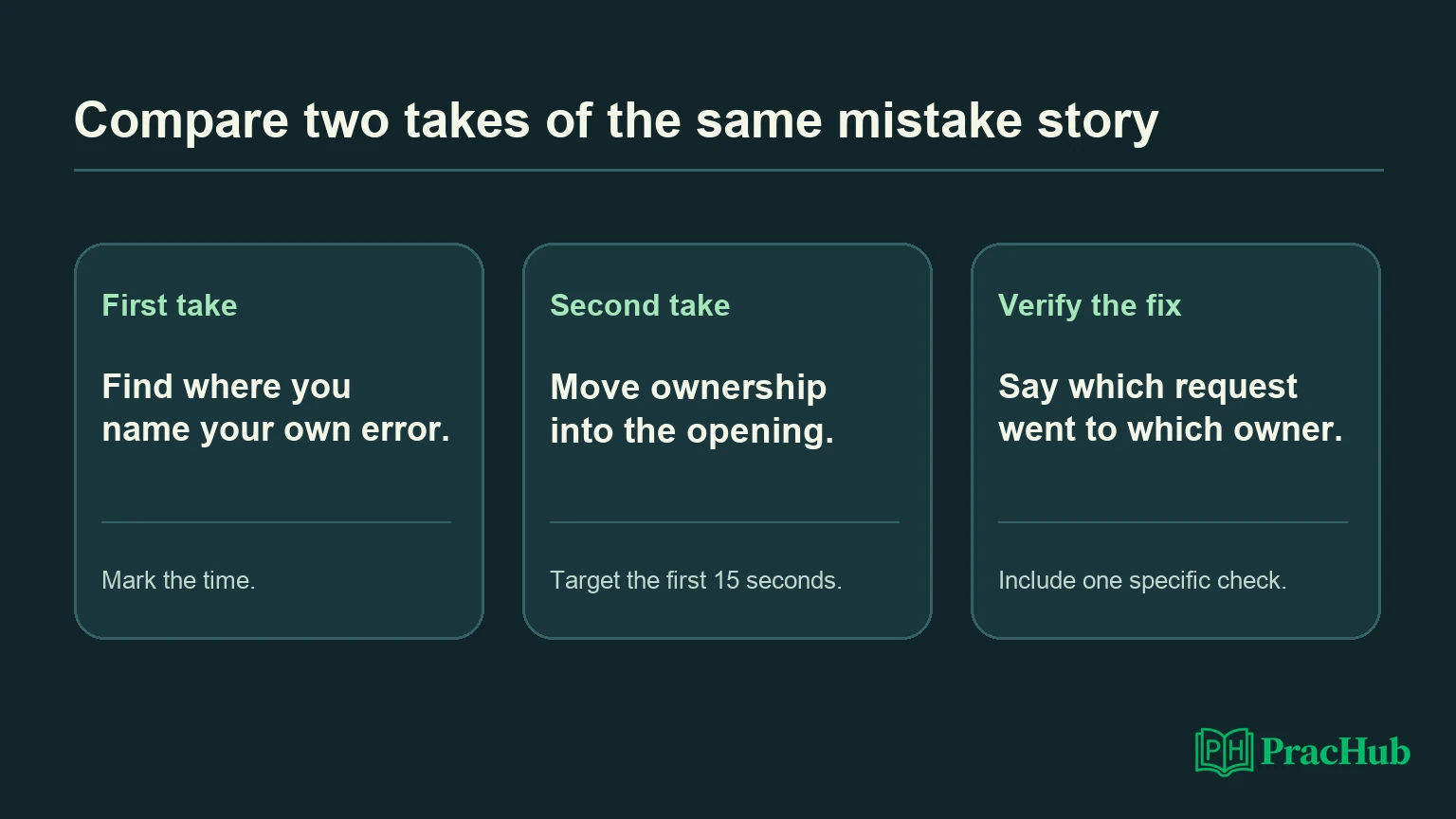
Record a 75-second answer in a tool you already control or use a permitted mock in your account. Stop and listen for the first time you say that your instructions contributed to the problem. If the first minute describes the incident without explaining your part, move the ownership sentence into the opening. On the second take, keep the example and facts constant. Your goal is to deliver the ownership decision within the first fifteen seconds and still leave space to explain what you verified. That is an editing target you can score by listening to either take.
Test whether the feedback changes the next answer
Try a challenge that your first answer does not already cover. “What did you do when someone asked you to correct the routing before you were sure which rule was active?” Explain how you limited the effect of a correction without stalling the entire team. In the fictional scenario, that could mean sampling known requests with the engineer, documenting a temporary routing instruction and telling the team which request class needed manual handling. If you did something different in your own example, use that. The follow-up helps reveal whether you understand the original decision or simply memorized a sequence.
Next, compare comments with each take. If a system flags pace, check where you sped up. Perhaps you rushed through the sentence that names the wrong owner. Slow down only there, and see if the cause and correction become easier to follow. If a note says the answer lacks a result, review the close. Replacing “things improved” with “we submitted one ticket from each of the two affected queues and checked where it appeared” is useful in this hypothetical example. The concrete change is easier to distinguish from a general score.
A gaze or expression judgment can be harder to interpret. Camera position, device behavior and personal communication styles can affect how a performance appears. A public feature description does not establish the meaning of any signal or its calibration across people. You can still ask whether every answer contains enough information for the listener. Check the substance on the audio or transcript, then evaluate a delivery suggestion only if it leads to a clear improvement and fits your way of speaking.
Run the second take without scripting every sentence. A complete script may make an answer sound polished while leaving the candidate unable to respond to a new question. Keep a short outline with the decision, one action and its observable consequence. After you say it, ask the follow-up without a pause. This tests whether you can use the original example under a little more pressure. It gives useful evidence whether your practice happened in Eva, with a friend or on a local recording.
Where guided practice fits in an interview plan
WorkUp's public offer suits a candidate who wants repeat attempts and a structured starting point for behavioral practice. Its limits leave room to redo common questions across a month under the advertised policy. A candidate preparing for a technical round would need a separate place to write and run code or work through a design, then rehearse the explanation. The reviewed WorkUp material does not show technical correctness grading for a coding or design task. A success criterion like clear ownership transfers across roles, but becomes only one part of preparation.
Before giving a paid program a role in your prep schedule, define which feedback you still lack. Perhaps you can already locate your own overlong openings but need someone to ask a rigorous second question. An automated take can make sense on the days you want repetition, while a knowledgeable reviewer can challenge the background assumptions about the work. The current public plan page shows where coaching sits in the offer. Your recordings and follow-ups show whether that extra conversation would change what you practice.
Keep one narrow artifact from each attempt
If you have transcripts, make a simple comparison of the turning point. Copy the sentence where you admit your role and the sentence where you prove the correction worked. If only a recording is available, use the two time markers. A first pass may state responsibility at second forty, with an outcome at second seventy. A second pass can make the responsibility clear at second twelve and bring the verification in before the minute ends. Those timings are illustrative targets for this exercise. They let a coach or peer respond to the same part of the answer without assuming that a product's overall score uses the same criteria.
Make the comparison harder by giving the listener a different prompt using the same event. “Tell me about a time you caught an error that had already reached another team.” Your original story still fits, but the new opening should emphasize who was affected and how you corrected their information. Keep the factual details constant. If the first answer overemphasized your intent and the second avoids the direct prompt, a faster delivery alone would not solve the problem. Listening for the exact claim helps you see which version addresses the interviewer.
The output can be a two-line note rather than a library of recordings. Keep the finding that mattered and one prompt you want to try again. If an automated or human reviewer supplies a concrete reason for a change, put it on the note too. This is enough to check whether the paid or free experience contributed something you would have been unlikely to notice yourself.
Five PracHub questions for behavioral retakes
| PracHub interview question | What to test |
|---|---|
| Own a Mistake with Real Consequences | Name your contribution to the error early. |
| Respond to Critical Feedback and Show the Change | Point to one behavior that changed on the retake. |
| Discuss an Interesting Project and a Deployment Mistake | Explain what you checked after the correction. |
| Behavioral: Conflict, Mistake, Inheriting a Departed Teammate's Project, Initiative | Distinguish the action you took from the surrounding context. |
| Turn Critical Feedback into a Measurable Improvement | Pick a time marker and one verifiable change. |
Choose a question from the PracHub behavioral interview bank that asks for a setback, disagreement or correction. Record an initial answer and one follow-up. Use the second take to move the exact decision earlier and add the check that made your result credible. Keep both versions to decide whether the feedback gave you a useful change.
Comments (0)