CI/CD Workflow Orchestration
Asked of: Software Engineer
Last updated
What's being tested
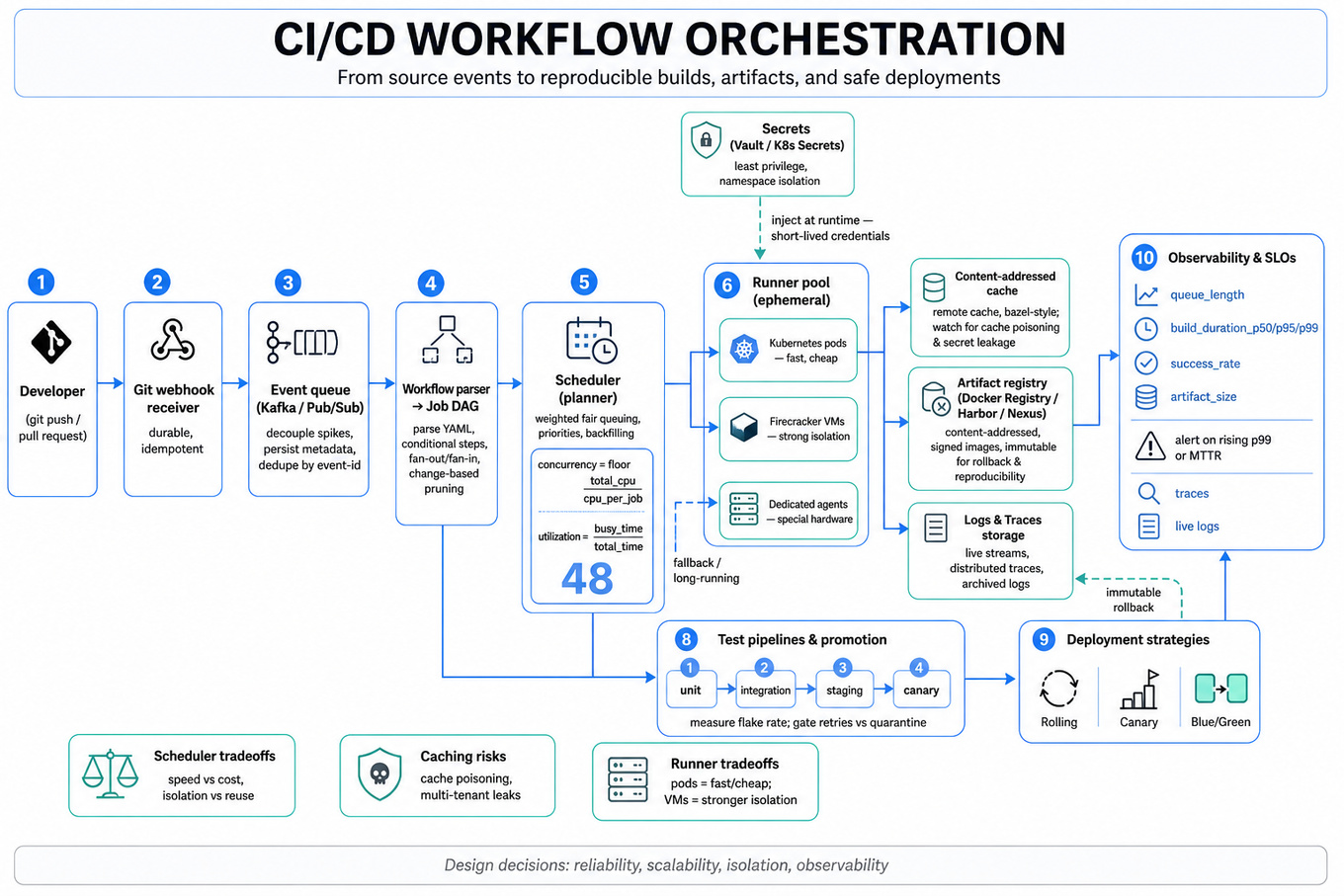
Candidates must show how to design a reliable, scalable CI/CD workflow orchestration system that turns source events into reproducible builds, tests, artifacts, and safe deployments. Interviewers probe architecture decomposition (ingest → planner/scheduler → runners → artifact & log storage), operational tradeoffs (speed vs cost, isolation vs reuse), and practical run-time concerns: scheduling policies, caching, observability, security, and rollback. Demonstrate concrete choices, capacity math, and failure-mode mitigation that a software engineer would own.
Core knowledge
-
Event intake: Git/webhook handling should be durable and idempotent; use a queue (
`Kafka`/Pub/Sub) to decouple spikes, deduplicate by event-id, and persist metadata for auditing and replay. -
Workflow parsing & DAG: Parse YAML into a job DAG; support conditional steps, fan-out/fan-in, and change-based pruning (skip downstream jobs if no affected files).
-
Scheduler & fairness: Scheduler implements priorities, weighted fair queuing, and backfilling; model capacity: concurrency = floor(total_cpu / cpu_per_job); utilization = busy_time/total_time.
-
Runners / isolation: Provide ephemeral runners via
`Kubernetes`pods, lightweight VMs (Firecracker), or dedicated agents; tradeoffs: pods = fast/cheap, VMs = stronger isolation. -
Caching & incremental builds: Use content-addressed caches (remote cache or
`bazel`-style) and artifact caching; beware cache poisoning and secret leakage between tenants. -
Artifact immutability and registries: Store artifacts in a content-addressed registry (
`Docker Registry`,`Harbor`,`Nexus`) and sign images; immutability simplifies rollbacks and reproducibility. -
Security & secrets: Inject secrets at runtime via
`Vault`/`Kubernetes`secrets with short-lived credentials; enforce least privilege and runtime namespace isolation. -
Testing layers & flakiness: Compose unit → integration → staging → canary; quantify flakiness (test flake rate) and gate retries vs quarantine to avoid wasting resources.
-
Observability & SLOs: Emit metrics: queue_length, build_duration_p50/p95/p99, success_rate, artifact_size; logs streamed live, distributed traces for long DAGs, alerts for rising p99 latency or MTTR.
-
Deployment strategies: Implement rolling, canary, and blue/green deployments plus feature-flag integration; ensure idempotent deployment APIs and immutable artifact references.
-
Multi-tenant constraints: Enforce per-tenant quotas, RBAC, logs/artifact scoping, and fair-share scheduling to prevent noisy neighbors; include admission control on resource consumption.
-
Cost & capacity planning: Estimate cost_per_build = CPU_seconds * price_cpu + storage_gb * price_storage + egress; shard scheduler when builds/day > ~10k or concurrency >> cluster size.
Tip: Prefer content-addressed artifact IDs and immutable tags; they make rollbacks and cache reuse deterministic.
Worked example — "Design a CI/CD pipeline with scheduler"
First 30s: clarify scope (single repo vs monorepo? polyglot builds?), SLOs (p95 build latency target), and scale (builds/day, avg duration, concurrency). State assumptions: monorepo, target ~500 builds/day, average 5min build, multi-stage tests.
Skeleton pillars to present:
-
Event ingestion: Git webhooks → validated → enqueue in
`Kafka`with dedupe. -
Workflow planner: YAML → DAG; compute affected tasks with file-change graph to skip irrelevant jobs.
-
Scheduler: global scheduler implements priority, backfilling, and slot accounting (CPU/memory/GPU). Maintain per-project quotas and tenant weights.
-
Runners & execution: ephemeral
`Kubernetes`pods using a sidecar for log streaming and secret injection; cache mounts from remote cache. -
Artifacts & deploy: push content-addressed artifacts to
`Harbor`, sign, then trigger deployment pipeline with canary rollout and automated rollback on health regression.
One tradeoff to flag: shared runner pools maximize utilization but require rigorous sandboxing and secret handling; dedicated runners increase latency and cost but give stronger isolation. Close by saying: if I had more time, I'd prototype scheduler policies with a load simulator, add ML-based prioritization for critical PRs, and detail quorum-based rollout health checks.
A second angle — "Design multi-tenant CI/CD workflow system"
Multi-tenancy shifts priorities: tenant isolation and fairness become first-class. Start by scoping isolation boundaries (logical via namespaces vs physical via clusters). Scheduler must enforce per-tenant quotas, weighted priorities, and admission control; consider hierarchical scheduling (global broker + per-tenant local scheduler) to scale. Artifact and log stores must be multi-tenanted with ACLs and encryption-at-rest; billing meters resource usage (CPU_seconds, storage_gb). Also design for noisy-neighbor mitigation: throttling, preemption, and per-tenant reservation pools.
Common pitfalls
Pitfall: Focusing only on fast median builds (p50) and ignoring p99 latency — this leads to bad SLOs; always present p50/p95/p99 and tail-case mitigation like pre-warmed runners.
Pitfall: Proposing naive shared caches without considering security and cache poisoning; articulate cache scoping and validation (content-addressed + signed artifacts).
Pitfall: Treating scheduling purely as FIFO; interviewers expect tradeoffs between fairness, priority, and cost — describe algorithms (weighted fair queuing, backfill) and capacity math.
Connections
Design conversations often pivot to distributed schedulers, observability/alerting (SRE practices), and build-system internals (remote execution, `bazel` caching). Be ready to dive into runtime security (sandboxing, attestation) or cost-optimization (spot instances, preemptible runners).
Further reading
-
Argo Workflows — practical model for
`Kubernetes`-native DAG execution and workflow controller. -
Tekton Pipelines — a vendor-neutral CI/CD primitives project with pipeline-as-
`Kubernetes`-CRDs, useful for scheduler/running patterns.
Practice questions
- Design a CI/CD pipelineOpenAI · Software Engineer · Technical Screen · hard
- Design a multi-tenant CI/CD platformOpenAI · Software Engineer · Technical Screen · hard
- Design a CI/CD pipeline with schedulerOpenAI · Software Engineer · Technical Screen · hard
- Design multi-tenant CI/CD workflow systemOpenAI · Software Engineer · Technical Screen · hard
- Design a CI/CD PipelineOpenAI · Software Engineer · Technical Screen · hard
- Design webhook, POI, chat, CI/CD, paymentsOpenAI · Software Engineer · Onsite · medium
Related concepts
- CI/CD Orchestration PlatformsSystem Design
- CI/CD, Release Engineering, And GPU Test InfrastructureSystem Design
- CI/CD, Jenkins, Blue-Green, Canary, And Rollbacks
- Distributed Data Processing PipelinesSystem Design
- Intermediate Representations, DAGs, And Test Workflow CompilationCoding & Algorithms
- Cloud File Storage ServiceSystem Design