Classical Machine Learning: KNN, PCA, And K-Means
Asked of: Data Scientist
Last updated
What's being tested
These questions test practical mastery of K-Nearest Neighbors, Principal Component Analysis, and K-Means: algorithmic behavior, preprocessing effects, numerical/implementation robustness, and hyperparameter selection. Interviewers want a Data Scientist who can choose the right tradeoffs (accuracy vs. scalability), diagnose failure modes (high-dimensional data, empty clusters), and implement/validate clustering and instance-based models reliably.
Patterns & templates
-
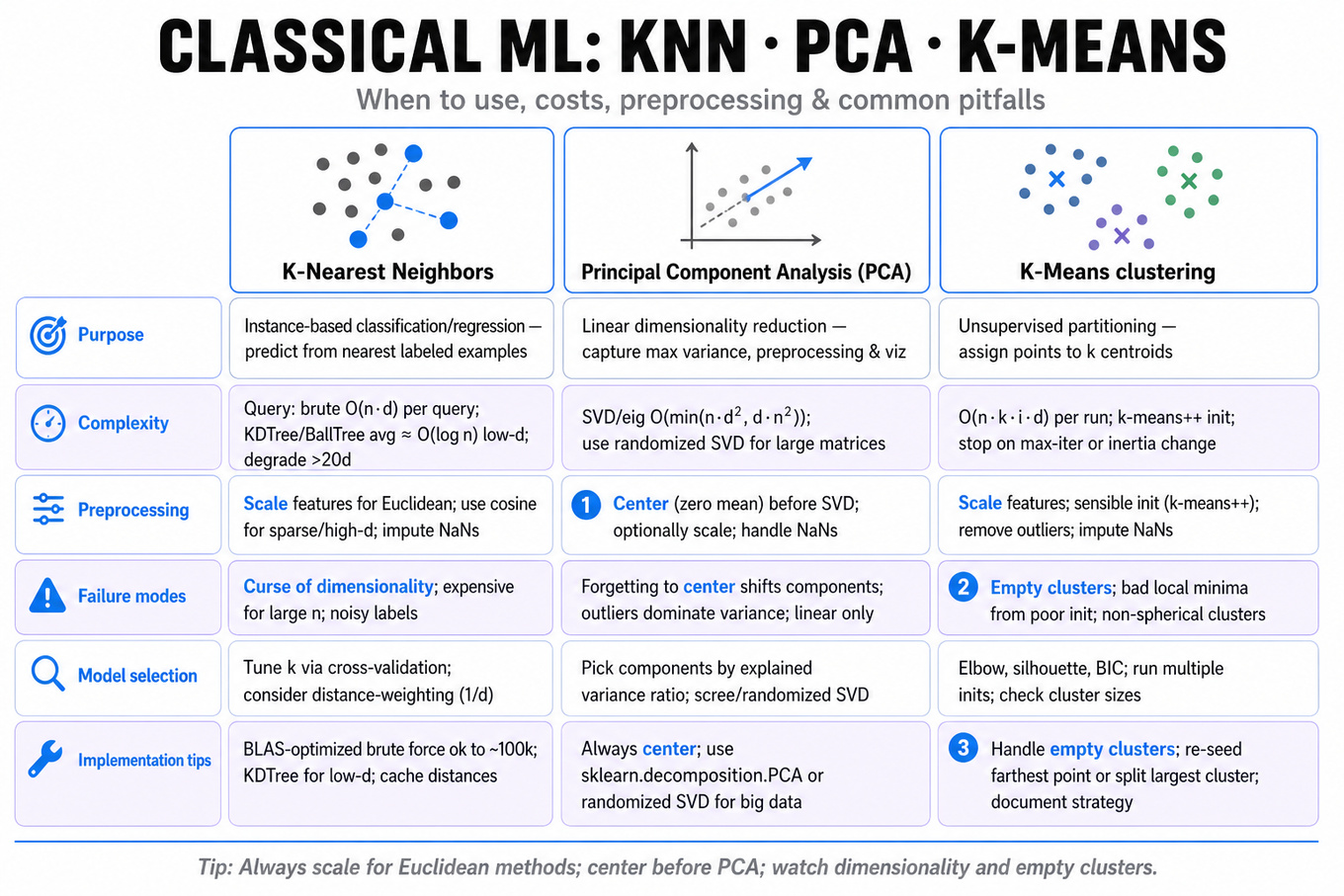
Brute-force KNN: compute pairwise distances O(n·d) per query, then sort/select k; acceptable for n up to ~100k with optimized
BLAS, else use indices. -
Indexed KNN: use
`KDTree`/`BallTree`for low-dimensional data (average query ≈ O(log n)); deteriorates under the curse of dimensionality. -
Distance choices: pick Euclidean for continuous features, cosine for sparse/high-d vectors, and consider distance-weighting (1/d) for soft voting.
-
PCA workflow: center data, compute SVD or eigendecomposition (
`sklearn.decomposition.PCA`); complexity ≈ O(min(n·d^2, d·n^2)); use randomized SVD for large matrices. -
K-Means basics: Lloyd’s algorithm with
`k-means++`init (`sklearn.cluster.KMeans`), complexity O(n·k·i·d); stop on max-iter or small inertia change. -
Empty-cluster handling: re-seed from farthest point, split largest cluster, or reduce k; document chosen strategy.
-
Model selection: tune
kvia cross-validation for KNN, elbow/silhouette/BIC for K-Means, and explained variance ratio for PCA components. -
Scaling & preprocessing: always scale features for Euclidean-based methods; impute or drop NaNs; consider PCA before KNN in very high-d sparse data.
Common pitfalls
Pitfall: Treating
`KDTree`as a cure-all—trees often perform worse than brute force in >20 dimensional data.
Pitfall: Forgetting to center data before PCA, which shifts principal components and invalidates explained variance.
Pitfall: Ignoring empty clusters in K-Means implementations; silent failures produce biased centroids and wrong cluster counts.
Practice these
The practice cards below cover the canonical variants — solve all of them and time yourself.
Practice questions
- Explain KNN and how to tune itMicrosoft · Data Scientist · Technical Screen · easy
- Explain KNN and PCA and key tradeoffsMicrosoft · Data Scientist · Technical Screen · easy
- Compare CNN/RNN/LSTM and implement K-meansMicrosoft · Data Scientist · Onsite · hard
- Implement robust k-means from scratchMicrosoft · Data Scientist · Onsite · hard
Related concepts
- Supervised ML Fundamentals, Regularization, And TroubleshootingMachine Learning
- Applied Machine Learning Modeling And EvaluationMachine Learning
- Supervised ML Fundamentals, Evaluation And Feature EngineeringMachine Learning
- ML System Design, Recommenders, Forecasting And AllocationMachine Learning
- Supervised ML, Imbalance, Overfitting, And OptimizationMachine Learning
- Machine Learning System Design For Real-Time DecisionsMachine Learning