Supervised ML, Imbalance, Overfitting, And Optimization
Asked of: Data Scientist
Last updated
What's being tested
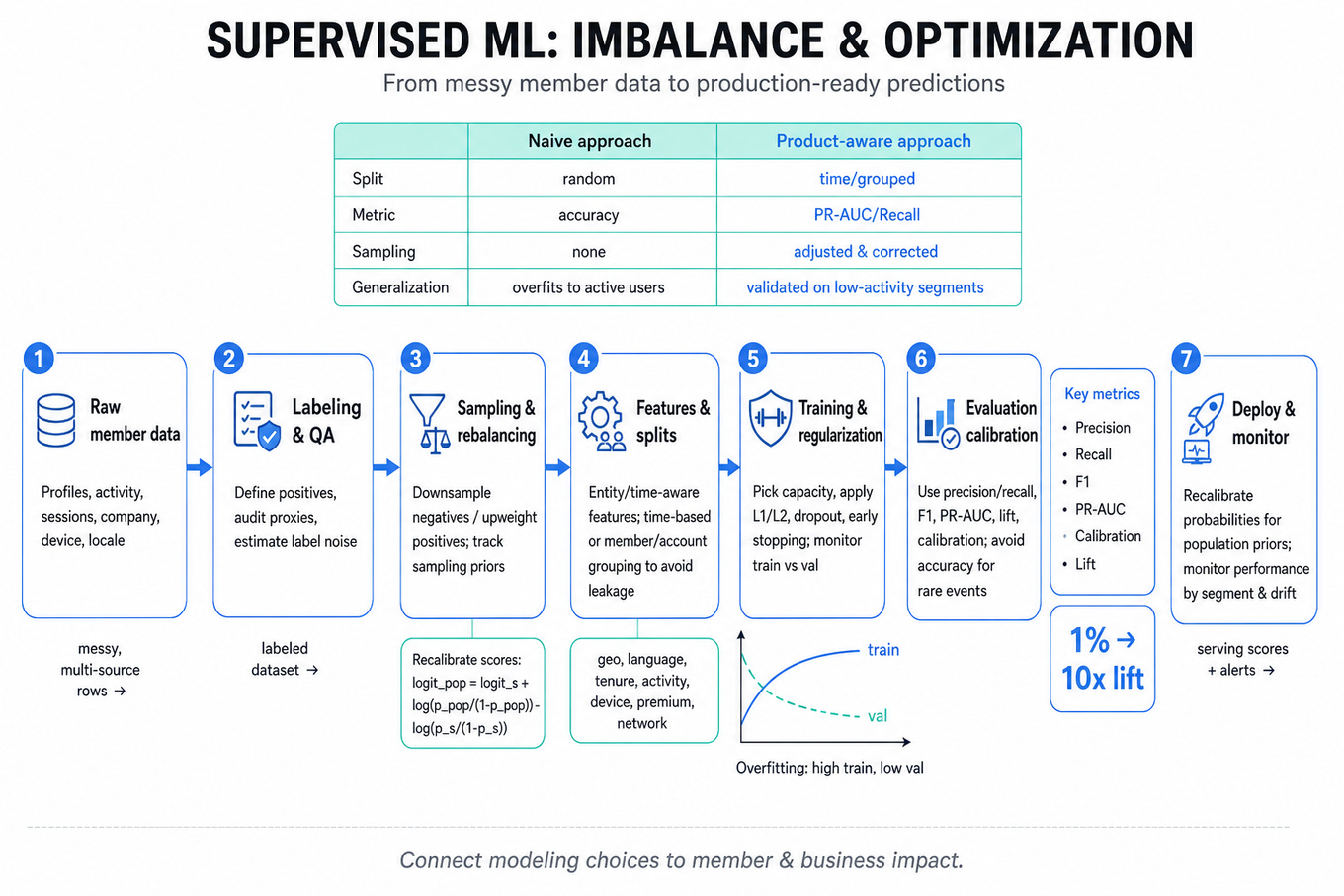
Interviewers are probing whether you can build and evaluate supervised learning models when the data is messy, skewed, and product-relevant rather than textbook-clean. For LinkedIn Data Scientists, this matters because many valuable prediction tasks are rare-event problems: identifying sales professionals, predicting product adoption, detecting low-frequency bad experiences, or ranking member-job interactions. You’re expected to reason about class imbalance, sampling bias, overfitting, regularization, and evaluation metrics in a way that connects model behavior to business and member impact. Strong answers show you can move between statistical fundamentals, practical modeling choices, and decision-quality evaluation.
Core knowledge
-
Class imbalance means the target classes have very unequal prevalence, such as 1% positives and 99% negatives. Accuracy becomes misleading: a classifier that predicts all negatives gets 99%
accuracybut has zerorecallfor the minority class. Useprecision,recall,F1,PR-AUC, lift, and calibration-aware metrics instead. -
Sampling strategy changes both training dynamics and probability interpretation. Downsampling negatives can make training faster and improve signal visibility, but predicted probabilities need correction if the sample class prior differs from production. If is the sampled prior and is the population prior, recalibrate before using scores as probabilities.
-
Representative sampling is not just random rows. For LinkedIn-style member data, check representativeness across geography, language, tenure, industry, activity level, device, premium status, and network size. A model trained on highly active members may generalize poorly to casual members, even if aggregate class balance looks fine.
-
Train/validation/test splitting must match the deployment question. Use time-based splits when predicting future behavior from past signals, because random splits can leak future engagement patterns. Use member-level or account-level grouping when multiple rows per entity exist; otherwise, the model may memorize user-specific patterns.
-
Label quality often dominates algorithm choice. For “Identify Sales Professionals,” self-reported titles, profile text, recruiter tags, company pages, and behavioral signals can all be noisy proxies. Define positives and negatives carefully, audit ambiguous labels, and consider a “silver label” approach with manual validation for a high-confidence evaluation set.
-
Logistic regression estimates It is equivalent to a one-layer neural network with a sigmoid output trained using binary cross-entropy: It is interpretable, strong for sparse features, and a good baseline.
-
Tree-based models such as
RandomForest,XGBoost, andLightGBMhandle nonlinearities and feature interactions well, but can overfit if depth, leaves, or boosting rounds are too large. Control complexity usingmax_depth,min_child_weight,min_samples_leaf,subsample,colsample_bytree, learning rate, and early stopping. -
Overfitting shows up when validation performance degrades while training performance keeps improving. In imbalanced settings, it can be hidden if you only monitor
accuracyorROC-AUC. Compare train versus validationPR-AUC, precision at fixed recall, recall at fixed precision, and calibration curves by segment. -
Regularization trades variance for bias. L2 regularization adds and shrinks coefficients smoothly; L1 regularization adds and can drive coefficients to zero, acting as feature selection. L1 may be useful for high-dimensional sparse text or profile features, but it can arbitrarily select one of many correlated features.
-
Optimization matters for explaining model training, not just implementation. Gradient descent updates parameters by moving opposite the loss gradient: . Adam adapts learning rates using first and second moment estimates of gradients, often converging faster than vanilla SGD, though learning rate and regularization still need validation.
-
Threshold selection should be tied to product cost. If false positives annoy members or sales teams, optimize precision at an acceptable recall. If missing true positives is costly, optimize recall subject to precision. Ranking use cases may care more about
precision@k,recall@k, lift over random, or incremental business value than a global classification threshold. -
Calibration is essential when scores drive decisions like opportunity sizing or resource allocation. A model can rank well but produce poorly calibrated probabilities. Use reliability plots, Brier score, Platt scaling, isotonic regression, or segment-level calibration checks before interpreting “20% probability of adoption” literally.
Worked example
For Train with imbalanced sampled data, a strong candidate would first clarify the prediction target, positive-class prevalence in the population, how the sample was drawn, and whether the output is used for ranking, classification, or calibrated probability estimation. In the first 30 seconds, you might say: “I’d separate three concerns: whether the training sample is representative, how imbalance affects learning, and which metric matches the product decision.” The answer skeleton should have four pillars: audit sample-to-population differences, choose an imbalance strategy, train with overfitting controls, and evaluate on an untouched population-like test set.
For sampling, you would compare distributions of key covariates between sampled and population data, such as member activity, region, seniority, industry, and historical engagement. For imbalance, you could discuss class weights, downsampling, upsampling, or algorithms that support weighted loss, while noting that resampling affects probability calibration. For overfitting, you would propose time-based validation, cross-validation where appropriate, early stopping for boosted trees, limiting tree depth, and monitoring train-validation gaps on PR-AUC or precision at target recall. A specific tradeoff to flag: downsampling negatives improves speed and minority signal, but may discard useful variation among negatives and requires prior correction if probabilities are used. You could close with: “If I had more time, I’d run segment-level error analysis and calibration checks, because overall PR-AUC can hide failure on smaller but important member cohorts.”
A second angle
For Explain Logistic Regression, Backprop, and Adam, the same ideas appear through the lens of model fundamentals rather than sampling design. Logistic regression is a supervised binary classifier trained by minimizing binary cross-entropy, and class imbalance can be handled by weighting the positive class more heavily in the loss. Backpropagation is simply the chain rule used to compute gradients of that loss with respect to model parameters; in logistic regression, the gradient has a simple form, but the same principle extends to deeper networks. Adam changes the optimization path by adapting step sizes per parameter, but it does not solve bad labels, leakage, poor metrics, or sampling bias. The best answer connects the math to practice: explain the formula, then say how you would validate convergence, regularization, threshold choice, and calibration.
Common pitfalls
Pitfall: Optimizing
accuracyon an imbalanced dataset.
This is the classic analytical mistake. If positives are rare, a high-accuracy model can be useless for the actual product decision. A better answer names the operating point: for example, “I’d optimize precision at 80% recall” or “I’d compare models using PR-AUC and lift in the top decile.”
Pitfall: Saying “just oversample the minority class” without discussing bias or calibration.
Oversampling can help the learner see enough positive examples, but it does not create new information unless paired with careful validation. If the sampled class prior differs from the production prior, raw model probabilities are not directly interpretable. Strong candidates explicitly distinguish ranking quality from probability calibration.
Pitfall: Giving a model-shopping answer instead of a diagnostic answer.
Jumping straight to XGBoost or a neural network can sound shallow if you ignore labels, leakage, sample representativeness, and evaluation design. Interviewers usually reward a structured debugging mindset: define the target, inspect the data-generating process, choose metrics, establish a simple baseline, then justify more complex models only if they improve validated decision quality.
Connections
Interviewers can pivot from here into experiment design, especially how you would validate that a model-driven product change improves member outcomes through an A/B test. They may also move into ranking evaluation, causal inference, feature leakage, calibration, or cohort-level error analysis, all of which are natural extensions for a Data Scientist working on LinkedIn products.
Further reading
-
The Elements of Statistical Learning — Deep reference for supervised learning, regularization, trees, boosting, and model assessment.
-
Imbalanced Learning: Foundations, Algorithms, and Applications — Focused treatment of imbalanced classification, sampling, cost-sensitive learning, and evaluation.
-
Deep Learning, Chapter 8: Optimization for Training Deep Models — Clear explanation of gradient-based optimization, momentum, adaptive methods, and practical training issues.
Featured in interview prep guides
Practice questions
- Explain Logistic Regression, Backprop, and AdamLinkedIn · Data Scientist · Onsite · medium
- Train with imbalanced sampled dataLinkedIn · Data Scientist · Technical Screen · medium
- Identify Sales ProfessionalsLinkedIn · Data Scientist · Onsite · medium
- Handle imbalance, sampling, and overfittingLinkedIn · Data Scientist · Technical Screen · medium
- LinkedIn Product Case Opportunity SizingLinkedIn · Data Scientist · Onsite · hard
Related concepts
- Supervised ML Fundamentals, Evaluation And Feature EngineeringMachine Learning
- Supervised ML Fundamentals, Regularization, And TroubleshootingMachine Learning
- Logistic Regression, Regularization, And Imbalanced ClassificationMachine Learning
- Applied Machine Learning Modeling And EvaluationMachine Learning
- ML Model Evaluation, Metrics, And ExperimentationML System Design
- Evaluation, Statistical Inference, And Class ImbalanceMachine Learning