Logistic Regression, Regularization, And Imbalanced Classification
Asked of: Data Scientist
Last updated
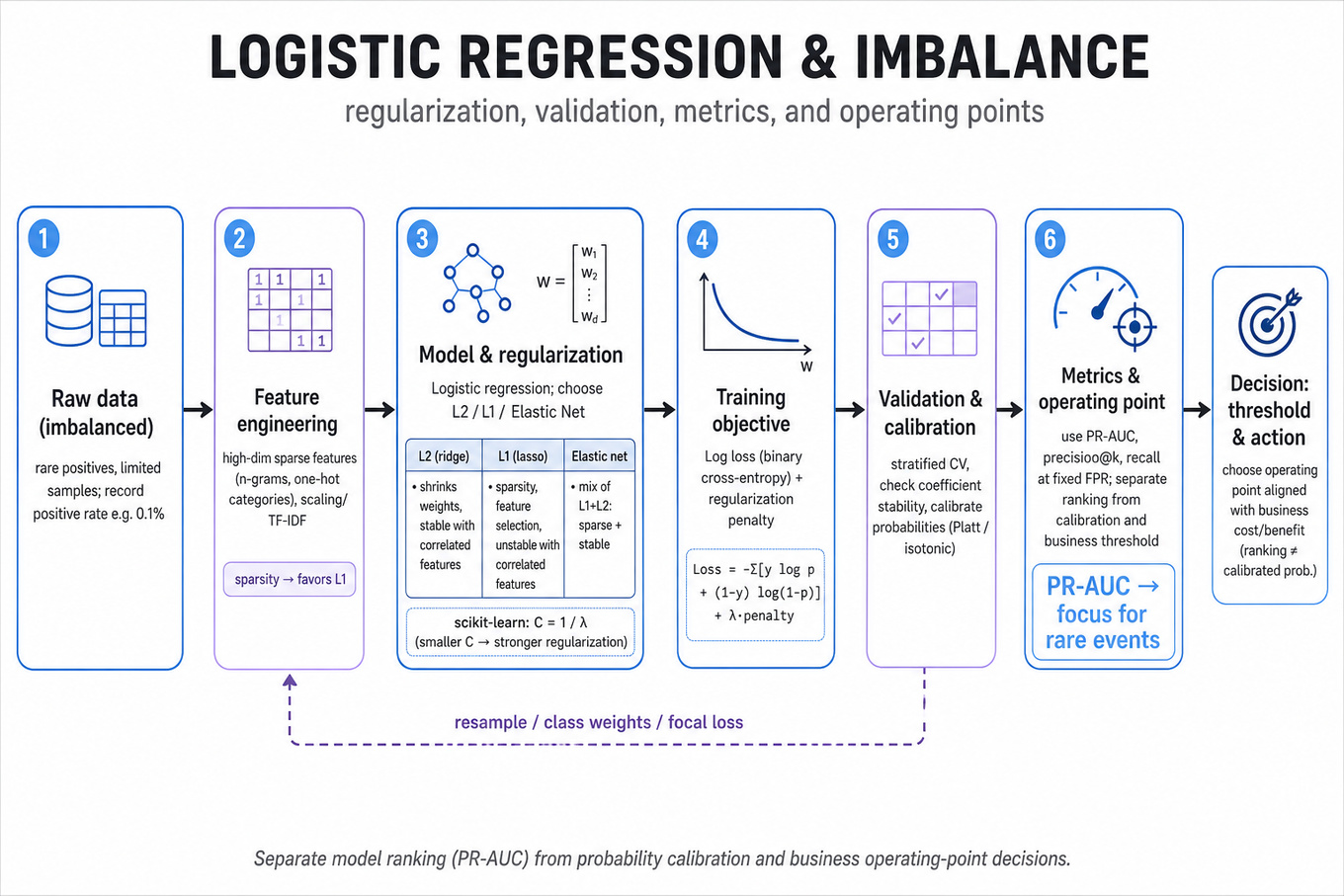
What's being tested
Interviewers are probing whether you can choose, diagnose, and evaluate a binary classification model under realistic data constraints: limited samples, high-dimensional sparse features, overfitting risk, and severe class imbalance. For a Data Scientist at Google, this matters because many product problems are rare-event predictions: spam, abuse, churn, conversion, fraud-like behavior, or low-frequency user actions. The expected answer is not “use logistic regression” or “use random forest,” but a structured explanation of model assumptions, regularization, validation design, metric choice, and thresholding. Strong candidates also separate model quality from business decision quality: ranking users well, calibrating probabilities, and choosing an operating point are related but distinct tasks.
Core knowledge
-
Logistic regression models the conditional probability of a binary label as
It is linear in the log-odds: , making coefficients relatively interpretable when features are well-defined. -
Log loss, or binary cross-entropy, is the standard training objective:
It rewards calibrated probabilities more than simple accuracy. In rare-event problems, small probability errors on many negatives can dominate the objective. -
L2 regularization adds to the loss, shrinking coefficients smoothly toward zero. It helps when features are correlated or when there are many weak predictors. In
scikit-learn, smallerCmeans stronger regularization becauseC = 1 / lambda. -
L1 regularization adds , which can set coefficients exactly to zero. This is useful for high-dimensional sparse data, such as one-hot encoded categories or text n-grams, where feature selection and interpretability matter. It can be unstable with highly correlated features.
-
Elastic net combines L1 and L2 penalties: . It is a good answer when you want sparsity but also want more stable behavior across correlated predictors than pure L1 provides.
-
Overfitting in logistic regression appears as high training performance but much lower validation performance, large coefficient magnitudes, unstable coefficients across folds, or performance that collapses on newer cohorts. Remedies include stronger regularization, fewer features, better feature grouping, cross-validation, and leakage checks.
-
Underfitting appears when both train and validation performance are poor. Causes include missing nonlinearities, overly strong regularization, weak features, or an inappropriate linear decision boundary. Adding interaction terms, monotonic transformations, splines, or trying tree-based models can help.
-
Random Forest models nonlinear interactions and feature thresholds automatically, but with limited data it may overfit, produce less stable probability estimates, and be harder to interpret. Logistic regression often wins when is small, features are sparse/high-dimensional, and the signal is approximately additive in log-odds.
-
Class imbalance makes raw accuracy misleading. If positives are 1%, a classifier predicting all negatives gets 99% accuracy but zero recall. Start by preserving prevalence in validation/test splits using stratified sampling, then evaluate metrics aligned with the use case.
-
AUROC measures ranking quality: the probability that a randomly chosen positive receives a higher score than a randomly chosen negative. It is threshold-independent and robust for comparing rankers, but it can look deceptively high when positives are extremely rare because false positives may be diluted among many negatives.
-
Precision-recall AUC is often more informative for rare-event detection because it focuses on positive-class retrieval. Use
precision,recall,F1,PR-AUC, and recall-at-fixed-precision when the product cost is dominated by false positives or limited review capacity. -
Threshold selection is a decision problem, not just a modeling problem. Choose a threshold using validation data based on cost: maximize expected utility, satisfy precision , hit recall targets, or fit a human-review budget. Never pick the threshold on the test set.
Tip: A strong DS answer usually separates four layers: data split and leakage prevention, model choice, metric choice, and threshold/business decision.
Worked example
For Build Classifier: Evaluate with AUROC for Imbalanced Data, a strong candidate would first clarify the base rate, the cost of false positives versus false negatives, whether the model is used for ranking or automated action, and whether labels are delayed or noisy. They might state an assumption like: “I’ll assume positives are rare, around 1%, and the product wants to prioritize likely positives for review or intervention.” The answer should be organized around four pillars: create a leakage-safe stratified train/validation/test split, train a simple regularized baseline such as logistic regression, evaluate ranking quality with AUROC and PR-AUC, then choose a threshold using validation-set precision/recall tradeoffs. They should explain that AUROC is useful because it is threshold-independent and measures rank ordering, but it may not fully capture operational performance under extreme imbalance. A good candidate would add a calibration check using reliability curves or Brier score if downstream users interpret scores as probabilities. For imbalance mitigation, they could mention class weights, downsampling negatives, or focal loss-style approaches, while noting that resampling changes the training distribution and may require calibration afterward. One explicit tradeoff to flag is that optimizing recall may flood the product with false positives, while optimizing precision may miss many true positives. They can close with: “If I had more time, I would compare a regularized logistic baseline against a tree-based model, validate across cohorts or time splits, and run sensitivity analysis across thresholds.”
A second angle
For Compare Logistic Regression and Random Forest in Limited Data Scenarios, the same concepts appear through model selection rather than metric selection. With limited data, a regularized logistic model can have lower variance, clearer coefficients, and more stable out-of-sample performance than a RandomForestClassifier. A Random Forest may still be attractive if the signal depends on nonlinear feature interactions, but the candidate should mention tuning tree depth, minimum samples per leaf, and validation performance to control overfitting. The framing should include interpretability: a DS may need to explain which features are associated with higher conversion, churn, or abuse risk, where logistic regression provides cleaner directional evidence. The strongest answer avoids absolutism: logistic regression is not always better with small data, but it is often the safer baseline when dimensionality is high and signal is approximately linear.
Common pitfalls
Pitfall: Using
accuracyas the main metric on imbalanced data.
This is the classic analytical mistake. A model with 99% accuracy can be useless if positives are 1% of the data and it predicts every case as negative. A better answer names AUROC, PR-AUC, precision/recall at a chosen threshold, and ties the final metric to the product cost.
Pitfall: Saying “L1 prevents overfitting because it removes features” without explaining the tradeoff.
That answer is directionally true but shallow. L1 induces sparsity and can reduce variance, but it can arbitrarily choose among correlated predictors and become unstable across samples. A stronger answer compares L1, L2, and elastic net, then says how they would tune regularization strength using cross-validation.
Pitfall: Treating probability scoring and classification as the same task.
A model can rank examples well but be poorly calibrated, or be calibrated but weak at top-k retrieval. If the use case needs a prioritized queue, ranking metrics like AUROC, PR-AUC, or recall-at-k matter; if the score drives user-facing decisions, calibration and threshold-specific error rates matter.
Connections
Interviewers may pivot from here into calibration, especially reliability plots, Platt scaling, isotonic regression, and Brier score. They may also connect this topic to experiment design, asking how you would evaluate a new classifier in an A/B test, or to causal inference, asking whether model features are predictive versus actionable. Adjacent model families include GradientBoostingClassifier, XGBoost, and generalized linear models with interaction terms.
Further reading
-
The Elements of Statistical Learning — Chapters on linear methods, regularization, and tree-based models give rigorous grounding.
-
scikit-learn: Classification metrics — Practical definitions and implementation details for
AUROC,PR-AUC, precision, recall, and calibration metrics. -
imbalanced-learn User Guide — Useful reference for resampling methods, class imbalance handling, and evaluation caveats.
Featured in interview prep guides
Practice questions
- Compute precision–recall curve on imbalanced dataGoogle · Data Scientist · Technical Screen · medium
- Build and evaluate bad-link classifierGoogle · Data Scientist · Technical Screen · medium
- Handle highly imbalanced classification dataGoogle · Data Scientist · Technical Screen · medium
- Explain logistic regression vs forests and boostingGoogle · Data Scientist · Technical Screen · hard
- Detect Overfitting or Underfitting in Logistic Regression ModelsGoogle · Data Scientist · Technical Screen · medium
- Compare Logistic Regression and Random Forest in Limited Data ScenariosGoogle · Data Scientist · Onsite · medium
- Build Classifier: Evaluate with AUROC for Imbalanced DataGoogle · Data Scientist · Technical Screen · medium
- Address Overfitting with L1 Regularization in RegressionGoogle · Data Scientist · Technical Screen · medium
Related concepts
- Classification Thresholds, Imbalanced Learning And RiskMachine Learning
- Logistic Regression And Linear ModelsMachine Learning
- Supervised ML Fundamentals, Regularization, And TroubleshootingMachine Learning
- Supervised ML, Imbalance, Overfitting, And OptimizationMachine Learning
- Evaluation, Statistical Inference, And Class ImbalanceMachine Learning
- Supervised ML Fundamentals, Evaluation And Feature EngineeringMachine Learning