Customer Segmentation And Funnel Strategy
Asked of: Product Manager
Last updated
What's being tested
Interviewers probe your ability to turn customer signals into a prioritized acquisition and funnel plan that balances growth, economics, and risk. They want to see structured segmentation, clear funnel metrics, ROI-driven tradeoffs, and defensible guardrails specific to a credit-card product. At Capital One, expect emphasis on risk-adjusted profitability, measurable incrementality, and operational constraints like regulatory/compliance boundaries.
Core knowledge
-
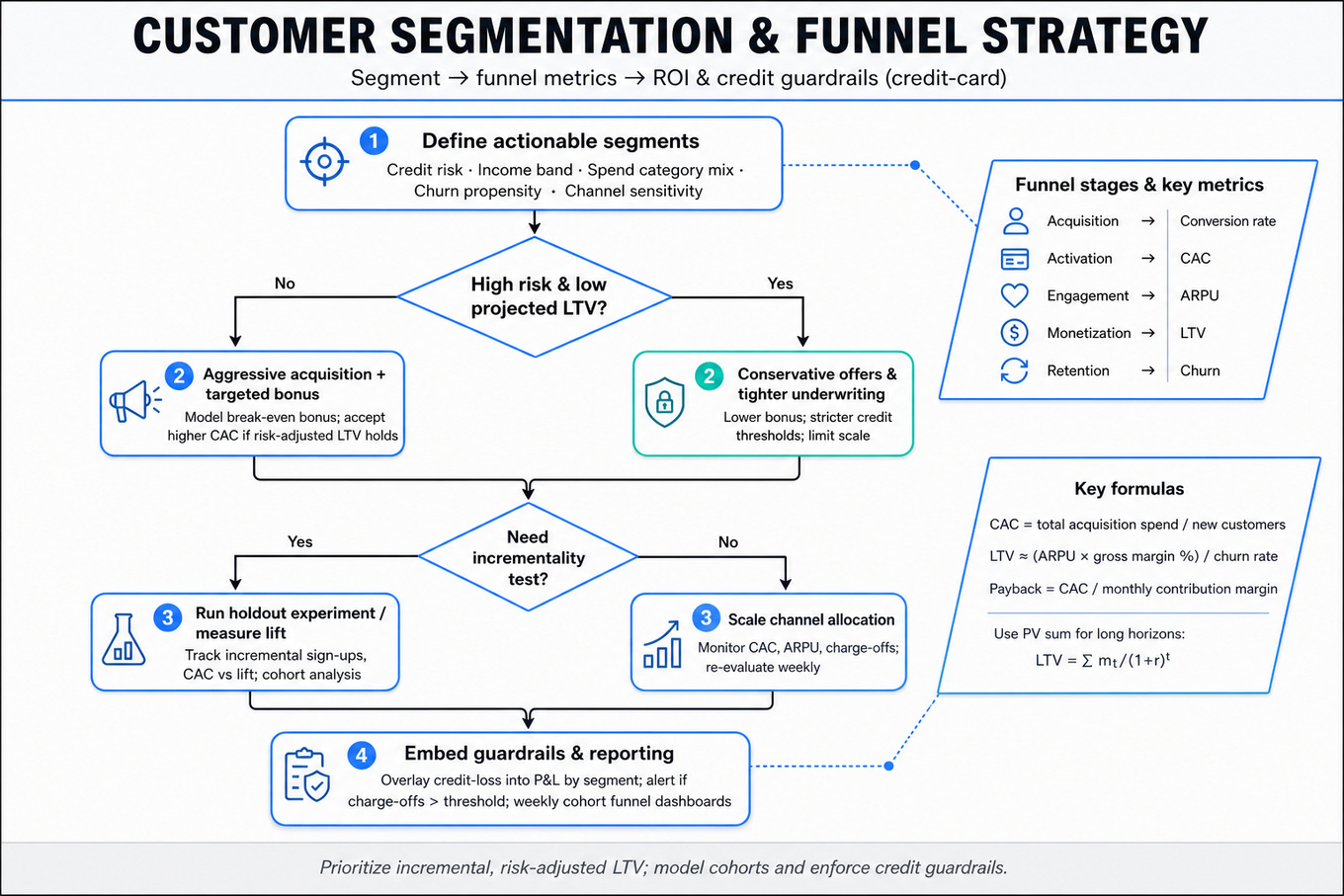
Customer Segmentation: segment by observable behaviors and value drivers — credit risk, income band, spend category mix, churn propensity, and acquisition channel sensitivity; segments must be actionable (i.e., map to different offers or channels).
-
Funnel stages & metrics: define Acquisition → Activation → Engagement → Monetization → Retention; key metrics: Conversion rate at each stage,
CAC,ARPU,LTV, and churn; instrument stage-level attribution for diagnosis. -
Economics formulas:
CAC= total acquisition spend / new customers;LTV≈ (ARPU× gross margin %) / churn rate. Payback period =CAC/ monthly contribution margin. Use present-value for long horizons: where is contribution margin, is discount rate. -
Incrementality vs. correlation: prioritize incremental sign-ups (causal lift) not raw attribution; recommend experiments or holdout groups for high-spend channels or partnerships to measure lift.
-
Promotion mechanics & tradeoffs: sign-up bonus increases short-term acquisition (lowers apparent
CAC) but may attract low-LTVcustomers; model cohorts to estimate break-even bonus size and dilution of long-term margin. -
Risk & credit guardrails: overlay credit-loss modelling into P&L per segment; express maximum acceptable charge-offs as a percent of revenue and translate into conservative underwriting thresholds for acquisition efforts.
-
Channel strategy mapping: map segments to channels by Cost-per-Lead and targeting fidelity — e.g., search/social for intent-rich prospects, partnerships/affiliates for niche segments; weigh scale vs. targeting precision.
-
Cohort analysis & retention levers: use
SQL/Lookercohort funnels to track early activation signals predictive ofLTV(e.g., first 30-day spend, category adoption); prioritize features/offers that move cohorts into higher-LTVbehaviors. -
Experimentation & measurement plan: propose A/B or geo-holdout tests with pre-specified primary metric (incremental funded accounts) and guard against seasonal confounders; ensure sample size and test duration are powered to detect business-significant lifts.
-
P&L & unit economics view: model per-segment unit economics (gross margin per account, expected default costs, amortized acquisition expense), and report simple break-even table by cohort/year.
-
Privacy & data constraints: account for
PII/consent limits and partner data-sharing constraints when planning targeting; prefer deterministic signals when available, fallback to aggregated segment-level analysis otherwise. -
Operational constraints: include onboarding friction (KYC/ID checks), regulatory time-to-decision, and fraud filters — these change funnel conversion rates materially and vary by segment.
Worked example — Capital One Credit Card: Acquisition & Promotion Strategy
First 30 seconds: ask clarifying questions — target market (mid-tier rewards), growth vs. profitability priority, current baseline funnel metrics, and any regulatory or partnership constraints. Frame answer around three pillars: (1) segmentation (who to target first), (2) channel & promotion design (which offers and channels per segment), and (3) measurement & guardrails (how to prove incremental value and limit credit losses). For segmentation, propose 3–4 segments (e.g., existing-credit customers with high spend, new-to-credit young professionals, rewards-seekers with moderate credit) and prioritize by expected LTV and ease of acquisition. For promotions, present a small-bonus/high-targeting approach for high-LTV cohorts and a larger-bonus/test for risk-tolerant channels, showing break-even math: model CAC vs. 12–24 month LTV and compute payback. Call out one explicit tradeoff: larger sign-up bonuses increase short-run conversion but reduce selection quality — propose a pilot with holdout control to measure incremental spend in first 90 days. Close: if given more time, say you'd build a 12-week pilot with sample-size calculations, partner-level attribution tests, and a plan to feed early activation signals into a dynamic offer engine.
A second angle — Evaluate a Credit Card Partnership
With a merchant partnership, the framing shifts to shared economics and attribution. Start by segmenting existing cardholders and potential incremental prospects by merchant affinity and incremental spend probability. Key pillars: partner cost (merchant discounting), segment-level incremental margin (net of interchange and fees), and strategic value (category growth, cross-sell potential). Design a pilot that uses a matched holdout to measure true lift from the partnership, report expected break-even number of purchases per acquired cardholder, and set time-boxed success criteria. Constraints differ: data-sharing limits, co-marketing reach, and merchant-level fraud/chargeback risk — require tighter guardrails and a shorter test horizon.
Common pitfalls
Pitfall: Focusing on headline acquisition volume instead of incremental funded accounts — you’ll over-invest in channels that cannibalize existing demand. Always ask for a control to measure lift.
Pitfall: Presenting
CACwithout integrating credit loss or churn — the unit economics will look deceptively positive. Always showCACvs. risk-adjustedLTVand payback.
Pitfall: Over-segmentation into too many micro-cohorts with no actionability — prefer a small set (3–6) of operationally distinct segments you can target and measure within the experiment window.
Connections
Interviewers may pivot to adjacent topics: A/B testing & experimentation design (sample sizing, click-through vs. downstream lift), pricing & rewards design (bonus sizing and breakage), or risk/fraud (how underwriting and limits change acquisition strategy). Be prepared to move between segmentation, measurement, and risk in the same conversation.
Further reading
-
Trustworthy Online Controlled Experiments: A Practical Guide to A/B Testing — practical experiment design/analysis for incremental measurement.
-
Lean Analytics — practical frameworks for metrics-driven product decisions and cohort thinking.
Practice questions
- Capital One Credit Card: Acquisition & Promotion StrategyCapital One · Product Manager · Technical Screen · medium
- Improve Capital One ShoppingCapital One · Product Manager · Onsite · medium
- Recommend Build vs Buy for RestaurantsCapital One · Product Manager · Onsite · medium
- Evaluate a Credit Card PartnershipCapital One · Product Manager · Onsite · medium
- Design a New Credit CardCapital One · Product Manager · Technical Screen · medium
Related concepts
- Product Metrics, Funnels, And SegmentationAnalytics & Experimentation
- Cohort, Retention, Funnel, And Conversion Analysis
- Product Debugging And Funnel AnalysisProduct / Decision Making
- Job Application Funnel AnalysisAnalytics & Experimentation
- Marketplace Funnel AnalysisAnalytics & Experimentation
- Cohort, Funnel, Retention, And Churn Analysis