Machine Learning Project Lifecycle
Asked of: Data Scientist
Last updated
What's being tested
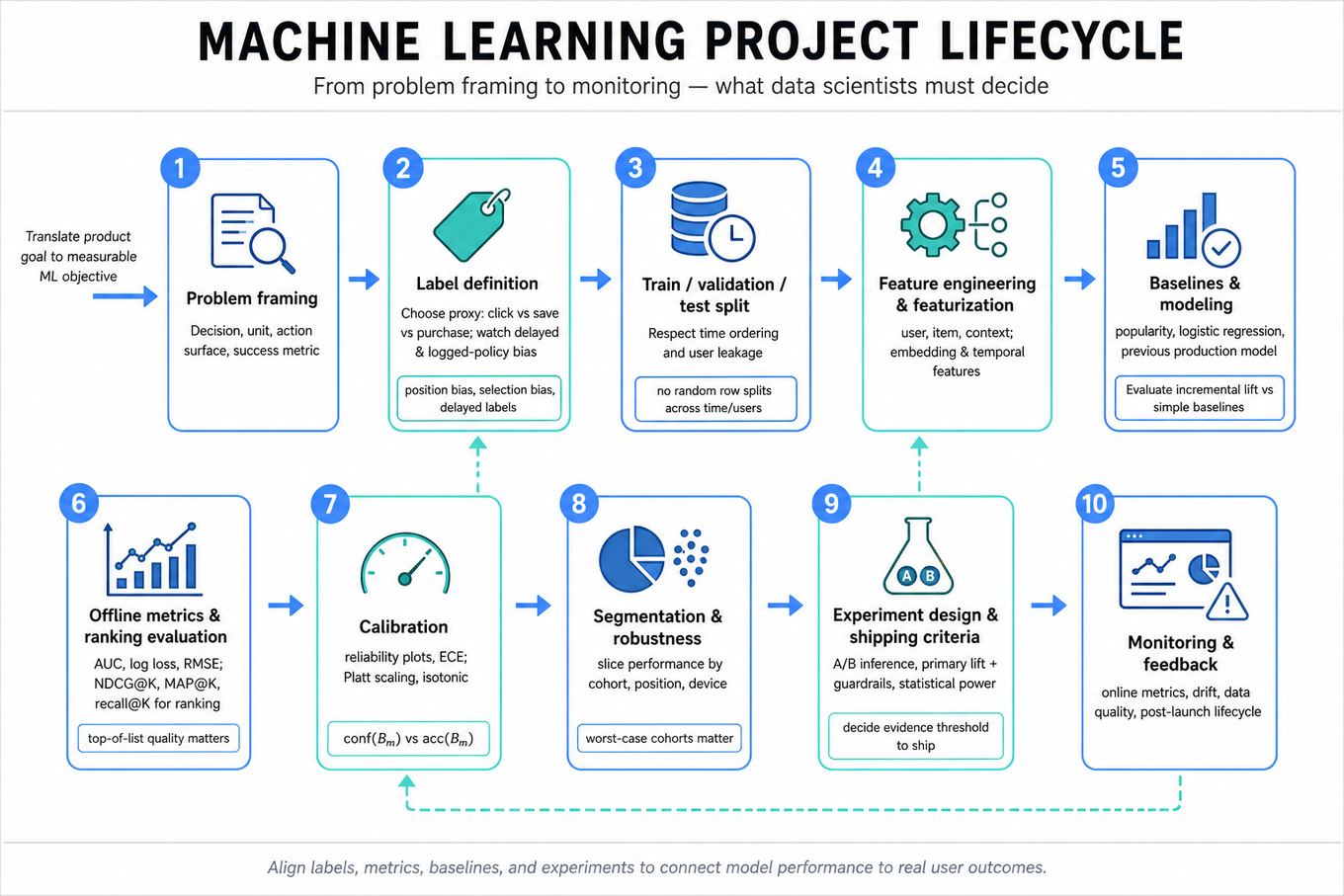
Interviewers are probing whether you can run the machine learning project lifecycle as a Data Scientist: translate a Pinterest-style product problem into a measurable ML objective, evaluate model quality offline, reason about ranking or recommendation tradeoffs, and decide what evidence is strong enough to ship. They care less about whether you can build serving infrastructure and more about whether you can defend choices around labels, features, metrics, baselines, calibration, segmentation, and experiment design. For Pinterest, this matters because recommender and ranking models affect home feed relevance, shopping discovery, ad quality, creator distribution, and long-term user retention. A strong answer shows you can connect model performance to user outcomes without hand-waving away statistical validity or business constraints.
Core knowledge
-
Problem framing comes before modeling: specify the decision being automated, prediction target, unit of prediction, action surface, and success metric. For Pinterest, “predict pin engagement” is weaker than “rank candidate Pins to maximize useful saves/clicks without hurting session satisfaction.”
-
Label definition is often the highest-leverage modeling choice. A click label may optimize curiosity, while saves, long-clicks, hides, purchases, or downstream sessions may better represent value. Watch for delayed labels, position bias, selection bias, and logged-policy bias in recommender data.
-
Offline metrics should match the model task. Use
AUCorlog lossfor binary classification,RMSE/MAEfor regression, andNDCG@K,MAP@K,MRR, or recall@K for ranking. For ranking, top-of-list quality usually matters more than average accuracy. -
Calibration matters when model scores are used as probabilities or combined with business rules. Check reliability plots and expected calibration error; for a probability bin , calibration compares to .
Platt scalingandisotonic regressionare common fixes. -
Baselines should include both simple and production-relevant references. A popularity model, recency heuristic, logistic regression, or previous model version often reveals whether
XGBoost,LightGBM, neural embeddings, or two-tower recommenders are adding real incremental value. -
Train/validation/test splitting must respect time and user leakage. Random row splits can leak future engagement or near-duplicate Pins across sets. For feeds and recommendations, prefer time-based splits and user- or item-aware checks when memorization is plausible.
-
Class imbalance changes evaluation and thresholding. For rare events like purchases or hides, accuracy is misleading; use precision-recall curves,
PR-AUC, lift, cost-weighted loss, or top-K recall. Sampling negatives can help training, but predicted probabilities may need correction. -
Regularization and overfitting controls depend on model family. Logistic regression uses
L1/L2; tree boosting uses max depth, learning rate, subsampling, and early stopping; neural recommenders use dropout, weight decay, and embedding constraints. Always compare train-vs-validation gaps. -
Hyperparameter search should avoid brute-force Cartesian explosion. Grid search with 6 parameters and 10 values each means trials; use random search, Bayesian optimization, successive halving, or targeted sweeps. Generate combinations lazily when enumeration is needed, but prioritize search strategy.
-
Metric tradeoffs are normal and should be explicit. A model may improve
CTRwhile hurting saves, hides, diversity, or creator fairness. For Pinterest, include guardrails such as hide rate, session length quality, fresh content exposure, shopping conversion, and long-term retention. -
Experiment design closes the lifecycle. Offline wins are not launch decisions; propose an
A/B testwith primary metric, guardrails, minimum detectable effect, power, duration, and segmentation. Analyze heterogeneous effects by new users, heavy users, country, platform, and content category. -
Monitoring from a DS lens means tracking model and product metrics after launch, not designing pipelines. Watch score distributions, feature missingness rates, calibration drift,
NDCG@Kproxies, engagement mix, and segment-level regressions to catch changes in user behavior or inventory.
Worked example
For “Explain your ML project end-to-end”, a strong candidate first clarifies the product goal, the prediction surface, and the launch criterion: “Are we ranking home feed Pins, predicting purchase propensity, or prioritizing notifications, and what metric defines success?” They should state assumptions, such as using historical impressions and engagements to train a ranking model, with NDCG@K and online saves/session as core evaluation metrics. The answer can be organized into five pillars: problem framing and metrics, data and labels, model development, evaluation and experimentation, and post-launch analysis.
For data and labels, they would discuss impression logs, user/content features, engagement labels, and biases like position bias or delayed conversions, without drifting into pipeline architecture. For modeling, they might start with logistic regression or gradient-boosted trees as a baseline, then compare against a ranking model optimized for top-K relevance. For evaluation, they would report offline metrics such as AUC, log loss, NDCG@10, calibration, and segment cuts, then explain why offline gains may not translate directly to user value. The key tradeoff to flag is between optimizing short-term clicks and long-term satisfaction: a click-heavy model may promote clickbait Pins, so saves, hides, return rate, or survey-based quality should be guardrails. They would close by saying that, with more time, they would run sensitivity checks on label windows, inspect error slices, estimate business impact, and design an A/B test with power calculations before recommending launch.
A second angle
For “Optimize Hyper-parameter Search to Prevent Combinatorial Explosion”, the same lifecycle thinking appears in the model development phase, but the constraint is computational and statistical efficiency rather than end-to-end storytelling. A Data Scientist should recognize that exhaustive grid search becomes infeasible when the search space grows multiplicatively, and that many hyperparameters contribute unevenly to model quality. A strong answer would propose random search for broad exploration, Bayesian optimization when evaluations are expensive, and early stopping or successive halving to kill weak configurations. The DS angle is not just “generate combinations lazily,” but “spend evaluation budget where it is most likely to improve validation performance while avoiding overfitting to the validation set.” They should also mention holding back a final test set because repeated tuning can leak information through metric peeking.
Common pitfalls
Pitfall: Optimizing the model metric while ignoring the product metric.
A tempting answer is “I chose the model with the highest AUC and shipped it.” That misses the Pinterest reality that ranking quality, user satisfaction, and creator/content ecosystem effects may matter more than a global classifier metric. A stronger answer ties offline metrics to online outcomes and names guardrails.
Pitfall: Describing implementation steps without analytical judgment.
Candidates often list “collect data, train model, deploy model, monitor model” as if the lifecycle were a checklist. Interviewers are looking for why you chose the label, why the split avoids leakage, why the baseline is fair, and what evidence would change your decision. Make tradeoffs explicit rather than narrating generic steps.
Pitfall: Treating hyperparameter search as purely mechanical.
Brute-force grid search sounds systematic but can waste huge compute and overfit the validation set. A better answer narrows ranges using model knowledge, uses random or adaptive search, applies early stopping, and preserves a clean test set for the final estimate.
Connections
Interviewers may pivot from here into recommender-system evaluation, A/B testing and causal inference, metric design, or bias and fairness in ranking systems. They may also ask how you would diagnose a launch where offline NDCG@K improved but online saves or retention declined.
Further reading
-
Rules of Machine Learning — Martin Zinkevich — Practical guidance on launching and iterating ML systems with metrics, baselines, and monitoring.
-
Random Search for Hyper-Parameter Optimization — Bergstra and Bengio, 2012 — Seminal paper explaining why random search often beats grid search under fixed evaluation budgets.
-
Recommender Systems Handbook — Ricci, Rokach, and Shapira — Broad reference for ranking metrics, collaborative filtering, evaluation, and recommender tradeoffs.
Featured in interview prep guides
Practice questions
- Explain your ML project end-to-endPinterest · Data Scientist · Technical Screen · hard
- Verify Machine-Learning Fundamentals for E-commerce Recommendation PlatformPinterest · Data Scientist · Onsite · hard
- Optimize Hyper-parameter Search to Prevent Combinatorial ExplosionPinterest · Data Scientist · Onsite · medium
Related concepts
- Supervised ML Workflows, Interpretability And DeploymentMachine Learning
- Machine Learning Model Design And EvaluationMachine Learning
- Applied Machine Learning Modeling And EvaluationMachine Learning
- Production ML Systems, Evaluation, And SafetyML System Design
- Production ML Pipelines And System DesignML System Design
- ML System Design, Recommenders, Forecasting And AllocationMachine Learning