Quantization
Asked of: Software Engineer
Last updated
What's being tested
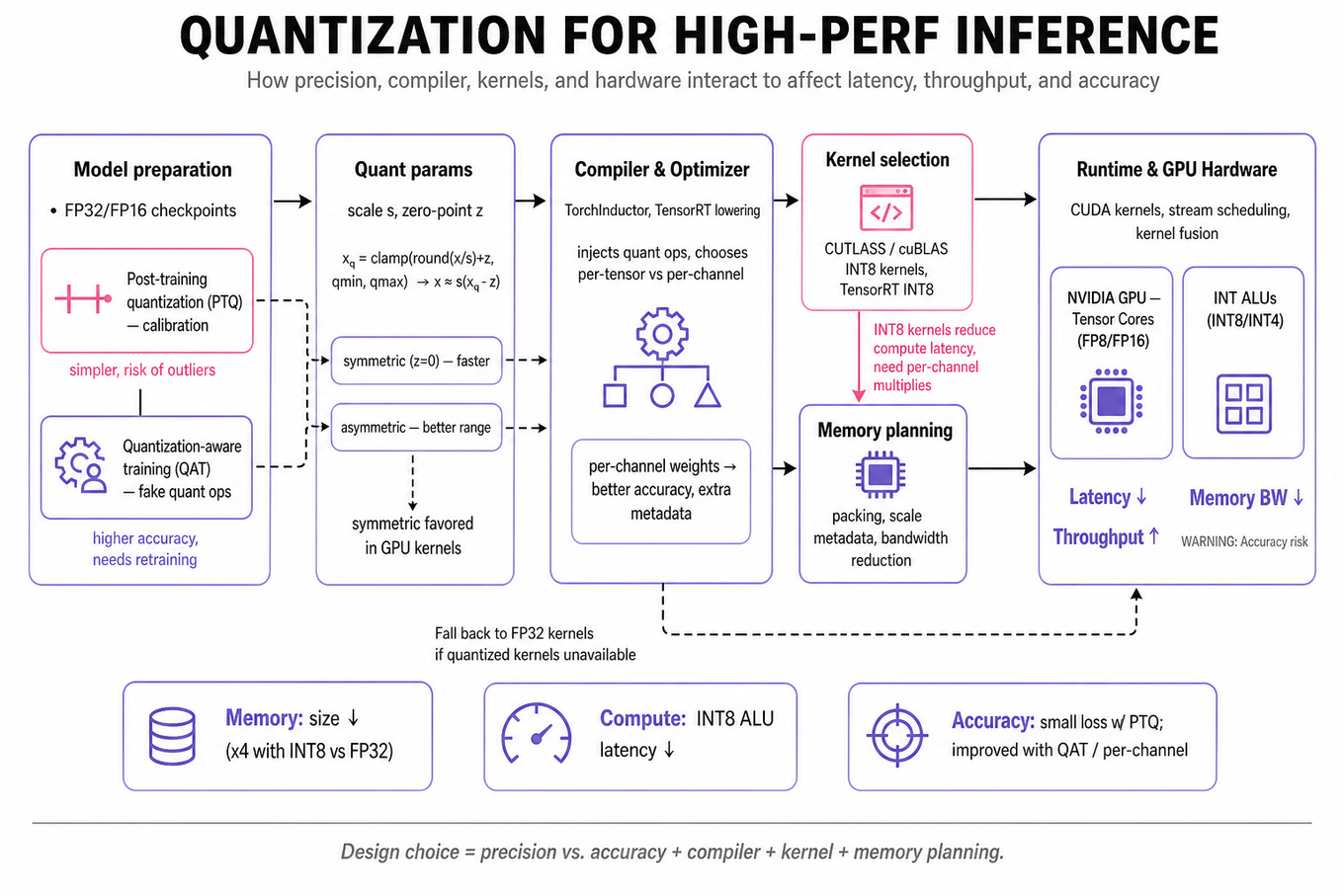
Interviewers are probing whether you can reason about quantization as a systems optimization, not just define “INT8 instead of FP32.” For a Software Engineer at NVIDIA, this means understanding how lower-precision arithmetic affects latency, throughput, memory bandwidth, kernel selection, compiler lowering, and GPU hardware utilization. You should be able to explain where quantization fits alongside kernel fusion, memory planning, operator scheduling, and parallelism strategies such as tensor parallelism and pipeline parallelism. The strongest answers connect the model-level idea to concrete runtime behavior in systems like TensorRT, PyTorch, TorchInductor, CUDA, and modern NVIDIA GPUs.
Core knowledge
-
Quantization maps high-precision tensors, typically
FP32orFP16, into lower-precision representations such asINT8,INT4,FP8, or binary formats. The goal is to reduce memory footprint and bandwidth while using faster hardware instructions where available. -
The basic affine mapping is where is the scale and is the zero-point. Dequantization approximates the original value as
-
Symmetric quantization uses zero-point , often simpler and faster for GPU kernels. Asymmetric quantization better represents ranges not centered around zero but adds arithmetic overhead. For high-throughput inference kernels, symmetric per-channel weight quantization is often preferred.
-
Per-tensor quantization uses one scale for an entire tensor; per-channel quantization uses separate scales per output channel, commonly improving accuracy for convolution and matrix multiply weights. Per-channel scaling costs extra metadata and arithmetic but is usually worthwhile for weights.
-
Post-training quantization converts an already trained model using calibration data. It is operationally simpler but can hurt accuracy when activation distributions are outlier-heavy. Quantization-aware training simulates quantization during training and usually preserves quality better, though it requires access to training code and retraining infrastructure.
-
Calibration estimates activation ranges using representative inputs. Common strategies include min/max clipping, percentile clipping, and KL-divergence calibration as used in tools like
TensorRT. A bad calibration set can produce excellent microbenchmarks but poor real-world output quality. -
Dynamic quantization computes activation scales at runtime, which can improve robustness for variable inputs but adds overhead. Static quantization precomputes scales from calibration, enabling more compiler optimization and generally better inference latency.
-
Hardware support matters.
NVIDIATensor Cores accelerate matrix operations for formats such asFP16,BF16,TF32,INT8, and on newer architecturesFP8. A quantized model is only faster if the compiler/runtime lowers it to kernels that actually use those hardware paths. -
Quantization mainly helps when the workload is memory-bandwidth-bound or uses matmul/convolution kernels with optimized low-precision implementations. It may not help small batch sizes, irregular operators, control-heavy graphs, or pipelines dominated by preprocessing, tokenization, CPU-GPU transfers, or synchronization.
-
In ML compilers, quantization interacts with graph rewriting. Patterns like
quantize -> matmul -> dequantizemay be fused into a single quantized GEMM. Poor graph boundaries, unsupported operators, or layout conversions can erase expected wins by inserting extraQ/DQ,cast, ortransposenodes. -
Benchmarking must separate end-to-end latency, kernel time, throughput, memory usage, and accuracy/quality regression. For serving, report warmup behavior, batch size, sequence length,
p50/p95/p99, GPU utilization, memory bandwidth, and whether measurements include host-device transfer. -
Quantization is not a replacement for parallelism. Tensor parallelism splits large tensor operations across GPUs, while pipeline parallelism splits model layers into stages. Quantization reduces per-GPU memory and communication volume, but it introduces scale handling and possible dequantization boundaries that must be considered.
Worked example
For “Design and benchmark optimized inference pipelines”, a strong candidate would first frame the problem around workload shape: “Am I optimizing a transformer, CNN, or mixed operator graph; what are the batch sizes, latency targets, GPU type, and acceptable quality regression?” They would state an assumption, such as targeting offline or online inference on NVIDIA GPUs with a PyTorch model exported through torch.compile, ONNX, or TensorRT.
The answer skeleton should have four pillars: first, establish a reliable baseline with FP16 or BF16; second, apply graph-level optimizations such as operator fusion, layout selection, and static memory planning; third, evaluate quantization choices like INT8, FP8, per-channel weights, and calibration strategy; fourth, benchmark with production-like inputs and report both performance and correctness metrics.
A strong candidate would explicitly mention that quantization is only beneficial if the runtime emits optimized kernels, for example INT8 Tensor Core GEMMs rather than quantizing tensors and then falling back to slower generic kernels. They would also flag the tradeoff between static calibration and dynamic activation scaling: static calibration enables better compiler optimization, but dynamic scaling can handle distribution shifts at runtime.
For benchmarking, they would avoid a single “tokens/sec” or “images/sec” number and instead compare warm versus steady-state latency, GPU utilization, memory footprint, and any inserted cast or dequantization operations in the compiled graph. They might inspect generated graphs from TorchDynamo, TorchInductor, or TensorRT engine logs to verify the expected low-precision path.
A good close would be: “If I had more time, I’d add A/B validation against representative traffic, inspect unsupported operators causing precision fallbacks, and test whether kernel fusion or batching gives larger gains than quantization alone.”
A second angle
For “Explain ML compilation optimizations and hardware fit”, the same concept is framed less as a deployment pipeline and more as compiler lowering. Here, the interviewer wants to know whether you understand how a high-level graph becomes hardware-efficient GPU code. Quantization is one pass among many: the compiler must choose layouts, fold constants, fuse Q/DQ patterns, tile matrix operations, allocate memory buffers, and schedule kernels to match Tensor Core capabilities. The key difference is that the answer should emphasize representation and lowering decisions rather than only benchmarking outcomes. A strong response would explain that an INT8 graph is not inherently fast; it becomes fast when the compiler can legally transform it into fused, tiled, low-precision kernels with minimal format conversions.
Common pitfalls
Pitfall: Treating quantization as a guaranteed 4x speedup because
INT8is four times smaller thanFP32.
This ignores bottlenecks. If the pipeline is dominated by CPU preprocessing, memory copies, unsupported operators, synchronization, or small GEMMs with poor occupancy, lower precision may give little benefit. A better answer says quantization reduces memory bandwidth and can unlock specialized hardware instructions, but speedup depends on kernel coverage and end-to-end profiling.
Pitfall: Explaining only accuracy tradeoffs and ignoring systems effects.
For a Software Engineer interview, don’t spend the whole answer on model quality, loss curves, or training recipes. Mention quality regression, but anchor the discussion in runtime behavior: graph rewrites, kernel selection, data layout, calibration artifacts, memory footprint, and profiling with realistic batch sizes.
Pitfall: Using vague phrases like “the compiler optimizes it” without naming the actual transformations.
A stronger answer names concrete compiler/runtime actions: fusing quantize/dequantize with GEMM, removing redundant casts, choosing NHWC or tensor-core-friendly layouts, tiling matrix multiplies, planning activation buffers, and avoiding precision fallback around unsupported ops.
Connections
Interviewers may pivot from quantization into kernel fusion, mixed precision, Tensor Core architecture, model parallelism, or PyTorch compilation internals such as TorchDynamo, AOTAutograd, and TorchInductor. They may also ask how quantization interacts with serving concerns like batching, memory pressure, GPU utilization, and p99 latency.
Further reading
-
NVIDIA TensorRT Developer Guide — practical details on calibration, precision modes, engine building, and GPU inference optimization.
-
PyTorch Quantization Documentation — useful overview of static, dynamic, and quantization-aware workflows in
PyTorch. -
Jacob et al., “Quantization and Training of Neural Networks for Efficient Integer-Arithmetic-Only Inference” — foundational paper explaining affine quantization and integer-only inference mechanics.
Featured in interview prep guides
Practice questions
- Explain ML compilation optimizations and hardware fitNVIDIA · Software Engineer · Technical Screen · medium
- Explain optimization and tensor vs pipeline parallelismNVIDIA · Software Engineer · Technical Screen · hard
- Explain ML framework trendsNVIDIA · Software Engineer · Technical Screen · hard
- Design and benchmark optimized inference pipelinesNVIDIA · Software Engineer · Technical Screen · medium
Related concepts
- Real-Time Edge Inference OptimizationML System Design
- ML Frameworks, Model Compilation, And ParallelismML System Design
- Streaming, Large Inputs, And External MemorySoftware Engineering Fundamentals
- Low-Level Performance EngineeringSystem Design
- LLM Inference Optimization And KV CacheSoftware Engineering Fundamentals
- ML Model Evaluation, Metrics, And ExperimentationML System Design