What to expect
Anthropic's Software Engineer interview is built to find people who write clean, adaptable code and reason honestly about systems, ownership, and the risks of the AI they're building. It leans toward practical, implementation-heavy engineering over algorithm trivia, and it screens hard for genuine mission alignment. This guide walks through every stage, what each round actually evaluates, and how to prepare so you're not surprised on the day.
It's written for engineers at any level applying to a generalist or infrastructure-leaning SWE role. If you came here hoping for a list of LeetCode patterns to memorize, this process rewards a different kind of preparation, and the sections below explain exactly what to do instead.
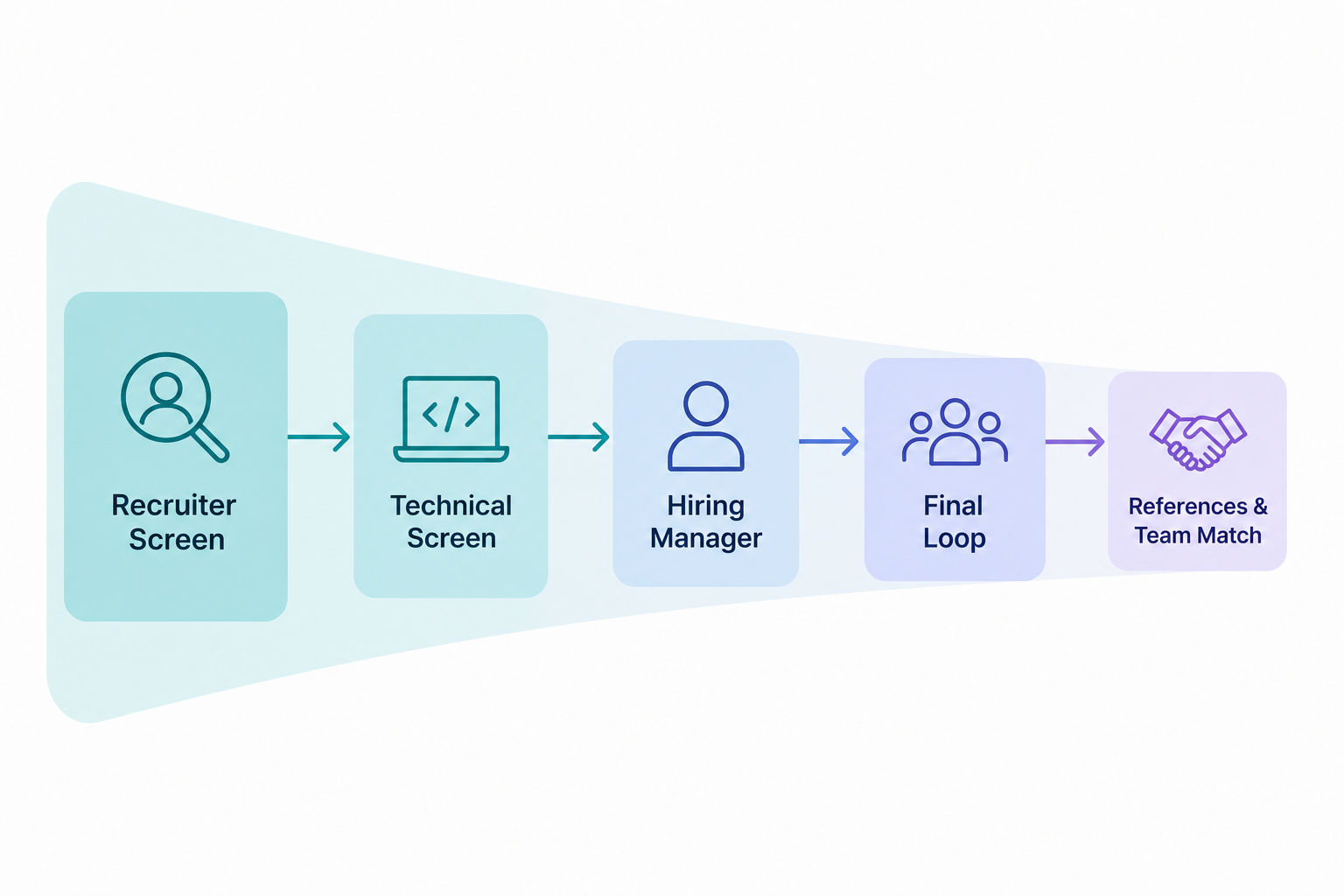
The interview process at a glance
The loop is typically 4 to 6 stages, with variation by team and level. Most candidates move through them in this order:
| Stage | Format | Length | Primary focus |
|---|---|---|---|
| Recruiter screen | Phone / video | ~30 min | Motivation, role fit, logistics |
| Technical screen | Live coding | 50-55 min | Practical implementation, adaptability |
| Hiring manager | Structured chat | 45-60 min | Ownership, tradeoffs, scope |
| Final loop | 4-5 interviews | ~4 hrs | Full profile: coding, design, values |
| References + team match | Async / calls | Varies | Validation and placement |
The overall tone tends to be rigorous and direct, with limited small talk and a high bar for authenticity. Treat every stage as a real evaluation, including the recruiter screen.
Interview rounds
Recruiter screen
A roughly 30-minute phone or video call covering your motivation for Anthropic, high-level role fit, communication, and logistics like compensation expectations and work authorization.
This round tends to carry more weight than the equivalent call at many companies, because Anthropic screens early for genuine interest in safe, beneficial AI rather than generic enthusiasm for "working in AI." Come ready to explain why this mission matters to you and what kinds of problems you actually want to work on.
Initial technical screen
A live coding interview with an engineer, usually 50-55 minutes (some variants run longer as a take-home-style challenge). It often uses Python and emphasizes practical implementation over pure pattern-matching.
You'll be evaluated on:
- Clean, modular code and sensible APIs
- Edge-case handling and debugging
- How well you adapt when the interviewer changes requirements mid-problem
Problems are frequently multi-step. A representative shape: build a small in-memory system, then extend it with things like timestamps, TTL (time-to-live expiry), or serialization. The extension is the real test, not the first working version.
For instance, you might be asked to implement an in-memory key-value store with set and get, then partway through be told to add per-key expiry, then a get_all that excludes expired keys, then snapshotting to disk. The interviewer is watching whether your original design absorbs each new requirement cleanly or forces a rewrite.
Hiring manager interview
A 45-60 minute structured conversation rather than a coding round, focused on role fit, ownership, decision-making, collaboration, and whether you're likely to succeed in Anthropic's environment.
Expect questions about your most important projects, how you make tradeoffs, how much scope you've owned, and why you want this role now. For experienced candidates, this round tends to probe depth of responsibility more than breadth of technologies.
Final interview loop
The final loop is typically 4-5 interviews of about 45-55 minutes each, often compressed into roughly four hours across one or two days. A common mix:
- One or two coding rounds
- A system design round
- A technical project deep dive
- A behavioral or values-focused interview
This stage evaluates your full profile: coding ability, architecture judgment, project ownership, communication, and alignment with Anthropic's culture. Senior and staff candidates may see deeper or earlier system design, and some candidates are given topic hints (for example Python, multithreading, low-level design, or system design) ahead of time. If you get a hint, take it literally and prepare narrowly.
Reference checks and team matching
After the loop, Anthropic commonly conducts reference checks and then team matching, especially for broader software engineering openings. Timing varies, and team placement may happen only after you've cleared the general bar.
At this stage they're validating your technical impact, reliability, collaboration, and follow-through on real projects. The practical implication: be prepared to speak broadly about your fit for the company, not just for one narrowly defined team.
What they actually test
Anthropic rewards practical engineering skill over interview-game fluency. Four themes show up repeatedly across the loop.
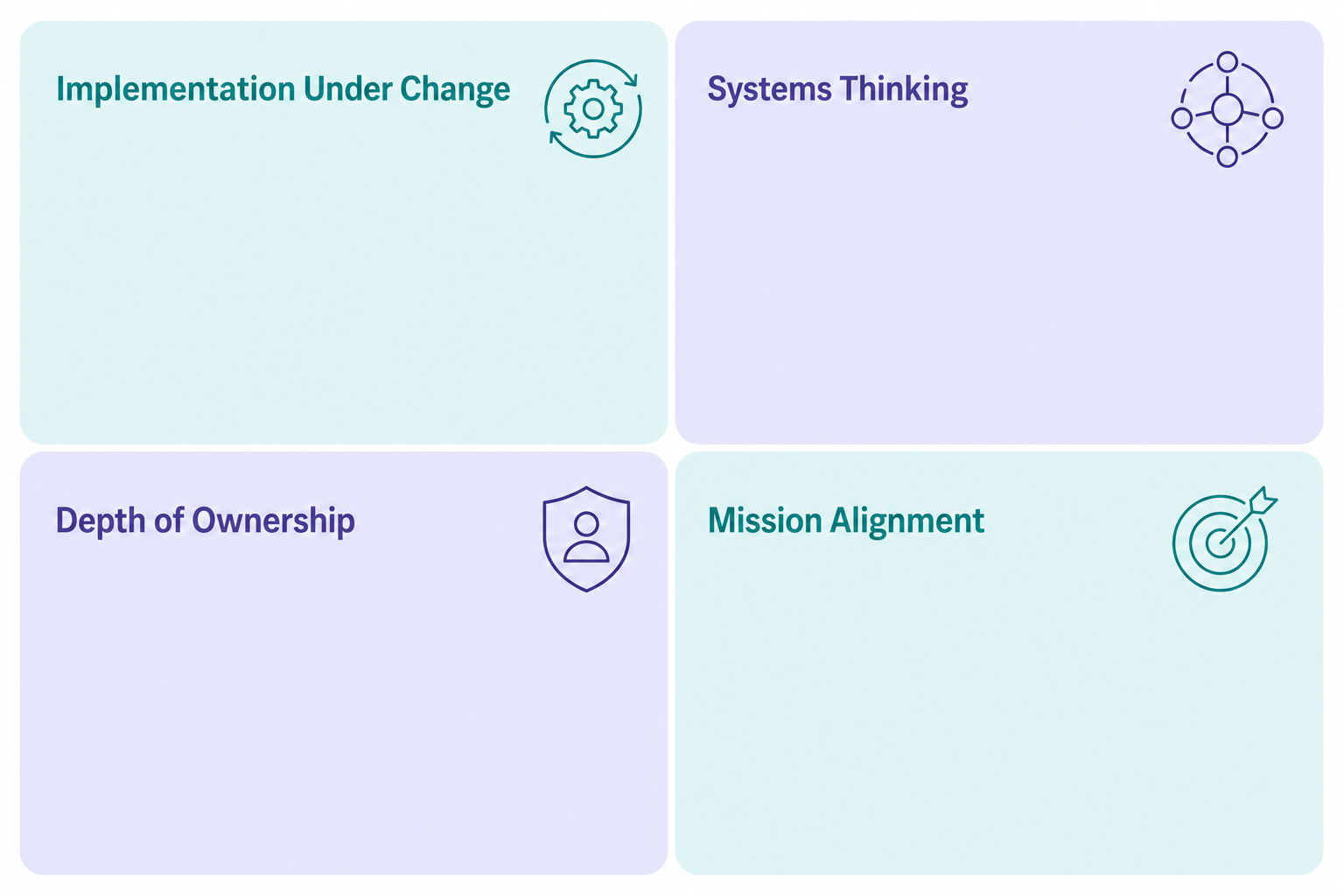
| Theme | What good looks like | What gets you dinged |
|---|---|---|
| Implementation under change | Clean interfaces that absorb new constraints; you refactor calmly | Brittle code that needs a rewrite each time requirements shift |
| Systems thinking | Reasoning about queues, caching, retries, throughput vs. latency | Hand-waving on failure modes and operational reality |
| Depth of ownership | Explaining why a design was chosen, what failed, what you'd redo | Thin resume bullets that collapse under follow-up |
| Mission alignment | Honest, specific reasoning about safety and downside risk | Generic "I'm excited about AI" with no substance |
Implementation under change. Coding rounds favor clean APIs, modularity, state management, debugging, and extensibility. Interviewers often add constraints midstream, so the real test isn't getting something working fast, it's designing code that can absorb change without collapsing.
Systems thinking. Be comfortable discussing distributed-systems building blocks: queues, batching, caching, sharding, routing, rate limiting, retries, fault tolerance, and throughput-versus-latency tradeoffs. Infrastructure-leaning roles place extra weight on resource management, database behavior, reliability, and performance under real constraints. Some prompts may be framed around inference serving, retrieval, or GPU usage, but the underlying evaluation is usually standard architecture judgment, not niche ML research knowledge.
Depth of ownership. In the project deep dive you'll need to explain why a system was designed the way it was, what failed, how you measured success, where the bottlenecks were, and what you'd redesign now. Interviewers tend to probe until they find the boundary of your real understanding, so shallow bullets get exposed quickly.
Cultural and mission alignment. Expect direct evaluation of intellectual honesty, long-term thinking, and your ability to reason about safety, downside risks, and responsible deployment. The signal they seem to want is an engineer who codes well and communicates clearly, makes careful tradeoffs, and takes the consequences of AI systems seriously.
How to prepare
A focused four-week plan beats months of unfocused grinding for this loop. Prioritize in this order:
- Drill implementation-heavy coding in Python, especially problems whose requirements expand mid-exercise. Practice keeping code clean as new constraints land, rather than optimizing only for a fast first pass. The PracHub question bank has implementation-style and design-leaning problems you can practice this way.
- Write a specific "why Anthropic" answer tied to reliable, steerable, and beneficial AI. "I want to work in AI" is too generic for this process. Draft it, say it out loud, and cut anything that could apply to any AI company.
- Narrate as you build. State assumptions, interfaces, failure modes, and extension points out loud. Interviewers assess how you think under evolving requirements, not just whether you finish.
- Practice infrastructure system design through AI-flavored scenarios like inference serving, batching, retrieval, or constrained compute. Center answers on queues, caching, hot-spot avoidance, retries, and operational tradeoffs.
- Pick one or two projects you genuinely owned and rehearse them in depth - architecture, metrics, bottlenecks, incidents, tradeoffs, and what you'd change today. Shallow ownership doesn't survive the deep dive.
- Bring concrete examples of choosing safety, reliability, or long-term quality over short-term speed. The behavioral bar here skews mission- and risk-oriented.
If your portal shows a domain hint (Python, multithreading, low-level design, or system design), tailor prep narrowly to that domain instead of grinding broadly.
A practical 4-week split
| Week | Focus | Concrete goal |
|---|---|---|
| 1 | Implementation coding | 8-10 multi-step build-then-extend problems in Python |
| 2 | System design | 5-6 infra scenarios; build a reusable mental checklist |
| 3 | Project deep dive + behavioral | Two stories rehearsed end to end; draft "why Anthropic" |
| 4 | Mocks + weak spots | Timed mocks while narrating; patch whatever broke |
You can pull realistic prompts from other Anthropic interview questions and broaden with software engineer interview questions across other companies.
Worked example: handling a mid-problem requirement change
The single most common way candidates lose points is freezing or rewriting when the interviewer adds a constraint. Here's how to keep it clean.
Example prompt: "Implement a rate limiter that allows N requests per user per minute." You ship a working sliding-window version. Then: "Now make it work across multiple servers." Then: "Now make the limit configurable per user tier."
Example of a strong response pattern:
- Restate the new requirement and name the design seam it touches ("the counter store has to move from in-process to shared, so I'll put it behind a
Storeinterface"). - Call out the tradeoff out loud ("a shared Redis counter adds a network hop and a failure mode; if Redis is down do we fail open or closed?").
- Make the smallest change that satisfies the new constraint without breaking the old behavior, then confirm the original cases still pass.
The content of your answer matters less than showing that your first design had a seam to extend, and that you reason about failure modes before writing more code.
Common pitfalls
- Optimizing for speed-to-first-solution. A fast brute force that can't extend loses to a slightly slower design that absorbs the next three requirements.
- Generic mission answers. Saying you're "passionate about AI" reads as a non-answer here. Be specific about reliability, steerability, and risk.
- Resume gloss. If you didn't actually own the design decisions in a project, don't lead with it. The deep dive will find the edge of your understanding.
- Silent coding. Heads-down typing hides exactly the reasoning they're trying to evaluate. Narrate.
- Skipping failure modes in design. Naming retries, timeouts, and what happens when a dependency is down is often the difference between a pass and a borderline score.
Key takeaways
- The bar is "strong engineer who also reasons clearly about systems, ownership, and AI safety," not "fastest algorithm solver."
- Clean, adaptable code under changing requirements beats a quick brute-force answer.
- Mission alignment is evaluated genuinely and early; prepare for it like a technical round, not an afterthought.
- Be ready to defend the depth of your past work. The deep dive rewards real understanding and punishes resume gloss.
For more company-specific walkthroughs, browse the full interview guide library or jump straight into the practice question bank.
How to Use This Page as a Prep Plan
Do not treat this as passive reading. Convert the ideas in this page into a short weekly loop: learn one idea, practice it under interview conditions, then write down what changed. That is the fastest way to turn advice into visible interview behavior.
| Prep area | What you need to prove | Practice artifact |
|---|---|---|
| Understand | Turn the prompt into a concrete goal. | Clarifying questions and success criteria. |
| Practice | Use realistic constraints and timed reps. | Worked examples with edge cases. |
| Explain | Make reasoning visible. | Tradeoffs, assumptions, and test strategy. |
| Improve | Review misses quickly. | A short feedback log and next action. |
For Anthropic Software Engineer Interview Guide 2026, the strongest candidates usually do three things well: they make their assumptions explicit, they use concrete examples instead of vague claims, and they review mistakes quickly enough that the next practice rep is better than the last one.
FAQ
Does Anthropic ask LeetCode-style algorithm questions?
Less than most big tech companies. The coding rounds lean toward practical, multi-step implementation problems (build something, then extend it) rather than memorized algorithm patterns. Solid fundamentals still help, but clean, adaptable code under changing requirements is what's actually scored.
How many interview rounds are there?
Typically 4 to 6 stages: a recruiter screen, a technical coding screen, a hiring manager conversation, a final loop of 4-5 interviews, and then reference checks plus team matching. The exact count varies by team and level.
Do I need machine learning or AI research knowledge to pass?
Generally no, for most software engineering roles. Some prompts are framed around AI-flavored scenarios like inference serving or retrieval, but they usually test standard architecture judgment (queues, caching, retries, tradeoffs) rather than ML research depth. Infrastructure roles weight systems and reliability more heavily.
What language should I use for the coding rounds?
Python is common and a safe default, and many problems are framed with it in mind. Use the language you're fastest and cleanest in, and confirm with your recruiter if you're unsure.
How important is the "why Anthropic" answer?
Important enough to prepare like a technical question. The recruiter screen and the behavioral round both probe genuine interest in safe, beneficial AI. A specific answer tied to reliability, steerability, and responsible deployment lands far better than generic enthusiasm for working in AI.
How long does the whole process take?
It varies by team, scheduling, and level, so plan for a few weeks end to end rather than a fixed timeline. The final loop itself is often compressed into one or two days, but reference checks and team matching can add time afterward.