A Microsoft Data Engineer interview can combine SQL, coding, data architecture, operational judgment, and competency-based questions. The exact mix depends on the team, level, and job description.
At a glance: Microsoft says most interviews include two to four conversations, each lasting up to one hour. Coding or a work sample may be included for some roles. Confirm the exact plan with your recruiter. (Microsoft Careers: How we hire)
This guide turns current Microsoft Careers postings and Microsoft Learn documentation into a practical preparation plan. Its 20 questions are original practice prompts—not a disclosed or fixed Microsoft question set.
What the role can cover
Microsoft uses the Data Engineer title across teams with different products and technical constraints. The common thread is turning raw data into reliable, secure, and usable data products.
A current Principal Data Engineer opening in CoreAI highlights work such as:
- Architecture: Own end-to-end data and analytics architecture for AI platforms.
- Pipelines: Build and optimize large-scale ETL and ELT workflows.
- Scale: Process high-volume, high-velocity data from multiple sources.
- Trust: Establish quality, lineage, security, privacy, and compliance controls.
- Modeling: Build semantic layers and data models for trusted analytics.
- Operations: Improve the reliability, scalability, and cost efficiency of distributed systems.
- Collaboration: Work across engineering, research, product, analytics, and business teams.
The posting names Azure Data Lake, Spark, Synapse, SQL, Azure Data Explorer, and PySpark, but those technologies are not a universal checklist for every Microsoft team. (Microsoft Careers: Principal Data Engineer - CoreAI)
Microsoft's Fabric Data Engineer profile provides another useful baseline: data architecture, ingestion, transformation, orchestration, security, monitoring, and optimization, with SQL, PySpark, and Kusto Query Language among the relevant skills. (Microsoft Learn: Fabric Data Engineer Associate)
Your best starting point: read the target job description line by line and mark every required language, platform, architecture pattern, and business domain. The interview is more likely to follow that requisition than a generic online checklist.
Interview process
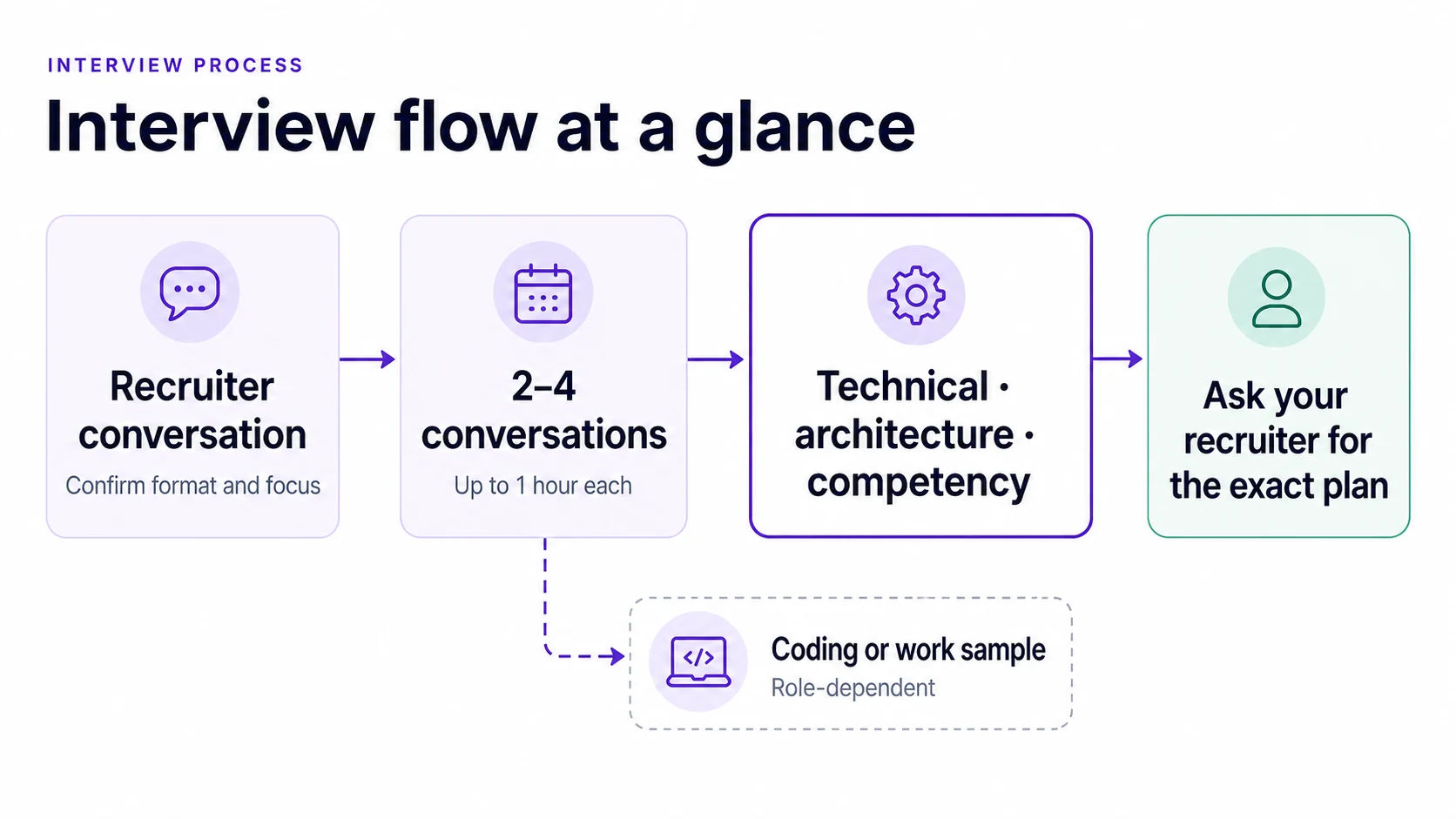
A preparation map based on Microsoft's general hiring guidance. The sequence is role-dependent; it is not a guaranteed interview loop.
1. Recruiter conversation
Be ready to explain why the role fits your experience and what kinds of data systems you have owned. Keep one concise example available for batch processing, streaming, data modeling, reliability, and stakeholder collaboration.
Ask for the interview count, format, focus areas, coding environment, and expected timeline. Microsoft directs candidates to their recruiter for the role-specific schedule. (Microsoft Careers: Interview tips)
2. Technical problem solving and coding
Microsoft's technical-interview guidance emphasizes technical principles, problem solving, agility, and strategic thinking. Candidates are advised to clarify ambiguity, plan before implementing, write runnable code in a familiar language, and test their work. (Microsoft Careers: Technical interviewing)
For a Data Engineer role, prepare to manipulate data in SQL and a general-purpose language such as Python. Explain correctness, complexity, edge cases, and tests—not only the happy-path answer.
3. Data-system or architecture discussion
You may be asked to design a pipeline, warehouse, lakehouse, streaming platform, or governed analytics layer. Start with requirements, then cover:
- Data contracts, volume, throughput, and latency.
- Storage, transformations, and serving patterns.
- Observability, recovery, security, and governance.
- Cost, operational complexity, and future scale.
Do not force Microsoft Fabric or Azure services into every answer. Select technology only after defining the constraints. For Fabric-focused roles, understand how OneLake, pipelines, notebooks, Spark, warehouses, and Delta tables fit together. (Microsoft Learn: Fabric Data Engineering overview)
4. Competency and resume discussion
Microsoft says its interviews include competency-based and resume questions. Current guidance highlights collaboration, drive for results, respect, integrity, accountability, and growth mindset. Microsoft recommends STAR(R): Situation, Task, Action, Result, and Reflection. (Microsoft Careers: Interview tips)
For each resume project, know the scale, service-level objective, failure modes, trade-offs, your individual contribution, and measured result. Finish with what you learned and what you would change.
What to prepare
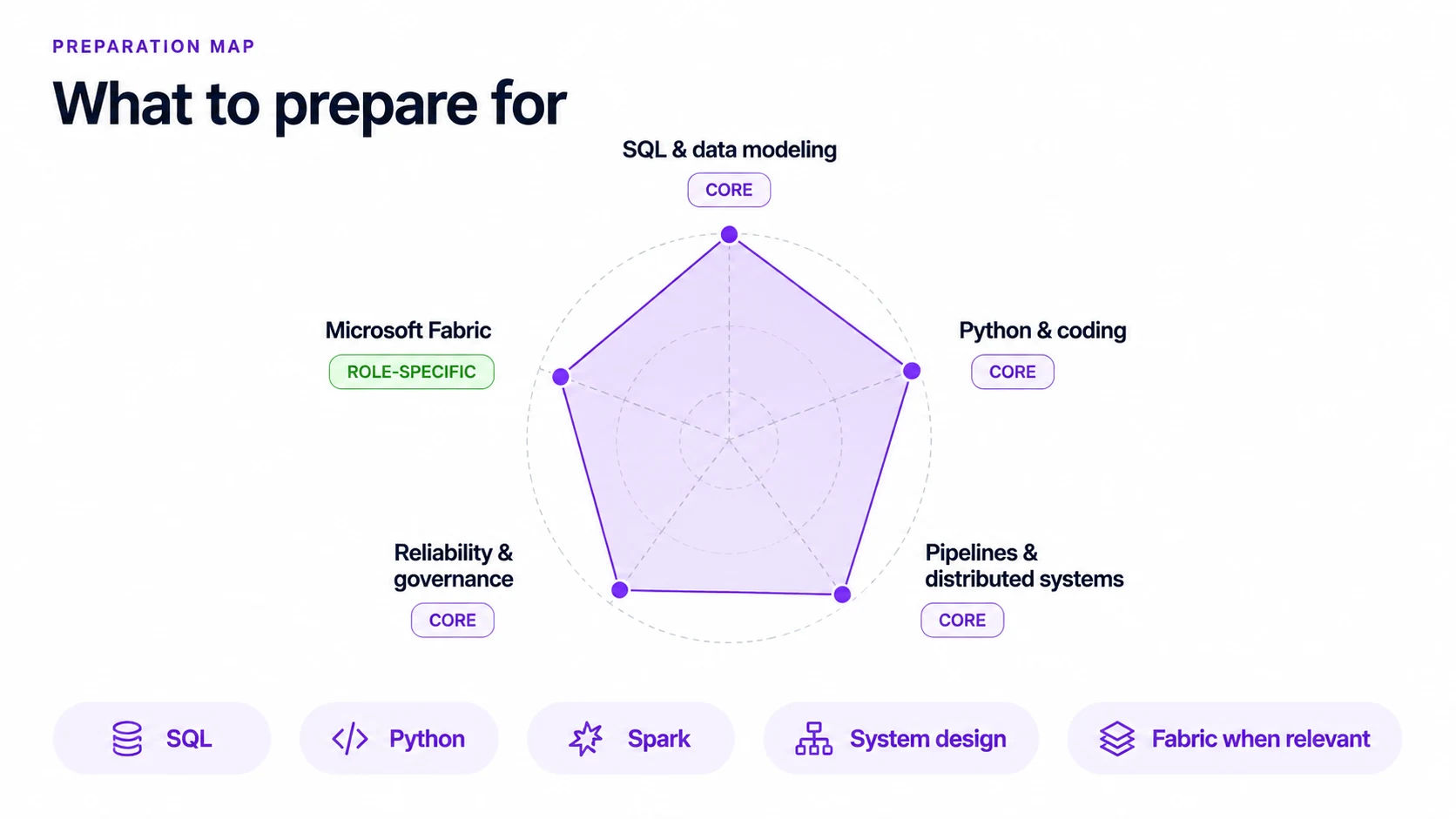
An editorial preparation map, not a claim about the frequency or weighting of Microsoft interview topics.
SQL and data modeling
Focus on: joins, aggregations, CTEs, subqueries, window functions, nulls, duplicates, sparse time series, deterministic tie-breaking, dimensional modeling, slowly changing dimensions, and query performance.
Practice habit: state the input and output grain first. Then define how duplicates, nulls, timestamps, and ties should behave before writing the query.
Python and coding fundamentals
Focus on: core data structures, iterators and generators, nested JSON, malformed records, unit tests, boundary cases, complexity, retry safety, idempotency, and checkpointing.
Practice habit: write clean, executable code in your strongest language. Explain when an in-memory solution stops being safe and how it would change for distributed data.
Distributed processing and Spark
Focus on: narrow and wide transformations, shuffles, partition sizing, skew, broadcast joins, drivers and executors, caching, checkpointing, failure recovery, small files, and batch-versus-streaming semantics.
Practice habit: diagnose before optimizing. Use execution plans and metrics to distinguish skew, shuffle cost, join strategy, memory pressure, and partition-count problems.
Lakehouse, warehouse, and Microsoft Fabric
Microsoft's current DP-700 study guide covers analytics-solution management, ingestion and transformation, and monitoring and optimization. It includes workspace settings, lifecycle management, security, orchestration, warehouse loading, Spark, Eventstreams, and performance. (Microsoft Learn: DP-700 study guide)
Be ready to compare:
- Warehouse versus lakehouse.
- Row-oriented versus column-oriented storage.
- Batch versus streaming ingestion.
- Full refresh versus incremental processing.
- ETL versus ELT.
- Star schemas versus normalized operational schemas.
- Managed tables versus external data and shortcuts.
For Fabric-oriented roles, understand that Delta Lake is a common storage format in OneLake. Delta combines Parquet files with a transaction log and supports ACID transactions, time travel, schema evolution, and unified batch and streaming access. (Microsoft Learn: Delta Lake overview)
Reliability, security, and governance
Focus on: data contracts, schema evolution, backfills, replay, deduplication, quality checks, quarantine paths, lineage, retention, deletion, encryption, identity, least privilege, monitoring, recovery objectives, and cost controls.
Practice habit: connect every control to a failure or threat. For example, an idempotency key prevents a retry from duplicating an event, while a freshness monitor detects a successful job that produced stale output.
Question bank
These 20 role-relevant questions are included directly in this Guide. They are original practice prompts, not a disclosed Microsoft question set.
SQL and analytics
- Write a query that calculates a seven-business-day rolling revenue average for each product when dates may be missing.
- Return each employee's cumulative salary within a department, ordered by salary with deterministic handling of ties.
- Return every active user's first and latest event, including users who have no events.
- Identify duplicate customer records using a business key, preserve one canonical record, and flag the rest for review.
- Explain how you would break a multi-stage reporting query into CTEs, and when materializing an intermediate result would be preferable.
- Compare
UNIONandUNION ALL, including correctness and performance implications. - Design a model that preserves the history of customer attributes while supporting point-in-time reporting.
Python and data manipulation
- Implement median and 25th-percentile calculations for an unsorted array without a statistics library. Define the percentile convention you use.
- Parse nested JSON records from a stream, flatten selected fields, reject malformed records, and keep memory usage bounded.
- Merge overlapping time intervals and explain the algorithm's time and space complexity.
- Implement binary search and write tests for an empty list, duplicate values, and a missing target.
- Process a file larger than available memory and produce grouped counts without loading the full dataset at once.
Pipelines and distributed systems
- Migrate a legacy batch ETL pipeline to an ELT architecture while preserving data quality and reconciliation controls.
- Diagnose a Spark join that runs slowly because a small number of keys contain most of the rows.
- Design a high-throughput event pipeline with a stated freshness target, replay support, and duplicate protection.
- Design a medallion lakehouse and explain what validation moves data from bronze to silver and from silver to gold.
- Add privacy, lineage, access control, and deletion workflows to a cloud data pipeline.
- Explain how your pipeline recovers when processing succeeds but the checkpoint update fails.
Behavioral and execution
- Tell me about a deployment or data pipeline failure you owned. How did you restore service, communicate impact, and prevent recurrence?
- Describe a time you challenged a stakeholder's requested design because of reliability, security, cost, or data-quality risk.
Answer frameworks
SQL: semantics before syntax
For a rolling-average question, first clarify whether “seven days” means calendar days, business dates, or existing rows. Ask how holidays and missing dates are represented. Then:
- Build or use a calendar table when calendar semantics matter.
- Aggregate facts to the required grain.
- Apply the correct window ordering and frame.
- Test gaps, nulls, duplicate transactions, and empty periods.
Spark: evidence before optimization
For a skewed join, inspect stage duration, task-size distribution, shuffle read/write, spill, executor memory, and key-frequency samples. Then compare options such as broadcasting a genuinely small table, filtering earlier, correcting partitioning, isolating hot keys, salting, or changing the model. State how you would measure improvement.
System design: use a repeatable sequence
- Requirements: producers, consumers, volume, latency, retention, availability, compliance, and budget.
- Contracts: schema, ownership, compatibility, timestamps, and identifiers.
- Ingestion: batch or streaming, partitioning, buffering, backpressure, and replay.
- Storage and models: raw retention, curated layers, table format, and serving patterns.
- Transformation: orchestration, dependencies, incremental logic, and idempotency.
- Trust: validation, quarantine, lineage, catalog, permissions, and sensitive-data controls.
- Operations: service-level indicators, alerts, incidents, backfills, and disaster recovery.
- Evolution: capacity, retention, workload isolation, migration, and future scale.
Make trade-offs explicit. Lower latency may add cost and operational complexity; eventual consistency requires consumers that can tolerate it.
Behavioral: make your decisions visible
- Situation: What system and business outcome were at risk?
- Task: What were you accountable for?
- Action: What evidence did you inspect, which options did you reject, and how did you coordinate the response?
- Result: Quantify restored availability, reduced latency, improved quality, or avoided cost where possible.
- Reflection: What changed afterward, and what would you do differently now?
Compensation examples
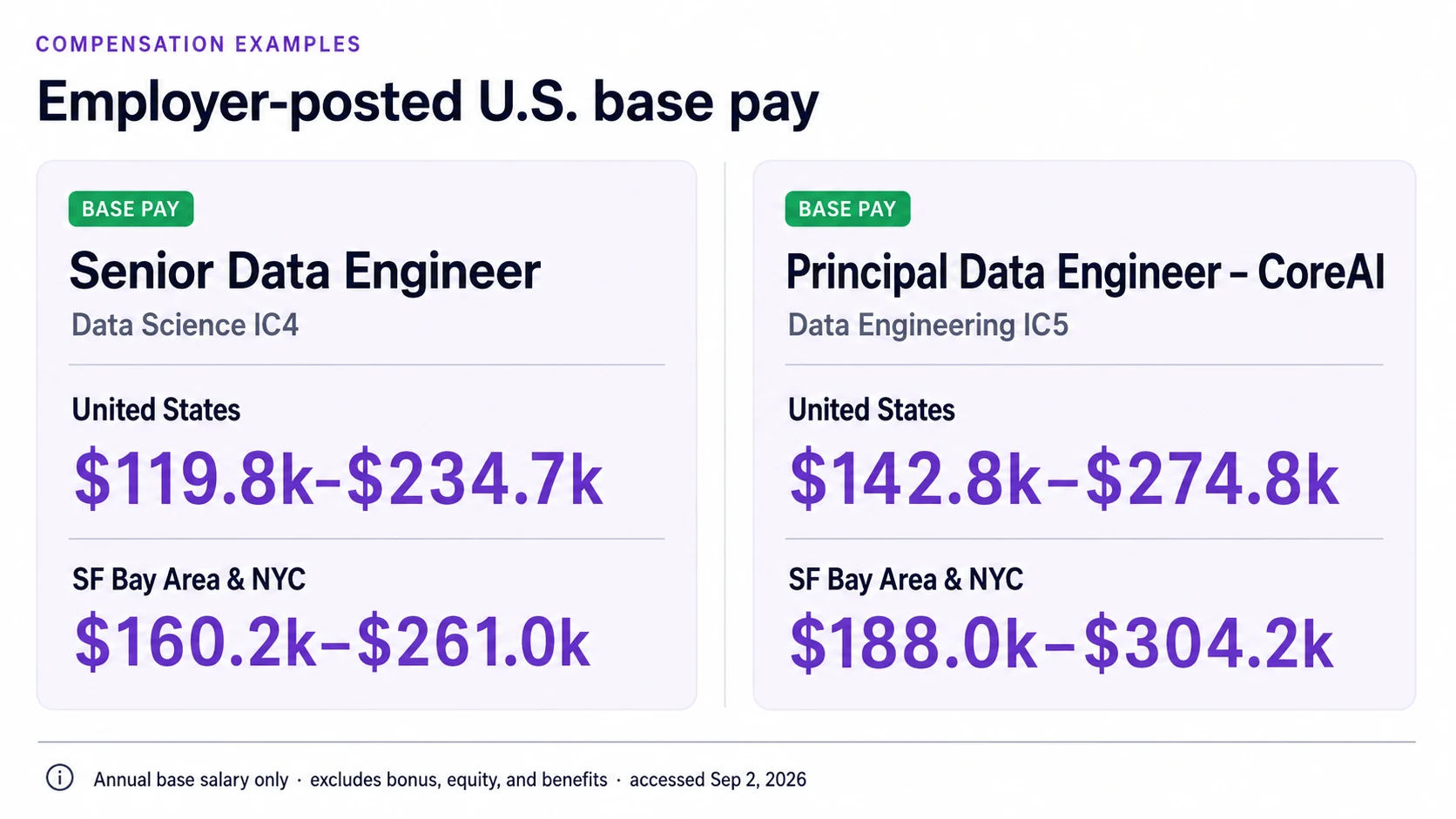
Employer-posted annual base salary ranges from two specific U.S. openings, accessed September 2, 2026. These figures exclude bonus, equity, and benefits.
- Senior Data Engineer — Data Science IC4: USD $119,800–$234,700 across the United States; $160,200–$261,000 in the San Francisco Bay Area and New York City metropolitan area. Posted August 28, 2026. (Microsoft Careers: Senior Data Engineer)
- Principal Data Engineer — CoreAI, Data Engineering IC5: USD $142,800–$274,800 across the United States; $188,000–$304,200 in the San Francisco Bay Area and New York City metropolitan area. Posted August 11, 2026. (Microsoft Careers: Principal Data Engineer - CoreAI)
These are examples, not a single “typical Microsoft Data Engineer salary.” Use the compensation section of your exact requisition when evaluating an offer; a title match does not establish the same level, job family, or pay range.
Four-week preparation plan
Week 1 — Diagnose gaps
- Map every job requirement to one project from your experience.
- Complete timed SQL exercises on joins, windows, CTEs, deduplication, and time-based analysis.
- Write executable Python solutions with tests.
- Record two behavioral stories and make your individual contribution explicit.
Week 2 — Build data-engineering depth
- Review dimensional modeling, incremental loads, change-data capture, and schema evolution.
- Diagnose sample Spark plans for shuffle, skew, partitioning, and memory behavior.
- Diagram one batch pipeline and one streaming pipeline.
- Define monitoring for freshness, completeness, distribution, and correctness.
Week 3 — Add Microsoft-relevant architecture
- Review the Microsoft Learn material that matches the requisition.
- If Fabric is in scope, study OneLake, Delta tables, pipelines, notebooks, Spark, warehouses, Real-Time Intelligence, security, and lifecycle management.
- Complete two timed system-design sessions and critique your trade-offs.
- Prepare stories about disagreement, operational ownership, and learning from failure.
Week 4 — Simulate the interview
- Run at least two 45-minute technical mock interviews.
- Write and test runnable code without relying on pseudocode.
- Practice asking requirement questions before solving.
- Rehearse project explanations using scale, constraints, decisions, and outcomes.
- Prepare questions about data producers, consumers, reliability, governance, and migrations.
Frequently asked questions
How many Microsoft Data Engineer interview rounds are there?
Microsoft's general hiring page says most interviews include two to four conversations with teammates and cross-functional colleagues, each lasting up to an hour. The exact number and sequence vary by role. (Microsoft Careers: How we hire)
How long does the full process take?
Microsoft does not publish a fixed Data Engineer application-to-offer duration. Scheduling, team, level, and location can change the timeline. Ask the recruiter when to expect each next step. (Microsoft Careers: Interview tips)
Will I need to code?
It depends on the opening. Microsoft says some roles may require coding, and its technical-interview guidance advises writing runnable code in a familiar language rather than pseudocode. For a Data Engineer role, prepare both SQL and the language named in the job description. (Microsoft Careers: Technical interviewing)
Is Microsoft Fabric knowledge required?
Only if the requisition or team scope makes it relevant. Fabric is especially useful for openings involving OneLake, lakehouses, pipelines, Spark, warehouses, or real-time analytics. Other teams may emphasize different Azure services, internal platforms, or general distributed-systems expertise.
Should I memorize Azure product details?
Know the services named in the job description, but lead with engineering principles. Define the requirement, compare options, choose a design, and explain the operational trade-offs.
Are the salary figures total compensation?
No. They are annual base salary ranges from two specific U.S. Microsoft job postings accessed September 2, 2026. They exclude bonus, equity, and benefits and do not represent every Microsoft Data Engineer opening.
Final checklist
- Confirm the interview format, coding language, and focus areas with the recruiter.
- Match preparation to the specific requisition and team.
- Practice SQL with explicit assumptions and edge cases.
- Write executable, tested code in your strongest language.
- Explain architecture from requirements through operations and governance.
- Prepare evidence-rich STAR(R) stories with a reflection.
- Check the compensation range on the exact job posting.
- Prepare questions that help you evaluate the team's technical challenges.
Sources and methodology
This guide was updated on September 2, 2026. Role scope and compensation were checked against current Microsoft Careers postings. Interview structure and preparation advice were checked against Microsoft's official hiring guidance. Fabric topics were checked against current Microsoft Learn documentation. The 20-question bank was written as a preparation resource and is not represented as a disclosed Microsoft interview set.
- Microsoft Careers: How we hire — general interview structure and role-dependent variation; accessed September 2, 2026.
- Microsoft Careers: Interview tips — competencies, STAR(R), and recruiter timeline guidance; accessed September 2, 2026.
- Microsoft Careers: Technical interviewing — problem solving, coding, testing, and technical-round guidance; accessed September 2, 2026.
- Microsoft Careers: Senior Data Engineer — current role example and employer-posted U.S. base salary ranges; accessed September 2, 2026.
- Microsoft Careers: Principal Data Engineer - CoreAI — current responsibilities, qualifications, level, and employer-posted U.S. base salary ranges; accessed September 2, 2026.
- Microsoft Learn: Fabric Data Engineer Associate — official role profile and skill areas; accessed September 2, 2026.
- Microsoft Learn: DP-700 study guide — current Fabric data-engineering domains; accessed September 2, 2026.
- Microsoft Learn: Fabric Data Engineering overview — official platform capabilities; accessed September 2, 2026.
- Microsoft Learn: Delta Lake overview — Delta Lake behavior in Fabric; accessed September 2, 2026.