This guide is for software engineers preparing for a Microsoft loop in 2026, from new grad through senior IC. It walks the full process round by round, what each interview actually tests, the bar Microsoft uses to evaluate you, and the concrete moves that separate a strong loop from a borderline one. Everything here is general guidance - your exact loop varies by team and level.
What to expect
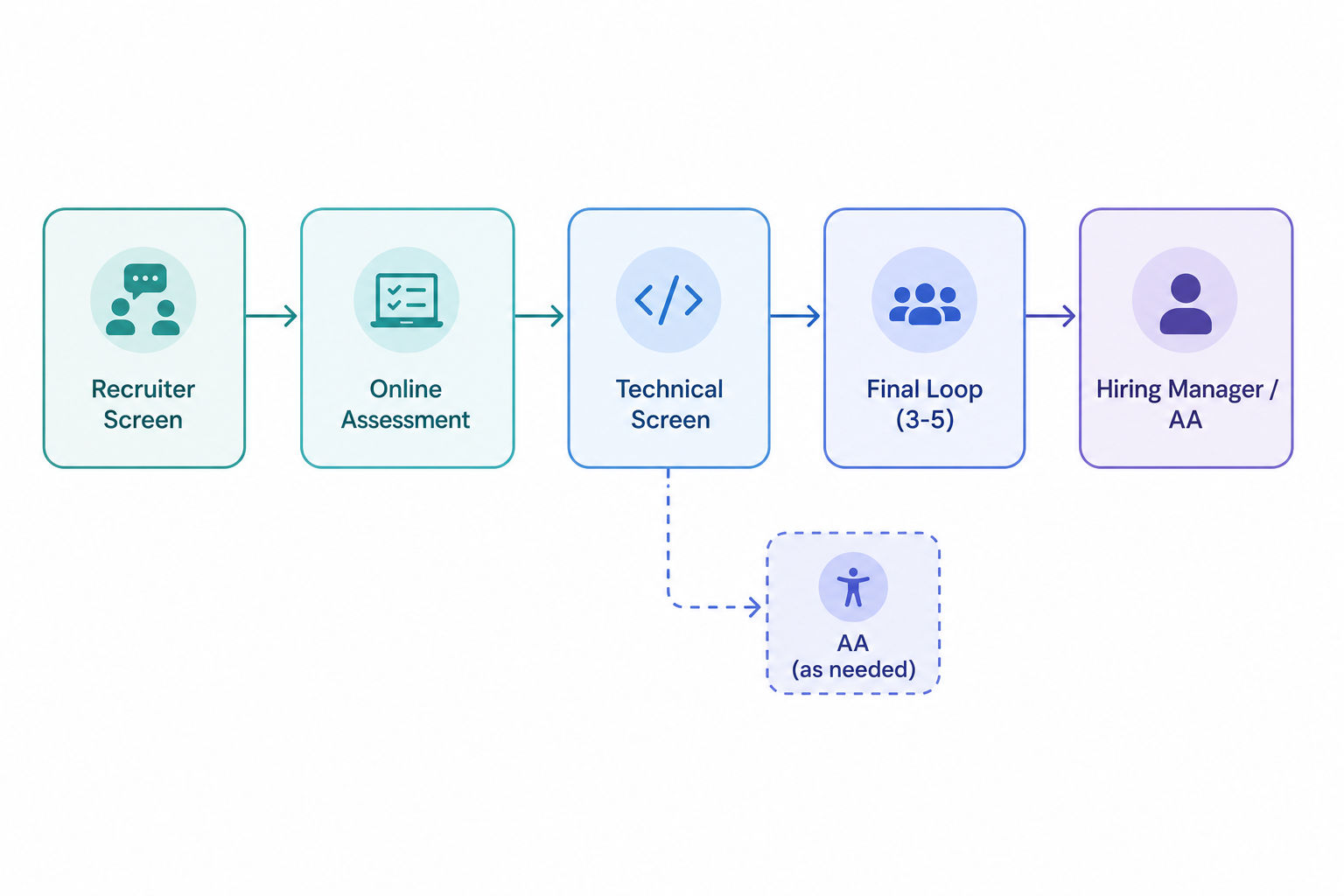
Microsoft's software engineer interview process in 2026 is usually virtual, fast per round, and heavily discussion-driven. Most candidates go through a recruiter screen, an online assessment or live technical screen, then a final loop of multiple 45-minute interviews - with an occasional extra "As Appropriate" (AA) round or hiring-manager follow-up depending on the team and level.
The process is team-dependent. Prepare for coding first, but expect behavioral questions in nearly every round and design questions once you reach IC2 or above.
What makes Microsoft distinctive is that interviewers often care as much about how you solve a problem as whether you reach the final answer. Expect clarifying questions, optimization follow-ups, resume deep dives, and conversations about trade-offs, testing, and maintainability - not a pure puzzle format. If you want targeted practice, PracHub has 100+ real Microsoft Software Engineer questions reported from actual loops.
The interview process at a glance
| Round | Typical length | Primary focus | How to win it |
|---|---|---|---|
| Recruiter screen | 15-30 min | Background, level, team fit, logistics | Be clear on level, location, and what you want to work on |
| Online assessment | 60-90 min | DS&A, correctness on hidden tests | Pass as many test cases as possible; clean, runnable code |
| Technical screen | 45-60 min | One medium/medium-hard coding problem | Clarify, narrate, optimize, test |
| Final loop | 3-5 rounds, ~45 min each | Coding, design, behavioral | Consistency across rounds; visible reasoning |
| Hiring manager | 30-45 min | Motivation, ownership, judgment, fit | Concrete ownership stories, real trade-offs |
| AA (as needed) | 30-45 min | Extra calibration on level/depth | Treat it like any loop round; bring your best example |
Interview rounds in detail
Recruiter screen
A 15-30 minute phone or Teams conversation focused on your background, level fit, interest in Microsoft, preferred team area, logistics, and compensation expectations - not deep technical evaluation. In some cases this round is skipped or folded into team matching. Use it to lock down which level and org you're being considered for, because that determines whether design rounds appear later.
Online assessment
The online assessment usually runs 60-90 minutes and is commonly two coding questions in about an hour, delivered on a platform like Codility or HackerRank. It evaluates core data structures and algorithms, correctness against hidden test cases, and coding quality under time pressure. You can sometimes advance without perfect test-case completion if your overall performance clears the team's threshold, so don't freeze on one hard sub-case - bank the cases you can pass.
Technical phone screen / virtual coding screen
Usually 45-60 minutes over Teams in a collaborative editor. You'll typically solve one medium or medium-hard coding problem, sometimes with follow-up optimizations, and you may also get project discussion or language and CS fundamentals questions. Interviewers watch closely how you clarify the problem, communicate while coding, reason about complexity, and test your own solution.
Final interview loop / virtual onsite
The final loop usually consists of 3-5 interviews, most around 45 minutes. For software engineering roles, the loop often includes 2-3 coding rounds, possibly an object-oriented or low-level design round, and for more experienced candidates a system design round. Behavioral questions are woven through nearly every interview. The loop is used to assess technical consistency, design judgment, collaboration, and level alignment - one weak round is survivable if the rest are strong and consistent.
Hiring manager / manager round
Usually 30-45 minutes, either separate or folded into the main loop. It's more conversational, with emphasis on motivation, ownership, prioritization, practical judgment, and team fit. Many managers also probe lightly into architecture or project decisions from your work, so be ready to defend a real decision you made.
As Appropriate (AA) round
The AA round is an additional 30-45 minute interview used selectively, not universally. It usually happens when the team wants extra calibration on your level or technical depth, or when loop feedback is mixed. Expect behavioral discussion, design follow-ups, or another coding problem with optimization questions. Treat it as a normal loop round rather than a sign something went wrong.
What they test
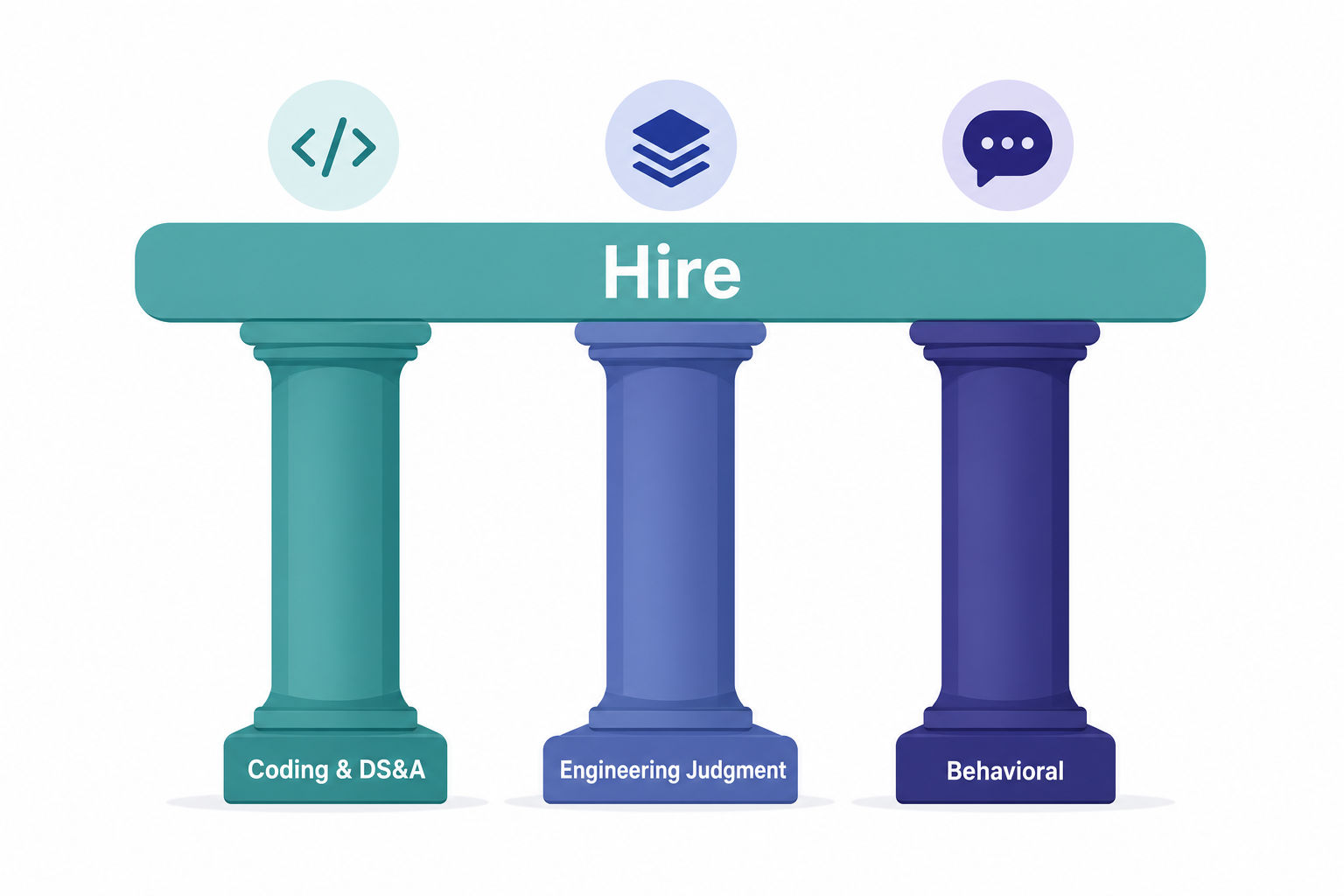
Coding and algorithms. Microsoft still puts coding at the center of SWE hiring. Expect strong coverage of arrays, strings, linked lists, stacks, queues, heaps, hash maps, trees, graphs, BFS/DFS, topological sort, sorting and searching, binary search, dynamic programming, greedy algorithms, recursion, and backtracking. The company also pays attention to fundamentals weaker candidates skip: time and space complexity, edge-case handling, debugging, and manual testing. In live rounds, the expectation is real runnable code in a language you know well - not pseudocode - and you need to manage a 45-minute window efficiently.
Engineering judgment. For junior roles this shows up through project discussion, basic CS knowledge, and clean implementation choices. For IC2 and above, expect object-oriented design, low-level design, and sometimes full system design, including APIs, modularity, data modeling, caching, scalability, reliability, consistency, and trade-offs between latency, storage, and maintainability. Microsoft leans heavily on resume deep dives, so be ready to explain what you personally owned, which architecture decisions you made, what production issues you debugged, and what measurable impact your work had.
Behavioral. Evaluation is spread across the whole process, not isolated into a single HR round. Be ready to discuss teamwork, conflict, mistakes, ambiguity, customer impact, prioritization, and learning. Microsoft tends to reward candidates who show a growth mindset, collaborative communication, and customer-focused reasoning over a combative or heavily memorized style.
How to stand out
A useful mental model: every coding round is graded on a few axes, not just "did it pass."
| Dimension | What weak looks like | What strong looks like |
|---|---|---|
| Problem clarification | Jumps straight to code | Confirms inputs, constraints, and edge cases first |
| Approach | Reaches for the optimal trick silently | States a simple approach, then improves it out loud |
| Coding | Pseudocode, unclear names, no tests | Runnable code, clear names, self-tested |
| Complexity | Hand-waves Big-O | States and justifies time/space, discusses trade-offs |
| Communication | Codes in silence | Narrates decisions; responds well to hints |
| Behavioral | Solo-hero stories, vague impact | Collaboration, specific ownership, measurable outcome |
Concrete moves that consistently help:
- Clarify before you code. Confirm constraints, inputs, failure cases, and expected behavior before writing anything. Microsoft interviewers use this to judge how you think, not just what you know.
- Make your reasoning visible. Outline a simple approach first, then improve it to the optimized version. This fits Microsoft's collaborative style and shows structured problem solving.
- Write code you'd ship. Clear naming, runnable, with quick manual test cases. Catch your own edge cases before the interviewer points them out.
- Prepare for optimization follow-ups. Microsoft interviewers often change constraints or ask how your solution shifts as scale or assumptions change. Have the next step ready.
- Know your resume cold. Be able to explain your exact ownership, architecture choices, trade-offs, and outcomes. Vague project summaries hurt because Microsoft probes on what you personally built and why.
- For IC2 and above, prep design even if only coding was mentioned. Team variation is high; some candidates get design-heavy rounds unexpectedly. Have one solid system design story and basic OOD ready.
- Frame behavioral answers around collaboration and learning, not solo heroics. Show how you worked through ambiguity, disagreement, or failure with others and improved the result.
A worked example: structuring a coding answer
Here's a lightweight script you can adapt to almost any Microsoft coding problem.
Example walkthrough - "Find the two numbers in an array that sum to a target."
- Clarify (15-30s). Example questions to ask: "Can the array have duplicates? Negative numbers? Is there always exactly one valid pair? Should I return indices or values?"
- State a simple approach. For instance: "The brute-force option is checking every pair, which is O(n²) time and O(1) space. Let me confirm that's correct, then optimize."
- Improve it. Example: "I can do one pass with a hash map of value to index. For each element I check if
target - valueis already in the map. That's O(n) time, O(n) space." - Code it cleanly, with names like
seenandcomplementrather thanmandx. - Test out loud. Example: "Let me trace
[2, 7, 11, 15], target9- at index 0 I store 2, at index 1 the complement 2 is in the map, so I return[0, 1]. Now an edge case: empty array returns nothing."
Notice what's being demonstrated: clarification, a stated baseline, a justified optimization, readable code, and self-testing. That sequence maps directly to the rubric above. Practice it on a range of interview questions until it's automatic.
A behavioral answer template (STAR)
Microsoft weaves behavioral questions through the whole loop, so have several stories ready in STAR form: Situation, Task, Action, Result. Keep the Action heavy on your specific decisions and the Result quantified where you honestly can.
Example structure for "Tell me about a time you disagreed with a teammate":
- Situation: "Two of us disagreed on whether to add a cache or fix the slow query first."
- Task: "We had a latency regression to fix before a release."
- Action: "I proposed we measure both, profiled the query, and shared the numbers instead of arguing from intuition."
- Result: "The query fix removed most of the latency, so we shipped on time and skipped the added complexity of a cache."
The point is collaboration and evidence-based reasoning, not winning the argument.
Final checklist before your loop
- You can clarify, narrate, and self-test a medium coding problem in 30-40 minutes.
- You can state and justify time/space complexity without prompting.
- You have 4-6 STAR stories covering conflict, failure, ambiguity, ownership, and customer impact.
- You can explain your top resume project's architecture, trade-offs, and your personal contribution.
- (IC2+) You have one system design story and can sketch APIs, data model, and scaling trade-offs.
- You've practiced under a timer on realistic problems - see the Microsoft question bank and the broader interview guide library.
How to Use This Page as a Prep Plan
Do not treat this as passive reading. Convert the ideas in this page into a short weekly loop: learn one idea, practice it under interview conditions, then write down what changed. That is the fastest way to turn advice into visible interview behavior.
| Prep area | What you need to prove | Practice artifact |
|---|---|---|
| Understand | Turn the prompt into a concrete goal. | Clarifying questions and success criteria. |
| Practice | Use realistic constraints and timed reps. | Worked examples with edge cases. |
| Explain | Make reasoning visible. | Tradeoffs, assumptions, and test strategy. |
| Improve | Review misses quickly. | A short feedback log and next action. |
For Microsoft Software Engineer Interview Guide 2026, the strongest candidates usually do three things well: they make their assumptions explicit, they use concrete examples instead of vague claims, and they review mistakes quickly enough that the next practice rep is better than the last one.
Video Walkthrough
Mayank Modi walks through the Microsoft Software Engineer loop first-hand. It is one candidate's account rather than an official spec, so treat the round order as indicative.
FAQ
How many interview rounds does Microsoft have for software engineers?
It varies by team and level, but a common shape is a recruiter screen, an online assessment or technical screen, and a final loop of 3-5 interviews of roughly 45 minutes each. Some candidates also get a hiring-manager conversation or an extra AA round.
Does Microsoft ask system design for software engineers?
For new-grad and junior roles, design is usually light - often object-oriented or low-level design at most. For IC2 and above, expect object-oriented design and sometimes full system design covering APIs, data modeling, caching, and scalability trade-offs. Because team variation is high, prepare at least one design story even if only coding was mentioned.
What coding topics should I prioritize for Microsoft?
Focus on core data structures and algorithms: arrays and strings, hash maps, two pointers and sliding window, trees and graphs with BFS/DFS, binary search, dynamic programming, and recursion/backtracking. Just as important are complexity analysis, edge cases, and writing clean, runnable, self-tested code. Practice across many real Microsoft questions rather than memorizing a fixed list.
How important are behavioral questions at Microsoft?
Very. Behavioral evaluation is spread across the whole loop rather than confined to one round. Interviewers look for collaboration, growth mindset, customer focus, and honest reflection on mistakes. Prepare several STAR stories you can adapt on the spot.
How should I prepare for the Microsoft online assessment?
Practice timed sets of two medium problems under realistic conditions on a platform-style editor, and aim to maximize passing hidden test cases with clean, runnable code. Don't stall on a single hard sub-case - secure the cases you can pass and revisit harder ones if time allows.
Is the Microsoft interview the same for every team?
No. Microsoft's process is notably team-dependent. The number of rounds, the presence of design interviews, and the balance between coding and behavioral can all shift by org and level. Confirm the expected format with your recruiter, and prepare broadly so an unexpected round doesn't catch you off guard. Browse role-specific prep on the software engineer track.