AceYourInterviews Review: LLD Lessons, Java References, and Design Practice Depth
Quick Overview
Review AceYourInterviews LLD lessons, Parking Lot ownership, Java reference claims, sign-in execution, self-review and an original last-spot race fixture. Dated public observations and original worked examples distinguish tested behavior, author descriptions and unverified capabilities.
AceYourInterviews addresses a common LLD preparation gap: naming classes without explaining ownership, concurrency and failure. Its Parking Lot material connects a Java reference to explicit invariants and different Engineer, Senior and Staff discussions. The access boundary matters: the page advertised locally verified reference checks and offered a sign-in-gated program runner, but explicitly said program output does not grade a learner’s design.
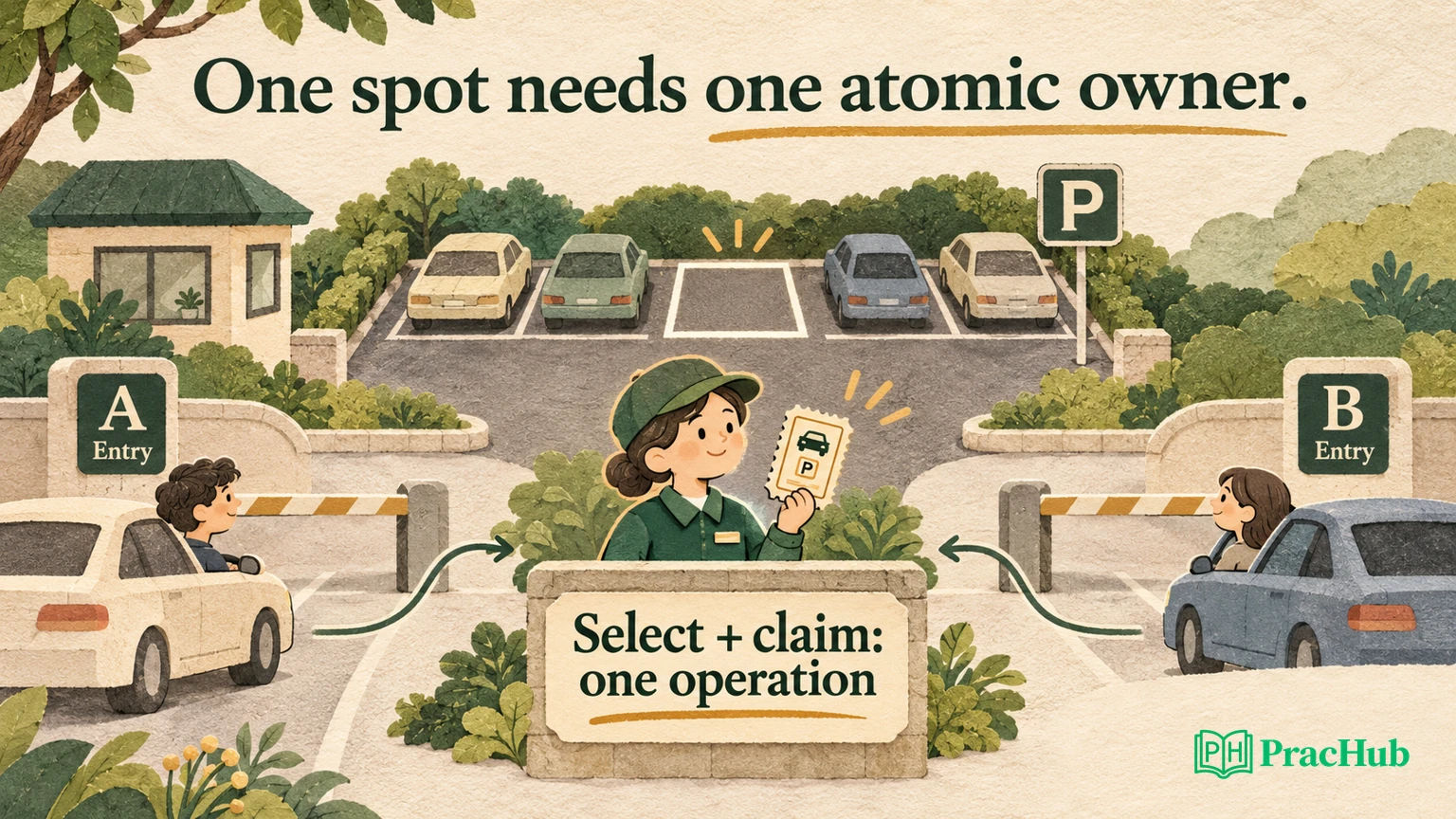
Begin with PracHub’s object-oriented Parking Lot question and state who owns the last compatible spot. Naming Vehicle, Spot and Ticket is not enough if two entry gates can both claim the same capacity. That invariant is a useful test of whether the reading becomes implementation reasoning.
Checked November 3, 2026: official authored material, our public browser inspection and an original local Python race fixture are separate evidence. We did not sign in to run Java, execute the full Java reference, or obtain independent design feedback. No candidate-outcome evidence establishes hiring effectiveness. PracHub publishes this review and provides the linked preparation questions.
What the LLD learning path provides
The low-level design path presents foundations and a library of design exercises. The inspected material included responsibilities, contracts, relationships, walkthroughs, alternatives and Java reference code. Those components can support a reasoned design discussion, but their presence does not prove that a learner can implement the design independently.
The concurrency chapter emphasized compound state changes, lock boundaries, idempotency and failure ambiguity. Its most useful theme is that making an individual container thread-safe does not automatically make a multi-step business decision atomic.
The Parking Lot chapter made that concrete. The allocation service owns spot selection, active tickets and related state changes. A first-fit scan is a deliberate simple mechanism, with one synchronization boundary around the compound operation. It is not rejected merely because a more elaborate index could exist.
For an interview, establish a correct small model, identify its cost and then explain when measurements or requirements justify another design. Starting with per-floor locks or multiple indexes before defining ownership can hide the very invariant the question is testing.
We read the public chapter and switched its level discussion. We did not assess the entire library’s consistency, independently rerun the publisher’s Java harness or measure the reference under sustained contention. Those remain distinct from the quality of the explanation visible on one page.
Reference verification, program execution and design judgment
At the top of the inspected Parking Lot page, the author reported a Java 21 reference verified with 30 checks, along with author self-review and independent review pending. That is a provider statement about its reference, not a claim that our own draft passed those checks.
The learner area included a code editor with language choices and a Run program panel. We opened the Java panel and observed a sign-in requirement. Its instructions said code and input would be sent to an execution provider and that running a program shows output rather than grading the design.
| Evidence layer | What we observed | What remains unverified |
|---|---|---|
| Authored reference checks | The page reported 30 Java 21 checks. | We did not independently execute that harness. |
| Learner program runner | A Java run panel existed and required sign-in. | We did not run a submitted Java program there. |
| Design evaluation | The page separated execution from design grading. | We obtained no independent judgment of a learner solution. |
| Self-review | Checkboxes asked about ownership, races and limits. | Checked boxes would not establish mastery. |
This distinction avoids two inaccurate conclusions. It would be wrong to say there is no execution interface simply because we did not sign in. It would also be wrong to describe the reference’s test count as a personal submission score or a verified automated design judge.
The editor’s device-save description said drafts stay on that device and do not synchronize to an account. We observed that statement, not a storage or cross-device recovery audit. Treat important design notes as work you should be able to export and revisit, rather than assuming account login implies synchronized drafts.
Parking, payment and exit are different transitions
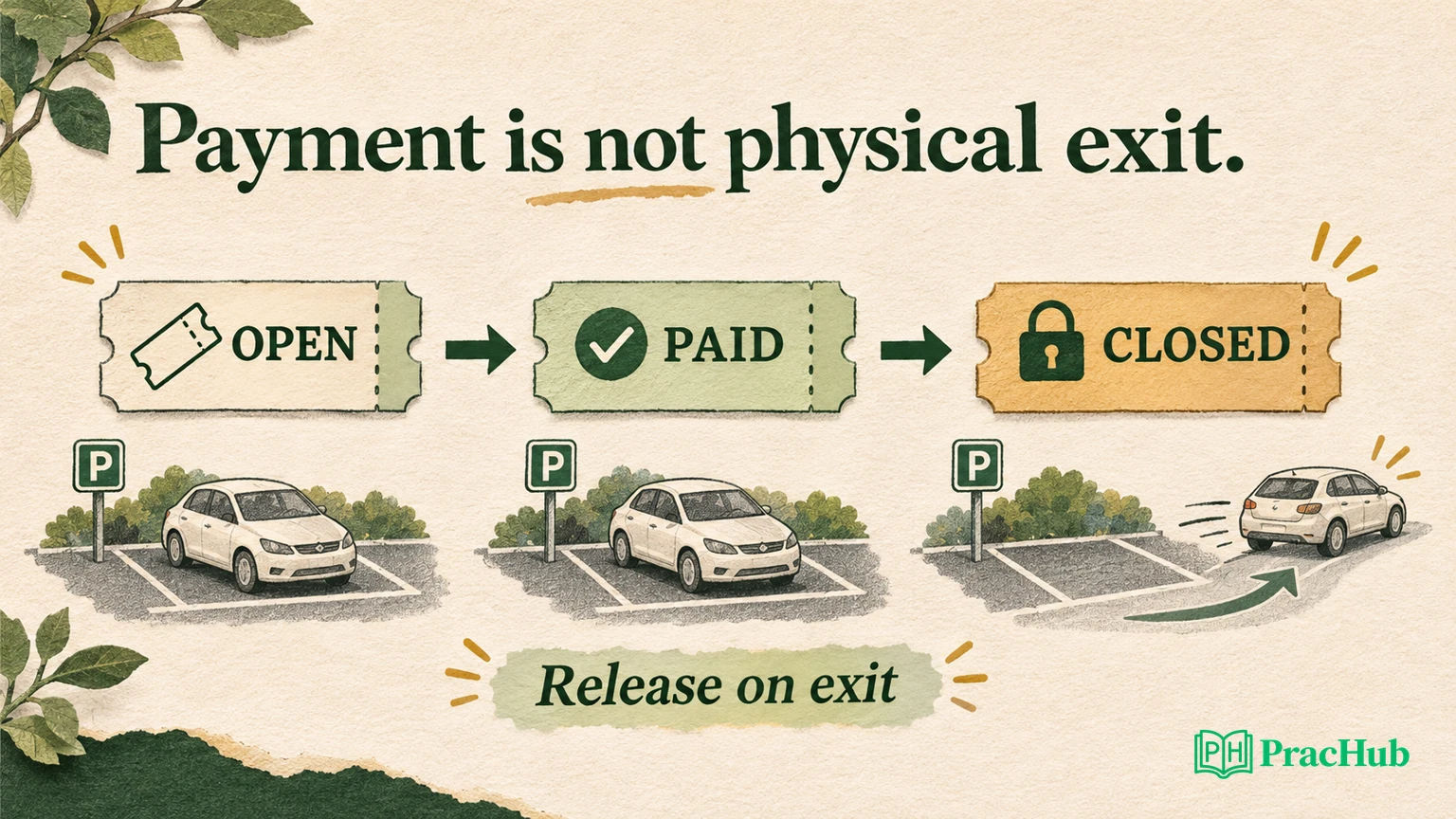
The main chapter’s lifecycle kept an OPEN ticket responsible for an occupied spot. Payment moved it to PAID, and physical exit moved it to CLOSED and released occupancy. Separating those events prevents a car that has paid but remains inside from sharing its bay with a newly admitted vehicle.
The chapter also described immutable pricing captured at entry. If the facility changes its rate while a vehicle is inside, an existing ticket does not silently acquire the new rate. The design makes historical behavior explainable through a captured policy rather than a lookup of the current configuration.
These are authored teaching contracts, not universal parking-industry rules. Another facility could impose a post-payment grace period, reservations or different pricing. The point is to make the rule explicit and carry it through methods and tests.
Our reading also found that some proposed persistence text used a simpler OPEN/CLOSED representation, while the main reference contract distinguished PAID. Use this as a review question: does the proposed durable schema preserve the lifecycle you are implementing? Do not assume an illustrative schema is an already deployed migration or that every section uses identical boundaries.
In an interview, connect each transition to an observation. After payment, occupancy remains one. After exit, it becomes zero. If the old exit command is repeated after the spot is reassigned, it must not release the new occupant. That last case tests identity and monotonic state, not merely a boolean occupied flag.
An original last-spot race you can reproduce
We built a small local Python fixture to isolate the ownership issue. It is not the site’s Java reference, and it does not establish Java memory-model behavior. Its purpose is to make the compound invariant visible with two entrants and capacity one.
In the broken version, each entrant reads the free flag before a barrier releases both threads. Each then acts on the earlier observation. Both are admitted, so the owners list contains two entries despite one available spot.
In the corrected version, both threads reach the start barrier, but each must hold one lock while checking and claiming the spot. Only one entrant is admitted. We checked the owner count rather than promising which entrant wins; scheduling is not part of this fixture’s contract.
| Original implementation | Competing entrants | Admitted owners | Invariant |
|---|---|---|---|
| Read free, then later claim without a shared boundary | Two | Two | Violated: one spot has two owners. |
| Check and claim while holding one lock | Two | One | Preserved in this bounded test. |
The repair must put every related ownership change inside the lock boundary. If selecting the spot is protected but creating the ticket and recording active ownership happen independently, another path may still observe or create an inconsistent relationship.
A concurrent map alone does not settle this problem. Individual map operations can be safe while a decision spanning several maps is not atomic. Describe the relationship that must hold before and after the operation, then select a mechanism that covers it.
Our fixture has no database, gate hardware, payment provider or restart recovery. Those limitations make it a clean teaching model. They also prevent a passing result from becoming a claim that the same design is durable or distributed.
Engineer, Senior and Staff should change the proof
The Engineer discussion we inspected focused on a small working model and deliberate choices such as compatible-spot allocation and immutable values. A useful learner output is an implementation whose basic transitions can be tested, not an inventory of design-pattern names.
Switching to Senior Engineer changed the discussion to protecting ownership under concurrency and repeated work. One follow-up moved payment-provider charging outside the monitor and asked what happens if the provider accepts but the adapter loses the response. That introduces an unknown outcome, not a simple failure you can safely repeat.
For Staff preparation, use the chapter’s extension framing to ask where local assumptions stop holding: multiple processes, durability, retention and ownership across adapters. We did not validate a distributed implementation. The purpose is to identify new proof obligations rather than relabel a single-process monitor as a scalable architecture.
Keep the progression tied to the same requirement. At Engineer level, show one ticket and one spot remain consistent. At Senior level, show two callers cannot violate that relationship and a retry cannot repeat an effect. At Staff level, explain which durable authority owns the relationship when processes fail or disagree.
This prevents a common practice mistake: adding components because a seniority label changed. An additional queue, cache or service must resolve a stated requirement and introduce costs you can explain. Otherwise, the diagram gets larger while the original invariant becomes harder to inspect.
How to turn reading into independent work
Read the problem contract first and hide the full reference until you have written a minimal solution. Create tests for the last spot, unpaid exit, repeated exit and a rate change while a ticket remains active. These are concrete behaviors; a class diagram alone cannot show them.
When you reveal a reference, compare decisions rather than matching class names. Does your service own the same state? Are returned objects snapshots or mutable handles? Where does a repeated request resolve its previous result? A different object arrangement can still satisfy the contract if you can prove its transitions.
Next, introduce one failure deliberately. Release occupancy on payment and show the conflicting admission. Recalculate an old ticket from the new rate and show the changed bill. These mutations establish what your tests actually detect, rather than merely increasing a test count.
If you later use the sign-in runner, supply an entry point and your own driver as the panel instructs. Successful output is evidence about that program and those inputs. Review ownership, failure recovery and requirements separately. An executable program can implement the wrong lifecycle perfectly.
Five questions for LLD transfer
The following PracHub questions provide independent Parking Lot and evolving-requirement practice. They are not AceYourInterviews submissions or predictions about an employer’s exact question.
| PracHub question | Focused follow-up |
|---|---|
| Object-Oriented Design and Code for a Parking Lot System | Assign the allocation invariant to one service before naming patterns. |
| Design a Parking Lot Management System's Object Model with Evolving Requirements | Revise the ownership model when requirements evolve. |
| Object-Oriented Parking Lot Design with Check-In and Check-Out | Explain check-in/check-out state transitions and repeated old requests. |
| Design an object-oriented parking lot system | Compare object responsibilities and concurrency boundaries. |
| Design a scalable parking lot system | State how scale changes the single-process allocation assumptions. |
These records share a domain intentionally: the aim is to change scope, entry/exit contracts and scale assumptions while preserving a clear ownership explanation. Do not memorize five near-identical class diagrams. Ask which requirement in each prompt changes the implementation or the proof.
The Premium page described plans as coming soon and said checkout and subscriptions were not active. We did not purchase anything. The public LLD chapter is therefore the sensible evaluation starting point for the features inspected here.
AceYourInterviews is most useful when you want a worked reference to challenge your own design reasoning. Use the last-spot fixture as a small correctness check, then choose another prompt from PracHub’s Software Engineer questions and explain the invariant, failure case and boundary before naming the pattern you used.
Comments (0)