Airflow Interview Questions for Data Engineers: DAGs, Scheduling, Backfills, and Failures
Quick Overview
Prepare for Airflow data engineering interviews with production-focused questions on DAG design, scheduling, data intervals, catchup, backfills, idempotency, retries, pools, sensors, and failure recovery.
Airflow interviews are rarely won by memorizing operator names. The harder questions ask whether you can design a workflow that runs for the correct data interval, survives retries, backfills history safely, and tells an on-call engineer what failed.
The best answers connect DAG structure, scheduling semantics, idempotent tasks, concurrency limits, and recovery. You should be able to explain not only what Airflow does, but also how you would operate a production pipeline when upstream data arrives late or a historical rerun suddenly creates hundreds of task instances.
Use PracHub interview questions with written solutions to practice explaining those decisions aloud. Attempt the prompt before reading the solution, then compare your answer against the framework below.
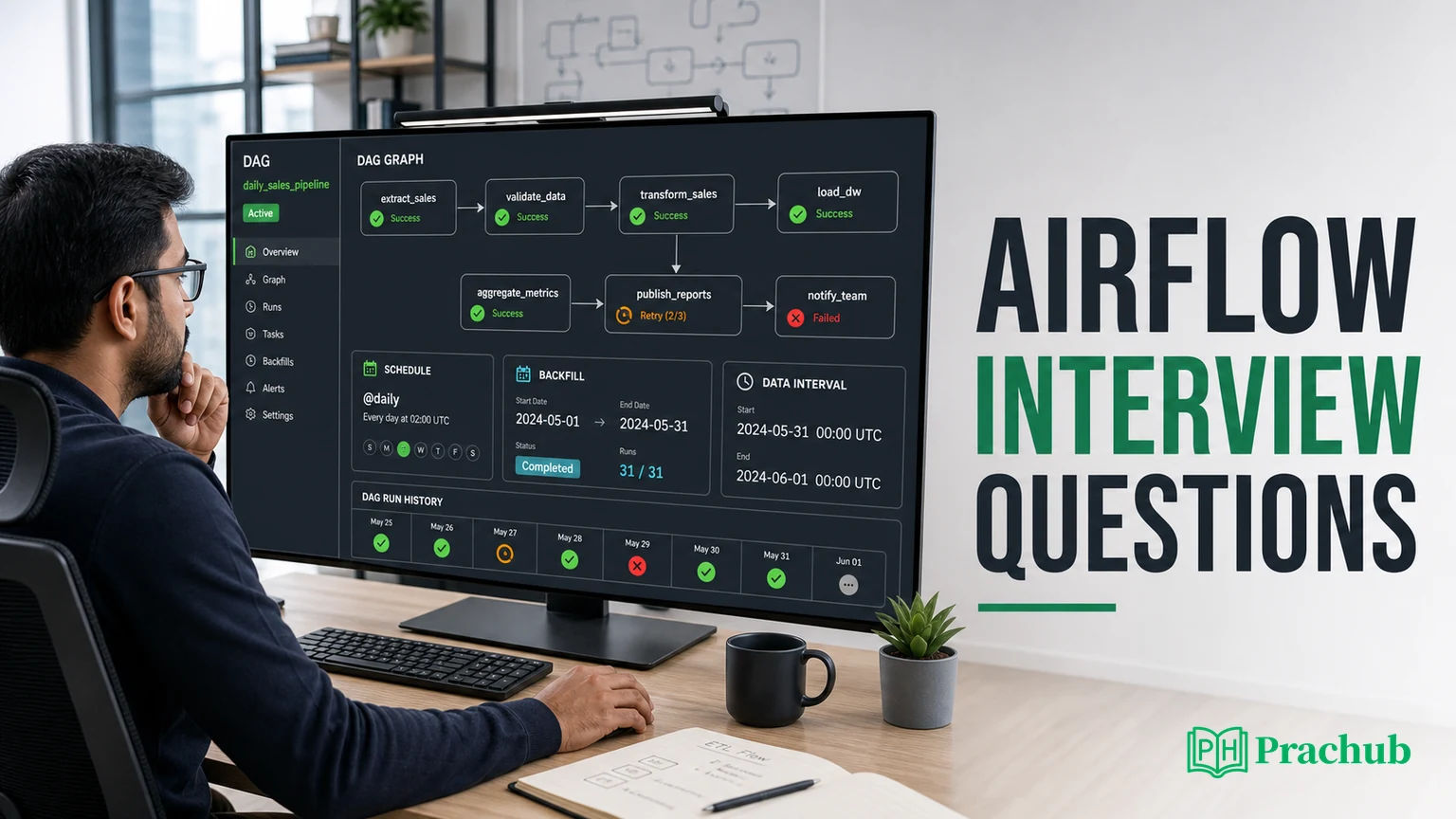
What Airflow interviewers are actually testing
Apache Airflow is a platform for developing, scheduling, and monitoring batch-oriented workflows. In an interview, however, defining a DAG as a directed acyclic graph is only the starting point.
Interviewers want to know whether you can turn a business data contract into a workflow that is correct across time, repeatable, observable, and safe under failure.
| Interview signal | Weak answer | Strong answer |
|---|---|---|
| DAG design | Lists operators and draws a long chain | Defines task boundaries, dependencies, data contracts, and failure isolation |
| Scheduling | Says a daily DAG runs at midnight | Explains data intervals, logical dates, time zones, and when a run is created |
| Backfills | Clears every task and hopes | Defines the historical range, concurrency, idempotency, validation, and rollback |
| Reliability | Adds several retries | Classifies failures, bounds retries, uses timeouts, and prevents duplicate side effects |
| Operations | Checks the UI after an alert | Uses freshness, duration, failure, queue, and data-quality signals with a runbook |
DAG design questions
What makes a good Airflow task boundary?
A task should represent one observable and retryable unit of work. If extraction, transformation, validation, and publication are hidden inside one large Python task, a failure forces you to repeat unrelated work and gives the operator little evidence about the broken stage.
At the other extreme, splitting every SQL statement into its own task creates scheduler overhead and a graph that is difficult to understand. A useful boundary usually has a clear input, output, owner, timeout, retry policy, and idempotency strategy.
Explain dependencies as data or control contracts. extract >> transform >> validate >> publish is meaningful because each transition protects a downstream assumption. A dependency added only to force visual order is a warning sign.
Should DAG files query databases or APIs while being parsed?
Usually no. The scheduler repeatedly parses DAG files, so network calls, large imports, and expensive computation at module scope can slow discovery and make parsing dependent on external systems.
Keep DAG construction deterministic and lightweight. Put runtime work inside tasks, load configuration predictably, and test that importing the DAG creates the expected graph without performing production side effects.
Static DAGs or dynamic task mapping?
Use a stable graph when the workload shape is known. Use dynamic task mapping when runtime data determines the task count, such as one task per new partition. Bound expansion with controls such as max_map_length and max_active_tis_per_dag so malformed input cannot consume the installation's capacity.
Scheduling questions: logical dates and data intervals
When does a daily DAG run?
For a time-based schedule, Airflow associates each DAG run with a data interval. A daily run normally starts after the interval it processes has ended. That is why a run labeled for January 1 may be created just after midnight on January 2.
The logical date identifies the start of the interval, not the wall-clock moment when the worker begins execution. This distinction matters whenever a query selects a partition, constructs a storage path, or reports pipeline freshness.
A strong answer templates the interval boundaries into the task and avoids using datetime.now() to decide what data to process. Otherwise, retrying the same logical run on a later day can silently read different data.
Cron schedule or timedelta schedule?
A cron schedule aligns runs to calendar boundaries, while a timedelta schedule advances relative to the prior interval. Start from the business requirement: calendar-day pipelines need an explicit time zone and daylight-saving policy, while a job that runs every six hours after activation may suit elapsed-time scheduling.
Catchup vs backfill
What is catchup?
Catchup asks the scheduler to create missing scheduled DAG runs for completed intervals. It is useful when each run is partition-safe and the pipeline can process historical intervals independently.
Airflow's current documentation notes that catchup is off by default at the installation level unless configuration or the DAG overrides it. In an interview, do not rely on a remembered default. Explain the intended behavior in the DAG and verify the deployment configuration.
What is a backfill?
A backfill deliberately creates DAG runs for a historical date range. It is an operational action with choices about reprocessing existing runs, maximum active runs, ordering, and configuration.
The distinction is practical: catchup is ongoing scheduler behavior; backfill is a bounded historical reprocessing job. Both are safe only when tasks use interval-scoped inputs and idempotent writes.
How would you backfill 90 days safely?
First estimate rows, API calls, warehouse slots, and downstream load. Choose the historical range and reprocessing policy, then restrict max_active_runs or use a dedicated pool so the backfill cannot starve production.
Write outputs by partition and use merge, replace-partition, or another deterministic write strategy. Validate counts, uniqueness, totals, and freshness before publication. Roll out a small date slice first, watch cost and correctness, and then expand the range.
Reliability questions: retries are not correctness
What makes an Airflow task idempotent?
An idempotent task produces the same intended state when the same logical interval is executed more than once. This is essential because task retries, manual clearing, worker loss, and backfills can all repeat work.
Prefer an upsert keyed by a stable business key, an atomic partition replacement, or a write to a temporary location followed by a transactional publish. Avoid blind append operations unless the sink has a deduplication contract.
Which failures should be retried?
Retry transient problems such as a temporary network timeout, a rate limit, or a brief service outage. Fail fast on deterministic problems such as invalid SQL, a missing required column, or an authorization error that will not change before the next attempt.
Use bounded retries, exponential backoff with jitter where appropriate, execution timeouts, and alerting after the final attempt. A retry policy must also respect downstream quotas and preserve the same idempotency key or partition identity.
What should go through XCom?
Use XCom for small coordination values such as a partition path, row count, job ID, or compact metadata. Store bulk data in object storage or a warehouse and pass a reference instead of moving a dataframe through the metadata database.
Concurrency, pools, and backpressure
Airflow exposes installation-wide parallelism, active-run and task limits, executor capacity, queues, and pools. Name the control that protects the actual bottleneck.
If a warehouse allows eight expensive queries, use an eight-slot pool and let heavier tasks consume multiple slots. Limit mapped tasks so one partition list cannot monopolize every worker.
Backpressure belongs close to the constrained dependency. Adding more workers does not help when the warehouse, vendor API, or source database is already saturated.
Sensors and waiting efficiently
A sensor waits for an external condition such as a file, partition, or upstream job. In poke mode, it occupies a worker slot while waiting. reschedule mode releases the slot between checks, while a deferrable operator hands waiting to the triggerer and resumes when its trigger fires.
Choose based on expected wait time, provider support, triggerer availability, and latency needs. Also define a timeout and failure path. An unlimited sensor is not reliability; it is an invisible outage that consumes operational attention forever.
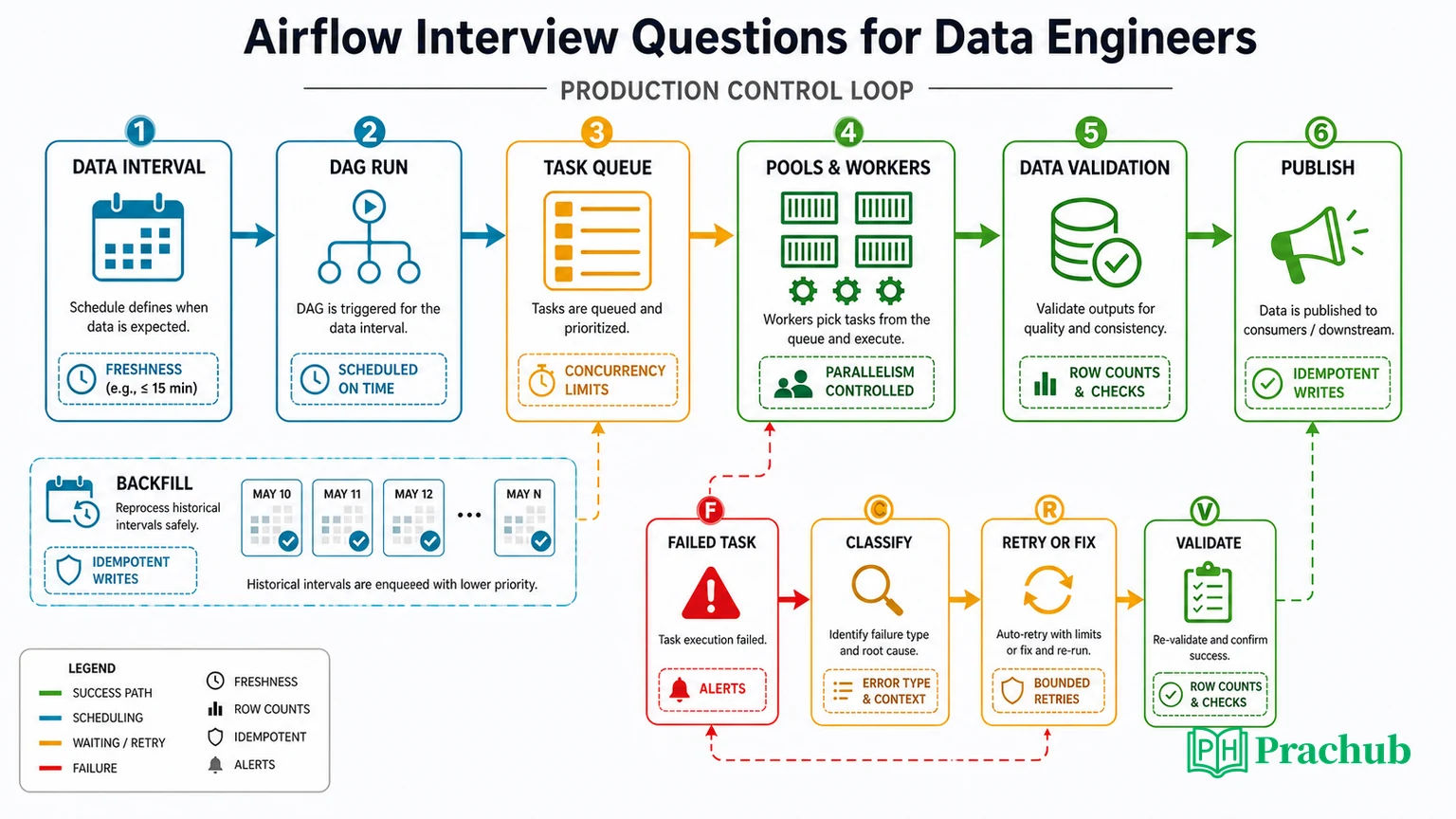
Production failure scenarios
A task is stuck in queued state. What do you inspect?
Start with pool slots, DAG and task concurrency limits, executor or queue health, worker capacity, and task priority. Then check whether the scheduler is healthy and whether the metadata database can support its scheduling loop.
Do not clear it immediately: a worker may still be running, and repeated side effects may not be safe. Check dispatch state, heartbeats, and idempotency first.
The DAG succeeded, but the data is wrong. Why?
Airflow task success means the task code returned successfully, not that the resulting dataset satisfies the business contract. Add explicit checks for schema, row counts, null rates, uniqueness, referential integrity, reconciled totals, and freshness.
Be careful with trigger rules on leaf tasks. Airflow determines DAG-run status from terminal leaf states, so an all_done cleanup task that succeeds can produce a surprising overall result if the graph is designed poorly.
An upstream partition is late. What should happen?
Define a freshness expectation and a maximum waiting window. The workflow can defer while waiting, fail and alert after the deadline, or process a documented degraded input. The correct choice depends on whether downstream consumers prefer late, partial, or stale data.
When the partition arrives, rerun the same logical interval. Idempotent writes and interval-based inputs should make recovery a normal operation rather than a custom repair script.
Practice with PracHub questions
These question-bank records exercise the same scheduling, DAG, pipeline, and recovery skills. They are practice material, not predictions of any specific interview.
| PracHub question | Practice focus | Why it helps |
|---|---|---|
| Design a Cron Job Scheduler | Recurring schedules, leases, missed runs, and idempotency | Builds the reasoning behind scheduler correctness and catchup decisions |
| Design task scheduler with dependencies | DAG state, dispatch, worker liveness, and backpressure | Trains end-to-end orchestration design beyond Airflow vocabulary |
| Design multi-core service startup scheduler | Topological readiness, bounded concurrency, timeouts, and failures | Strengthens DAG scheduling and resource-allocation explanations |
| Walk Through an ETL Project | Pipeline design, tests, monitoring, backfills, and schema changes | Prepares a production-focused project deep dive for data roles |
| Describe ETL and Pipeline Challenges | Data integrity, retries, deduplication, and incident recovery | Connects Airflow operations to measurable data-quality outcomes |
A seven-day Airflow interview plan
| Day | Focus | What to do |
|---|---|---|
| Day 1 | DAG fundamentals | Draw one pipeline with task contracts, dependencies, retries, and timeouts |
| Day 2 | Scheduling | Explain logical date, data interval, cron, catchup, and backfill without notes |
| Day 3 | Correctness | Rewrite a non-idempotent append task as a safe partitioned or merge workflow |
| Day 4 | Capacity | Diagnose queued tasks using pools, active-run limits, workers, and downstream quotas |
| Day 5 | Failures | Work through late data, partial writes, schema drift, worker loss, and bad outputs |
| Day 6 | Mock interview | Answer one scheduler design and one ETL project question under time limits |
| Day 7 | Review | Build a one-page runbook with metrics, alerts, validation checks, and recovery steps |
Common Airflow interview mistakes
Avoid answers that treat Airflow as a data-processing engine. Airflow orchestrates work; Spark, warehouses, Python services, and other systems perform the heavy processing.
Do not say "exactly once" without naming the sink transaction, idempotency key, or deduplication rule that makes repeated execution safe. Do not use retries as a substitute for failure classification. And do not design a backfill without protecting current workloads and validating historical output.
Connect every setting to a production constraint. Naming pool, max_active_runs, or a deferrable sensor matters only when you explain what it protects and how success is measured.
Frequently asked questions
Is Airflow a data processing engine?
No. Airflow schedules and monitors workflows. Tasks usually submit work to databases, Spark, Kubernetes, cloud services, or Python processes that perform the computation.
What is the difference between a DAG run and a task instance?
A DAG run is one execution of the workflow for a particular interval or trigger. A task instance is one task's state and attempt within that DAG run, including retries and mapped indexes when applicable.
Why does a daily Airflow DAG look one day late?
Time-based runs are normally created after the data interval ends. A run for Monday's interval may start just after Tuesday begins; the logical date describes the interval, not the launch timestamp.
Can Airflow guarantee exactly-once processing?
Airflow can coordinate attempts, but exactly-once business results depend on the task and destination. Use idempotent writes, stable keys, transactions, partition replacement, or deduplication so repeated attempts do not create duplicate outcomes.
How should I explain a failed Airflow pipeline in an interview?
Describe the symptom, affected interval and consumers, root cause, immediate mitigation, safe recovery, validation, and preventive change. Include measurable impact such as freshness delay, affected rows, recovery time, or reduced recurrence.
Final takeaway
A strong Airflow interview answer follows one thread: define the interval, build a clear DAG, make every task safe to repeat, control concurrency at the bottleneck, and design recovery before failure occurs.
Practice the architecture and incident scenarios on PracHub, then explain your decisions without hiding behind configuration names. That is the difference between knowing Airflow and showing that you can own a production data platform.
Sources and Further Reading
- Apache Airflow: DAG Runs, data intervals, catchup, and backfill
- Apache Airflow: Backfill controls
- Apache Airflow: Scheduler architecture
- Apache Airflow: DAG concepts and testing
- Apache Airflow: Pools and pool slots
- Apache Airflow: Dynamic task mapping
- Apache Airflow: Deferrable operators and triggers
- Apache Airflow: Task and asset state stores
Research note: This guide was checked on August 25, 2026. Airflow behavior can vary by version and deployment configuration, so verify your installation's documentation and settings.
Related Articles
Jane Street Data Engineering Internship 2027: Interview Process, SQL, and Systems Questions
Prepare for Jane Street's 2027 Data Engineering Internship with verified process details, SQL and Pandas practice, systems topics, and a 7-day plan.
Databricks Interview Questions for Data Engineers: Spark, Delta Lake, and Lakehouse Design
Prepare for Databricks data engineer interviews with Spark tuning, Delta Lake reliability, lakehouse design, debugging frameworks, and practice questions.
Snowflake Interview Questions for Data Engineers: Warehouses, Micro-Partitions, and Query Tuning
Prepare for Snowflake data engineer interviews with warehouse sizing, micro-partition pruning, query tuning, ingestion, SQL, and scenario-based questions.
IBM Data Engineer Intern OA 2027: Coding, SQL, and the Recorded Competency Assessment
Prepare for the IBM Data Engineer Intern OA 2027: coding, SQL, recorded video questions, work preferences, timelines, and a 7-day plan.
Comments (0)