IBM Data Engineer Intern OA 2027: Coding, SQL, and the Recorded Competency Assessment
Quick Overview
A current guide to the IBM Data Engineer Intern OA 2027, covering coding, SQL, recorded competency questions, work-preference assessments, timeline uncertainty, and a practical seven-day preparation plan. It separates official IBM guidance from current candidate reports and includes linked PracHub practice questions.
You open an IBM assessment expecting two LeetCode problems. Instead, the first task tests programming, the second asks for SQL, and another email leads to recorded video questions and a long work-preference section.
That combination is what makes the IBM Data Engineer Intern OA 2027 easy to misread. Advice written for IBM Software Developer applicants may focus on repository debugging, while generic HireVue advice may ignore the technical screen. Data Engineer candidates need a more targeted plan: write correct code, reason precisely about SQL, and explain past decisions clearly on camera.
Start with Data Engineer interview questions on PracHub. Use the coding and SQL sections as a diagnostic before deciding which part of your preparation deserves the most time.
Quick verdict
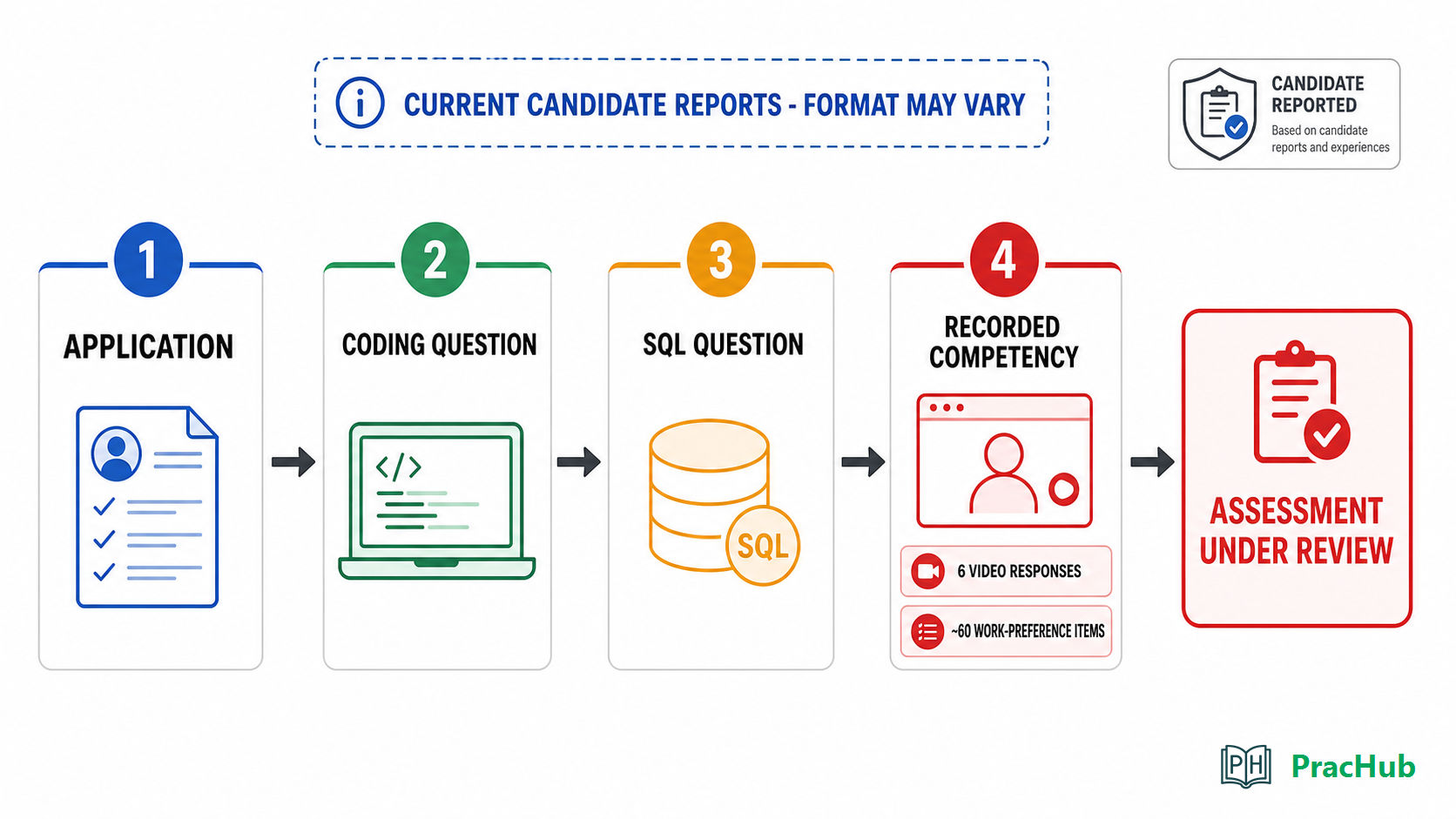
Prepare for three separate signals, not one giant test. Current August 2026 candidate discussions most often describe a technical assessment with one programming question and one SQL question. Some candidates then receive a recorded competency assessment containing video responses and work-preference items.
IBM does not publish that exact combination as a universal format. Its official careers pages say assessments may include coding, video, English-language, and work-behavior components depending on the role. Your invitation remains the authority for the provider, timer, question count, permitted resources, recording rules, and deadline.
| Assessment detail | Evidence level | Best preparation decision |
|---|---|---|
| IBM may use coding, video, and work-behavior assessments | Official IBM guidance | Prepare technical execution and spoken examples separately. |
| Data Engineer candidates report one coding and one SQL question | Multiple current candidate reports | Split technical practice between programming and query writing. |
| Reported coding difficulty ranges from easy to challenging | Candidate reports disagree | Build a reliable baseline instead of betting on one difficulty level. |
| Six video questions and about 60 preference items | Current report for one assessment | Rehearse the format, but do not assume the counts are guaranteed. |
| Some recorded answers may not allow another attempt | Current candidate report | Test the setup and use any practice screen before starting. |
What IBM officially confirms
IBM's application-process page says a coding assessment can contain multiple-choice questions or a coding challenge, depending on the role. It separately describes video assessments that use a webcam and microphone. IBM's assessment FAQ also lists coding, video, English-language, and IBM work-behavior assessments as possible stages.
The official guidance is deliberately broad because IBM hires across countries, business units, and job families. It does not promise one question count, one assessment provider, or one global sequence for every Data Engineer internship.
IBM recommends completing an assessment within the deadline in the invitation, checking whether it is timed, using any available practice run, and choosing a quiet environment. Those basic instructions matter more than a screenshot from someone else's assessment.
What current Data Engineer candidates report
Several August 2026 discussions describe a Data Engineer or data-focused HackerRank assessment with one coding task and one SQL task. The reports agree on the two-part shape more than they agree on difficulty.
One candidate described an easy programming problem and straightforward SQL. Another said the SQL was easy once the required function was recognized, but the programming task was harder. A separate data-focused report mentioned a connected-components-style problem alongside simple SQL.
That variation is useful evidence. It suggests the right strategy is not to memorize one leaked prompt. It is to become dependable across common coding patterns and the SQL operations that appear in short, automatically graded queries.
This is not the Software Developer repository assessment
IBM's current Software Developer Intern reports describe a different technical variant: a conventional coding problem plus a repository task using a framework such as Django, Node.js, or Spring Boot. That is covered in the IBM Software Developer Intern OA 2027 guide.
Do not spend your full Data Engineer preparation window learning web-framework debugging unless your own invitation mentions a repository or project environment. For this role, prioritize programming fundamentals, data transformations, SQL correctness, and clear communication about data systems.
How to prepare for the coding question
The coding task may be short, but automatic grading still punishes weak assumptions. Your solution must parse the input correctly, handle boundaries, and produce the exact expected output. A nearly correct approach can score poorly when it fails hidden cases.
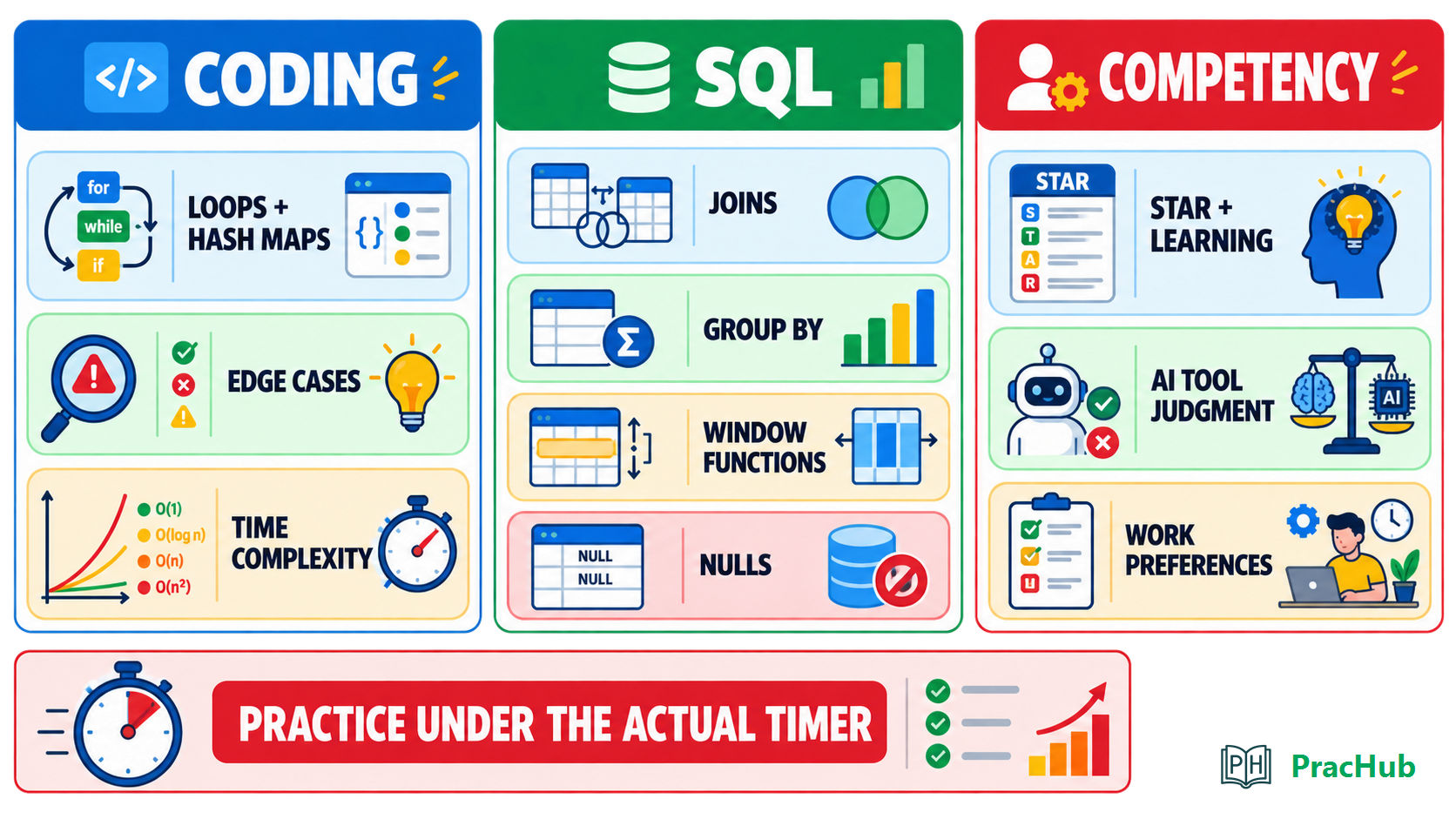
Focus on the patterns that transfer well to data-engineering work and general intern screens:
- Arrays, strings, hash maps, sets, and counting
- Sorting, two pointers, and sliding windows
- Queues, breadth-first search, and connected components
- Parsing structured records and grouping data
- Basic time and space complexity analysis
You do not need to abandon harder algorithms, but the highest-return habit is completing ordinary problems cleanly. State the input assumptions, choose a data structure deliberately, and test empty input, one element, duplicates, unexpected order, and maximum-size cases.
Use a three-pass workflow
In the first pass, restate the task and write two examples. In the second, implement the simplest correct solution that fits the constraints. In the third, test boundaries and remove accidental complexity.
If you are stuck, preserve a working baseline rather than attempting a clever rewrite in the final minutes. Correctness, readable structure, and explicit edge-case handling are stronger signals than an unfinished optimization.
How to prepare for the SQL question
Candidates often call the SQL problem easy, then mention losing time because they forgot one function or misunderstood the output grain. SQL rewards precision more than speed. Before writing a query, identify what one output row represents.
Review these areas first:
| SQL area | What you should be able to do | Common failure |
|---|---|---|
| Filtering and NULLs | Use WHERE, IS NULL, COALESCE, and correct boolean logic | Treating NULL like an ordinary value |
| Joins | Choose join keys and preserve the required population | Turning a left join into an inner join through a filter |
| Aggregation | Use GROUP BY, HAVING, conditional counts, and distinct counts | Mixing row-level and group-level logic |
| Dates and strings | Extract, truncate, compare, and transform values | Guessing dialect-specific function names |
| Window functions | Rank, deduplicate, calculate running totals, and compare rows | Filtering before the window is computed |
| Query grain | Define the entity represented by each result row | Producing duplicates after a one-to-many join |
The safest workflow is: write the expected output columns, identify the base table, add one join at a time, check row counts, then add aggregation or windows. Use a tiny mental dataset with duplicates and missing values. That exposes incorrect joins faster than rereading the query.
Prepare for dialect differences
HackerRank questions may specify a SQL dialect or expose the available database in the editor. Review the exact syntax shown in your invitation or practice environment. Functions for dates, string aggregation, and limiting rows differ across MySQL, PostgreSQL, SQL Server, and Oracle.
Do not memorize every dialect. Know the conceptual operation and verify the permitted syntax before the scored timer begins.
The recorded competency assessment
Current Data Engineer candidates also describe a separate recorded competency stage. One detailed report says it contained six video questions, with about one minute to prepare and three minutes to answer each, followed by roughly 60 work-preference statements. The same candidate reported that recorded answers could not be retried.
Treat those details as a current example, not an IBM guarantee. The IBM Competency Assessment 2027 guide covers that stage in depth.
For a Data Engineer applicant, prepare six adaptable stories involving:
- Finding and fixing a data-quality issue
- Working through disagreement about a technical approach
- Prioritizing under an incomplete requirement
- Learning from a failed pipeline, query, model, or deployment
- Explaining technical work to a nontechnical stakeholder
- Using an AI tool while verifying accuracy, privacy, and reproducibility
Use STAR plus learning
Keep the situation and task brief. Spend most of the answer on your decisions: what you checked, which trade-off you made, how you involved others, and how you verified the result. Finish with an outcome and what changed in your later work.
A strong data example sounds like this: a daily metric changed unexpectedly; you traced lineage and compared source counts; you discovered an upstream schema change; you added validation and alerting; the team restored the report and prevented a repeat. It is concrete, technical, collaborative, and measurable.
How to discuss generative AI
Current candidates mention a question about AI tools, their capabilities, and verification. Avoid both extremes. Saying you never use AI can sound disconnected from modern work, while saying it produced the solution for you raises questions about judgment.
Explain the task you used it for, the data you refused to share, how you checked the output, and where human responsibility remained. For SQL or code, verification might include reading every line, testing edge cases, checking execution plans, comparing against a trusted baseline, and documenting assumptions.
Work-preference questions
IBM's FAQ says work-behavior assessments may ask you to choose between statements and select the one you agree with slightly more. Current candidates describe a longer section with approximately 60 items and a five-position scale.
Read literally, choose the statement that better reflects your normal professional behavior, and use the strength of the scale honestly. Do not attempt to present yourself as maximally independent, maximally collaborative, maximally fast, and maximally cautious on every item. A coherent working style is more credible than a manufactured perfect profile.
Video, code, and privacy
IBM's current Talent Acquisition Privacy Notice says IBM may store recordings from video-enabled assessments. It also says assessment processing can include code created during an exercise and one or more webcam photographs.
Read the notice and platform terms that accompany your invitation. Confirm the camera, microphone, browser, identification, and accommodation requirements before starting. Do not assume another candidate's proctoring setup applies to your assessment.
Practice with IBM and Data Engineer questions from PracHub
These question-bank records train useful skills; they are not predictions of your exact 2027 OA. Each complete title in the first column opens the question and written solution.
| PracHub question | Practice focus | Why it helps |
|---|---|---|
| How Would You Use Generative AI at Work? | AI judgment and verification | Prepares a current IBM competency theme without relying on a memorized script. |
| Find Minimum Subarray Length with K Distinct Integers | Sliding window, maps, and boundaries | Builds careful implementation and hidden-case discipline. |
| Answer SQL and Data Warehouse Fundamentals for a Data Engineering Interview | SQL, modeling, and warehouse concepts | Connects query mechanics to broader data-engineering reasoning. |
| Explain Pandas and SQL Basics | Data manipulation in Python and SQL | Trains the two modes commonly expected in data-focused screens. |
| Solve SQL and Python Coding Tasks | Query writing and practical coding | Provides a compact combined rehearsal before the assessment. |
A seven-day preparation plan
| Day | Focus | What to do |
|---|---|---|
| Day 1 | Diagnostic | Complete one timed coding problem and one SQL problem without notes. Record every mistake. |
| Day 2 | Coding foundations | Review maps, sets, sorting, sliding windows, and exact input-output handling. |
| Day 3 | SQL correctness | Drill joins, aggregation, NULL behavior, dates, and output grain. |
| Day 4 | Data patterns | Practice one graph or connected-components problem and one deduplication query with a window function. |
| Day 5 | Competency stories | Build six STAR-plus-learning outlines, including data quality, disagreement, failure, and responsible AI use. |
| Day 6 | Full simulation | Combine one coding task, one SQL task, and two timed video responses in one uninterrupted session. |
| Day 7 | Final review | Confirm rules and deadline, test equipment, review errors, and stop learning new topics. |
What happens after submission?
Current candidates report portal messages such as Assessment under review, while others say the application page continued showing a reminder even after the assessment provider confirmed completion. These status labels can lag behind the assessment system and do not reveal a score or hiring decision.
Save the completion page and email. If the provider confirms submission, allow time for IBM's systems to synchronize. Use the support contact in the invitation if the deadline is close, a link fails, or completion is not recognized.
IBM does not publish one response timeline for every role. The next step can depend on eligibility, resume fit, assessment performance, team demand, location, and available headcount. Continue preparing and applying rather than treating a quiet portal as a hidden rejection signal.
Frequently asked questions
Is the IBM Data Engineer Intern OA two questions?
Multiple current candidates report one coding question and one SQL question, but IBM does not publish that as a universal format. Follow the structure shown in your own invitation.
Should I practice LeetCode or SQL first?
Take one timed diagnostic in each. If your coding solution is correct but your SQL has join, NULL, or aggregation errors, prioritize SQL. If SQL is comfortable but you cannot finish a medium implementation, shift more time to coding. Do not ignore either half.
How difficult is the coding question?
Reports vary from very easy to challenging, including a connected-components-style problem. That disagreement is a reason to build balanced fundamentals rather than target one rumored question.
Is the recorded competency assessment a live interview?
Current reports describe asynchronous recorded answers rather than a live interviewer. IBM officially says its video assessments use a webcam and microphone. The platform instructions will show the exact format.
Can I record an answer again?
One current candidate reported no reattempts. Because rules can vary, use any practice screen and confirm the policy before starting the scored section.
Does finishing the assessment guarantee an interview?
No. IBM does not publish such a guarantee. The assessment is one signal in a broader hiring process that can include eligibility, resume review, team needs, and headcount.
Final takeaway
The IBM Data Engineer Intern OA 2027 is best treated as three preparation problems: write dependable code, produce exact SQL, and communicate evidence clearly on camera. Current reports provide useful clues, but they should shape practice rather than become promises about your test.
Use PracHub's Data Engineer coding and algorithm questions and SQL and data-manipulation questions to expose weak areas before the timer does. Then build a compact story bank for the competency stage and enter each assessment ready for the instructions you actually receive.
Sources and Further Reading
- IBM Application Steps and Tips — official assessment types, video assessment, interview process, and variable timelines.
- IBM Assessment FAQ — official guidance on coding, video, work-behavior, deadlines, practice runs, and statement choices.
- IBM Talent Acquisition Privacy Notice — official information about video recordings, assessment code, webcam photographs, and recruitment-data processing.
- Current candidate discussion: IBM Data Engineer Intern OA — candidate-reported coding and SQL format, difficulty variation, and preparation concerns.
- Current candidate discussion: IBM Competency OA 2027 — candidate-reported video timing, preference items, AI question, and portal status.
- Current candidate discussion: IBM Software Developer Intern 2027 changes — evidence that the Software Developer repository format differs from the Data Engineer reports.
- Current IBM weekly employment discussion — candidate reports about the data-focused coding and SQL assessment label.
- Current data-engineering assessment discussion — additional candidate reports about one coding task and one SQL task.
Research note: This guide was reviewed on August 18, 2026. Candidate experiences are anecdotal and can vary by role, team, location, and assessment version. They are not presented as IBM policy.
Related Articles
Airflow Interview Questions for Data Engineers: DAGs, Scheduling, Backfills, and Failures
Prepare for Airflow interviews with practical questions on DAGs, scheduling, catchup, backfills, retries, pools, sensors, and pipeline failures.
Jane Street Data Engineering Internship 2027: Interview Process, SQL, and Systems Questions
Prepare for Jane Street's 2027 Data Engineering Internship with verified process details, SQL and Pandas practice, systems topics, and a 7-day plan.
Databricks Interview Questions for Data Engineers: Spark, Delta Lake, and Lakehouse Design
Prepare for Databricks data engineer interviews with Spark tuning, Delta Lake reliability, lakehouse design, debugging frameworks, and practice questions.
Snowflake Interview Questions for Data Engineers: Warehouses, Micro-Partitions, and Query Tuning
Prepare for Snowflake data engineer interviews with warehouse sizing, micro-partition pruning, query tuning, ingestion, SQL, and scenario-based questions.
Comments (0)