Jane Street Data Engineering Internship 2027: Interview Process, SQL, and Systems Questions
Quick Overview
A research-backed guide to the Jane Street Data Engineering Internship 2027 for candidates preparing for SQL or Pandas data exercises, progressive coding interviews, and practical pipeline design. It separates Jane Street's official role and interview guidance from cycle-specific candidate reports, then provides direct PracHub practice questions and a seven-day preparation plan.
The hardest part of a Jane Street data engineering interview may not be writing a correct SQL query. It may be proving that you can look at unfamiliar, messy data, decide what it actually means, and build a result that another engineer or researcher can trust.
That is the clearest signal in Jane Street's current Data Engineer Internship description. The role combines Python, SQL, data investigation, pipeline engineering, quality monitoring, and clear communication. It is not simply an analytics internship, and it is not a standard LeetCode-only software engineering process.
This guide separates Jane Street's official information from candidate-reported interview formats. Start with the Jane Street interview questions on PracHub, then use the framework below to prepare for SQL or Pandas work, progressive coding questions, and practical data systems discussions.
Quick verdict: what should you prepare for?
| Candidate question | Evidence-based answer |
|---|---|
| Is SQL part of the role? | Yes. Jane Street explicitly lists SQL alongside Python and OCaml. Recent candidates have also reported data-cleaning exercises completed in SQL or Pandas. |
| Will there be a fixed SQL round? | Jane Street has not published a universal 2027 round sequence for this internship. Treat SQL or Pandas exercises as a strong preparation target, not a guaranteed format. |
| Should you expect coding? | Yes. Jane Street's Technology interview guidance says candidates work through coding challenges, and its official example uses real code in a shared editor. |
| Will systems questions appear? | Candidate reports and the role itself support preparing data pipelines, orchestration, reliability, and data-quality trade-offs. The depth and order can vary. |
| Do you need finance or OCaml experience? | No. Jane Street says no specific academic or finance background is required, and candidates should interview in the language they know best. |
The short answer: prepare like a software-minded data engineer. You should be able to manipulate data quickly, write maintainable code, reason about incomplete information, and explain how a pipeline stays correct when inputs arrive late, duplicated, or out of order.
What Jane Street officially confirms for the 2027 internship
Jane Street's current New York internship page describes work with structured and unstructured sources such as world news, decades of weather history, deidentified spending data, and packet captures from exchange feeds. Interns are expected to investigate an unfamiliar dataset, explain anomalies, and write code that ingests, transforms, and monitors it.
The posting also says interns take ownership of two projects while receiving mentorship from full-time Data Engineers and context from data users. That combination matters for interview preparation: the role is testing more than syntax. It needs people who can move from an ambiguous business question to a dependable data product.
The skill profile is broader than SQL
Jane Street explicitly asks for comfort manipulating data in Python, SQL, R, or a similar tool. It also values analytical reasoning, curiosity about what data means, organization, humility, and clear written and verbal communication. The full-time Data Engineer posting reinforces the same profile and mentions SQL or DataFrame tools such as Pandas or Polars.
You do not need to arrive as a polished distributed-systems expert. You do need to turn an idea into working code and make careful decisions when the data does not match your first assumption.
Finance knowledge is not the gate
The internship description says no background in computer science, data engineering, or finance is required. That does not make the interview easy. It means the useful preparation is general reasoning applied to realistic data, rather than memorizing trading vocabulary.
If a prompt mentions orders, fills, or market feeds, ask for the semantics you need. Define identifiers, timestamps, ordering guarantees, duplicate behavior, and the meaning of a correction. Strong candidates make the domain legible before they optimize the implementation.
What the Jane Street Data Engineering interview process may look like
Jane Street says interview structure varies by discipline and that processes not publicly outlined can be bespoke. Its general recruiting page says applications are reviewed on a rolling basis, recruiters explain the next step to selected candidates, and post-interview decisions are normally communicated within a week.
Recent reports add useful detail, but they should not be converted into a guaranteed 2027 flow. A March 2026 Hong Kong candidate described a medium coding interview followed by data cleaning in either Pandas or SQL. An older London Data Engineer report described an initial background discussion, a progressive pair-programming problem, and questions about data impact, Airflow, and orchestrator design.
| Possible stage | What the evidence supports | Best preparation |
|---|---|---|
| Application review | Rolling review; Jane Street may consider candidates across open roles. | Show data investigation, ownership, programming, and measurable impact. |
| Recruiter or background conversation | Motivation, prior projects, role fit, and logistics may be discussed. | Prepare a concise project deep dive and a specific answer to "Why Jane Street?" |
| Technical coding | Official Technology guidance confirms coding challenges; candidate reports describe evolving constraints. | Write executable code, test edge cases, and narrate each design decision. |
| Data exercise | Multiple reports mention inspecting and transforming data with SQL or Pandas. | Practice profiling, cleaning, joining, aggregating, and validating unfamiliar data. |
| Systems or final interviews | Reports mention pipeline, orchestration, and practical engineering trade-offs; exact sequence varies. | Design for correctness, retries, late data, backfills, observability, and ownership. |
Your recruiter and invitation remain the source of truth. Confirm the number of interviews, expected tools, whether you will receive a dataset in advance, and whether code must run. Do not prepare around a third-party claim of an exact round count or timeline unless Jane Street confirms it for you.
How to handle the SQL or Pandas data exercise
A strong data exercise answer starts before the first query. Inspect the schema, count rows, check types, measure missingness, identify candidate keys, and look for impossible or suspicious values. Then state what you believe each field represents and which assumptions still need confirmation.
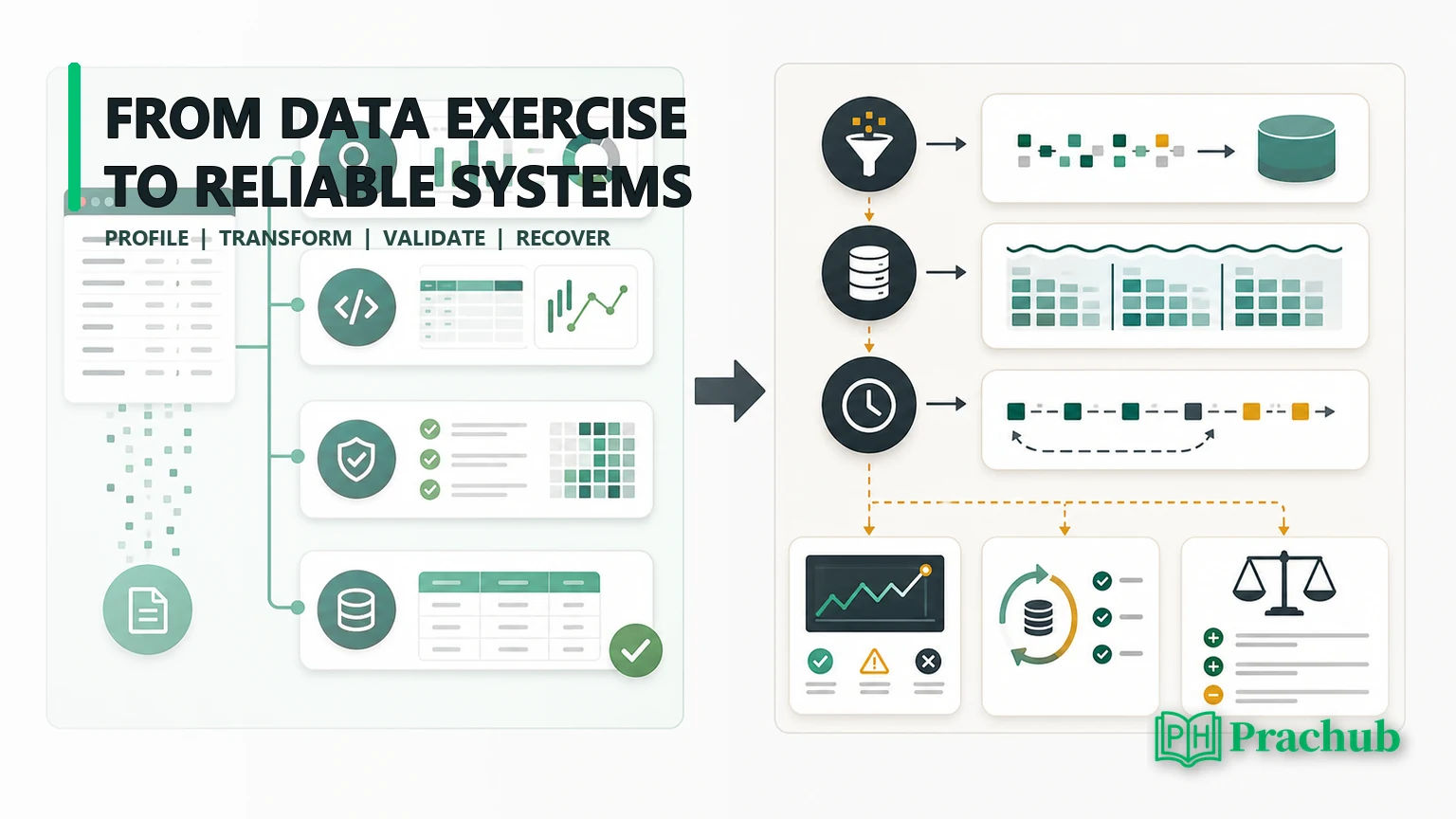
Use a four-pass workflow: profile, define, transform, validate. Profiling tells you what is present. Defining makes duplicate, null, timestamp, and correction semantics explicit. Transforming produces the requested result. Validation proves that the transformation did not silently lose or invent data.
SQL topics worth practicing
Be comfortable with joins, grouped aggregation, conditional logic, common table expressions, window functions, and deduplication. Time-oriented work often requires ranking records within an entity, calculating rolling values, pairing events with the latest known state, or detecting gaps and reversals.
For each query, explain the grain of every intermediate result. If one row represents a trade before a join and several rows afterward, say why. Check row counts, null rates, and aggregate totals before and after the transformation. PracHub's SQL interview practice is useful for building that habit under time pressure.
Pandas topics worth practicing
Know how to inspect dtypes, normalize dates and categorical values, filter safely, merge DataFrames, group and aggregate, sort deterministically, and remove duplicates under a stated rule. Prefer vectorized operations, but do not force a clever one-liner when a clear sequence of transformations is easier to verify.
Watch for silent index alignment, mixed timestamp zones, chained assignment, accidental object dtypes, and a merge that multiplies rows. A strong explanation names the risk and adds a check. For example, validate join cardinality, compare the number of unique IDs, and reconcile an important total.
How Jane Street coding questions differ from routine LeetCode
Jane Street's official software interview example expects real code in a shared editor and encourages candidates to use their strongest language. It also shows an interactive style: begin with a basic version, then adapt as the interviewer changes the requirements.
That pattern appears in Data Engineer reports too. The point is not to predict one exact problem. It is to practice extending working code without breaking earlier behavior. Keep state representation simple, name invariants, and separate core logic from input parsing so a new requirement has a clear place to go.
Use a visible problem-solving loop
Start by restating the contract and asking two or three high-value questions. Propose the simplest correct design, state its complexity, and implement it in small testable pieces. After each new constraint, explain what changes in the model before editing code.
Avoid long silent stretches. Jane Street says collaborative problem solving matters, so give the interviewer material to work with. A correction after useful discussion is a stronger signal than quietly pursuing an elegant but incorrect interpretation.
Systems questions: think in data contracts and failure modes
For a pipeline design question, begin with consumers and correctness requirements. Researchers may care about reproducibility, historical backfills, and point-in-time correctness. A production feed may prioritize freshness, deterministic ordering, and rapid detection of missing or duplicated events.
Define the source, schema, identifiers, event time, ingestion time, expected volume, and service-level objective. Then describe ingestion, validation, storage, transformation, serving, and monitoring. Only introduce tools after the requirements make their purpose clear.
Trade-offs interviewers can explore
Expect follow-ups about batch versus streaming, exactly-once claims, idempotent writes, schema evolution, partitioning, replay, backpressure, and late data. Explain how you would quarantine bad records, reprocess a corrected source, compare two systems of record, and prevent a backfill from contaminating live output.
Observability should cover more than whether a job ran. Discuss freshness, completeness, uniqueness, distribution shifts, reconciliation totals, and lineage. A healthy pipeline can still deliver incorrect data, so operational success and data correctness need separate signals. Practice these choices with PracHub's system design questions.
Practice with Jane Street questions from PracHub
These are Jane Street question-bank records stored by PracHub. They are not predictions of the exact 2027 internship interviews. Use them to train the data transformation, validation, ordering, and systems reasoning that the current role description emphasizes.
| PracHub question | Stored round | Level | Practice focus |
|---|---|---|---|
| Transform Sparse Time-Code Stream to Dense Rows | Technical Screen | Easy | Streaming transforms, missing values, ordering, and bounded memory |
| Validate Order Book Data Across Multiple Databases | Onsite | Easy | Data invariants, reconciliation, duplicates, replay, and monitoring |
| Sort Trade Executions Into a Canonical Order | Onsite | Easy | Deterministic ordering, tie-breakers, normalization, and scale |
| Design Exchange-Trading System Message Flow | Onsite | Easy | Contracts, idempotency, ordering, reconnects, and failure handling |
Attempt the first problem in executable Python, then explain how you would handle out-of-order timestamps. Use the validation problem as a 35-minute design drill. Finish by comparing the canonical-sort and message-flow questions: one tests deterministic transformation, while the other tests the guarantees around a live system.
Prepare your project and behavioral stories
Jane Street values people who ask good questions, communicate clearly, admit mistakes, and learn quickly. Prepare one project where the data was misleading, one incident where a pipeline or analysis failed, and one decision where you balanced speed against correctness.
For each story, explain the original assumption, the evidence that challenged it, the action you took, and the measurable outcome. Include how you worked with the data's consumers. A technically strong pipeline that solves the wrong problem is not a strong Data Engineering result.
Use PracHub's behavioral and leadership practice to rehearse the stories, but keep the delivery conversational. Your goal is not a memorized monologue. It is a clear explanation that can survive follow-up questions.
A seven-day Jane Street preparation plan
| Day number | Focus | What to do |
|---|---|---|
| Day 1 | Baseline | Complete one timed SQL set and one Python transformation. Record every correctness and communication gap. |
| Day 2 | Messy data | Profile an unfamiliar dataset, define its grain and keys, clean it, and write five validation checks. |
| Day 3 | Progressive coding | Solve one stateful implementation problem, then add two changing requirements without rewriting everything. |
| Day 4 | Pipeline design | Design ingestion, storage, transformation, backfill, and monitoring for one time-series data source. |
| Day 5 | Jane Street practice | Attempt the four linked PracHub questions and review every assumption, edge case, and missed invariant. |
| Day 6 | Mock interview | Run a 60-minute mock combining data work, evolving requirements, and a short systems follow-up. |
| Day 7 | Final review | Rehearse your project deep dive, "Why Jane Street?", logistics, and a concise checklist for validating results. |
Frequently asked questions
Does the Jane Street Data Engineering internship have an online assessment?
Jane Street does not publish one universal 2027 Data Engineering Internship assessment sequence. Some reports across Jane Street roles mention online assessments, while Data Engineer reports more consistently describe live coding and data exercises. Use your invitation and recruiter guidance as the authority.
Is the data exercise SQL or Pandas?
Recent candidates have reported being allowed to use SQL or Pandas for data cleaning and analysis. The official internship page confirms that SQL and Python are relevant to the work, but it does not promise that every candidate will receive the same choice or exercise.
Do you need to learn OCaml before the interview?
No. The internship uses OCaml, but Jane Street's interview guidance explicitly says candidates do not need to know it and should use the language they know best. Learn enough about the role to explain why the environment interests you, but do not sacrifice fluency by interviewing in a new language.
How difficult are the systems questions?
The exact depth varies. Prepare to reason about practical data systems rather than recite architecture diagrams. Strong answers define contracts, identify failure modes, choose measurable guarantees, and explain how to validate both the pipeline and its output.
How long does Jane Street take to respond?
Jane Street's general interview page says candidates should normally hear back within a week after interviews. Application-stage timing can vary under rolling review. A current 2027-cycle applicant reported a recruiter update after roughly two weeks, but one report is not a service-level promise.
Final takeaway
The Jane Street Data Engineering Internship rewards a particular combination: curiosity about messy data, disciplined programming, and systems thinking grounded in correctness. Prepare SQL and Pandas, but do not stop at producing an answer. Explain the data's meaning, test your assumptions, and show how the result stays reliable when the input behaves badly.
Build that preparation around the Jane Street interview questions on PracHub. Use the company-specific records to practice transformations, validation, ordering, and failure handling, then carry the same reasoning into whichever interview sequence your recruiter confirms.
Sources
Related Articles
Airflow Interview Questions for Data Engineers: DAGs, Scheduling, Backfills, and Failures
Prepare for Airflow interviews with practical questions on DAGs, scheduling, catchup, backfills, retries, pools, sensors, and pipeline failures.
Databricks Interview Questions for Data Engineers: Spark, Delta Lake, and Lakehouse Design
Prepare for Databricks data engineer interviews with Spark tuning, Delta Lake reliability, lakehouse design, debugging frameworks, and practice questions.
Snowflake Interview Questions for Data Engineers: Warehouses, Micro-Partitions, and Query Tuning
Prepare for Snowflake data engineer interviews with warehouse sizing, micro-partition pruning, query tuning, ingestion, SQL, and scenario-based questions.
IBM Data Engineer Intern OA 2027: Coding, SQL, and the Recorded Competency Assessment
Prepare for the IBM Data Engineer Intern OA 2027: coding, SQL, recorded video questions, work preferences, timelines, and a 7-day plan.
Comments (0)