Aman Manazir SWE Accelerator Review 2026: Is the Yearlong Coaching Program Worth It?
Quick Overview
Compare the SWE Accelerator’s public duration descriptions, coaching scope, pricing disclosure and conditional guarantee. Two customer reports and an original feedback-capacity exercise help you identify what a written offer must resolve.
Aman Manazir’s SWE Accelerator deserves a conditional review, especially if you found it described as a yearlong program. The current homepage and coaching FAQ still use that description, while the coaching headline advertises a 12-week offer outcome. An outcome target and a support period can differ; the pages do not establish your live-coaching schedule.
Our assessment: consider it when you need coordinated human feedback across several recruiting stages, after you confirm the deliverables and total cost. For a narrow coding weakness, first establish a baseline with Find the Earliest Pair with a Target Sum and identify what feedback you need.
Evidence and disclosure: PracHub competes in interview preparation. This review checks public provider pages and two independent customer reports. We did not enroll, join a sales call, attend a mock, or inspect an enrollment agreement. Provider promises, customer experiences, and our assessment are distinguished below.
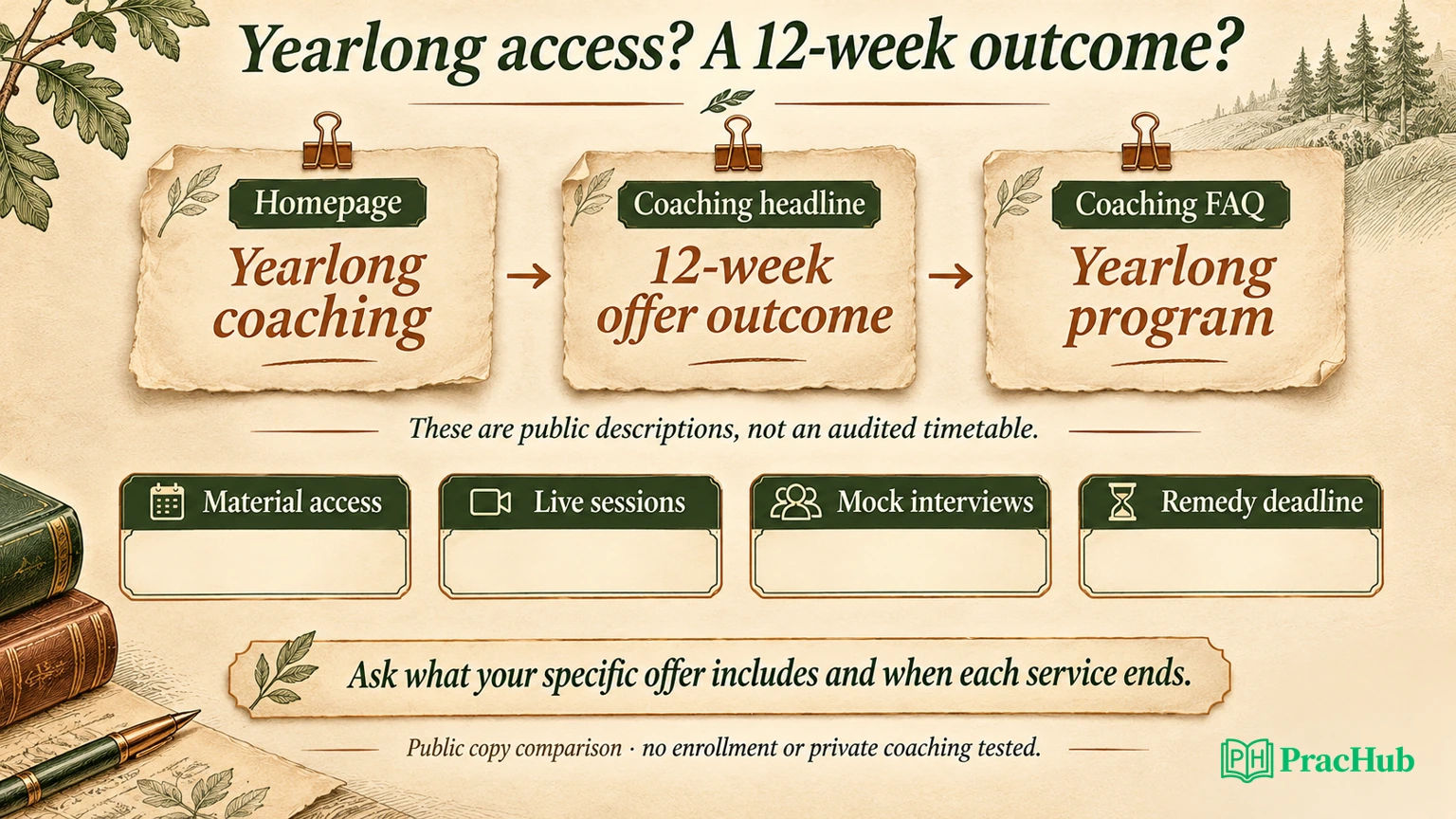
Resolve the yearlong and 12-week descriptions first
Official public copy: the homepage describes yearlong coaching. The coaching page combines a 12-week offer headline with a yearlong description in its FAQ. This establishes what the pages say, rather than which arrangement you will receive.
Our interpretation is that an outcome target, learning schedule, platform access period, and live-service period can differ. There is insufficient public detail to assign each phrase to a specific contractual entitlement. Use this ledger to separate the public descriptions from the service dates you need.
| Public description | What it establishes | What your offer still needs to resolve |
|---|---|---|
| Homepage: yearlong coaching | The provider uses a one-year description | Start date, end date, pauses, and included live support |
| Coaching headline: 12-week outcome | A marketing target appears in the headline | Whether it is a target, service period, or guarantee deadline |
| Coaching FAQ: yearlong program | The longer description remains on the sales page | Which sessions and reviews remain available later |
| Individual enrollment offer | Not inspected for this review | Your tier’s actual access and service schedule |
Ask for separate dates for curriculum access, community access, scheduled sessions, and eligibility for any remedy. Twelve months of material access would not, by itself, establish twelve months of recurring mocks. Equally, a 12-week headline does not prove that every service stops after week twelve.
Evaluate the feedback you would actually receive
The provider’s terms describe career and technical coaching, resume and LinkedIn support, application strategy, and mock interviews. These are provider-described services, not services we tested. Services overview.
Translate that broad scope into a working example. Suppose your last coding mock failed because you implemented the first plausible solution without checking tie rules. Useful feedback would identify the missed rule, show the counterexample, and ask you to demonstrate the correction in another problem. “Practice more algorithms” would leave the diagnosis unresolved.
For resume support, ask whether the reviewer will examine your actual project evidence and target roles. A rewritten bullet is less useful if you cannot defend its scope or metric in an interview. For behavioral preparation, look for feedback on your decisions and contribution, rather than a script you cannot adapt.
A sample debrief, anonymized review, or clearly described revision process can help you judge specificity. Availability of a sample is a question to ask; this review does not claim that one is publicly offered. A coach’s employer does not tell you whether your tier includes a reviewed retry after a failed mock.
Pricing and the guarantee require separate answers
Official public information: the coaching FAQ says tuition and multiple tiers exist; the reviewed page does not show a universal tuition amount. Its footer makes the results guarantee conditional and disclaims specific placements, salaries, and outcomes. These are provider statements, not a guarantee endorsed by this review. Coaching FAQ and disclosure.
The published refund policy says tuition is non-refundable unless the enrollment agreement provides otherwise. It also describes conditional deposit refundability and a follow-up-call cutoff. That policy does not establish the terms of an agreement we have not seen.
Keep the questions separate: when is payment due, what qualifies for a remedy, what must you complete, and what happens if you withdraw? “You do not pay” could otherwise be mistaken for no upfront charge, although that payment schedule has not been established here.
Request a written explanation connecting the advertised guarantee to the payment and refund provisions for your offer. If the explanation and documents differ, resolve the difference before deciding. This review reports published wording; it does not determine enforceability or your legal rights.
A missed-call rule, a pause request, and a failed-outcome claim are also different situations. Record which condition applies to each. A general promise of support cannot answer all three.
Read customer reports as individual experiences
Customer report: L N’s August 7, 2026 review praises networking, resume improvement, and coding fundamentals, while requesting more system-design support and later mock access. The reviewer says they did not obtain an offer by program completion and received a refund. This is one person’s account, not proof that every participant qualifies for the same remedy. L N’s review.
Customer report: Manan Mehta’s October 23, 2026 review describes the program’s roadmap as useful for people starting out. It does not document that reviewer’s session allowance, tuition, or employment outcome. Manan Mehta’s review.
Together, these reports suggest questions about structure, specialist depth, and service timing. They cannot establish a typical placement rate or prove that a particular current tier matches an earlier enrollment. The provider discloses that some on-site testimonials may be incentivized. We found no evidence establishing that either linked Trustpilot report was incentivized.
Our assessment is to use reviews to design questions. If system design is your main weakness, ask specifically about that support. If you expect mocks throughout a year, request their schedule. Avoid treating a positive story as a forecast or a disappointed customer as a complete description of the program.
Diagnose your recruiting problem before comparing packages
Consider a synthetic job-search ledger: sixty applications, six initial conversations, two technical interviews, and no offers. These invented counts illustrate diagnosis; they are not Accelerator results or a reliable benchmark.
First check whether the applications were comparable. Different locations, levels, eligibility requirements, referral routes, and dates can produce different response patterns. The ledger alone does not identify which intervention will improve your results.
| Observation in the synthetic ledger | Inspect before buying help |
|---|---|
| Few conversations | Targeting, eligibility, project evidence, resume, and application route |
| Conversations but few technical rounds | Role fit, communication, and how experience is presented |
| Technical interviews without progression | Clarification, implementation, testing, and explanation |
| Late-stage rejection | Actual feedback, role expectations, behavioral evidence, and team fit |
A broad coaching package may be useful when several unresolved problems interact. A single targeted review may be enough when the weakness is clear. These are our preparation judgments, not measured claims about either option’s effectiveness.
Bring one failed answer and one successful answer to a prospective coach. Ask what they would diagnose differently and what evidence would show improvement. That discussion is more informative than comparing course-module counts.
Budget your available practice and feedback time
Here is an original capacity exercise, not a provider requirement. Suppose you can reserve six hours a week for twelve weeks: seventy-two hours total. Allocate six hours to diagnosis, twenty-four to coding practice, twelve to behavioral preparation, eighteen to applications, and twelve to reviewing feedback.
The arithmetic is straightforward; your calendar determines whether it is realistic. If you already spend those six hours on applications, adding coaching sessions without changing the plan leaves no time to apply corrections.
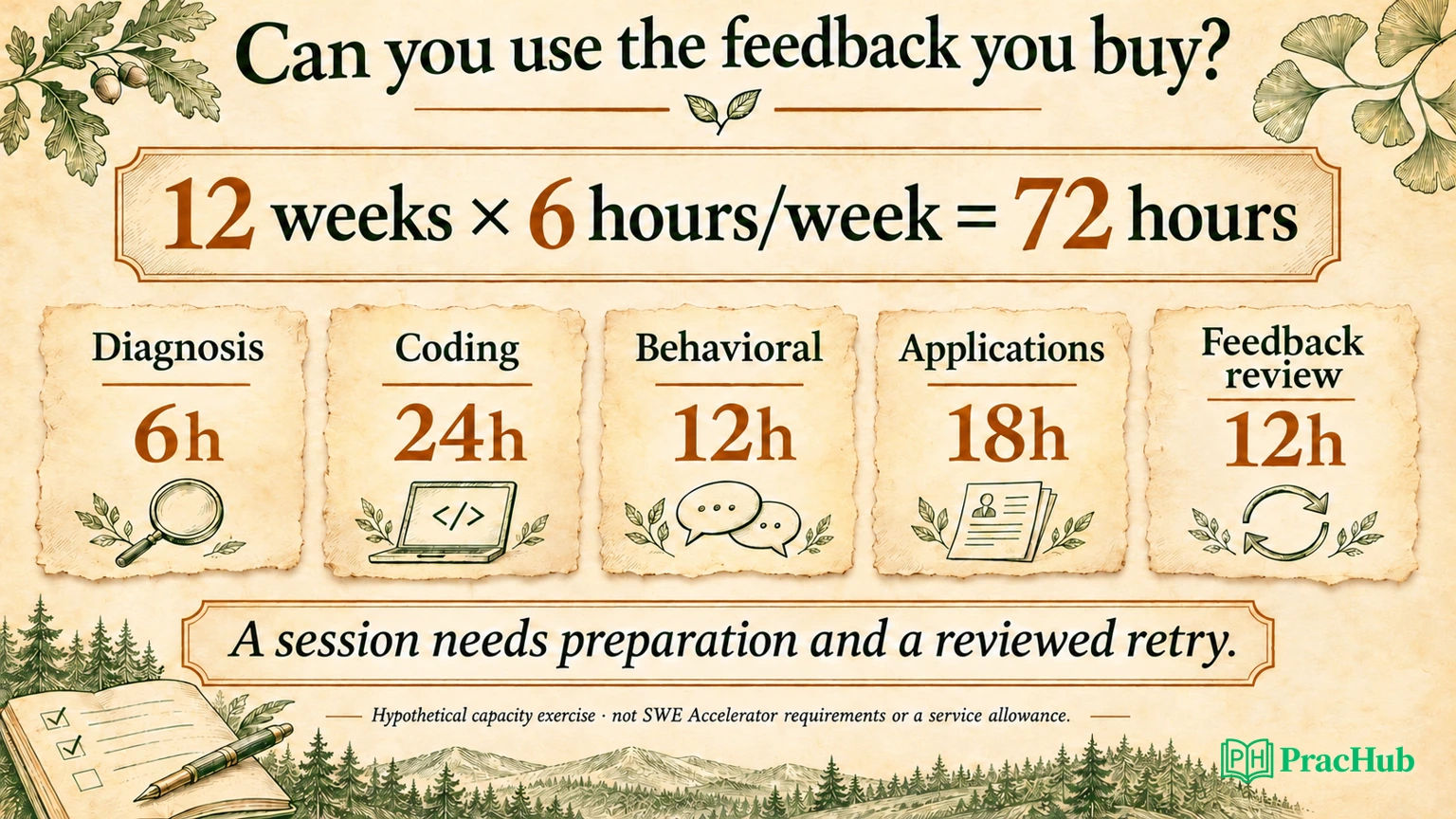
The twelve-week horizon here is a planning example prompted by the provider’s headline. It is not a recommended completion deadline or evidence that the program requires six hours weekly.
For a written quote Q, compare cost with feedback you can use. If your plan assumes eight substantial reviews but your availability allows only four, Q divided by four is twice Q divided by eight. This is a utilization calculation, not an estimate of the program’s price, value, or hiring return.
Count preparation and revision time around each session. A mock without subsequent practice may reveal a weakness without changing it. Conversely, a less frequent review can be useful when you have enough time to test and apply its recommendations.
Compare written offers by the same service units
Prepare this original comparison sheet before a call or purchase. Fill it from the specific offer, leaving unknowns visible.
| Service unit | Record for each offer |
|---|---|
| Live mock | Format, length, interviewer, scheduling window, and feedback artifact |
| Written review | Material reviewed, revision allowance, and response time |
| Ongoing access | What remains available and the date each service ends |
| Missed session | Rescheduling conditions and whether the allowance is consumed |
| Outcome remedy | Eligibility, required evidence, deadline, and stated remedy |
| Total commitment | Total payment, installments, additional charges, and available practice time |
Do not make unlike offers appear equal. Four observed coding mocks differ from four group office hours; a library subscription differs from recurring review of your own work. Both may be useful, but the comparison should preserve those distinctions.
Choose two requirements that would change your decision. For example, a senior candidate might prioritize system-design review and access after the first recruiting cycle. A student might prioritize project explanations and a repeatable application process. A large service list has little value when it leaves your decisive requirement unresolved.
Run one observable practice-and-review cycle
Before choosing a broad package, complete one bounded cycle with resources you already have. Solve a problem, preserve the attempt, obtain specific feedback where available, and retry a related problem. This is our suggested diagnostic, not a free trial promised by the Accelerator.
For target-sum practice, record the problem’s pair-selection rule, a duplicate-value counterexample, and why your stored index is sufficient. A higher score alone may reflect familiarity with the problem.
If you cannot obtain actionable feedback, that is evidence of an unmet preparation need. It still does not identify which paid provider will meet it. Compare how each proposed service would observe your work and follow up on the correction.
Use PracHub questions to locate a specific gap
These verified question records span coding, design, and explanation. They are independent practice material, not an Accelerator curriculum, a coaching entitlement, or a prediction of your interview.
| PracHub question | Evidence to produce |
|---|---|
| Find the Earliest Pair with a Target Sum | A precise tie rule, implementation, and edge tests |
| Assign a Minimum Rental Fleet with Exact Timestamps | An interval model and deterministic assignment explanation |
| Design a Concurrent Image Processing Service | Concurrency and failure-handling decisions |
| Describe a Strongly Held View That Proved Wrong | Your decision, contradictory evidence, and changed behavior |
| Evaluate an AI-Assisted Engineering Workflow | Tool boundaries, verification, and evidence for the result |
Pick the question corresponding to a failure you can observe. If the target-sum implementation is correct but its explanation is unclear, preserve both observations. Save the explanation that went wrong as well as the code that passed, so the next review addresses the moment you struggled.
Make the decision from scope, fit, and unresolved questions
SWE Accelerator may merit further evaluation when you want coordinated human support and will use it. Public information supports examining that proposition; it does not establish your likely outcome or justify a blanket recommendation.
The immediate unresolved issue is how the yearlong description relates to the twelve-week headline and your tier’s live services. Resolve that alongside price, payment, feedback frequency, specialist depth, and remedy conditions. Reconsider if the written offer leaves your most important requirement unanswered.
Return to Find the Earliest Pair with a Target Sum, save one attempt, and identify the feedback you need. Use that saved attempt to ask for the type of feedback you need before choosing a package.
Sources and Further Reading
- Official SWE Accelerator homepage
- Official coaching page, FAQ, and results disclosure
- Official refund and deposit policy
- Official terms of service
- Official privacy policy
- L N’s individual customer review
- Manan Mehta’s individual customer review
Public information rechecked November 3, 2026, Pacific time. Service descriptions and individual offers can change. No enrollment, payment, private coaching, or customer outcome audit was performed.
Comments (0)