Amazon Bar Raiser Interview Guide 2026: Leadership Principles, Signals, and Questions
Quick Overview
Understand the Amazon Bar Raiser interview in 2026, including the Bar Raiser's role in the hiring loop, how Leadership Principles shape evaluation, what strong behavioral evidence looks like, representative practice questions, follow-up drills, common myths, and a six-step preparation plan for software engineers.
You can solve every coding problem in an Amazon interview and still leave the loop uncertain. Why? Amazon is not only asking whether you can write code. It is gathering evidence about how you make decisions, take ownership, handle disagreement, learn from failure, and deliver for customers.
That is where the Amazon Bar Raiser interview matters. The Bar Raiser is an experienced interviewer, usually from outside the hiring team, who helps the panel evaluate you against the role and Amazon's Leadership Principles with a long-term, evidence-based view.
The best preparation is not guessing which interviewer is the Bar Raiser. Build a reusable story bank, practice precise follow-ups, and connect behavioral evidence to your technical decisions. Start with PracHub's behavioral and leadership interview practice, then use company-specific interview prep to rehearse a realistic Amazon loop.
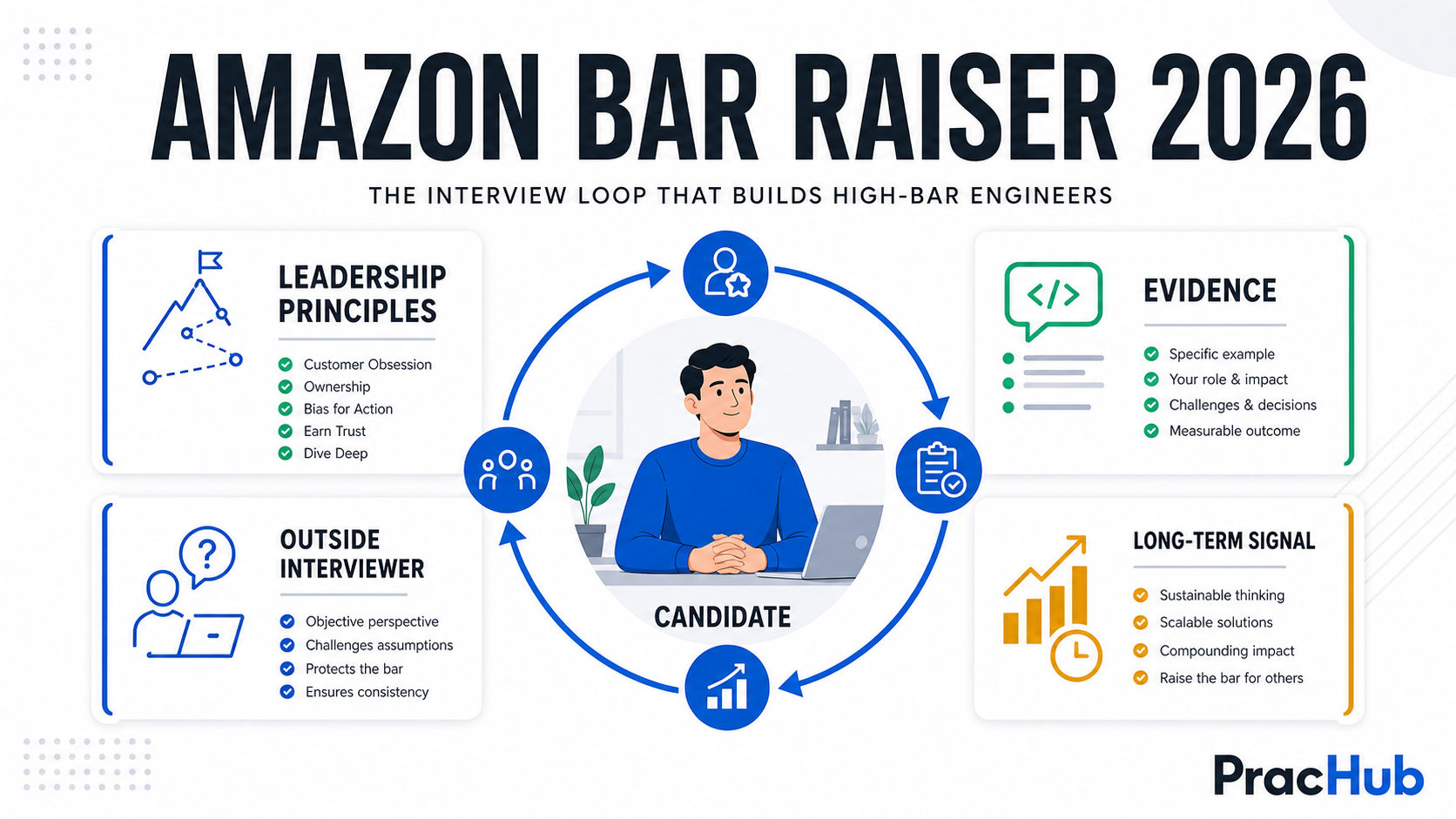
The Bar Raiser looks for durable evidence across Leadership Principles, role skills, and long-term impact.
Quick Answer: What Is an Amazon Bar Raiser?
An Amazon Bar Raiser is a trained interviewer who joins a hiring loop as an objective third party. Amazon says the role is to assess the candidate, help the panel conduct an open and fair evaluation, and keep the decision aligned with the company's long-term hiring standard.
The Bar Raiser is not simply the person who asks the hardest behavioral question. They may evaluate assigned Leadership Principles or role competencies, coach other interviewers, and guide the debrief. Amazon's published description says the Bar Raiser and hiring manager make the final hiring decision together.
What the Bar Raiser Actually Does
Amazon describes three connected responsibilities. As an interviewer, the Bar Raiser evaluates evidence against the role and long-term success at Amazon. As a decision driver, they help the group examine written feedback, surface contradictions, and reach a data-based decision. As a teacher and mentor, they improve question quality and help interviewers distinguish observations from impressions.
The broader goal is to reduce short-term hiring pressure. Because the Bar Raiser commonly sits outside the hiring team, they can ask whether the candidate raises the company-wide standard rather than merely filling an urgent vacancy. Amazon describes that standard as hiring people with growth potential and skills stronger than at least half of their would-be peers in similar roles.
Amazon Bar Raiser Myths vs. Official Reality
| Common claim | More accurate interpretation |
|---|---|
| The Bar Raiser has a secret solo veto. | Amazon says the Bar Raiser guides the discussion and makes the final decision with the hiring manager. Treat the outcome as a structured group evaluation, not one mysterious vote. |
| There is one predictable Bar Raiser round. | The loop varies by role. Each interviewer assesses different competencies, and you may not be told who the Bar Raiser is. |
| You need a perfect story for all 16 principles. | Amazon says candidates are not expected to score highly on every principle. The relevant mix depends on the role, but your examples should cover a broad range. |
| A technical round is separate from Leadership Principles. | Technical work still reveals ownership, judgment, depth, standards, and communication. Expect to explain both the solution and the decisions behind it. |
How the Interview Loop and Debrief Work
During Amazon's interview loop, you meet several employees individually. Each person is assigned different aspects of your skills and experience, which can include technical competencies and selected Leadership Principles. The exact mix changes by level, team, and role.
After the interviews, the panel compares evidence rather than simply averaging opinions. The Bar Raiser helps ensure each interviewer participates, probes weak or conflicting claims, and keeps the discussion tied to the hiring standard. You cannot control that meeting, but you can make your evidence easy to evaluate: state what you did, why you chose it, what changed, and what you learned.
For software roles, prepare for the behavioral layer alongside coding and design. PracHub's Amazon OA Work Simulation guide covers the earlier assessment stage, while our Amazon system design interview guide shows how Leadership Principles appear in architecture trade-offs.
Which Leadership Principles Should You Prepare?
Amazon currently publishes 16 Leadership Principles and says they are all considered equal. In practice, the interview team selects principles and competencies relevant to the role, so your recruiter and job description should guide your emphasis.
For software engineers, a useful core story bank often covers Customer Obsession, Ownership, Dive Deep, Deliver Results, Learn and Be Curious, Insist on the Highest Standards, Bias for Action, Are Right, A Lot, and Have Backbone; Disagree and Commit. Senior and management candidates should also prepare evidence about developing others, setting direction, operating across teams, and considering the wider effects of scale.
Do not force one anecdote into every principle. Choose six to eight substantial situations with different stakes: a failure, a disagreement, an ambiguous launch, a customer problem, a difficult technical diagnosis, a quality trade-off, and an example of influence without authority. One rich story can support several principles when the question genuinely fits.
What Strong Answers Show
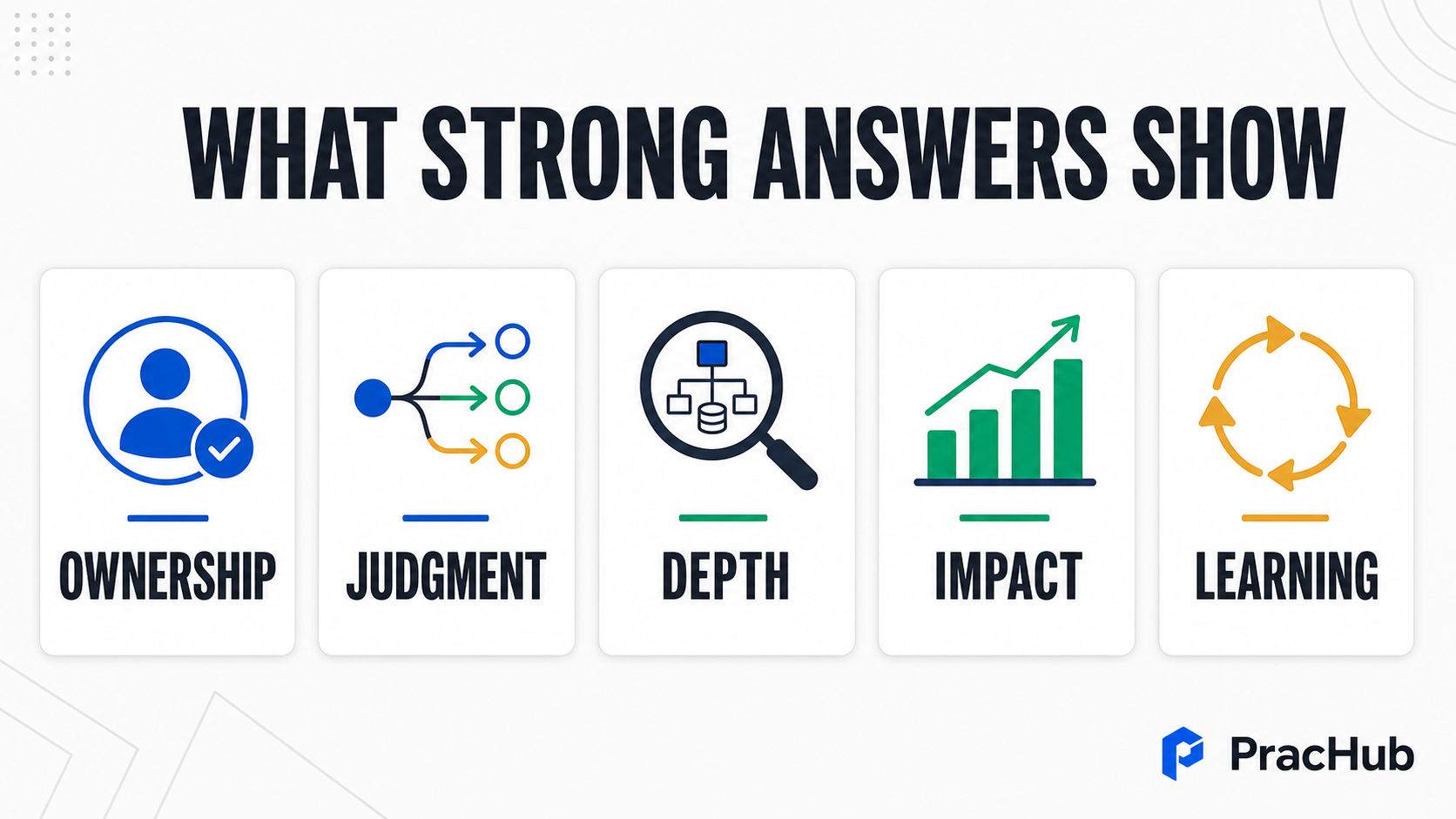
Strong answers make ownership, judgment, depth, impact, and learning visible.
| Strong answer signal | Weak version |
|---|---|
| Ownership: You identify your decisions, actions, and accountability beyond the minimum scope. | "We" did everything; your contribution remains unclear. |
| Judgment: You explain options, data, constraints, reversible versus irreversible choices, and why the trade-off made sense then. | You present the outcome as obvious and ignore alternatives. |
| Depth: You can move from the summary into metrics, mechanisms, edge cases, and root causes when probed. | You repeat a polished headline without operational detail. |
| Impact: You connect the result to customers, reliability, cost, speed, quality, or team capability with credible numbers where available. | You say the project was successful without defining success. |
| Learning: You name a mistake or missed signal, the lesson, and the mechanism you changed afterward. | You disguise a strength as a failure or blame another team. |
Use STAR, Then Add Reflection
Amazon officially recommends the STAR method: Situation, Task, Action, and Result. Keep Situation and Task short enough to orient the interviewer. Spend most of the answer on Action, because that is where your reasoning, ownership, and collaboration become visible.
Then add a brief reflection. Explain what you would repeat, what you would change, and how the experience altered your later behavior. This is not a replacement for STAR; it is a practical way to show that the lesson survived beyond one project.
A useful two-minute shape is roughly 20 seconds of context, 15 seconds on your responsibility, 60 to 75 seconds on actions and trade-offs, and 20 to 30 seconds on results and learning. Do not memorize the timing as a script. Use it to prevent a long setup from consuming the evidence.
Amazon Bar Raiser Questions to Practice
The questions below are representative practice prompts, not leaked Amazon questions. Their purpose is to train the kind of evidence a structured Leadership Principles interview can explore.
| Practice question | Likely evidence area |
|---|---|
| Tell me about a time you found a customer problem that was not in your team's plan. What did you do? | Customer Obsession, Ownership, prioritization, measurable impact |
| Describe a technical decision you made with incomplete information. How did you reduce the risk? | Bias for Action, judgment, reversibility, data gathering |
| Tell me about a production issue whose root cause was difficult to find. | Dive Deep, mechanisms, debugging discipline, follow-through |
| When did you strongly disagree with a peer or leader? What happened after the decision? | Have Backbone; Disagree and Commit, Earn Trust, execution |
| Tell me about a result you missed. What was your part, and what changed afterward? | Ownership, learning, honest self-assessment, corrective mechanisms |
| Describe a time you raised a quality standard even though it increased short-term work. | Insist on the Highest Standards, trade-offs, long-term value |
Prepare for the Follow-Up, Not Just the Opening Question
The first answer establishes the story; follow-ups test whether it is real. Rehearse questions such as: What did you personally own? Which metric changed? What alternatives did you reject? What was the hardest disagreement? What failed? What would your teammate say? What would you do differently now?
If you do not remember an exact number, say so and give a clearly labeled range or the metric you used at the time. Credible uncertainty is stronger than invented precision. Also practice separating team outcomes from individual contribution without minimizing collaborators.
A Six-Step Amazon Bar Raiser Prep Plan
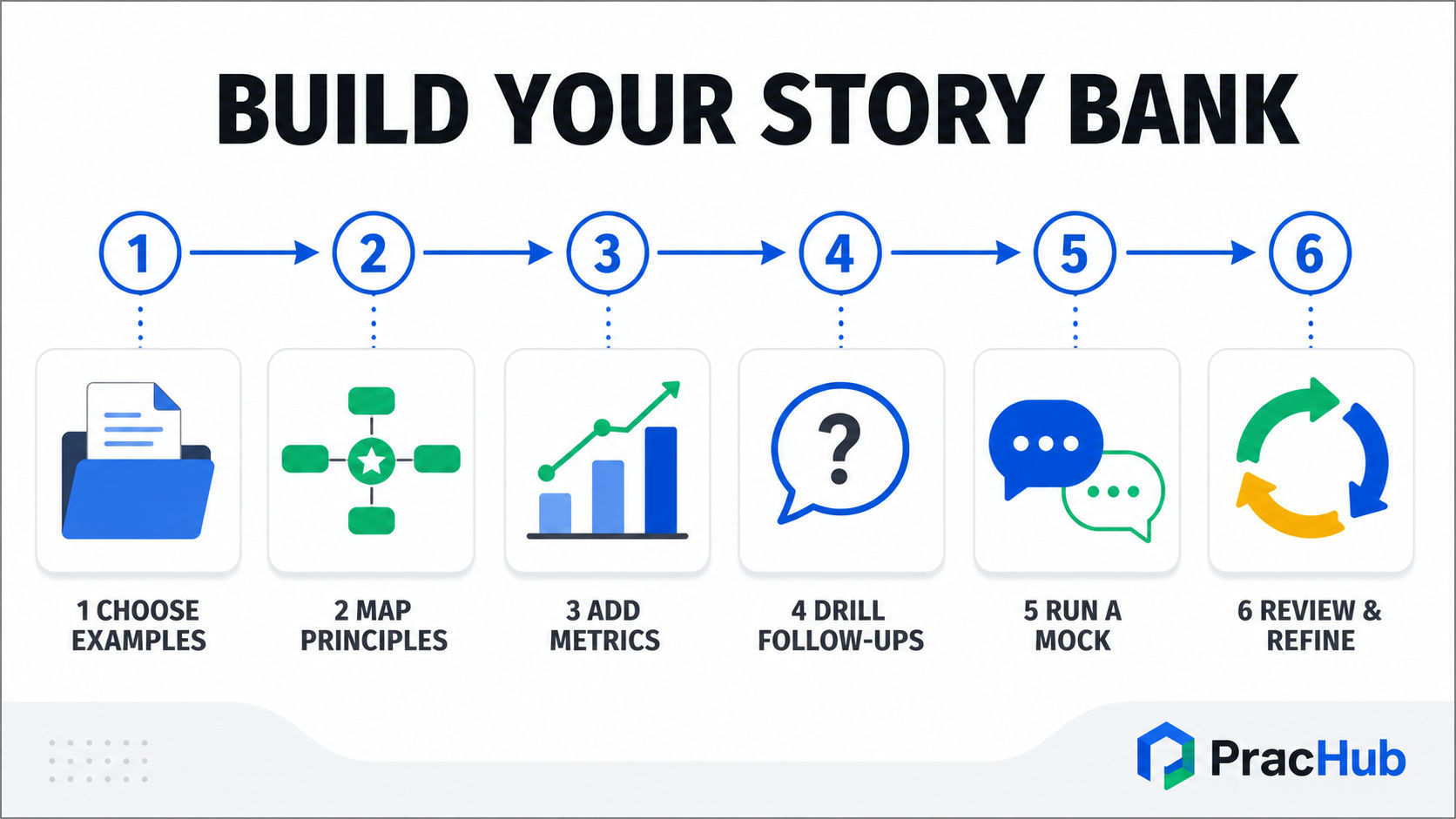
Build stories from evidence, map them to principles, then pressure-test them with follow-ups.
1. Read the job description. Mark the outcomes, scope, customers, and collaboration patterns the role requires. 2. Select six to eight stories. Favor recent, difficult examples in which your choices materially affected the result.
3. Map principles without forcing them. Give each story one primary and one or two secondary principles. 4. Add evidence. Record the baseline, constraints, alternatives, your actions, result, and lesson.
5. Drill follow-ups. Have a partner interrupt the polished version and ask for mechanisms, numbers, conflict, and failure. 6. Run a mixed mock loop. Combine one coding or system design problem from PracHub's real interview questions with written solutions with two behavioral prompts so you practice moving between technical and leadership evidence.
Common Mistakes That Weaken the Signal
Over-rehearsed scripts often collapse under follow-up questions. Know the evidence, not a speech. Vague team language makes your contribution impossible to score. Give teammates credit, then state your own decision and action.
Principle name-dropping is not evidence. You do not need to announce "this shows Ownership"; let the actions demonstrate it. Finally, avoid flawless-hero stories. A credible mistake, correction, and lasting mechanism can reveal more maturity than an outcome with no tension.
Frequently Asked Questions
Does the Amazon Bar Raiser have veto power?
Amazon's public explanation does not describe a simple solo veto. It says the Bar Raiser drives the group decision and, together with the hiring manager, makes the final hiring decision. That is substantial influence, but the official model is a structured evaluation involving the full interview loop.
Will I know which interviewer is the Bar Raiser?
Not necessarily, and identifying them should not change your approach. Every interviewer may collect Leadership Principles and role evidence. Give each round the same clarity, specificity, and depth.
How many Leadership Principles should I prepare?
Review all 16, then build six to eight rich stories that collectively cover the principles most relevant to your role. Amazon recommends identifying one or two anecdotes for each principle, but reusable stories can reduce memorization when they honestly fit more than one.
Are Amazon Bar Raiser questions always behavioral?
No universal format is published. The Bar Raiser can assess role competencies as well as Leadership Principles, and technical interviews can contain behavioral follow-ups. Prepare to explain the judgment behind code, architecture, priorities, and collaboration.
Should I use the same story twice?
Avoid repetition when you have another strong example, because breadth helps the panel evaluate consistency across situations. If a follow-up genuinely requires the same event, focus on a different decision or dimension rather than retelling the identical answer.
Final Takeaway
The Amazon Bar Raiser interview is not a trivia test about 16 slogans. It is an evidence test: can the panel see how you owned a difficult problem, made a reasoned trade-off, went deep enough, delivered an outcome, and learned?
Use PracHub's behavioral and leadership practice to pressure-test your stories, then combine them with company-specific coding and system design questions. The goal is not to sound like Amazon. It is to make your real judgment and impact easy to evaluate.
Official Sources and Methodology
This guide was checked against Amazon's official pages on the Bar Raiser role and debrief responsibilities, interview tips from Bar Raisers, interview loop and STAR method, current Leadership Principles, and software development interview topics. Practice questions and preparation timing are PracHub recommendations, not leaked questions or an internal Amazon rubric. Processes can vary by role and region, so follow your recruiter instructions.
Related Articles
Object-Oriented Design Interview Guide: Framework, UML, and Common Questions
Prepare for an object-oriented design interview with a six-step framework, practical UML, common OOD questions, follow-ups, and a focused practice plan.
Machine Coding Round Guide 2026: Requirements, Architecture, Tests, and Working Code
Prepare for the machine coding round in 2026: clarify requirements, design clean architecture, write tests, ship working code, and handle change requests.
Shopify Life Story Interview Guide 2026: Questions, Timeline, and How to Prepare
Prepare for the Shopify Life Story interview in 2026: format, current timeline, evaluation signals, practice questions, story map, and common mistakes.
Palantir Learning Interview Guide: What to Expect and How to Prepare
Prepare for the Palantir Learning Interview: format, evaluation signals, re-engineering tasks, common mistakes, and a practical 2026 study plan.
Comments (0)