Shopify Life Story Interview Guide 2026: Questions, Timeline, and How to Prepare
Quick Overview
Prepare for the Shopify Life Story interview in 2026 with the current recruiter-led format, official stage durations, role-specific timeline variations, evaluation themes, representative practice questions, a six-anchor career story map, software engineering preparation, common mistakes, and clear guidance on response timing.
The Shopify Life Story interview can sound like the easiest part of the hiring process. There is no algorithm to optimize and no architecture diagram to draw. Yet an unstructured answer can turn a promising career into a confusing list of jobs.
Shopify is listening for the pattern underneath your resume: why you made important choices, how you affected other people or customers, what difficult moments taught you, and why this role makes sense now. The goal is not to deliver an autobiography. It is to make your judgment, growth, and impact easy to understand.
Prepare the evidence before you polish the story. Use PracHub's behavioral and leadership interview practice to rehearse pivotal moments, then use company-specific interview prep to connect those moments with the Shopify role you actually want.
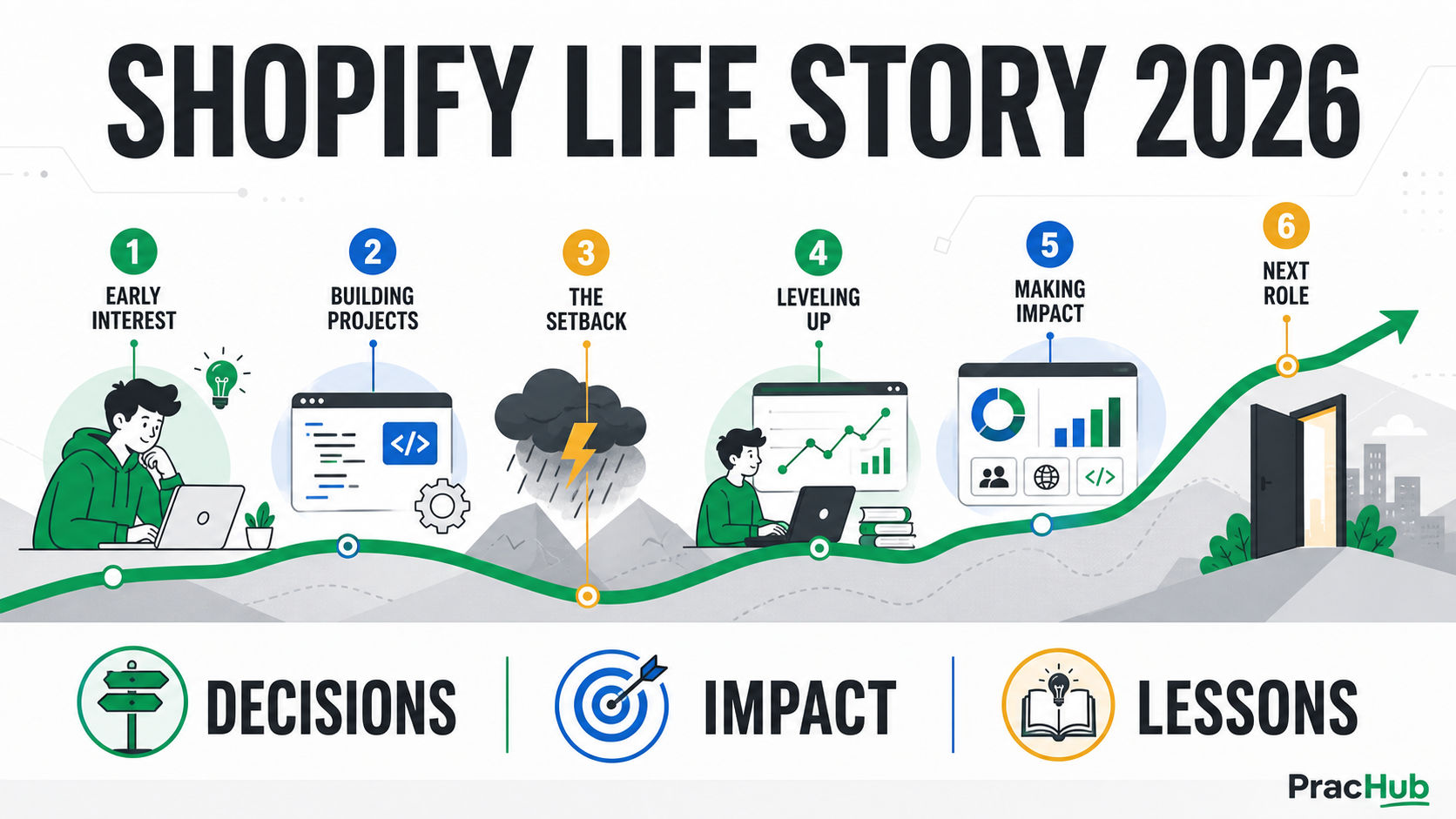
A strong Life Story connects career decisions, measurable impact, and lessons into one coherent journey.
Quick Answer: What Is the Shopify Life Story Interview?
Shopify's current Careers FAQ describes the Life Story as a 30–60 minute conversation-style interview with a recruiter. It explores the themes of your career journey, what you learned, and how you made a difference. Shopify says it wants both the “trophies and the bruises”: problems solved, challenges faced, decisions made, and lessons learned.
This is a genuine interview, but it should feel more like a two-sided conversation than a rapid behavioral questionnaire. Expect the recruiter to follow interesting transitions, ask why you chose a path, and test whether your reflection matches the impact you claim.
Is Shopify Still Using the Life Story in 2026?
Yes. Shopify's current Careers FAQ still names “The Life Story” as a formal hiring stage, and current discipline pages also include it in their published process. The exact order and number of interviews can vary by role and team.
That variation matters for technical candidates. Shopify currently says some R&D applicants may move directly into pair programming before the Life Story, while other candidates may have an initial call and craft assessment first. Treat your recruiter invitation as the source of truth rather than assuming an older online timeline applies to your loop.
The Current Shopify Interview Timeline
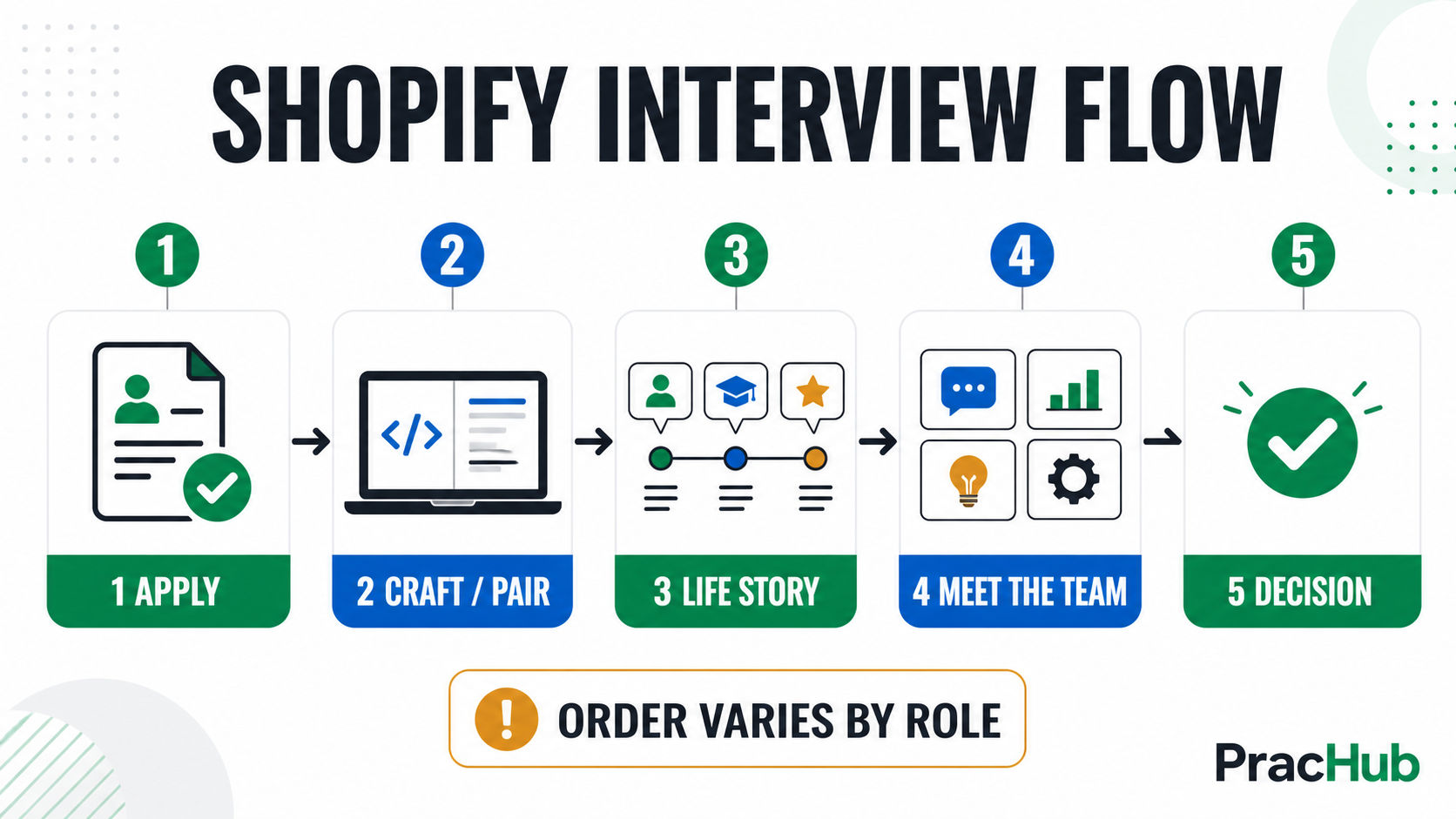
Shopify publishes a common sequence, but the order and number of interviews can change by role and team.
| Stage | Current published guidance |
|---|---|
| Application | Apply to one or two roles that closely match your experience and interests. |
| Initial call | Depending on the role, a 15–30 minute conversation with a recruiter or hiring manager. Some R&D candidates may skip this step. |
| Craft assessment | A 60–75 minute craft-focused interview. Shopify also mentions a brief predictive assessment; technical formats can vary. |
| Life Story | A 30–60 minute recruiter conversation about career themes, decisions, impact, challenges, and learning. |
| Meet the team | Three to five future colleagues, for up to an hour each, may explore how you solve and communicate problems. |
| Decision | The hiring team reviews feedback. Shopify does not publish a fixed total turnaround time; timing varies by role and applicant volume. |
This is a process map, not a calendar promise. If you are wondering how many days it takes to hear back, ask the recruiter for the expected next checkpoint. Candidate anecdotes can describe one cohort, but they cannot guarantee your schedule.
What Shopify Is Listening For
Shopify's technical interview guide names five Life Story traits: Impact, Readiness, Trust, Engagement, and Self-awareness. Its current Careers FAQ uses broader language about mindset, difference made, decisions, and lessons. Together, those public descriptions suggest that the recruiter needs evidence, not a perfectly inspirational narrative.
| Signal | Evidence to make visible |
|---|---|
| Impact | What changed because of your work, who benefited, and how you know. |
| Readiness | The scope you can own now and why the next role is a credible step rather than a vague ambition. |
| Trust | How you supported others, handled conflict, shared context, or repaired a mistake. |
| Engagement | What energizes you, where you show curiosity, and why you chose to invest deeply. |
| Self-awareness | What you misunderstood, the feedback you received, and how your later behavior changed. |
This table is a preparation lens based on Shopify's public guidance, not a leaked internal scorecard. Your interviewer can follow different threads depending on the role and your answers.
Do Not Give a Resume Walkthrough
A resume walkthrough says where you worked and what you built. A Life Story explains why the chapters connect. For each major transition, clarify what you wanted, what you learned in the previous chapter, what trade-off you accepted, and why the next move followed.
Chronology helps the recruiter follow you, but equal time for every year does not. Compress routine periods and slow down at pivotal decisions, hard projects, failures, and moments when your direction changed. A five-year career may need six meaningful anchors, not fifty facts.
Build a Six-Anchor Story Map
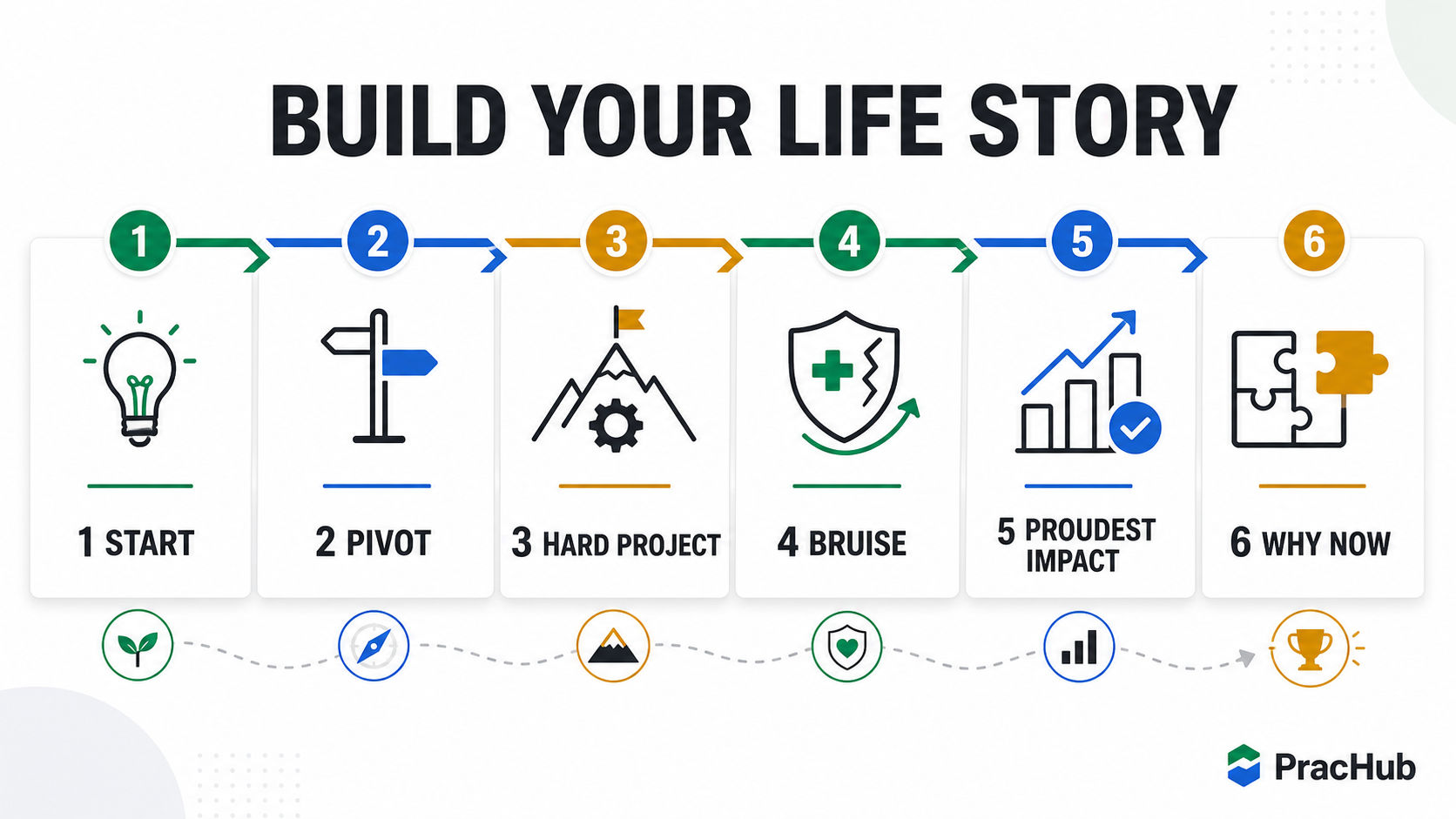
Choose a small number of moments that reveal direction, impact, setbacks, and readiness for the next step.
1. Starting point: What first pulled you toward this craft? 2. First pivot: Which choice changed your direction, and why? 3. Hard project: Where did complexity test your judgment or collaboration?
4. Bruise: Which miss, failure, or difficult feedback changed you? 5. Proudest impact: Where did your work make a measurable difference? 6. Why now: Why does Shopify and this specific role make sense as the next chapter?
Write one line for each anchor before rehearsing full answers. Under each line, add the decision, your personal action, the result, and the lesson. This prevents a polished story from drifting away from verifiable evidence.
Shopify Life Story Questions to Practice
Shopify does not publish a fixed question bank. The prompts below are representative practice questions derived from its public description, not leaked interview questions.
| Practice prompt | What to make clear |
|---|---|
| Walk me through the choices that brought you to your current work. | Motivation, transitions, and a coherent direction rather than job titles alone. |
| Which project are you proudest of, and why? | Your contribution, who benefited, measurable impact, and why it mattered to you. |
| Tell me about a difficult miss or piece of feedback. | Honest ownership, the lesson, and a later behavior or mechanism that changed. |
| Why did you leave one chapter and choose the next? | Decision criteria and trade-offs without attacking a former employer. |
| When are you most energized in your work? | The conditions, problems, and collaborators that produce sustained engagement. |
| Why Shopify, and why this role now? | A specific connection between your story, the role's scope, and Shopify's work. |
How to Structure Each Career Chapter
Use a simple six-part sequence: chapter, choice, challenge, action, outcome, reflection. Name the period, explain the important choice, identify what made it hard, specify what you did, show the result, and close with what changed in you.
STAR is useful inside a project story, but the whole Life Story should not sound like six disconnected STAR answers. Use short transitions between chapters so the recruiter can see cause and effect: “That incident made me prioritize reliability, which is why I chose my next role.”
Keep most chapters to one or two minutes, then let the interviewer pull on details. A two-sided conversation needs room for follow-ups; a memorized fifteen-minute opening monologue does not.
How Personal Should Your Life Story Be?
Shopify's engineering guide says the conversation can be as personal as you want it to be. That means you may include formative experiences, interests, or non-work chapters when they genuinely explain your decisions. It does not mean you must disclose private information.
Choose details that you are comfortable discussing and that illuminate motivation, resilience, trust, or growth. You can set a boundary and return to professional evidence without apologizing. Authenticity is not measured by how much personal history you reveal.
Preparation for Software Engineers
Technical candidates should connect the career narrative to engineering judgment. When discussing an important project, be ready to explain the problem, your role, key trade-offs, collaboration, failure modes, and business or merchant impact without turning the recruiter conversation into a system design lecture.
The Life Story is only one part of the loop. Pair it with PracHub's Pair Programming Interview Guide and Technical Interview Rubric. Then use real interview questions with written solutions to practice shifting from personal evidence to live technical reasoning.
Common Mistakes
Starting too early and including everything hides the important pattern. Select the moments that changed your direction. Giving only wins removes the self-awareness Shopify explicitly wants; include a bruise with a real correction.
Using “we” for every action makes your contribution unclear. Credit the team, then state what you decided or delivered. Forcing Shopify into every chapter sounds calculated. Tell the truth about the past, and make the Shopify connection specific in the final chapter.
Finally, do not confuse conversational with casual. Prepare deeply enough that you can relax, listen, and answer the follow-up actually asked.
Frequently Asked Questions
How long is the Shopify Life Story interview?
Shopify's current Careers FAQ says 30–60 minutes with a recruiter. An older official engineering guide describes a one-hour conversation. Use the duration in your calendar invitation as the practical source of truth.
Is the Shopify Life Story interview behavioral?
It explores behavioral evidence, but its format is broader than a list of isolated behavioral questions. Expect a conversational journey through decisions, impact, challenges, motivation, and learning, with follow-ups on the chapters that matter.
Does the Life Story happen before the technical interview?
Not always. Shopify says interview order can vary, and its current FAQ notes that some R&D candidates may complete pair programming before the Life Story. Follow the sequence your recruiter provides.
How long does Shopify take to respond afterward?
Shopify does not publish a fixed response time. Its FAQ says total hiring timelines vary by role and applicant volume. Ask for the next expected checkpoint, then send one concise follow-up if that date passes.
Should I memorize my Life Story?
No. Memorize the six anchors, evidence, and transitions rather than a script. You should be able to shorten a chapter, expand a decision, or follow a new question without losing the thread.
Final Takeaway
A strong Shopify Life Story is selective, specific, and reflective. It shows why your career moved the way it did, what changed because of your work, where you were tested, and how those experiences prepared you for this role now.
Build the six-anchor map, rehearse it as a conversation, and pressure-test the difficult chapters with PracHub's behavioral and leadership questions. The objective is not a perfect life story. It is a credible one that makes your readiness visible.
Official Sources and Methodology
This guide was checked against Shopify's current Careers FAQ and hiring process, its official technical interview process guide, and current discipline-level hiring sequence. Shopify's FAQ is the primary source for current durations and process variation. Practice questions, the six-anchor map, and answer timing are PracHub preparation recommendations rather than a confidential Shopify rubric.
Related Articles
Object-Oriented Design Interview Guide: Framework, UML, and Common Questions
Prepare for an object-oriented design interview with a six-step framework, practical UML, common OOD questions, follow-ups, and a focused practice plan.
Machine Coding Round Guide 2026: Requirements, Architecture, Tests, and Working Code
Prepare for the machine coding round in 2026: clarify requirements, design clean architecture, write tests, ship working code, and handle change requests.
Amazon Bar Raiser Interview Guide 2026: Leadership Principles, Signals, and Questions
Prepare for the Amazon Bar Raiser interview in 2026: Leadership Principles, evaluation signals, STAR stories, follow-ups, myths, and practice questions.
Palantir Learning Interview Guide: What to Expect and How to Prepare
Prepare for the Palantir Learning Interview: format, evaluation signals, re-engineering tasks, common mistakes, and a practical 2026 study plan.
Comments (0)