Palantir Learning Interview Guide: What to Expect and How to Prepare
Quick Overview
Candidate-focused guide to the Palantir Learning Interview and Re-engineering round. Understand how it differs from Decomposition, what unfamiliar-code and live-learning tasks may test, which signals interviewers observe, how to communicate when stuck, and how to practice with a six-session PracHub preparation plan.
Imagine joining a coding interview and discovering that the main challenge is not a familiar algorithm. The interviewer introduces an unfamiliar idea, gives you documentation or an existing system, and watches how quickly you turn new information into a working change.
That is the intent candidates commonly associate with the Palantir Learning Interview, sometimes called a Learning round or Re-engineering round. The exact task can vary, because Palantir says its interview format is personalized to the candidate, skill set, and role.
The safest preparation is not memorizing a reported prompt. Use PracHub's real interview questions with written solutions and company-specific interview prep to practice reasoning aloud, then add short exercises in unfamiliar repositories so you can learn and implement under time pressure.
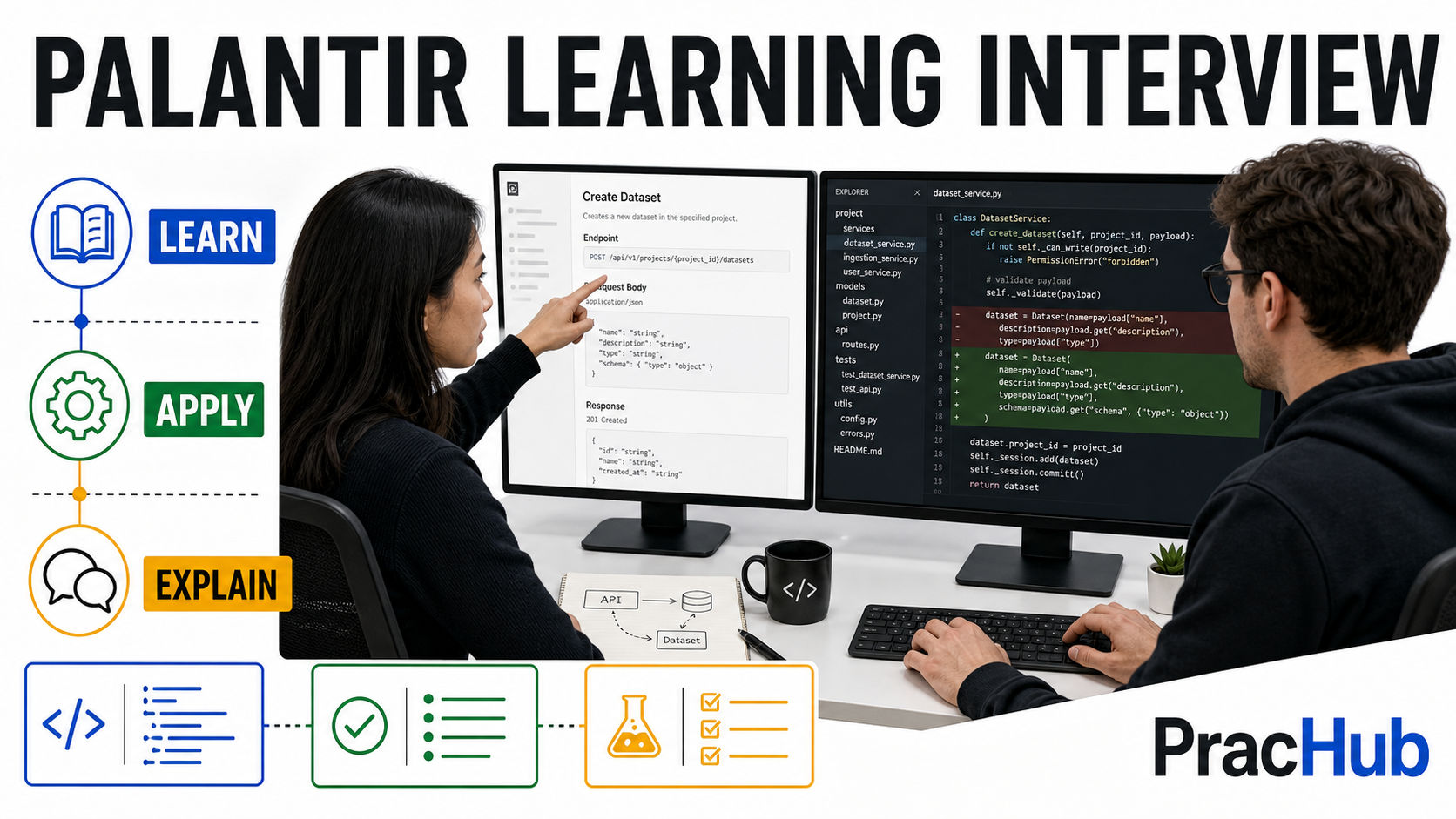
The Learning Interview rewards rapid understanding, collaborative reasoning, and a focused implementation.
Quick Answer: What Is the Palantir Learning Interview?
The Learning Interview is best understood as an adaptability and engineering judgment round. You may need to understand unfamiliar code, absorb a new API or concept from information provided during the interview, explain the current behavior, and then modify, debug, or extend the system.
Palantir's public careers pages do not promise one fixed round named "Learning" or publish a universal question format. They do say the process is personalized and highlight competencies such as working inside existing systems, writing maintainable code, analyzing efficiency, solving technical problems, and collaborating with the interviewer. Your recruiter-provided preparation material is therefore the source of truth for your loop.
Learning Interview vs. Decomposition Interview
| Dimension | Learning / Re-engineering | Decomposition |
|---|---|---|
| Starting point | Existing code, a new concept, documentation, or a constrained technical task | An ambiguous product, operational, or system problem |
| Main signal | How quickly you understand, learn, test, and improve | How clearly you define, split, prioritize, and design |
| Typical output | Explanation, hypothesis, code change, test, and trade-off discussion | Problem map, scoped solution, components, interfaces, and risks |
| Best preparation | Unfamiliar-codebase drills and learning from short documentation | Open-ended design and structured problem decomposition |
These rounds can both involve ambiguity and communication, but they are not interchangeable. For the second format, use our separate Palantir Decomposition Interview guide.
What the Learning Round May Look Like
First, you build a model of the system. The interviewer may provide code, definitions, an API contract, or a small domain explanation. Your job is to identify the important objects, data flow, invariants, and current behavior without reading every line at equal depth.
Next, you learn something new. That could be an unfamiliar library, concurrency primitive, interface, data model, or system constraint. Strong candidates paraphrase the new contract, ask targeted questions, and check their understanding with a small example.
Then, you apply it. You may need to repair a bug, remove a bottleneck, add behavior, or rework part of the implementation. The specific prompt matters less than whether your change follows from a clear hypothesis and respects the surrounding design.
Finally, you validate and reflect. Run or describe meaningful tests, consider edge cases and complexity, and explain what you would improve with more time. Palantir explicitly emphasizes code that is effective, efficient, readable, maintainable, and easy to test.
What Interviewers Are Likely Evaluating
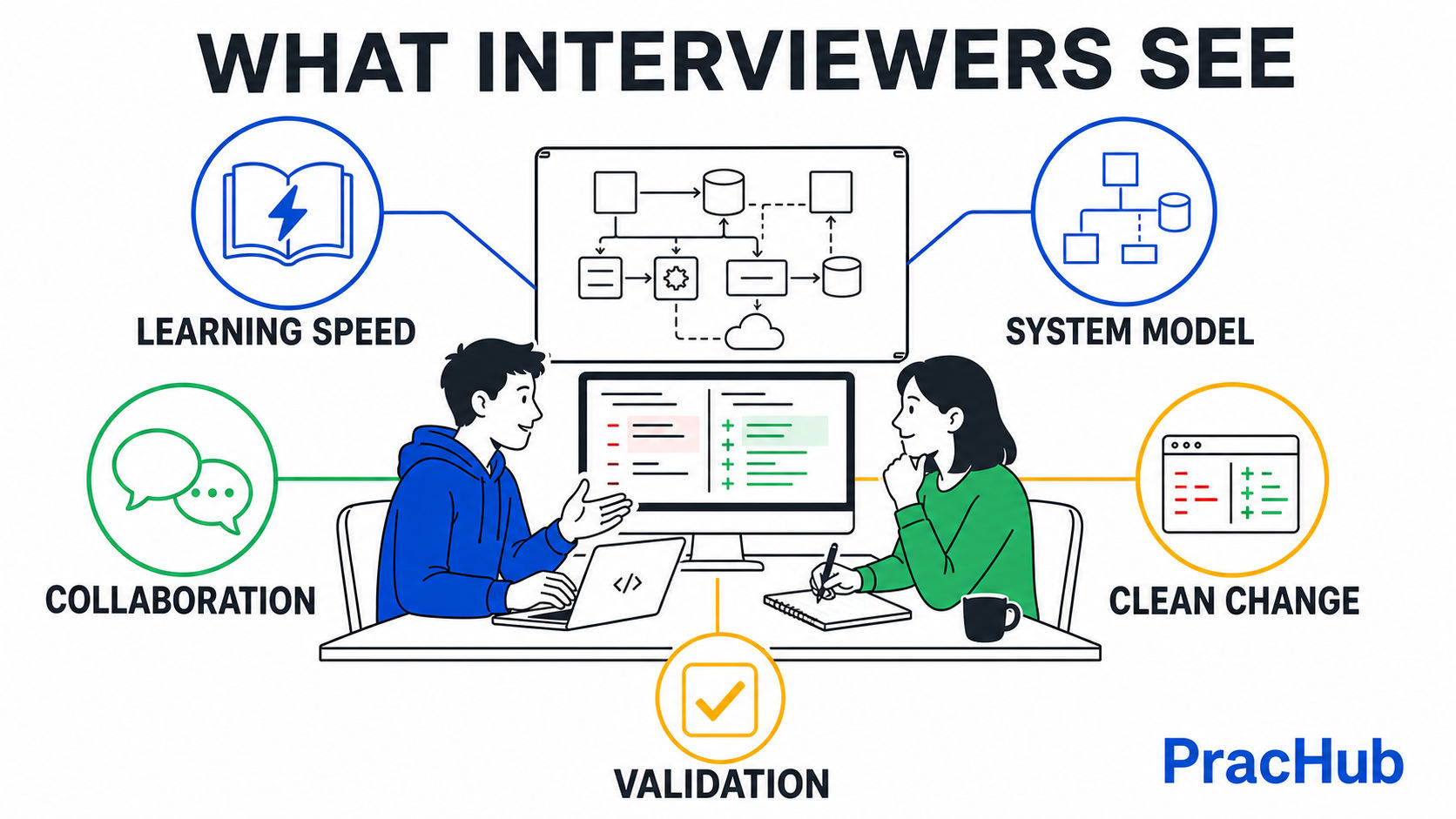
Progress is visible in how you learn, communicate, modify the system, and validate the result.
| Signal | Strong behavior | Risky behavior |
|---|---|---|
| Learning velocity | Restates the new concept, tests understanding, and applies it incrementally | Pretends to understand or repeatedly asks the same broad question |
| System navigation | Traces one relevant path and uses evidence to refine a hypothesis | Reads files randomly or proposes a rewrite before finding the behavior |
| Collaboration | Explains decisions, asks precise questions, and incorporates feedback | Works silently or treats interviewer guidance as a failure |
| Implementation | Makes a scoped, readable change that fits existing abstractions | Changes unrelated areas or optimizes before correctness is established |
| Validation | Tests the original failure, normal cases, boundaries, and regressions | Stops after coding or relies only on one happy-path example |
This scoring model is an inference from Palantir's published engineering competencies, not a leaked internal rubric. It is useful because each signal is observable and trainable regardless of the prompt you receive.
A Reliable Workflow for Unfamiliar Code
Start by restating the requested behavior and identifying the observable failure or missing capability. Then map the smallest relevant execution path: input, entry point, transformations, state changes, output, and tests. You do not need complete system knowledge before making progress.
Form one hypothesis at a time and say what evidence would support or reject it. Inspect or run the narrowest useful check, update your model, and repeat. Once the cause is clear, prefer a minimal patch that works with the existing structure over a broad rewrite.
Our Existing Codebase Interview guide expands this workflow with repository-mapping and debugging drills.
How to Learn a New Concept During the Interview
When the interviewer teaches a concept, do not rush from documentation to code. State the contract in your own words: what goes in, what comes out, what can fail, what ordering or state guarantees exist, and what cost the abstraction introduces.
Ask for one concrete example if the boundaries are unclear. Build a tiny mental or written example, predict the result, and confirm it before changing the main implementation. This turns a passive explanation into an active correctness check.
If you realize your model was wrong, correct it openly. The round is designed to reveal how you update your thinking; defending an invalid assumption is usually more damaging than revising it quickly.
Write Code That Fits the Existing System
Palantir's guidance warns against immediately deciding that unfamiliar code should be rewritten. Show that you can understand why the current design exists, preserve its useful conventions, and change only what the task requires.
Before typing, name the files or functions you expect to touch and why. During implementation, use clear names, isolate new logic when appropriate, and keep API calls and complexity visible. Afterward, review the diff as if another engineer must maintain it tomorrow.
For practice spotting correctness and maintainability issues, pair this round with PracHub's Code Review Interview guide.
How to Communicate When You Are Stuck
Silence hides useful signal. Give the interviewer a short status update: what you know, what remains uncertain, which hypothesis you are testing, and what result you expect. That lets the conversation stay collaborative without turning every thought into narration.
A strong question is narrow enough to unblock a decision: "Does this callback preserve input order?" is better than "How does this library work?" If you need a hint, explain the two approaches you considered and the exact trade-off you cannot resolve.
A Six-Session Preparation Plan
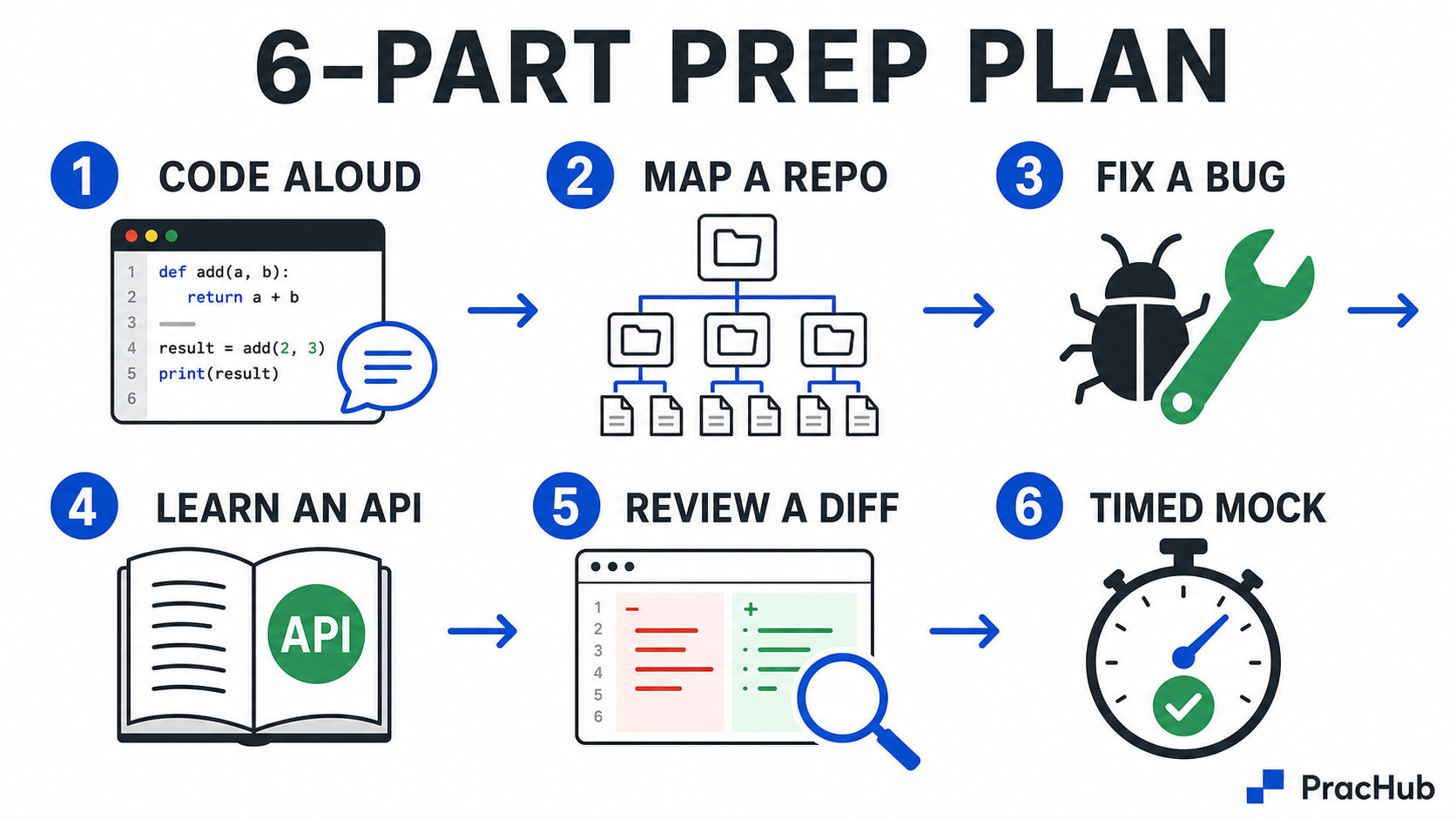
Train the learning process itself: understand, hypothesize, modify, test, and explain.
Session 1: Solve a company-relevant coding problem while explaining assumptions, edge cases, and complexity. Session 2: read a small unfamiliar repository and produce a five-minute architecture map without changing code.
Session 3: reproduce and fix one bug from a test or issue description. Session 4: learn a small unfamiliar API from its documentation, then use it in a focused feature.
Session 5: perform a code review and propose the smallest safe improvement. Session 6: combine everything in a timed mock: ten minutes to map, twenty-five to modify, ten to test, and five to discuss trade-offs. Adjust the timing to match your recruiter instructions.
Common Preparation Mistakes
Memorizing a candidate-reported problem creates brittle confidence. The concept, language, and codebase can change, while the underlying skill stays the same. Practice transferable behaviors instead of expecting a prompt match.
Another mistake is doing only LeetCode. Algorithms help with coding fluency, but they rarely train repository navigation, documentation reading, incremental debugging, or modifying someone else's design. The opposite extreme is also risky: spending hours reading architecture without writing and testing a change.
Finally, do not rehearse a nonstop monologue. The goal is a technical collaboration with clear checkpoints, not a performance in which every keystroke receives commentary.
Frequently Asked Questions
Is the Palantir Learning Interview a LeetCode round?
Not necessarily. It can involve coding, but the differentiating signal is learning and applying new information within an unfamiliar technical context. Standard data structures and complexity still support good implementation.
Is Learning the same as the Palantir Decomposition round?
No. Learning or Re-engineering is more implementation- and adaptation-oriented, while Decomposition focuses on structuring an ambiguous problem and designing a scoped solution.
Should I study a specific framework or concurrency library?
Only if your recruiter material names it. Otherwise, become comfortable learning from concise documentation in your strongest language. The process is more transferable than one library.
What if I do not understand the concept immediately?
Paraphrase what you understood, identify the missing part, ask a precise question, and test the answer with a small example. Visible course correction is better than pretending certainty.
Which programming language should I use?
Follow the interviewer's available environment and recruiter guidance. When you have a choice, use a mainstream language in which you can read, debug, test, and discuss complexity comfortably.
Final Takeaway
The Palantir Learning Interview is difficult to memorize for, but it is very possible to train for. Build a repeatable habit: understand the goal, map the relevant system, learn the new constraint, make a focused change, validate it, and explain what you discovered.
PracHub gives you the realistic question practice and company context needed to make that workflow automatic before interview day. Start with PracHub's interview question library, then add one unfamiliar-code exercise to every practice session.
Sources and Methodology
This guide distinguishes Palantir's published competencies from candidate-reported round names. It was checked against Palantir's official pages on the interview process, working inside existing systems, writing good code, code efficiency, and technical problem solving. A community-maintained candidate guide was used only to identify the Learning/Re-engineering terminology; exact formats can change.
Comments (0)