Amazon Behavioral Interview Questions for Software Engineers: Leadership Principles, STAR Stories, and Follow-Ups
Quick Overview
Map Amazon behavioral questions to Leadership Principles, build probe-ready STAR stories, and practice the follow-ups that test engineering judgment.
You can solve the coding problem and still lose the Amazon offer in the behavioral portion. The reason is not that Amazon expects a perfect personality. It is that interviewers need concrete evidence of how you make engineering decisions when customers, deadlines, reliability, and disagreement collide.
Amazon's official preparation material tells candidates to study its Leadership Principles, use the STAR method, emphasize personal actions, and include data where possible. For software engineers, that means your best stories are rarely generic teamwork anecdotes. They involve incidents, architecture choices, technical debt, customer pain, cross-team dependencies, or a decision you would now make differently.
Start with Amazon Software Engineer questions on PracHub, then filter toward behavioral prompts. Attempt each question aloud before reading the written solution; the goal is to discover which details disappear when an interviewer starts probing.
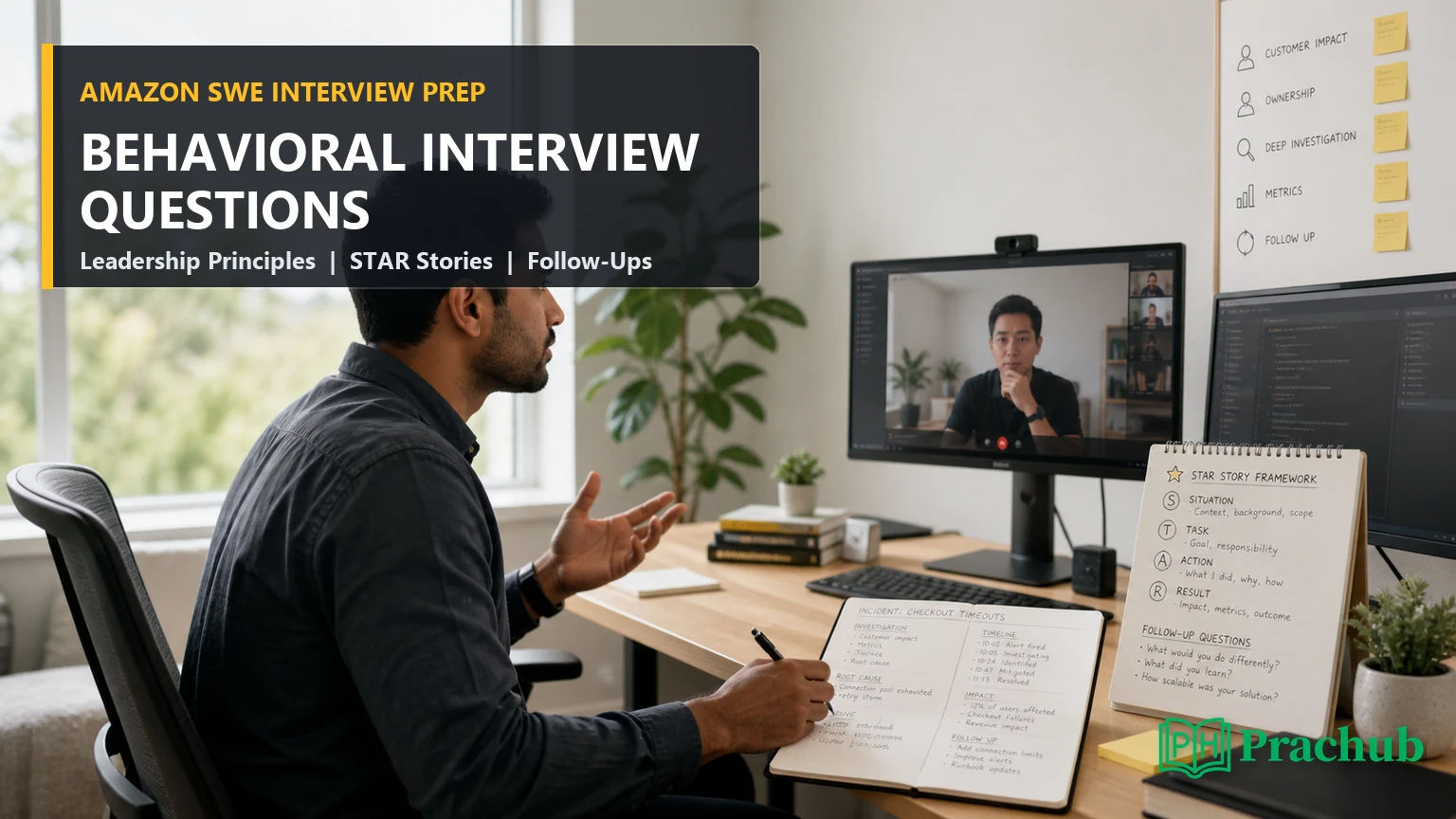
Quick answer: how should an Amazon software engineer prepare?
Build eight to ten authentic engineering stories, map each one to several Leadership Principles, and rehearse the evidence behind every decision. A strong response should identify the stakes, your responsibility, the alternatives you considered, the action you personally took, the measurable result, and what you learned.
Do not memorize sixteen polished speeches. Prepare a flexible story bank covering customer impact, ownership, failure, conflict, ambiguity, technical investigation, quality, speed, and helping others. Practice a two-minute opening, then defend it under follow-ups.
Your recruiter or invitation remains the source of truth for the exact loop. Amazon's public pages describe general expectations, while interview count, timing, and the principles assigned to a particular interviewer can vary by level, team, and location.
What Amazon officially says about behavioral interviews
Amazon currently publishes 16 Leadership Principles. Its official SDE III preparation page says a significant portion of the conversation focuses on how candidates demonstrated those principles in previous jobs. It recommends examples involving risk, success, failure, and growth, structured with STAR and supported by metrics.
For that senior process, Amazon says each interviewer typically asks two or three behavioral questions. This is not a promise for every SDE loop, but it shows why preparation cannot be isolated to one short culture round. Recent reports also place Leadership Principle questions beside coding, design, and project deep dives.
Interviewers are not testing whether you can recite definitions. They need evidence of the judgment behind them. "I demonstrated Ownership" is weak; a specific decision that prevented repeated customer harm is evidence.
The highest-signal Leadership Principles for software engineers
Any of Amazon's 16 principles may appear. The following map helps you choose engineering evidence without pretending that only these principles matter.
| Leadership Principle | Strong SWE evidence | Likely follow-up |
|---|---|---|
| Customer Obsession | Changed a technical plan after discovering a real customer failure mode. | How did you know this represented more than one user? |
| Ownership | Closed an operational or product gap beyond the narrow ticket you were assigned. | What did you personally own, and where did you ask for help? |
| Dive Deep | Used logs, traces, experiments, or data to disprove the obvious root cause. | Which signal changed your hypothesis? |
| Bias for Action | Made a reversible decision quickly while controlling blast radius. | Why was acting safer than waiting? |
| Insist on the Highest Standards | Added a durable quality mechanism rather than fixing one defect. | What cost did the higher bar impose? |
| Invent and Simplify | Removed repeated work, reduced an interface, or automated a fragile process. | How did you prove the simpler design was sufficient? |
| Earn Trust | Disclosed risk or a miss early and rebuilt confidence with transparent actions. | What did you say before you knew the full answer? |
| Have Backbone; Disagree and Commit | Challenged a technical direction with evidence, then supported the final decision. | What if the decision still had failed? |
| Deliver Results | Protected the critical outcome by changing scope, sequence, or implementation. | What did you deliberately not deliver? |
Senior candidates should also prepare Think Big, Hire and Develop the Best, and Success and Scale Bring Broad Responsibility. Scope grows with level: a new graduate may own a feature, while a senior engineer should show mechanisms that improved multiple engineers, services, or teams.
Common Amazon behavioral interview questions for software engineers
Customer, ownership, and delivery
Expect prompts such as: Tell me about a time you worked backward from a customer problem. Describe a project you owned end to end. Tell me about a deadline you missed or nearly missed. Give an example of delivering an important result with limited resources.
The strongest answers connect engineering work to an observable outcome. Instead of saying a migration "improved scalability," state what constraint existed, what changed, and whether latency, incidents, cost, conversion, or developer lead time moved.
Technical judgment and deep investigation
Prepare for: Tell me about a difficult bug you investigated. Describe a decision you made with incomplete data. When did you simplify a complex system? Tell me about a time your high standard created disagreement.
These are behavioral questions with a technical defense layer. Be ready to explain the architecture, alternative hypotheses, relevant metrics, and why your chosen trade-off was appropriate at that moment. If the technical logic is vague, the Leadership Principle label will not rescue the story.
Conflict, influence, and trust
Common themes include disagreeing with a manager, influencing a peer without authority, receiving difficult feedback, and rebuilding trust after a mistake. Choose disagreements where both sides had rational goals. A story in which everyone else was careless and you were obviously correct reveals little judgment.
Explain how you understood the other position, what shared criterion moved the discussion, and what happened to the relationship afterward. For Disagree and Commit, make both halves visible: the respectful challenge and your support once the decision was made.
Failure, learning, and developing others
Amazon may ask about your biggest failure, a decision you would reverse, a skill you learned quickly, or a teammate you helped grow. Use a real setback with consequences. "I care too much" and other disguised strengths collapse under one follow-up.
A credible failure answer identifies the faulty assumption, the impact, and the mechanism you changed. The lesson is believable only when later behavior shows that it lasted.
Use STAR-L, not a memorized STAR script
STAR is useful because it keeps a story auditable. For Amazon, add a short Learning section and treat the Action portion as the center of gravity.
Situation: establish the system, team, customer, and stakes in two or three sentences. Task: state your responsibility and the constraint. Action: explain your decisions, alternatives, communication, and risk controls. Result: provide a supported outcome, including mixed results when appropriate. Learning: name what changed in your judgment or process.
For example, imagine a checkout dependency increased p95 latency and occasionally failed. A weak answer says, "We added a cache and performance improved." A stronger answer explains that you measured the dependency, compared synchronous, precomputed, and fallback designs, proposed a canary with a circuit breaker, and protected the checkout SLO while testing revenue impact.
The result should not be suspiciously perfect. You might report that the launch met its business goal while adding operational complexity, then explain the monitoring and cleanup work you introduced. Honest trade-offs give the interviewer something real to evaluate.
Follow-up questions that expose weak stories
Amazon-style follow-ups often move from the headline to the evidence. Prepare an "evidence packet" for each story: timeline, baseline, metric source, alternatives, stakeholders, risks, and what happened after the immediate result.
- What was your exact contribution rather than the team's?
- What data did you have, and what did you still not know?
- Which alternative did you reject, and why?
- Who disagreed with you, and what was their strongest argument?
- How did you measure the result, and over what time window?
- What went wrong despite your actions?
- What would you do differently with the same information?
- How did the fix scale beyond one project or one heroic effort?
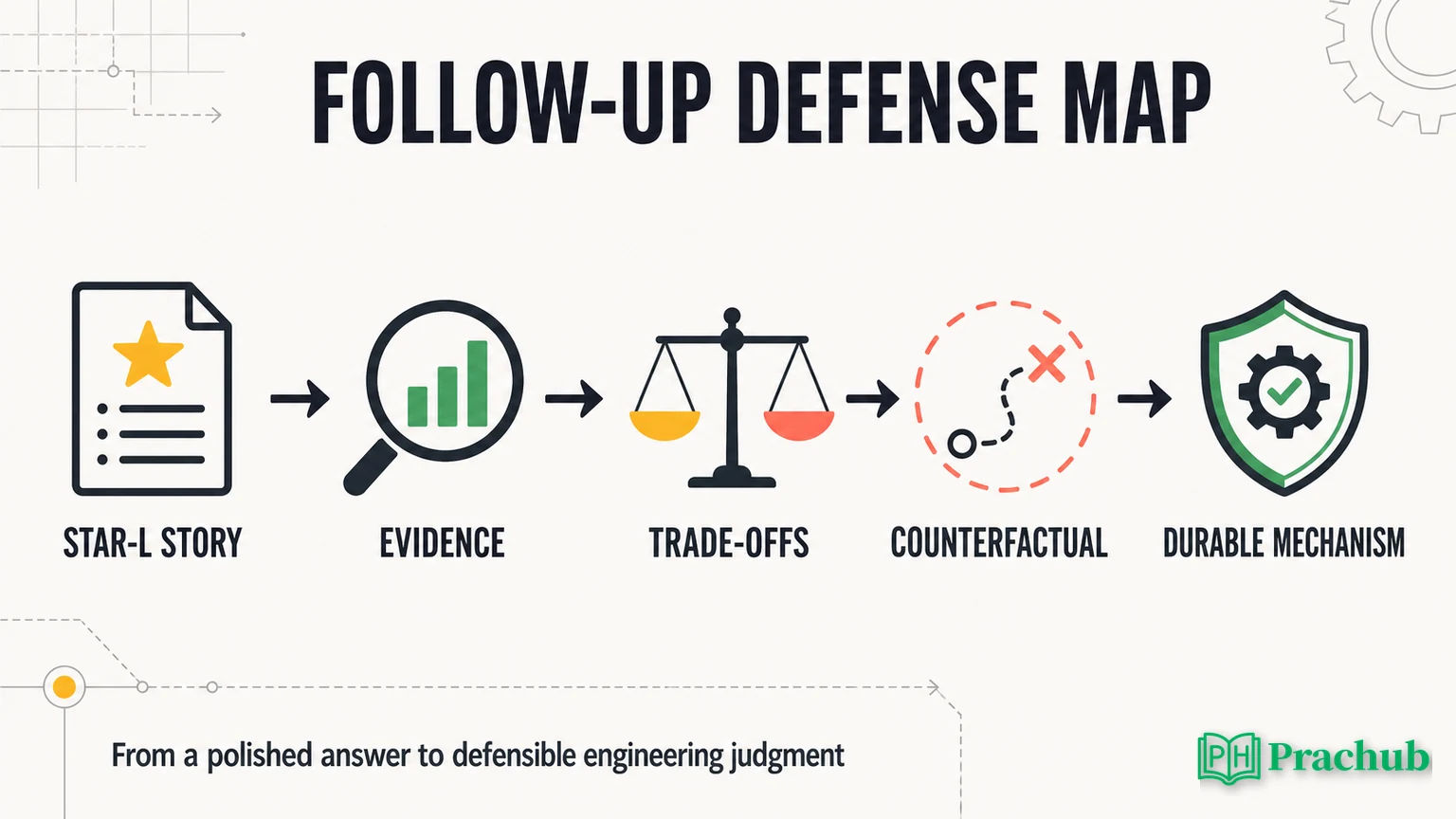
Do not answer every possible follow-up in your opening response. Give a complete but concise story, then let the interviewer choose where to dig. Overloading the first answer with every log query and stakeholder meeting makes it harder to identify your judgment.
Build a reusable Amazon story bank
Eight to ten stories are more useful than one per principle. Select experiences with different stakes: a customer issue, incident, architecture disagreement, missed commitment, ambiguous project, quality improvement, simplification, mentoring situation, and meaningful failure.
For each story, record a primary principle and two secondary principles. A production incident could demonstrate Bias for Action through rollback, Dive Deep through diagnosis, and Ownership through the permanent prevention mechanism. Do not force the same story into every answer; interviewers may compare notes, and repetition reduces the evidence they receive.
Keep a one-page matrix with the story name, principles, metrics, key trade-off, and hardest follow-up. Rehearse from anchors rather than memorizing sentences.
Calibrate stories to your engineering level
Intern and new graduate
Use internships, substantial projects, research, open-source work, or student leadership. Make the constraint and your contribution explicit. Small scope is acceptable; invented scale is not.
Mid-level software engineer
Show independent ownership, operational judgment, and cross-functional communication. Include decisions you made, not only tasks assigned by a lead.
Senior software engineer
Emphasize ambiguous multi-team problems, architectural consequences, mechanisms, and how you raised others' performance. Be ready for questions about long-term ownership and second-order effects.
Practice Amazon behavioral questions on PracHub
Use these prompts to test different parts of your story bank. Each full title in the first column opens the question and written solution.
| PracHub question | Practice focus | Why it helps |
|---|---|---|
| Answer Amazon Leadership Principles Questions | Core LP coverage, metrics, trade-offs, and reflection | Tests whether several stories remain specific under a broad Amazon prompt. |
| Discuss Feedback, User Needs, Influence, Deadlines, and Learning | Feedback, customer evidence, peer influence, and learning | Prevents one ownership story from carrying the entire interview. |
| Recover from a Missed Deadline | Accountability, scope-quality trade-offs, and trust recovery | Builds an honest failure story with a durable prevention mechanism. |
| Support a Struggling Teammate Without Sacrificing Team Health | Coaching, standards, delivery, and empathy | Strengthens senior-level evidence about developing others and protecting the team. |
For broader practice, use PracHub's Behavioral and Leadership interview questions. Record your first answer, compare it with the solution, then repeat only after writing down the missing evidence.
A seven-day Amazon behavioral preparation plan
| Day | Focus | What to do |
|---|---|---|
| Day 1 | Story inventory | List 12 experiences, then select eight with distinct stakes and outcomes. |
| Day 2 | Leadership Principle map | Assign one primary and two secondary principles to each story; identify gaps. |
| Day 3 | STAR-L structure | Write concise anchors for situation, task, actions, result, and learning. |
| Day 4 | Engineering evidence | Add timelines, metrics, architecture context, alternatives, and risk controls. |
| Day 5 | Failure and conflict | Practice the two stories candidates most often soften, blame, or over-polish. |
| Day 6 | Follow-up pressure | Have a partner interrupt with five why, evidence, and counterfactual questions. |
| Day 7 | Mixed mock loop | Alternate coding or design with behavioral questions so context switching feels normal. |
Common mistakes that weaken strong experience
Reciting the principle: describe behavior and let the evidence reveal the principle. Using only "we": give collaborators credit, but make your decisions visible. Inventing metrics: use supported measures, ranges, or qualitative evidence rather than false precision.
Hiding the trade-off: every meaningful engineering choice has a cost. Blaming another team: explain dependencies without outsourcing accountability. Stopping at the launch: show adoption, monitoring, cleanup, or the mechanism that made the improvement durable.
Frequently asked questions
How many Amazon Leadership Principles should I prepare?
Review all 16 because any may be evaluated. Build a smaller story bank that covers them in combinations, then prioritize principles most relevant to your role and level.
How long should an Amazon STAR answer be?
Aim for roughly two minutes for the opening answer, then expect follow-ups. The right length depends on the prompt, but the Action section should receive the most detail.
Can I reuse the same story for multiple principles?
Yes, if the evidence genuinely supports each principle. Avoid repeating one story across several interviewers when you have alternatives, because the loop benefits from varied evidence.
Do Amazon coding interviews include behavioral questions?
They can. Amazon's official materials make Leadership Principles central to SDE evaluation, and recent candidate reports often describe behavioral questions inside technical rounds. Your invitation and recruiter guidance determine the exact format.
What if I do not have a quantified result?
Do not invent one. Use observable evidence such as incidents avoided, stakeholder adoption, review outcomes, customer feedback, or a process change that remained in use. Explain how you would measure it now.
Should I name the Leadership Principle in my answer?
You usually do not need to announce it. Use Amazon's language naturally when accurate, but focus on concrete decisions, results, and reflection rather than labels.
Final takeaway
Amazon behavioral interview preparation is an engineering exercise: gather evidence, define the decision, expose trade-offs, and test the story against failure cases. Know the Leadership Principles, but spend more time making eight to ten authentic stories specific, measurable, and resilient to follow-ups.
Practice with Amazon Software Engineer questions, answer aloud before opening the solution, and keep revising the weakest story until your ownership, judgment, and learning are obvious without reciting a principle.
Sources and Further Reading
- Amazon Leadership Principles
- Amazon Software Development Interview Topics
- Amazon SDE III Interview Prep
- Amazon Interview Loop Preparation
- Amazon Interview Strategies from a Manager
- Recent Candidate Report: Amazon New Grad SDE Virtual Interview
Research note: This guide was checked on August 24, 2026. Interview formats, question counts, and Leadership Principle assignments can vary by role, level, team, location, and recruiting cycle.
Comments (0)