Amazon Customer Obsession Interview Questions: Connect Customer Evidence to Engineering Choices
Quick Overview
Prepare Amazon Customer Obsession interview answers by connecting firsthand customer evidence to engineering acceptance criteria, comparing alternatives and competing customer needs, and reporting segmented outcomes with clear limits. Includes an original order-confirmation case and verified practice questions.
Amazon Customer Obsession interview questions become easier to answer when you can connect a customer's evidence to an engineering choice. Explain whose problem you investigated, what changed your understanding, which alternative you rejected, and how you checked the customer outcome. Naming the principle or describing extra effort leaves that decision unexplained.
This guide focuses on requirements and technical judgment. Use PracHub's Customer obsession story: when first-hand customer insight changed a product decision to rehearse that connection. The worked checkout case below is original practice, not Amazon's architecture, a disclosed interview prompt, or a personal story to memorize.
Evidence boundary: Amazon's published principles and preparation guidance support the company-specific advice. No universal interview format, question frequency, private scoring rule, or hiring outcome is claimed. We have not established a current process from independent same-cycle candidate reports. All customer observations, counts, alternatives, and rollout results in the example are synthetic.
What does Amazon mean by Customer Obsession?
Official principle: Amazon's Leadership Principles connect Customer Obsession with understanding customers first, reasoning backward from their needs, and preserving their trust. Competitor awareness belongs in that definition, but customers remain the focus. Prepare a decision that demonstrates those ideas rather than substituting a slogan for evidence.
For an engineer, the useful question is what changed because you understood the customer better. You might change a success metric, reject a requested implementation, alter a rollout boundary, or prioritize an overlooked failure mode. Those are preparation inferences from the principle, not Amazon's disclosed grading categories.
An answer about working late can demonstrate effort while leaving the customer need unclear. An answer about shipping a requested feature can leave the same gap. Show how you established that the technical choice served the underlying task, including any costs imposed on other customers.
Amazon's public interviewer discussion of the principles also explains that a customer can be an internal team for a software engineer. Identify that relationship accurately. An internal platform story needs a concrete consuming team and blocked workflow; calling every colleague a customer without explaining the dependency adds little.
Which customer problem should your answer begin with?
Begin at the moment the customer cannot achieve something important. “The API was slow” names a technical symptom. “Customers could not tell whether an order existed and were afraid to submit it again” identifies a decision the product failed to support. The distinction helps you decide which traces, observations, and engineering alternatives matter.
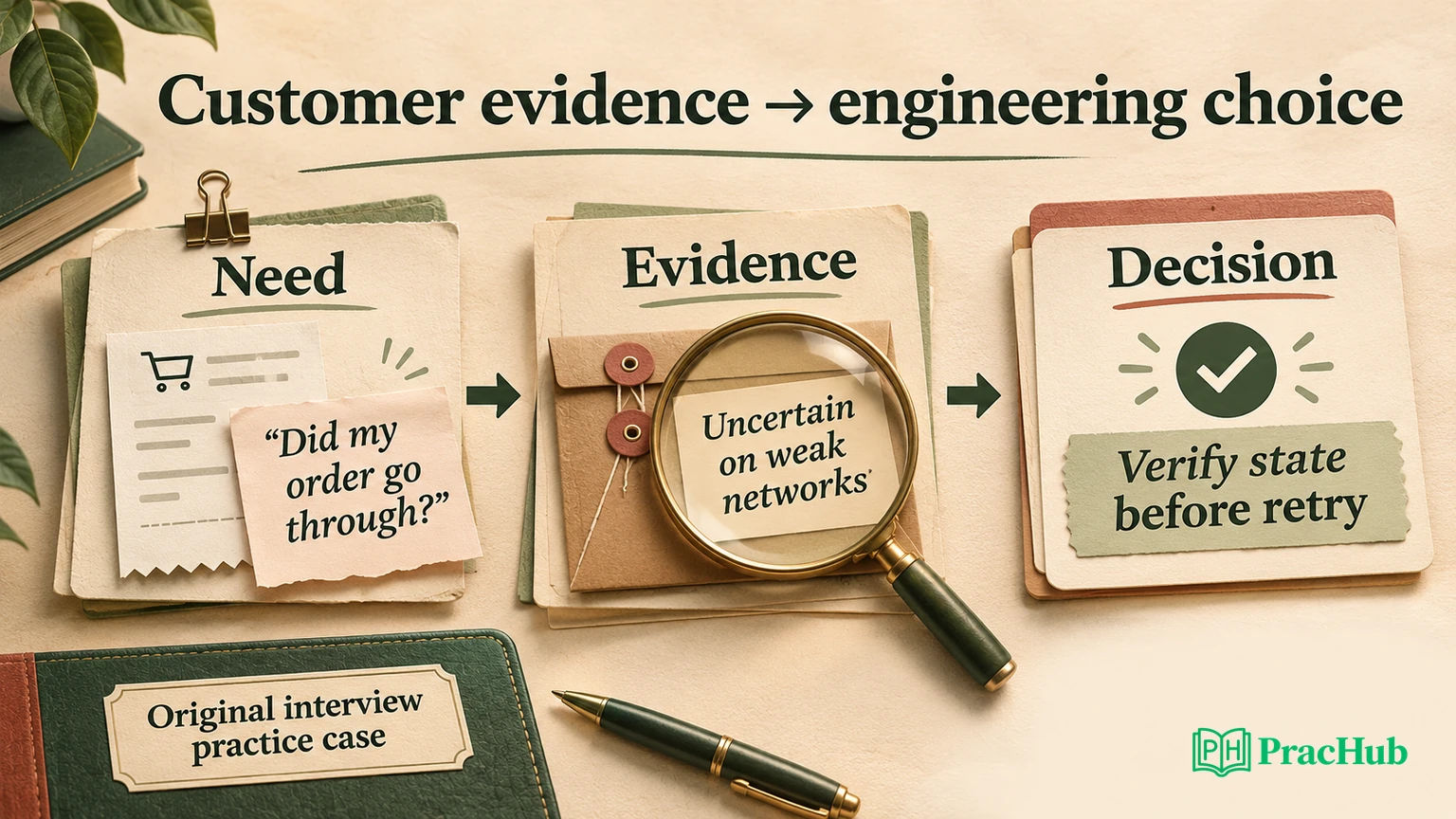
In the original case, a mobile checkout team receives requests for a more prominent retry button. The request is a proposed implementation. The underlying need could be faster submission, confidence that an order exists, recovery after a lost connection, or avoiding a duplicate purchase. An engineer should investigate before treating those needs as interchangeable.
Suppose the team reviews 72 support contacts from 12 customers and observes several checkout sessions. These contacts generate hypotheses; repeated messages from one person do not establish how widespread the problem is. Follow the experience directly, then compare it with product records using a stable customer-task denominator.
Keep the distinction visible in your interview answer: who reported the problem, what you observed yourself, and what broader data supported. If you only received a summary from a product manager, explain that contribution honestly. Do not imply that you conducted interviews, examined production logs, or designed the study unless you did.
Which evidence should change the engineering requirements?
The fictional service dashboard shows 11,940 accepted requests out of 12,000 attempts: 99.5% acceptance. But an accepted request does not establish that the customer saw an authoritative order status. Attempts also include retries, so they are a different unit from distinct checkout intentions.
Define the exercise's customer-facing measure as a unique checkout intention for which the customer lacks an authoritative status within two minutes. The intention needs a stable identifier across retries. This measure is a chosen diagnostic proxy; it does not fully measure confidence, satisfaction, or long-term trust.
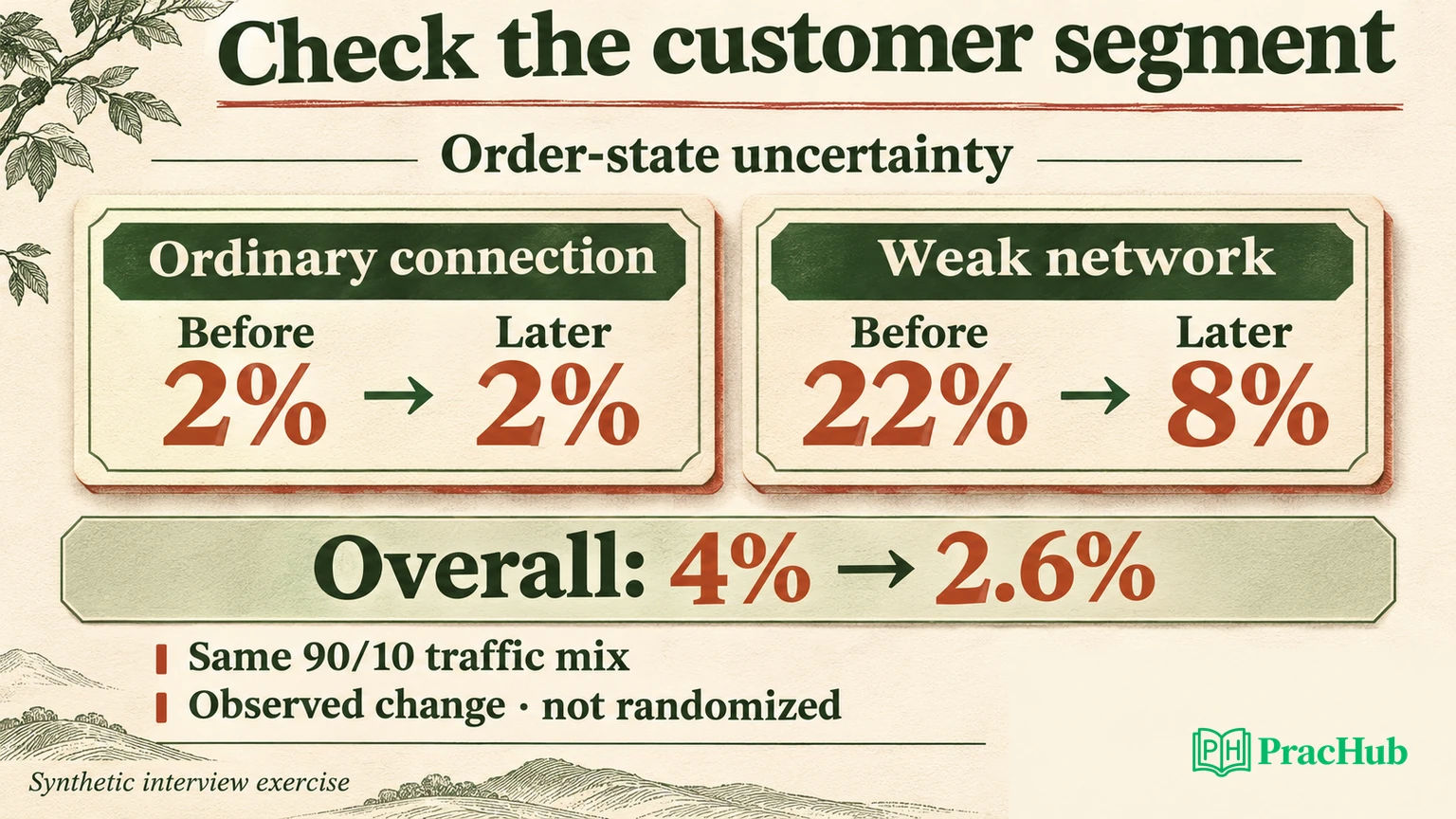
Among 10,000 intentions in the baseline packet, 400 meet that uncertainty definition. Ordinary connections account for 180 of 9,000 intentions, or 2%. Weak-network users account for 220 of 1,000, or 22%. The overall 4% conceals a much worse experience for a smaller cohort. Treat network cohort as a pre-submission flag recorded under the same rule in both periods; classifying customers by whether confirmation failed would bake the outcome into the grouping.
Use the evidence to revise acceptance criteria:
| Evidence in the original case | Engineering implication | What still needs checking |
|---|---|---|
| A request can be accepted while confirmation is lost. | Recover authoritative order state after reconnecting. | How state lookup behaves during partial failures. |
| Retries can represent one purchase intention. | Preserve an operation identity across supported retries. | Expiry, changed order contents, and concurrent submissions. |
| Weak-network uncertainty is 22% versus 2% elsewhere. | Evaluate the affected cohort separately. | Classification accuracy and missing client telemetry. |
| Several contacts come from the same customer. | Separate repeated contacts from distinct affected customers. | Whether quiet or abandoned sessions are underrepresented. |
These implications are a design hypothesis for the fictional system. They do not establish an exactly-once guarantee or describe Amazon checkout. A customer-focused explanation names the failure the requirement addresses and the remaining boundary, rather than claiming a reassuring architectural property without proof.
How do you compare the requested feature with alternatives?
Consider three options. A larger retry button improves discoverability but can encourage another submission while the original outcome is unknown. A longer timeout may let more confirmations arrive, while making ordinary users wait and still leaving disconnects unresolved. Recovering order state before offering an appropriate next action addresses the customer's uncertainty more directly, but requires coordinated client and server behavior.
The hypothetical engineer proposes a bounded version of the third option: retain the operation identity, show an honest pending state, recover authoritative status after reconnection, and offer retry only under the supported contract. The key interview claim is why this direction follows from the evidence. It is not that every ordering system should implement the same design.
Explain what would change the choice. If the server already exposes reliable status recovery and the client merely hides it, a smaller client repair may be enough. If identifiers are unstable, a cosmetic confirmation screen will not resolve ambiguity. If a lookup cannot determine the outcome, the interface must preserve that uncertainty and provide a safe recovery path.
For a real story, describe the alternative you actually considered and what information was available then. Avoid retroactively treating the eventual diagnosis as obvious. The strongest decision explanation preserves the observation that changed your mind.
How do competing customer needs and economics affect the choice?
The weak-network cohort is smaller, but its higher rate and potential duplicate-purchase harm warrant investigation. That is a reasoned priority argument, not a universal rule that the worst percentage always wins. Compare the number affected, severity, available workaround, accessibility implications, engineering effort, and maintenance cost.
Amazon's Customer Obsession explanation by Andy Jassy explicitly discusses sustainable economics as part of serving customers over time. A proposal that cannot be maintained may fail future customers. Explaining cost does not automatically contradict Customer Obsession; hiding the customer consequence behind a cost label is equally unhelpful.
In the case, a permanent manual support intervention might help a few customers while creating a queue that grows with usage. A supported recovery path has implementation costs and can still be incomplete. State who owns those costs, which customer groups benefit, and what work is deferred. Do not invent a revenue or retention gain to make the proposal seem inevitable.
A customer request can also conflict with quality or access boundaries. Explain the underlying goal, the specific constraint, and a workable alternative. A refusal that leaves the customer with no explanation or recovery path needs more work. Customer Obsession is demonstrated through the decision and its consequences, not through automatic agreement.
What result can you honestly claim after a rollout?
Suppose a later, nonrandomized observation period contains 5,000 intentions under the same definitions. Ordinary connections contribute 90 uncertain intentions out of 4,500; weak-network connections contribute 40 out of 500. The mix remains 90% ordinary and 10% weak-network traffic.
| Cohort | Before: uncertain / intentions | Before rate | Later: uncertain / intentions | Later rate |
|---|---|---|---|---|
| Ordinary connection | 180 / 9,000 | 2% | 90 / 4,500 | 2% |
| Weak network | 220 / 1,000 | 22% | 40 / 500 | 8% |
| Overall | 400 / 10,000 | 4% | 130 / 5,000 | 2.6% |
The observation supports saying that measured uncertainty was lower in the later weak-network cohort. It does not isolate the release's causal effect. Check comparable observation windows, eligibility, traffic sources, logging coverage, and simultaneous changes. Also inspect duplicate orders, abandonment, waiting time, and support burden so an improved proxy does not hide displaced harm.
A separate counterexample shows why segmentation matters. Keep the original rates of 2% and 22%, but change the population to 9,900 ordinary intentions and 100 weak-network intentions. You get 198 plus 22 uncertain intentions: 220 out of 10,000, or 2.2%. The overall rate has fallen even though neither cohort improved. That is a traffic-mix effect, not the later rollout packet above.
The local arithmetic checks validate the weighted rates and this counterexample. They do not test a checkout implementation, interview customers, or establish product impact. In a real interview, distinguish observed outcomes, causal conclusions, and customer trust that you have not directly measured.
How should you explain the decision through STAR?
Amazon's official interview-story guidance recommends authentic examples, personal contributions, and the situation–task–action–result structure. Use that structure to expose the decision. It cannot supply missing facts or turn this hypothetical packet into your own experience.
For the situation, establish the gap between the accepted-request dashboard and customers' uncertainty. For the task, state the actual responsibility: perhaps investigating repeated checkout complaints and recommending what to change. Do not quietly claim ownership of the entire product because you owned one analysis.
For the action, trace the change in understanding: examine repeated contacts, observe the customer task, define distinct intentions, identify the weak-network cohort, and compare retry, timeout, and recovery alternatives. The engineering choice should appear as a consequence of that chain. Name collaborators' work and who approved the implementation separately.
For the result, report the later cohort rates with their limitations and the relevant guardrails. If only a prototype or approved plan exists, end there. If the release shipped but customer outcomes remain unmeasured, say that. Describe what you learned about the gap between service acceptance and customer certainty without claiming a business outcome the evidence cannot support.
Which follow-ups should you be ready to defend?
A useful rehearsal question is, “Why did you believe these customers represented a wider problem?” Answer with the limits of the small observation sample and the distinct cohort analysis. If quiet users were not observable, acknowledge that missing population. More support messages do not automatically mean more affected customers.
Another is, “What did you choose not to build?” Explain the rejected implementation, customer risk, cost, and alternative offered. Then consider what evidence would reverse that decision. This keeps the answer grounded in judgment rather than a rehearsed declaration that you always put customers first.
Amazon's recruiter and hiring-manager tips encourage concrete details and honest discussion of failures. Prepare a moment when your first interpretation was wrong or your solution had a limit. Explain how customer evidence changed the next decision instead of adding a flawless ending.
Practice five customer-evidence questions on PracHub
These verified Amazon-associated records span engineering and product roles. Use their prompts to challenge your evidence chain; their labels do not guarantee your interview's questions or format. For a broader responsibility-extension story, use the separate above-and-beyond engineering answer guide.
| Complete PracHub question | Evidence to rehearse |
|---|---|
| Customer obsession story: when first-hand customer insight changed a product decision | The observation that changed your plan. |
| Behavioral: Turning What Customers Told You Into Something New | The difference between a request and its underlying need. |
| Amazon PM behavioral: how you uncover real customer needs, shown through an example | How firsthand evidence and broader data fit together. |
| Setting Customer Expectations With an Estimate Before Scope Is Clear | How you communicate an uncertain commitment. |
| Going Above and Beyond for a Customer and Refusing to Lower the Quality Bar | The customer risk behind a quality boundary. |
Choose one genuine decision, then rehearse the first prompt with the customer need, disconfirming evidence, rejected alternative, and observed outcome visible. Have a partner challenge whichever link is weakest. Revise the claim to match what you know before polishing the delivery.
Sources and Further Reading
- Amazon: Leadership Principles
- Amazon: An interviewer explains the Leadership Principles
- Amazon: Customer Obsession explanation by Andy Jassy — transcript
- Amazon: How to use the Leadership Principles in your interview
- Amazon: Interview tips from recruiters and hiring managers
Sources checked November 19, 2026. Checkout observations and metrics are original synthetic practice; no Amazon product or candidate experience was tested.
Comments (0)