Amazon Writing Assessment for PM and PM-T Interviews: Structure, Evidence, and Revision
Quick Overview
Prepare for Amazon PM and PM-T writing assessments with official guidance, invitation checks, and a fictional paragraph-by-paragraph revision exercise. Learn to clarify customer impact, decision alternatives, personal ownership, technical depth, and measured outcomes, then verify claims and the final submitted version.
For Amazon's PM and PM-T writing assessment, start with the instructions in your invitation, then choose an experience whose decisions and results you can explain with evidence. A polished story is not enough if its central claim, numbers, or ownership cannot survive a follow-up.
Our preparation thesis: a useful revision makes a consequential decision easier to inspect. Show the customer problem, what you knew at the time, the alternatives, your action, and the limits of the outcome. The worked example below is entirely fictional practice material, not an Amazon prompt or a candidate's submission.
Use PracHub's Amazon Product Manager questions to find follow-ups that test your own experience before you turn it into a written answer.

What Amazon confirms about the writing assessment
Official PM guidance: Amazon's Product Manager preparation page says a recruiter sends the writing assessment when arranging the interview loop after successful phone screening. Its process diagram places the assessment two days before the loop. The page also recommends recalling specific experiences, using relevant data, and structuring behavioral responses with STAR. Amazon's PM preparation page.
Official PM-T guidance: the separate Product Manager–Technical page also lists a writing assessment two days before the loop. It describes technical depth and communicating with engineers as relevant to the role. That supports preparing to explain technical product decisions; it does not establish a different universal essay template. Amazon's PM-T preparation page.
Neither public page establishes that every applicant must submit a PR/FAQ, exactly two pages, or an answer without bullets. The two-day placement is not evidence of a 48-hour writing timer. Confirm your actual deadline and submission rules.
Candidate-report boundary: an April 2025 discussion describes uncertainty about opening an assessment link. A commenter identifying as an L6 manager describes their own business-case format, but the thread does not establish PM or PM-T requirements. We did not find two independent same-cycle, role-matched reports sufficient to reconstruct a standard assignment. The historical discussion.
Read the invitation before choosing a format
Extract the exact prompt, deadline and time zone, length limit, accepted file type, submission route, and assistance rules. Also check whether you must answer one of several questions or address every part of a single question.
If opening the link might start a timed session and the invitation is unclear, ask the recruiter before experimenting. Another candidate's ability to return to a page does not establish how your assessment works.
A prompt about a past decision calls for an actual experience. A prompt requesting a proposal calls for a recommendation supported by stated assumptions. Do not submit a retrospective success story when the task asks you to evaluate a new idea.
Build your outline around the requested reasoning, not around a format you recognize from Amazon's broader writing culture. If the invitation specifies headings, paragraph form, or a particular structure, follow it. Otherwise, use a readable structure that makes the answer complete within the allowed length.
For AI tools, external feedback, and editing assistance, follow the assessment's explicit rules. General preparation advice does not grant permission to outsource an assessed submission. Write from your own experience and retain only claims you can explain yourself.
Choose an experience with a real decision inside it
Compare two or three possible stories before drafting. Favor one with a clear customer problem, personal responsibility, a meaningful alternative, and evidence you can discuss without disclosing confidential information.
A large launch can be a weak choice if your contribution was narrow and the outcome is unclear. A smaller decision can reveal more judgment when you can explain why the obvious solution was wrong, what evidence changed your view, and what you did next.
Write a one-sentence answer to the prompt first. For a hypothetical decision prompt: “I delayed a dashboard feature to address export failures because the failures blocked merchants' weekly reconciliation.” Every later paragraph should help the reader understand or evaluate that decision.
Then list the facts you actually know. Separate contemporaneous evidence from what you learned afterward. A result that became visible after launch cannot honestly be presented as the reason you made the original decision.
If a number is unavailable, describe the observable outcome precisely. Do not manufacture a percentage because a preparation framework asks for metrics. A documented customer escalation, an approved change, or a measurable process improvement can be useful evidence when described within its limits.
A fictional practice case with a fixed fact sheet
The following exercise concerns a fictional merchant analytics product. It is a revision lesson, not a ready-to-submit answer. All names, quantities, actions, and outcomes are invented for this example.
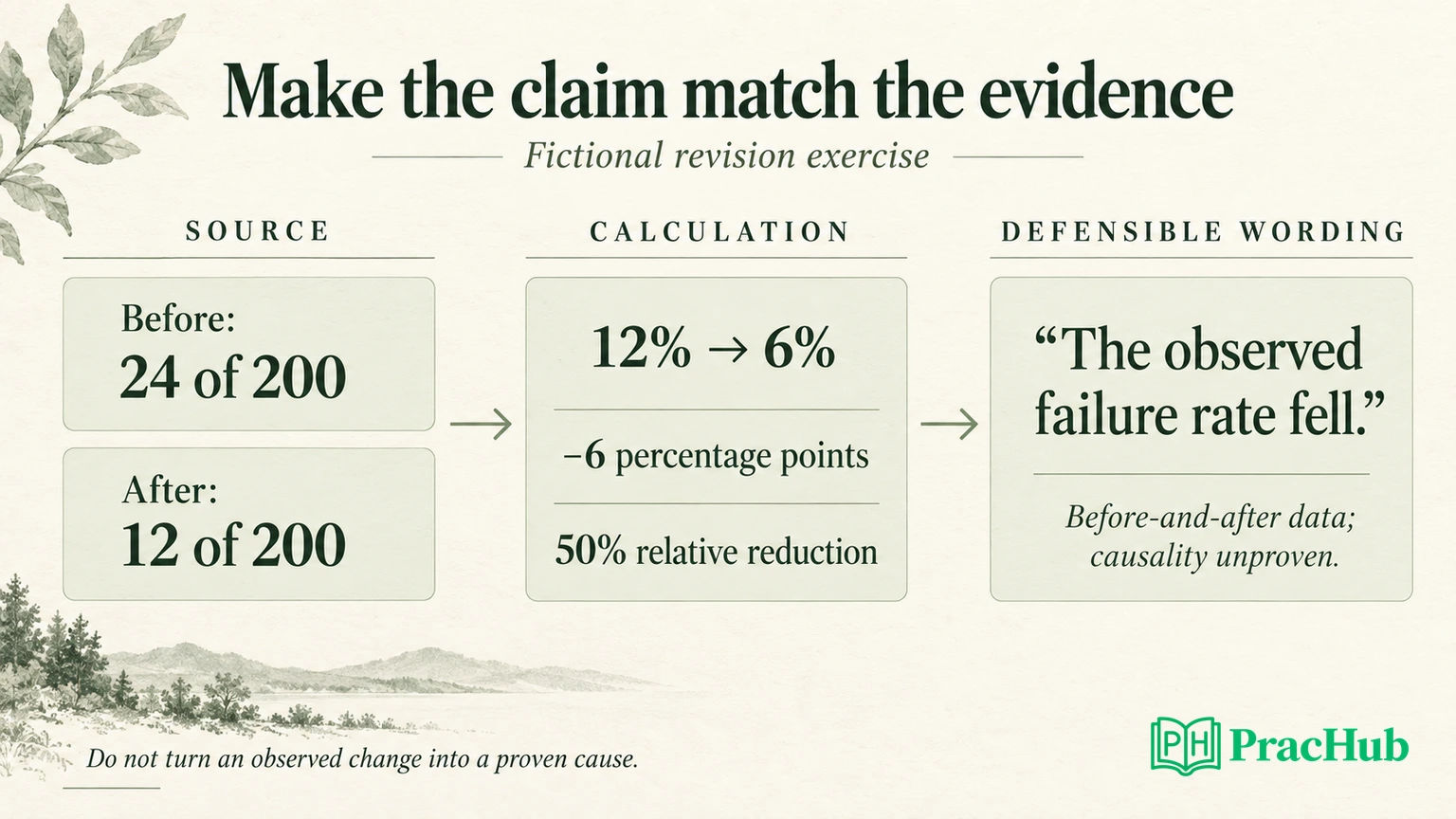
The fact sheet says that 24 of 200 export attempts failed during a two-week baseline window. Six merchant interviews indicated that failed exports interrupted weekly reconciliation. Engineering estimated two weeks for a bounded reliability fix and six weeks for a full export-service rebuild. These were estimates, not guaranteed delivery dates.
The fictional PM owned prioritization, customer interviews, acceptance criteria, and the recommendation. Engineering owned implementation. The team chose the bounded fix and deferred a dashboard feature. In a later two-week window, 12 of 200 export attempts failed. There was no randomized comparison, and merchant mix differed between windows. No revenue effect was measured.
Keep that fact sheet beside the draft. Its purpose is to prevent an attractive sentence from quietly adding evidence that does not exist.
Revision one: replace an impressive opening with a clear problem
Weak draft:
I led a transformational initiative that improved customer satisfaction and delivered major business impact. Our platform had several issues, so I worked with stakeholders to find a scalable solution.
Stronger draft, using only the fictional facts:
I recommended delaying a dashboard feature to address export failures that interrupted merchants' weekly reconciliation. In a two-week baseline window, 24 of 200 export attempts failed. I interviewed six merchants to understand the workflow impact and owned the prioritization recommendation; engineering owned the fix.
The revision names the decision, affected workflow, evidence, and responsibility. It removes “customer satisfaction” and “major business impact” because the fact sheet contains no satisfaction measurement or business-impact estimate.
The number of interviews describes the evidence collected, not the prevalence of the problem across all merchants. Six conversations can explain a mechanism without supporting a population-wide claim.
Revision two: show why the chosen option won
Weak draft:
After aligning the team, I selected the best solution and drove execution. We balanced short-term and long-term needs while maintaining a strong focus on customers.
Stronger draft:
I compared a bounded reliability fix, estimated by engineering at two weeks, with a full export-service rebuild estimated at six weeks. I recommended the bounded fix because it addressed the immediate reconciliation problem sooner. The trade-off was deferring broader architectural work and the dashboard feature. I owned the acceptance criteria and recommendation; engineering owned implementation.
“Best solution” concealed the evaluation criteria. The revision makes speed to relief and deferred scope visible. It also distinguishes engineering estimates from the PM's decision instead of implying the PM personally calculated or delivered every technical component.
A further revision could explain acceptance criteria or stakeholder disagreement, but only if the underlying experience supports those details. In this exercise, do not invent a skeptical executive, a rollback threshold, or a launch date simply to make the narrative feel complete.
Revision three: report the outcome without overstating causality
Weak draft:
My solution cut failures by 50%, increased revenue, and proved that customer obsession drives exceptional results.
Stronger draft:
In a later two-week window, 12 of 200 export attempts failed, compared with 24 of 200 in the baseline window. The observed failure rate fell from 12% to 6%. Because the merchant mix changed and we had no randomized comparison, I cannot attribute the entire reduction to the fix. We did not measure a revenue effect.
This version is less dramatic and more defensible. It describes the observed change and names the alternative explanation. Removing unsupported revenue impact strengthens the account by leaving the reader with a result they can evaluate.
The absolute change is six percentage points. The relative reduction is 50%: the six-point drop divided by the original 12% rate. Those statements describe the same observations in different ways; neither proves causality or statistical significance.
Use a claim ledger before polishing sentences
For your own answer, create a private ledger connecting important statements to their support. This is a preparation aid, not a required attachment or an official Amazon scoring rubric.
| Claim and evidence to check | Wording decision |
|---|---|
| Customer impact: workflow, research notes, support records | State the observed impact; avoid claiming every customer was affected |
| My decision: actual role and approval path | Separate recommendation, approval, and implementation |
| Faster option: estimates available when you decided | Identify estimates and who supplied them |
| Better result: counts, time window, same metric definition | Distinguish observed change from causal impact |
| Business benefit: measured outcome or supported qualitative evidence | Remove unsupported revenue or retention claims |
| Learning: a later change in your decisions or working process | Explain the changed behavior rather than adding a slogan |
Audit units and denominators as carefully as arithmetic. “Export attempts” is not interchangeable with merchants, sessions, or completed exports. If customers retry after failure, attempt-level rates can move differently from customer-level success.
Check whether an estimate became a fact during revision. “We expected to save two weeks” and “we saved two weeks” require different evidence. Likewise, distinguish a planned rollout from a completed rollout and an agreed metric from a measured result.
Keep private information private. Use permitted descriptions or clearly identified approximations when appropriate, preserving the relationship that matters. If anonymization would make the claim misleading or disclosure is not permitted, choose another example.
Add technical depth for PM-T when it changes the decision
Our preparation inference: a PM-T answer benefits from enough technical detail to explain the product trade-off. Detail should clarify why an option was feasible, risky, expensive, or valuable to customers.
For the fictional export case, a useful follow-up would ask what failure mode the bounded fix addressed and what architectural limitation remained. The fact sheet does not answer those questions. A real candidate should supply their actual evidence; the exercise should leave the gap visible.
Do not fill that gap with a stack inventory. Naming databases, queues, and cloud services does not explain why one option was chosen. Describe the relevant dependency, failure behavior, or constraint, then connect it to customer impact and your decision.
Also identify where you relied on engineering judgment. You can own product prioritization while crediting an engineer's diagnosis or estimate. Explain how you tested the recommendation against requirements rather than claiming expertise or implementation work you did not have.
Revise for the reader, then verify the submitted version
First, check prompt coverage. Underline the sentence that directly answers each requested part. If a section only describes background, shorten it until the decision and action have enough space.
Next, read for ownership and chronology. Replace an ambiguous “we” where the reader needs your action, but retain team credit for shared outcomes. Make the sequence clear enough to distinguish evidence available before the decision from results observed afterward.
Then make the language easier to read. Replace “facilitated cross-functional alignment” with the action you performed, such as comparing options with engineering and explaining the recommendation to the approving manager. Keep technical terms only when they help the reader judge the decision.
Finally, inspect the actual upload or submission preview. Confirm the correct version, intact paragraphs, readable symbols, complete answer, and compliance with the invitation's limits. Save the confirmation and a permitted copy of your submitted text so later discussion stays consistent.
Five questions to test the evidence behind your answer
These PracHub records are practice prompts, not predictions of your writing assessment. Four cover Amazon PM preparation; the Google prompt adds a focused test of how you handle misleading evidence.
| PracHub question | Revision practice |
|---|---|
| Amazon Behavioral Deep-Dive | Identify the decision and ownership behind a polished story. |
| Behavioral Deep-Dive & Leadership Scenarios | Explain alternatives and action under uncertainty. |
| Answer AWS PM behavioral prompts | Connect technical investigation to customer and product outcomes. |
| Share Customer-Obsessed Leadership Stories | Make the customer's problem specific enough to evaluate. |
| Learning from Wrong Data | Check whether your evidence really supported the decision. |
Choose one question from PracHub's Amazon Product Manager collection, draft from your own experience, and revise the weakest claim before practising its follow-ups aloud.
Comments (0)