Are AlgoMonster's 48 Coding Patterns Enough for Technical Interviews?
Quick Overview
AlgoMonster's 48 coding patterns provide a strong framework for recognizing common algorithm structures, but pattern recognition alone does not prove interview readiness. This guide explains what the curriculum covers, where candidates still struggle, and how to combine structured pattern learning with PracHub's real company questions, timed explanation, system design, and behavioral practice for a complete 2026 technical interview plan.
Forty-eight coding patterns sounds like a clean answer to a messy problem. Instead of grinding thousands of unrelated questions, you learn a finite set of reusable moves, recognize the signal, and apply the right template. That is far more efficient than random practice.
But there is a harder question behind the marketing number: does recognizing 48 patterns make you ready for an actual technical interview?
The honest answer is not by itself. AlgoMonster can give you an excellent map of the coding landscape. Interview readiness begins when you can use that map on an unfamiliar problem, explain your decisions under time pressure, adapt to follow-up questions, and perform across the rest of the interview loop.
Quick Verdict: Are 48 Coding Patterns Enough?
AlgoMonster's 48 coding patterns are enough to build a strong algorithm foundation, but they are not enough to cover a complete technical interview. They help candidates classify problems and recall common solution structures. They do not automatically prove that you can solve unseen variations, communicate clearly, debug live, or prepare for system design and behavioral rounds.
A practical workflow is to learn patterns first, then test them against real interview questions with written solutions. Use company-specific interview prep to see whether your target employer actually emphasizes arrays, graphs, dynamic programming, APIs, concurrency, or another mix. This moves PracHub into the plan before you spend weeks perfecting patterns that may not match your interview.
Best fit: Use AlgoMonster for structured pattern learning. Use PracHub to diagnose whether those patterns transfer to recently reported company questions and the rest of the loop.
What Are AlgoMonster's 48 Coding Patterns?
AlgoMonster's official site describes a curriculum organized around 48 core patterns, supported by more than 325 lessons and problems, illustrations, step-by-step solutions, an AI assistant, and a company-specific question bank. It positions this approach as a focused alternative to solving thousands of random problems.
That premise is sound. Many coding questions share a smaller number of underlying structures: two pointers, sliding window, binary search, graph traversal, heap selection, interval processing, backtracking, dynamic programming, and related techniques.
Patterns reduce cognitive load. When a problem says "longest contiguous segment," you should think about a window. When it asks for the shortest path in an unweighted graph, breadth-first search should enter the conversation. When it asks for repeated top-K retrieval, a heap may be relevant.
The important distinction is this: a pattern is a starting hypothesis, not a complete solution.
What Pattern-Based Learning Does Well
1. It replaces random grinding with a curriculum
A structured sequence helps beginners understand what they are missing. Instead of bouncing between unrelated medium and hard questions, candidates can build from common data structures toward more complex combinations.
2. It improves problem classification
Interview speed often depends on recognizing the shape of a problem quickly. Pattern study helps you connect phrases in the prompt to useful tools and narrow the search space before coding.
3. It creates reusable mental templates
A strong template is not code to memorize. It is a checklist: what state must be tracked, what invariant must remain true, when should a pointer move, and what determines termination?
4. It is efficient for candidates with foundation gaps
If you regularly stare at coding questions without knowing where to begin, a pattern curriculum can be more valuable than another list of 100 problems. It gives names and structure to techniques you may have encountered only informally.
Pattern Knowledge vs. Interview Readiness
| Capability | Pattern Study Helps? | What Still Needs Testing |
|---|---|---|
| Recognize common structures | Yes | Can you recognize them when the prompt is disguised? |
| Recall a standard approach | Yes | Can you adapt it when constraints change? |
| Write correct code | Partly | Implementation, edge cases, testing, and debugging |
| Communicate clearly | Partly | Clarifying questions, trade-offs, and explanation under pressure |
| Handle company-specific interviews | Partly | Current question mix, role expectations, and round format |
| Cover the full interview loop | No | System design, behavioral, domain, and role-specific rounds |
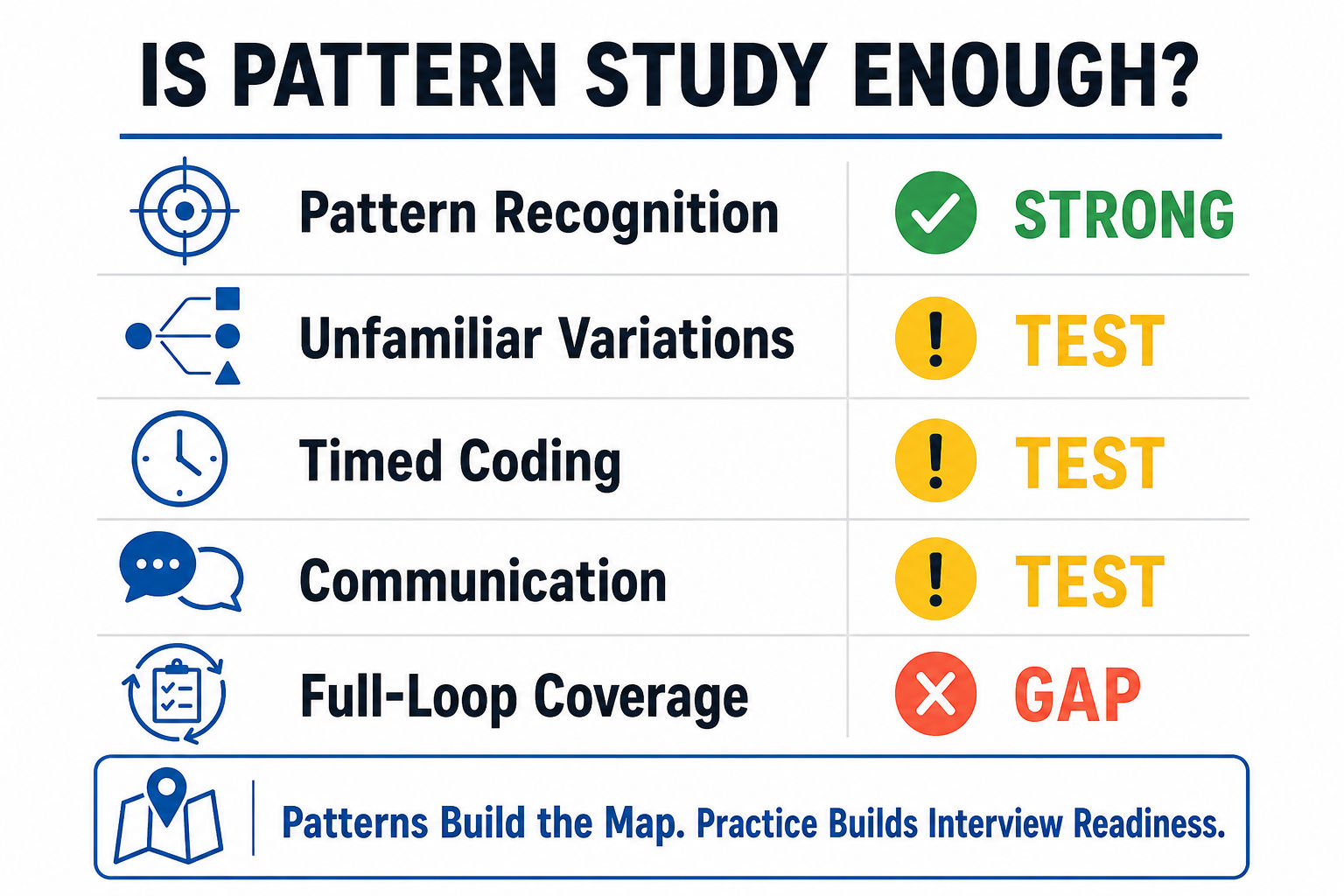
Where 48 Patterns Stop Being Enough
Unfamiliar variations break memorized templates
A familiar-looking problem may introduce streaming input, memory limits, duplicate handling, or a follow-up that changes the optimal data structure. Candidates who memorized a template often force it onto the problem instead of rebuilding the reasoning from constraints.
After learning a pattern, solve at least two questions where the pattern is not named in advance. If you need the category label to choose an approach, recognition is not yet transferable.
Real interviews score the process, not only the final code
Your interviewer can observe how you clarify requirements, compare options, state an invariant, test examples, and respond to a hint. A correct solution reached through silent trial and error may create a weaker signal than a slightly incomplete solution with disciplined reasoning.
Practice saying the following out loud: "A brute-force approach would cost O(n squared). The constraint suggests we need one pass, so I want to maintain this invariant with a hash map." That sentence demonstrates more than naming the pattern.
Company and role differences matter
A general pattern curriculum cannot tell you exactly what your next employer will emphasize. A frontend candidate may face JavaScript behavior and UI implementation. A backend candidate may see concurrency, APIs, data modeling, or debugging. Senior candidates may spend more time on architecture and trade-offs than on a textbook dynamic programming problem.
Before selecting your final practice set, map the target company's recent questions by role, difficulty, and round. PracHub's company pages make that diagnosis faster.
Coding is only one part of many technical loops
Even perfect algorithm recognition does not prepare you to scope a distributed system, tell a concise leadership story, or defend a database decision. Senior software engineering loops often combine several signals.
Add system design questions and behavioral and leadership interview practice to the same plan. Candidates interviewing for data-heavy roles can also use the correct SQL interview practice collection.
The Five-Part Interview Readiness Test
Do not ask whether you have "finished" all 48 patterns. Ask whether your knowledge survives these five tests:
- Cold recognition: Can you identify a useful approach without seeing the pattern label?
- Variation handling: Can you adapt when constraints, input shape, or follow-ups change?
- Timed implementation: Can you produce clean, testable code within the interview window?
- Communication: Can you explain complexity, invariants, trade-offs, and edge cases while coding?
- Loop coverage: Are you also prepared for system design, behavioral, and role-specific rounds?
If you fail one of these tests, the answer is not necessarily "learn more patterns." Often the answer is practice the same knowledge in a more realistic environment.
How to Turn 48 Patterns Into Interview Performance
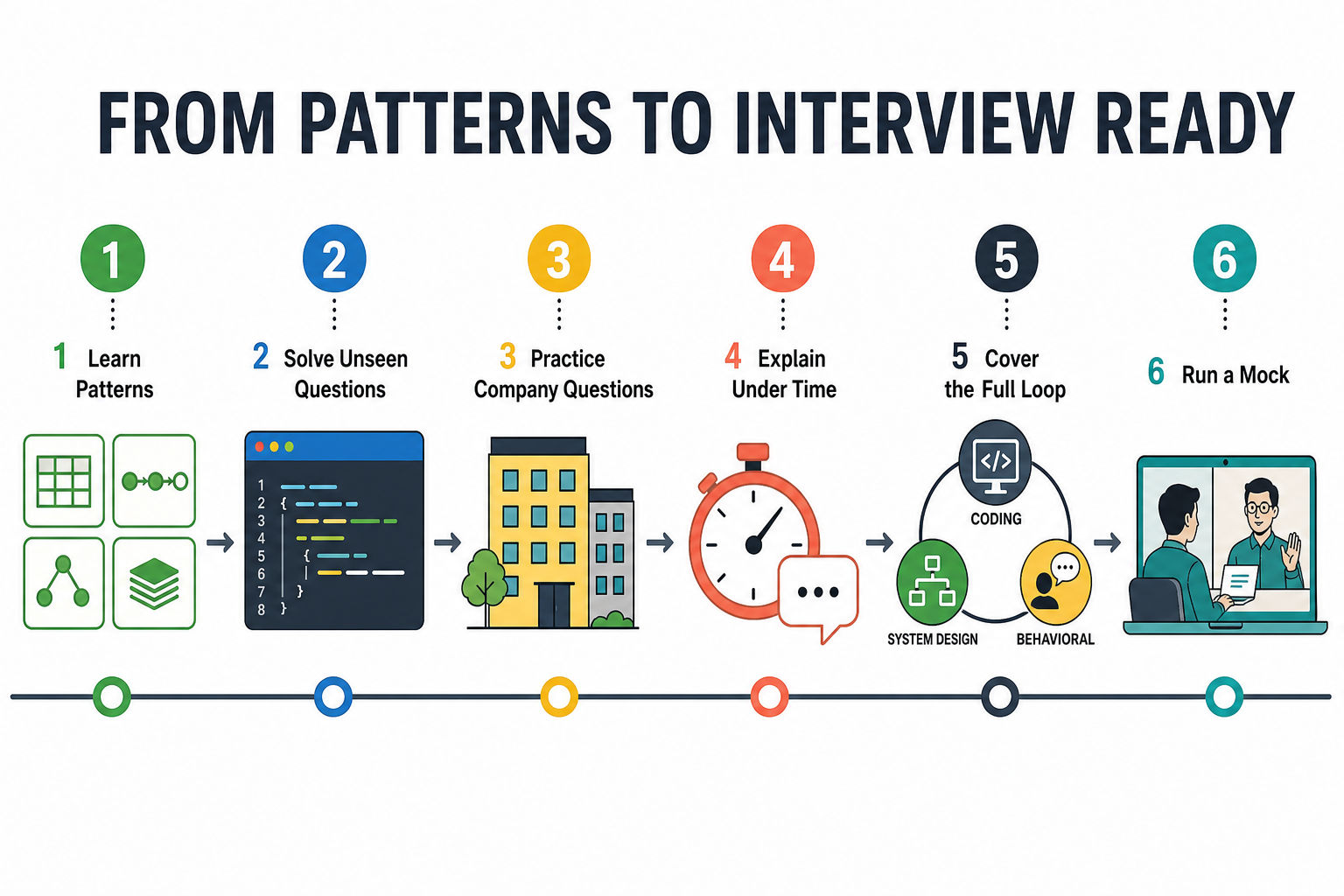
Step 1: Learn the pattern and its invariant
For every pattern, write one sentence explaining what remains true while the algorithm runs. For sliding window, define what makes the window valid. For binary search, define which side can still contain the answer. For graph traversal, define what "visited" means and when a node enters the queue or stack.
Step 2: Solve one unseen question cold
Remove the category label and start a timer. Spend the first two or three minutes clarifying inputs, outputs, constraints, and examples. Only then choose a data structure and approach.
Use PracHub's real company question bank for this diagnostic. Attempt the problem before opening the written solution, then compare not only the final code but also the reasoning and edge cases.
Step 3: Practice the target company's question mix
Select a company and role before choosing more problems. Ten relevant questions usually teach you more about interview fit than ten random questions at the same difficulty.
Track which patterns appear, but also track non-pattern signals: API design, testing, debugging, concurrency, object-oriented design, SQL, or communication.
Step 4: Explain every solution under time
For each practice problem, explain the brute-force option, optimized approach, correctness argument, and complexity. Then walk through one normal case and one edge case. Record yourself if you do not have a mock partner.
Step 5: Build the rest of the loop
Once coding is stable, allocate preparation time according to the actual interview schedule. A candidate with a system design round next week should not spend every remaining hour collecting more algorithm templates.
Step 6: Run a realistic mock
A mock should include ambiguity, follow-up questions, and a fixed clock. The goal is to expose behavior that ordinary solo practice hides: rushing, going silent, overcoding, weak testing, or refusing to reconsider an approach.
A 7-Day Pattern-to-Interview Diagnostic
| Day | Focus | Action |
|---|---|---|
| 1 | Pattern audit | List patterns you can explain without notes; mark weak invariants. |
| 2 | Cold coding | Solve two unlabeled questions under time. |
| 3 | Company fit | Review recent questions for your target company and role. |
| 4 | Communication | Explain two solutions aloud, including tests and complexity. |
| 5 | Full-loop gap | Practice one system design or behavioral round. |
| 6 | Mock interview | Run a realistic coding mock with follow-ups. |
| 7 | Decision | Study only the gaps exposed by the previous six days. |
This diagnostic prevents a common mistake: spending another month studying content you already understand because realistic practice feels less comfortable.
Who Should Use AlgoMonster's Pattern Curriculum?
AlgoMonster is a strong fit if you are early in your preparation, lack a coherent DSA framework, repeatedly miss common structures, or want a guided alternative to random problem selection.
It is less likely to be sufficient by itself if your interview is close, you already recognize most common patterns, you are targeting a senior role, or your loop includes substantial system design, behavioral, frontend, backend, SQL, or domain-specific evaluation.
For many candidates, the best choice is not AlgoMonster or PracHub. It is a sequence: learn the pattern, test it on real questions, diagnose the gap, and practice the complete loop.
Frequently Asked Questions
Do I need to memorize all 48 AlgoMonster patterns?
No. You should understand the conditions, invariant, complexity, and failure modes of the most relevant patterns. Memorizing 48 templates without being able to adapt them creates false confidence. Prioritize transferable reasoning and use cold questions to verify recall.
How many coding patterns are enough for interviews?
There is no universal number because companies, roles, and seniority levels differ. A smaller set mastered deeply can outperform a larger memorized catalog. Readiness is better measured by performance on unseen, timed, company-relevant questions than by the number of completed modules.
Is AlgoMonster better than random LeetCode practice?
For candidates who lack structure, a pattern-based curriculum can be more efficient than random practice. Once the patterns are familiar, however, random or unlabeled questions become useful because they test whether you can identify the right approach without being told the category.
Can coding patterns prepare me for senior software engineering interviews?
They can support the coding portion, but senior interviews often evaluate architecture, trade-offs, technical leadership, ambiguity, and communication more heavily. Add company-specific system design and behavioral practice instead of treating algorithm coverage as the entire loop.
What should I use after finishing AlgoMonster?
Move to real, recently reported interview questions from your target companies. Attempt them under realistic constraints, compare your work with written solutions, and add mocks plus system design or behavioral practice based on your scheduled rounds.
Final Verdict: Patterns Are the Map, Not the Interview
AlgoMonster's 48 coding patterns can make your preparation more organized and efficient. They are enough to teach a useful vocabulary of algorithmic problem solving. They are not enough to guarantee performance in an unfamiliar, timed, interactive, company-specific interview.
The best next step is simple: choose your target company, attempt several real interview questions on PracHub without labels, and evaluate your implementation, explanation, and edge cases. Then use the results to decide whether you need another lesson, more company-specific reps, or broader full-loop practice.
Do not measure readiness by how many patterns you have completed. Measure it by what you can do when nobody tells you which pattern to use.
Comments (0)