Are HackerRank Certifications Worth Adding to a Software Engineer Resume?
Quick Overview
Evaluate HackerRank certification as a bounded resume signal, compare it with tested projects and interview preparation, and write claims that match verifiable evidence.
Add a HackerRank certificate to your software engineer resume when it is relevant, verifiable, and adds evidence that the rest of the page lacks. It can help an early-career applicant or career changer document a newly learned skill. It should not push out stronger project or employment evidence, and it does not establish that an employer will waive an assessment or offer an interview.
This article separates official HackerRank facts from editorial judgment about resume space. We did not establish evidence measuring how much a certificate improves recruiter responses. The applicant profiles and resume examples below are fictional teaching examples, not candidate reports or promised hiring outcomes.
Use PracHub Software Engineer questions to check whether you can explain and apply the skill beyond the credential. A resume claim is more useful when you can defend it in a follow-up conversation.
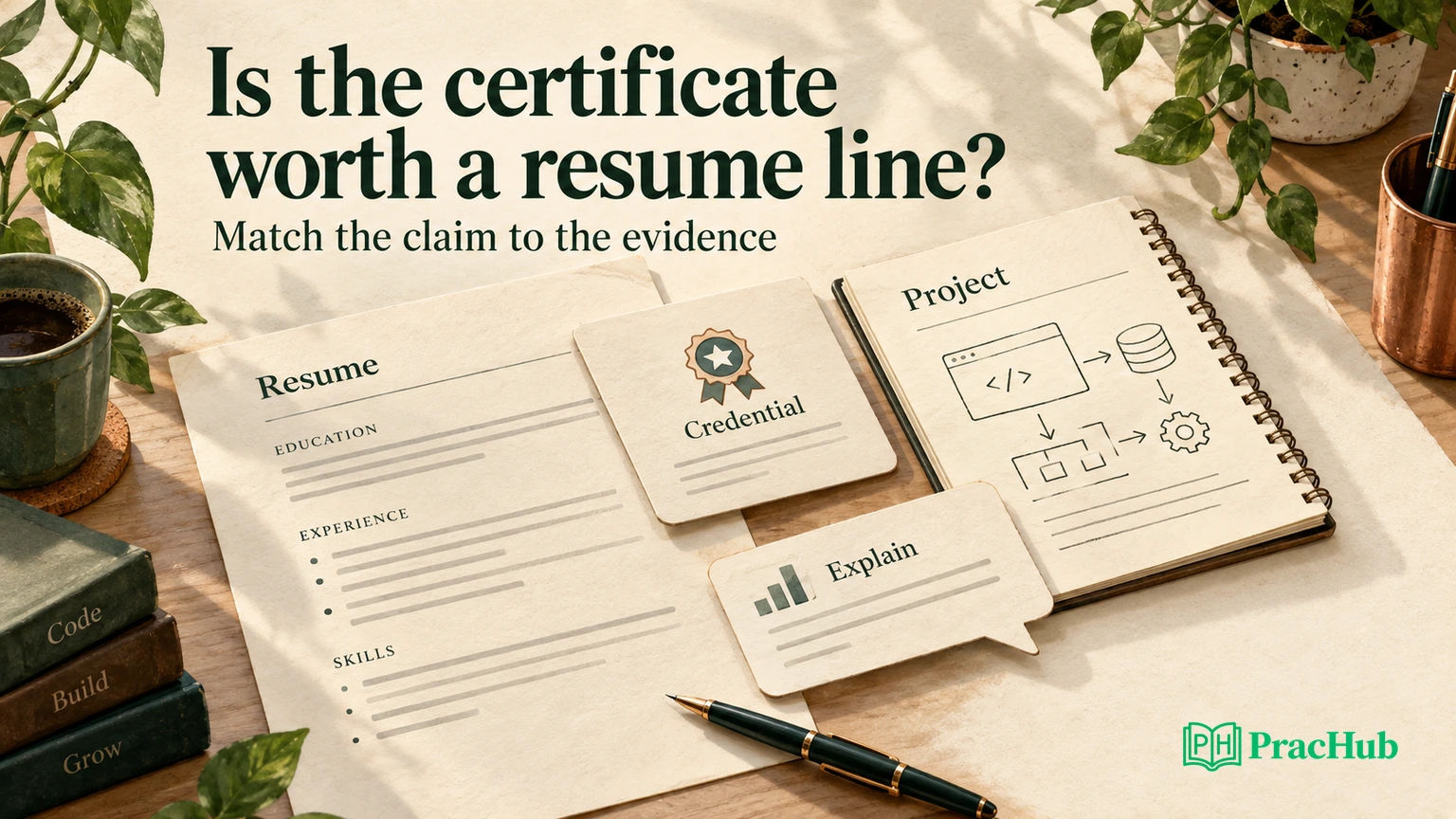
What does a HackerRank certificate actually establish?
Official fact: HackerRank describes its certifications as free, timed assessments for individual skills or job roles. Its introduction distinguishes skill-based credentials from role-based assessments that cover several related competencies. For example, it lists problem-solving, SQL, and REST API for the Software Engineer role certification.
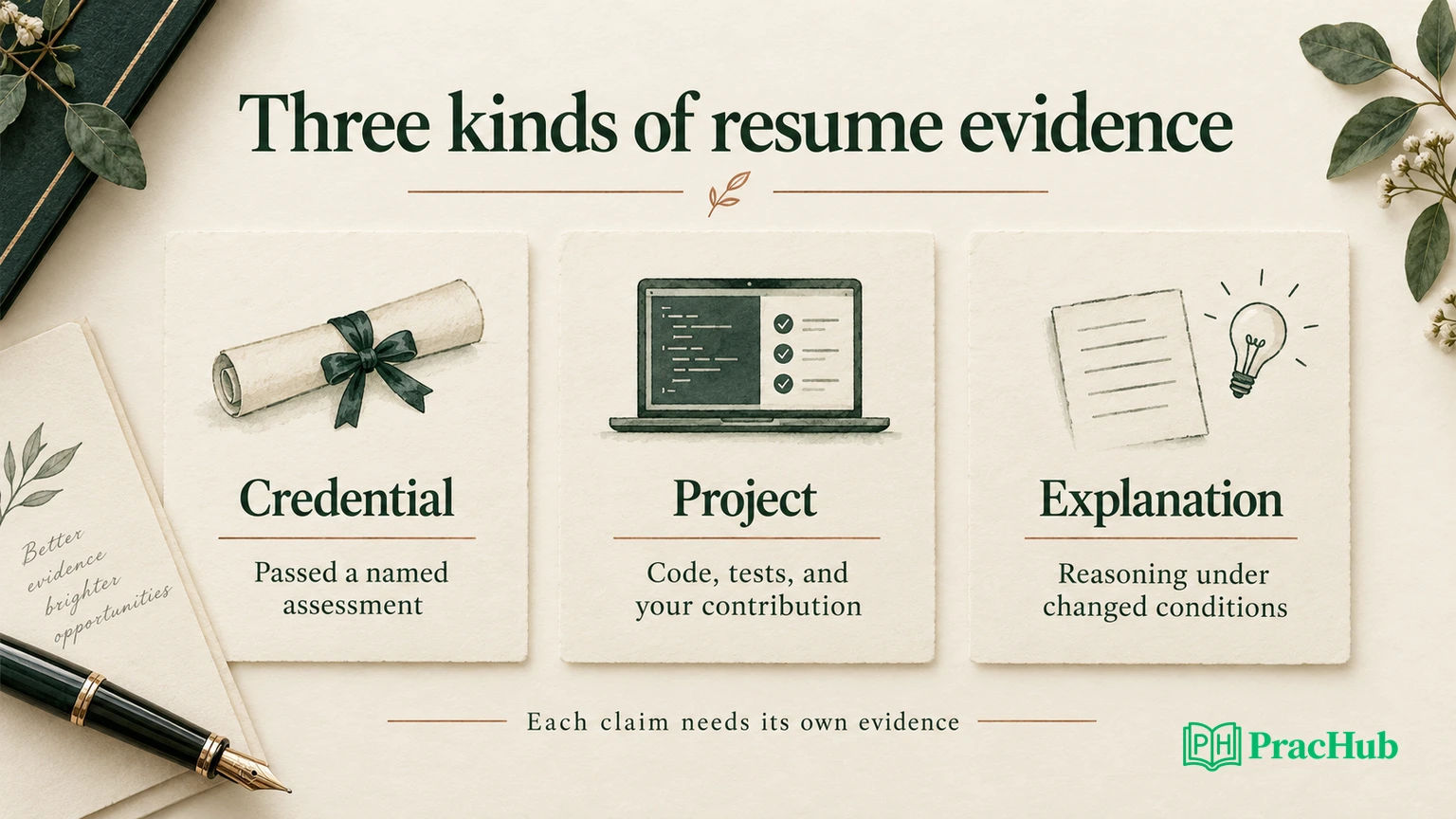
That description supports a narrow resume statement: you passed a named certification assessment. It does not demonstrate that you maintained a production service, designed a safe rollout, reviewed another engineer's code, or handled changing product requirements. Those are different claims requiring different evidence.
The public [certification catalog] we reviewed(https://www.hackerrank.com/skills-verification) lists both role and skill options, including Software Engineer and SQL at multiple levels. Use the exact issued credential name. A SQL credential and a Software Engineer credential are not interchangeable, and adding your own seniority label does not make an assessment broader.
Distinguish a personal certification from an employer's recruiting test. Both may use the same platform, but they serve different purposes. Unless the employer explicitly confirms transfer or exemption, keep preparing for the assessment described in its invitation. A certificate link is not an employer-issued invitation or a hiring-stage result.
Ask what the badge adds for this application. It is whether a reader learns something relevant and accurate about your candidacy from that line.
Compare the evidence before allocating resume space
The following original decision table compares three fictional applicants. It is an editorial framework, not a recruiter survey or a rule used by HackerRank.
| Applicant and missing evidence | Certificate contribution | Stronger next evidence to build | Resume decision |
|---|---|---|---|
| New graduate with coursework but little independent coding | A relevant passed assessment can document a bounded skill check | A small project with runnable setup, meaningful tests, and an explanation of one design choice | Keep one concise credential if space remains; prioritize the project once it exists. |
| Career changer targeting backend work after learning SQL and APIs | A credential can support the stated transition without claiming professional experience | An endpoint that uses a database correctly and handles invalid inputs and pagination | Link the relevant credential beside concrete transition evidence. |
| Experienced engineer with substantial service ownership | A basic certificate may add little beyond existing work history | Clear ownership, technical constraints, incident learning, and measured outcomes when available | Usually give the strongest work evidence the space first. |
These cases differ because the missing evidence differs. A career changer may need to make a new skill visible. An experienced engineer may need to explain the depth of an existing skill. Neither should use certification to conceal the gap the role is actually testing.
Read the target job description and identify one capability you are claiming. Then inspect your resume for evidence of that capability. If a certificate merely repeats a supported skills list, its marginal value is limited. If the resume otherwise offers only an unsupported assertion, a relevant passed assessment can add a concrete reference.
Do not turn this into a points system. We have no basis for assigning a credential a fixed recruiter value or estimating an increase in interview probability. The table helps choose evidence; it does not quantify hiring impact.
Write a credential line that stays within its evidence
Put the exact credential name, issuer, issue date, and a working verification destination in a compact Certifications or Additional Information section when that fits your resume. Check the visible certificate before copying these details. An account profile, a screenshot, and a certificate verification page can expose different information.
For a fictional applicant who actually holds the credential, a bounded line could read:
HackerRank — SQL (Intermediate), issued May 2026 — certificate link
The date and credential in this example are placeholders. Replace them with your own issued record; do not copy them as an achievement. Link the words identifying the certificate rather than filling the page with a long URL. Test the link from the final exported resume, because a link that works in your editor may be missing in the PDF.
Avoid inflating the same record into “HackerRank-certified senior backend engineer” unless that is the actual credential title and the claim is independently justified. A platform assessment does not assign your employment seniority. Similarly, do not describe a credential as an internship, professional license, degree, or employer endorsement.
If you have passed several relevant assessments, select the ones that match the application rather than listing every badge. One relevant SQL credential is easier to interpret than a row of overlapping basic badges with no explanation of how you used the skills. This is a recommendation about clarity, not a claim that applicant-tracking systems reward a particular number.
Show the difference between a badge and a project claim
Consider this original resume rewrite for a fictional applicant:
Before: Expert in Python, SQL, and backend engineering; HackerRank certified.
The problem is not the presence of the certificate. The line collapses several claims into an unsupported level of expertise. It provides no exact credential, no application of the skills, and no boundary on what the applicant did.
An evidence-focused version might separate two lines:
Credential: HackerRank — SQL (Intermediate), issue date and certificate link.
Project: Built a small inventory API with validated quantity updates, cursor-based listing, and tests for duplicate item names and invalid quantities; repository link.
The project statement is also fictional. Use it only as a structure for describing work you actually completed. Do not invent test counts, latency reductions, users, or production deployment to make the project sound stronger.
Each line now gives the reviewer a different way to verify your claim. The credential can be checked against its issued record. The project can be examined through setup instructions, tests, code, and design explanations. If you wrote the quantity update but someone else designed pagination, state your contribution accordingly.
A useful project explanation goes beyond “used Python and SQL.” Explain what one endpoint accepts, what it rejects, and which database condition it protects. If a test proves duplicate names are rejected, describe how the schema and application behavior work together. If it does not test concurrent requests, do not claim concurrency safety.
This is the main advantage of keeping the claims separate: you can show both a bounded assessment result and a deeper piece of work without making either pretend to be the other.
What if you have limited preparation time?
Editorial judgment: choose the next activity according to the missing evidence and the next recruiting event. If your resume lacks a relevant skill reference and the certification fits that skill, completing one may be reasonable. If an interview is approaching and you cannot explain joins or debug a failing endpoint, direct practice may be more urgent.
A free assessment still costs time. Include preparation, the test itself, and the possibility that you need further study. Avoid collecting overlapping credentials simply because each one is available. The opportunity cost is the project, application revision, or interview explanation you did not work on during that period.
For the new graduate in the table, an original next session might be implementing one input-validation rule and a test that fails without it. For the career changer, it might be explaining why an API list endpoint needs stable pagination. For the experienced engineer, it might be rewriting a service-ownership bullet to make the exact responsibility visible.
These are examples of different next actions, not a universal study schedule. You do not need to abandon certification to build a project, or finish a large application before earning a relevant credential. Keep the activities connected to the evidence you need.
Before registering, read the rules for the specific certification. HackerRank's FAQ lists some tests as allowing only one attempt, while giving a 30-day retake interval for retakable certification tests. Do not assume unlimited attempts or copy rules from an unrelated employer assessment.
The same FAQ says HackerRank does not share official certification questions or solutions. Prepare by learning the competencies and working on original or authorized practice. Memorized answer collections are weak preparation for a changed input or a request to explain why the method works.
Verify the credential and the claim before submitting
First, check that the certification was actually passed and issued. The official FAQ directs users to the same Community account used for the test and the certification status/profile. Completing an attempt is not the same as earning a certificate. If the record is missing, resolve that status rather than claiming issuance prematurely.
Second, compare the resume with the visible record: name, credential level, date, and link. The FAQ says certificate dates cannot be changed after issuance. Use the actual issue date instead of rewriting it as the month you last practised the skill.
Third, open the final document's link in the way a recipient will encounter it. Check what appears without your personal account context. If it requires access the recipient will not have, choose an appropriate public verification route or clearly provide the identifier the issuer makes available. Never expose unrelated account details just to demonstrate a credential.
Finally, rehearse the nearby skill and project statements. Ask a partner to pick one claim and request an explanation, an edge case, and a change in requirements. If a changed input leaves you unable to explain the method, study the concept again before claiming broad proficiency.
Do not infer a hiring outcome from a later rejection or invitation. Many application factors change together. Without a controlled comparison, a personal before-and-after story cannot establish that adding or removing the credential caused the result.
Five questions to test the skills behind the line
These verified PracHub questions are transferable practice, not HackerRank certification questions. The mix checks input handling, structured reasoning, SQL, and API behavior so that preparation goes beyond collecting a badge.
| PracHub question | Evidence to practise |
|---|---|
| Validate CSV Company Records for Missing Fields, Length, Forbidden Words and Overlap | Turn written validation requirements into observable tests. |
| Parse Parent-Child Task Records and Render Them as a Connector Tree | Explain data representation and malformed input handling. |
| Query Active Loans by Borrower ID in SQL | State the row-selection rule before writing the query. |
| Implement a robust REST API method | Trace input, response, and failure behavior. |
| Implement a REST GET Endpoint and Evolve Its Contract Safely | Explain compatibility when requirements change. |
Start with one Software Engineer practice question that matches a resume claim and explain it without relying on a memorized solution. Keep a relevant certificate when it adds verifiable information, then use the remaining space and preparation time to make your actual engineering work easier to assess.
Comments (0)