Arm Software Engineering Intern Interview 2027: C/C++, Computer Architecture, and Embedded Systems
Quick Overview
Arm internship preparation separates current Engineering Pathways information from historical candidate reports, with original byte-decoding and cache-line exercises.
An Arm software engineering intern interview in 2027 calls for more than recognizing an algorithm. You should be able to explain what your code assumes about memory, how those assumptions interact with hardware, and how you would investigate a failure that appears only on a particular system.
Evidence checked September 7, 2026: Arm has a current engineering internship entry that includes software and systems work, but the posting reviewed does not explicitly identify its internship year as 2027. This guide separates that official information from historical candidate reports and original preparation exercises. Use PracHub’s Arm Software Engineer questions alongside the requirements of your specific team.
Start with the team, not a universal Arm interview syllabus
Official role evidence: Arm’s Intern Program—Engineering Pathways, job 2026-19305, was posted September 1, 2026. It covers several North American locations and multiple engineering areas. Software and tools work includes C/C++, Python, Linux, embedded systems, and automation; systems and performance work includes modeling, simulation, and benchmarking.
The posting says applicants should be enrolled in a relevant degree program and return to their studies after the internship. It also states that this role does not provide visa sponsorship. Those are requirements of this particular posting, not a substitute for reading a different country’s requisition.
It asks about applicants’ interests and technologies to help match them with opportunities, and encourages early applications. It does not publish a universal closing date or explicitly confirm a summer 2027 schedule.
Our preparation advice: A GPU software team, firmware team, compiler team, and cloud software team can all require different depth. Highlight the nouns in your job description: drivers, toolchains, performance, operating systems, or embedded targets. Turn those into priorities rather than treating every hardware interview report as relevant to software engineering.
What the official process and candidate accounts establish
Official process: Arm’s internship page describes an initial virtual interview focused on motivation, thinking, and problem solving, followed by a final interview with potential teammates and leaders. It explicitly allows differences by location. The page emphasizes ownership, working through ambiguity, and collaboration; it does not give one mandatory OA format or passing score.
Historical candidate reports: An April 2026 entry on Glassdoor’s Software Engineer (Internship) page describes a January 2026 Cambridge interview involving HireVue and a video conversation with engineers, with roughly four weeks overall. Another entry posted in April 2026 actually describes an October 2024 interview, including a video assessment, coding, and technical discussion.
In a Reddit software-intern discussion, a commenter identifying their role as a GPU software internship reports résumé discussion and C coding followed by deeper fundamentals questions. That is one team-specific account. The original poster’s invitation is not evidence that they completed the process.
These sources do not supply two independently verified reports from the 2027 cycle. Treat HireVue, timings, and question styles as historical signals. Confirm your own assessment platform, language options, permitted tools, and interview duration with the recruiter.
C/C++: explain the boundary before writing the loop
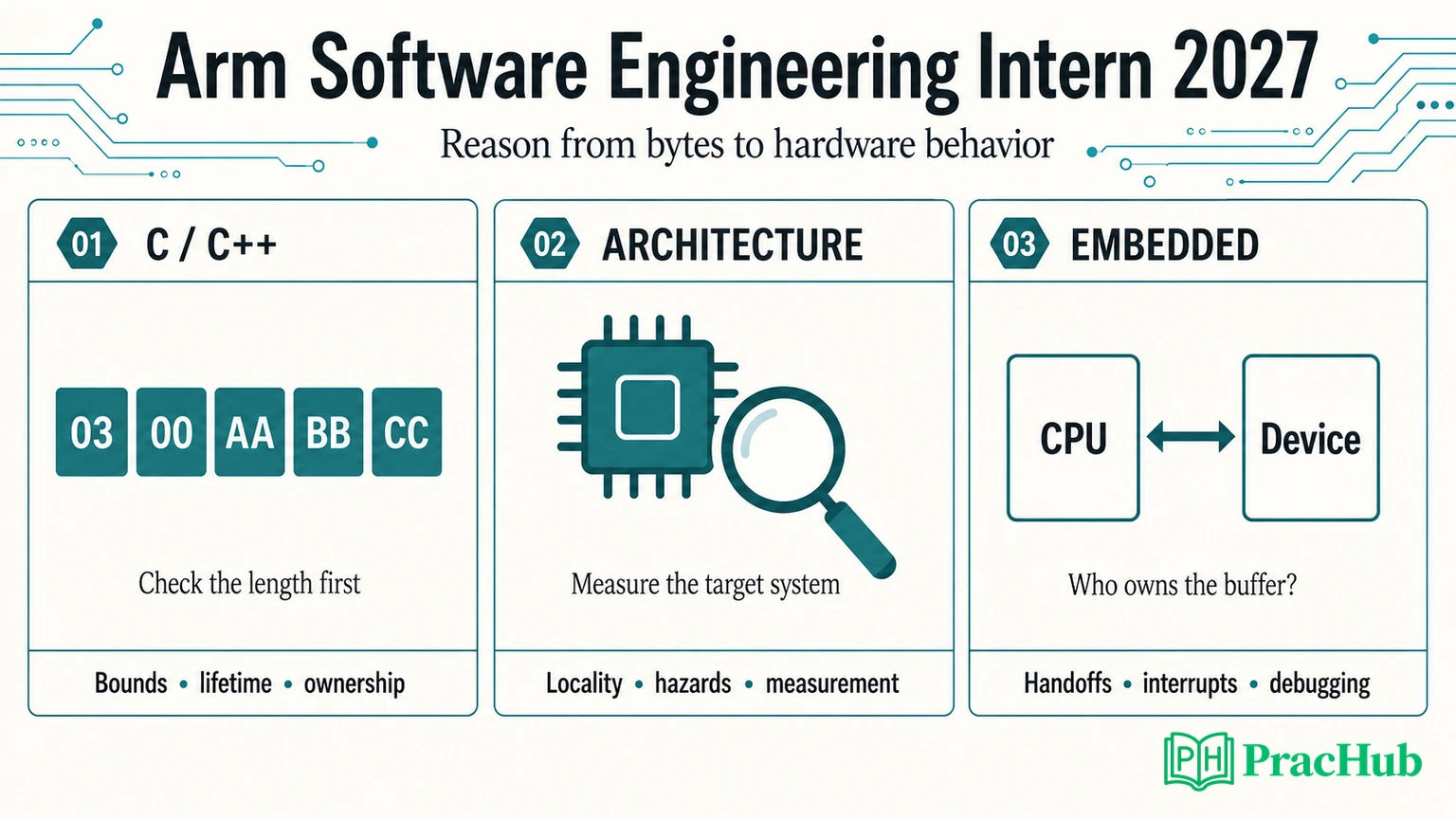
Original practice exercise—not an Arm-reported question: Parse a byte buffer whose first two bytes encode a little-endian, unsigned payload length. Exactly that many payload bytes must follow. A zero-length payload is valid; trailing bytes are not. Assume eight-bit bytes and that the caller provides a valid readable buffer of the stated size.
Begin by checking that the buffer contains at least two bytes. Only then decode the length and compare it with size - 2. This ordering prevents subtracting the header length from an undersized unsigned size.
For C++17, a small implementation could be:
#include <cstddef>
#include <cstdint>

bool valid_frame(const std::uint8_t* data, std::size_t size) {
    if (size < 2 || data == nullptr) return false;
    const auto length = std::uint32_t{data[0]}
                      | (std::uint32_t{data[1]} << 8);
    return length == size - 2;
}
The widened unsigned operands make the shift explicit. Reading separate bytes avoids assuming that the input address is aligned for a wider integer or that the host’s byte order matches the wire format. Casting the buffer to a uint16_t* would introduce assumptions this contract does not grant.
Walk through concrete inputs:
| Bytes, in hexadecimal | Expected result | Reason |
|---|---|---|
03 00 AA BB CC | Valid | Three payload bytes follow the header |
03 00 AA BB | Invalid | Declared payload is truncated |
00 00 | Valid | Empty payload is allowed |
00 00 AA | Invalid | Extra byte violates the exact-length contract |
00 | Invalid | Header itself is incomplete |
This function validates framing only. It does not verify a checksum, authenticate a sender, or validate the payload’s meaning. Naming what the code does not establish is part of an accurate explanation, not a reason to expand every small exercise into a protocol stack.
For a follow-up, return a view of the payload. Then discuss lifetime: the view is usable only while the backing buffer remains alive and unchanged in the required ways. A view into a local temporary would dangle. In C++, distinguish owning storage from pointers or spans that merely refer to it.
For C preparation, rehearse allocation failure, ownership conventions, and bounds checks. For C++, add RAII, destructor behavior, copy versus move, and iterator invalidation. Choose one example where an apparently harmless container change invalidates a stored reference, and explain how the interface could avoid that dependency.
Computer architecture: count the work before predicting performance
Technical reference: Arm’s memory hierarchy learning path explains caches and address translation and shows how to inspect a system’s cache topology. Read the actual target’s properties rather than assuming every Arm processor has the same line size, cache organization, or latency.
Original reasoning exercise: Assume an aligned array of 256 four-byte elements and a cache with 64-byte lines. The array occupies 1,024 bytes, or 16 lines. Ignore prefetching and other traffic for this first calculation, and begin with those lines absent from the cache.
A sequential pass reading every element touches 16 distinct lines and performs 256 element reads. A second pattern reading indices 0, 16, 32, and so on through 240 also touches 16 distinct lines, but performs only 16 element reads. Each selected element lies in a different line.
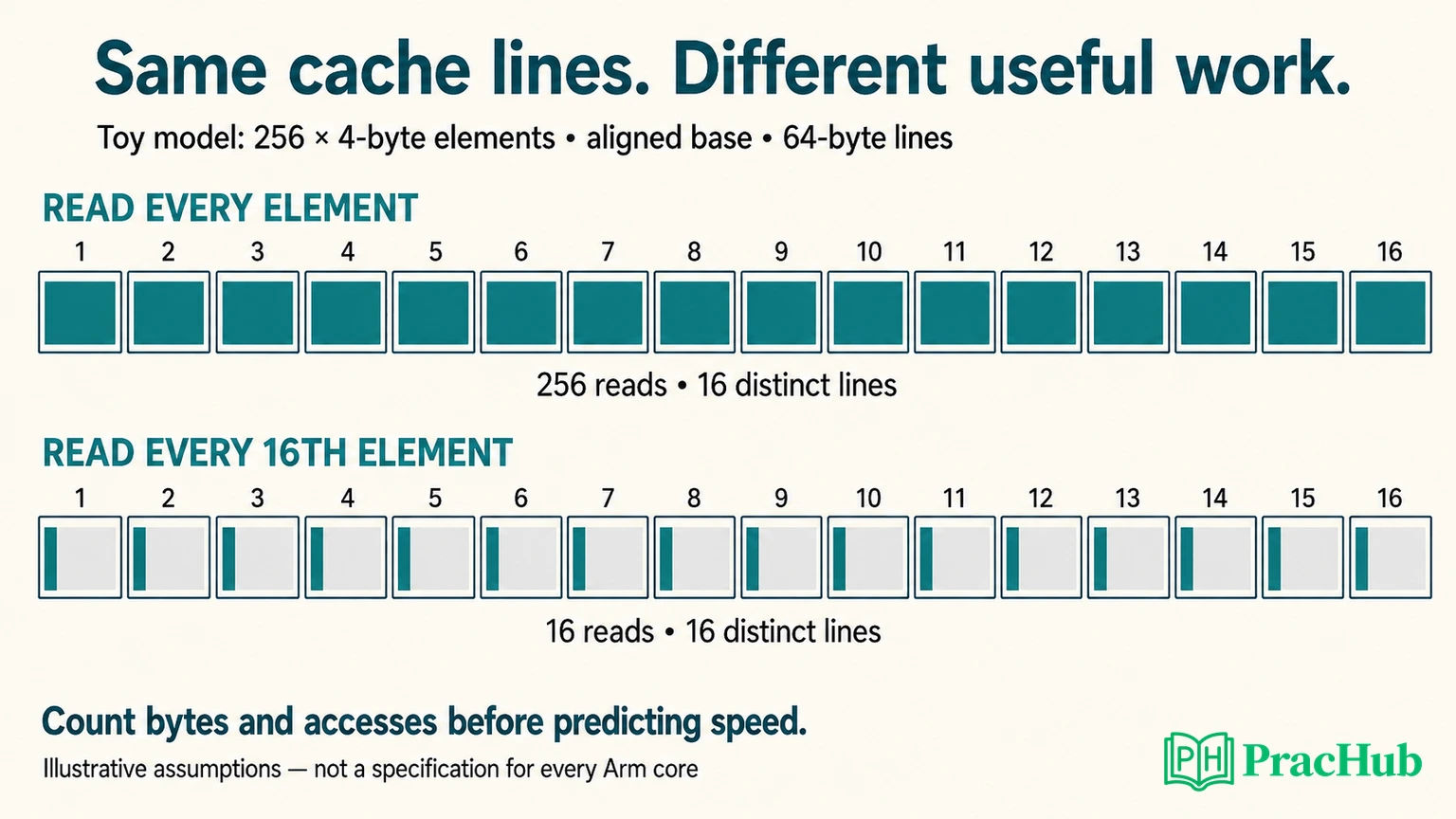
The second loop does less useful work per fetched line. That observation does not prove that the first loop is sixteen times faster, or even that comparing their total runtimes measures the same task. The number of operations and the amount of useful data differ.
Now change an assumption: move the base address four bytes past a line boundary. A full sequential pass spans 17 lines. This small change is a useful check that you understand addresses rather than just dividing element count by a memorized constant.
In an interview, explain what you would measure next: elapsed time for equivalent work, compiler optimization settings, cache behavior where counters are available, and whether the working set remains cached between runs. Keep the result observable so the compiler cannot simply eliminate the computation.
Beyond caches, practice explaining a dependency hazard: an instruction needs a result that an earlier instruction has not produced yet. Distinguish the architectural behavior software relies on from the microarchitecture used to execute it. If asked about a particular pipeline, request the model rather than inventing a universal stage count.
Embedded systems: distinguish access, ordering, and ownership
Technical fact: GCC’s documentation on volatile accesses explicitly warns that volatile accesses do not order writes to ordinary, non-volatile memory. A volatile flag is not a general solution for publishing a buffer safely to another execution context.
Preparation advice: Separate three questions. Is the compiler required to perform the access? Are operations ordered and synchronized correctly? Does the CPU or device observe the intended data? A keyword that helps with one question does not automatically answer the others.
For an original embedded discussion, suppose a peripheral uses direct memory access, or DMA, to fill a buffer while the CPU processes completed buffers. Start with ownership: the CPU must not read a buffer the device is still modifying, and the device must not reuse one the CPU is still processing.
Sketch explicit states such as free, device-owned, and CPU-owned. Identify the event that transfers ownership and the platform mechanism that makes the completed data safe to consume. A completion interrupt is a useful event to discuss, but do not assume that naming it answers every memory-visibility question.
On a non-coherent system, cache maintenance may be needed as part of the platform’s DMA protocol. On another platform, coherent access or an operating-system API may handle relevant details. State the target assumptions and use its driver documentation; do not prescribe one barrier instruction as a portable fix.
If the interviewer switches to two ordinary C++ threads, use that model instead. Discuss a mutex or a suitable atomic synchronization protocol around the shared invariant. Do not copy a device-register pattern into thread communication simply because both involve concurrency.
Keep interrupt work bounded where the platform requires it. Explain what must happen immediately, what can be deferred, and how a full queue is handled. Dropping a sample, blocking a producer, and overwriting old data are distinct policies with different consequences; ask which behavior the application permits.
A debugging explanation that crosses software and hardware
Original scenario: A sensor application occasionally reads a stale value only in an optimized build. Do not immediately conclude that the compiler is broken or add volatile to every variable.
First establish the failure: which value is stale, where it was produced, and how you know the producer completed. Reproduce it with a smaller workload and record the compiler flags, target, and event sequence. Separate an incorrect parser from an ownership violation or a visibility problem.
Next inspect the narrowest relevant boundary. Are buffer lengths checked? Is an object already destroyed? Can the producer overwrite the same slot? Does the driver require a DMA synchronization call before the CPU reads? Each hypothesis should lead to a test or a documented contract check.
Instrumentation can change timing, so explain that a failure disappearing when logging is added does not identify the cause. Compare traces carefully and keep a minimal regression test once the underlying issue is understood.
For a project deep dive, present the symptom, your competing hypotheses, the decisive evidence, and the change you made. Include what you would investigate next if the fix failed. A small lab project explained this way can demonstrate more judgment than a long list of technologies without a concrete debugging story.
Five questions to focus your practice
The first two entries are Arm-tagged PracHub questions. The remaining three are cross-company exercises for transferable C++ and buffering skills. This is not a confirmed 2027 question list; prioritize GPU-specific material only when it fits your team.
| Practice question | What to explain aloud |
|---|---|
| Explain GPU pipeline and execution hazards | Separate rendering stages and data dependencies; state the execution model. |
| Explain your fit and motivation | Connect one project and learning goal to the actual Arm team. |
| Explain C++ memory, types, and concurrency fundamentals | Make lifetime, type rules, and synchronization assumptions explicit. |
| Compare C++ new, malloc, and Placement new | Distinguish allocation, construction, destruction, and storage reuse. |
| Implement buffered file writer with concurrency support | Define ownership, capacity boundaries, and behavior during a flush. |
After solving, ask a follow-up that changes the environment: a shorter buffer, a different cache alignment, or a concurrent producer. Explain which part of your answer remains valid and which assumption must be revisited.
Prepare for the conversation and track the next milestone
Our advice: Build a short explanation of why Arm and why this role. A firmware candidate might connect a board-level debugging project to lower-level software work; a performance candidate might discuss a measurement that overturned their initial guess. Keep the link specific and truthful.
Prepare a collaboration example where you revised your approach after evidence or feedback. Explain how you communicated uncertainty and what you owned. You do not need to claim expertise across every architecture topic; you need to show how you reason when a question exceeds what you currently know.
For scheduling, record the requisition, assessment deadline and timezone, interview format, and recruiter’s expected next update. The historical four-week account does not establish a guaranteed response time. Follow up after a promised date passes, and share a genuine competing deadline if relevant.
Before the interview, aim to parse bytes safely, explain one cache calculation, trace one ownership handoff, and defend one debugging decision. Those are concrete preparation goals even while the precise 2027 process remains unconfirmed.
Sources and Further Reading
- Arm Engineering Pathways internship, job 2026-19305 — current broad internship entry; no explicit 2027 program date.
- Arm Internship Programs — official process and location caveat.
- Arm Software Engineer (Internship) reports — historical anonymous accounts.
- Software-intern technical interview discussion — team-specific GPU software account.
- Arm: CPU memory hierarchy and address translation — technical preparation reference.
- GCC: Volatile accesses — compiler guarantees and limitations.
Comments (0)