AskDADA AI Review: Cloud Interview Scenarios, Follow-ups, and Practice Limits
Quick Overview
Assess AskDADA as contextual cloud interview answer assistance. Compare current public access terms, follow-up reasoning, data boundaries and an original HTTP-route experiment.
AskDADA AI is worth considering as a source of contextual answer suggestions for cloud interview preparation. Its public cloud guide emphasizes troubleshooting steps and follow-ups, while its product facts explicitly stop short of an autonomous spoken mock interviewer. Check whether its suggestions preserve evidence and uncertainty before treating them as technical feedback.
PracHub publishes this review and owns the complementary practice links. Our production-incident exercise provides another setting for defending your next diagnostic step. The local web-service experiment below is an original example, separate from an AskDADA session or a deployed cloud environment.
Start with the public cloud scenarios
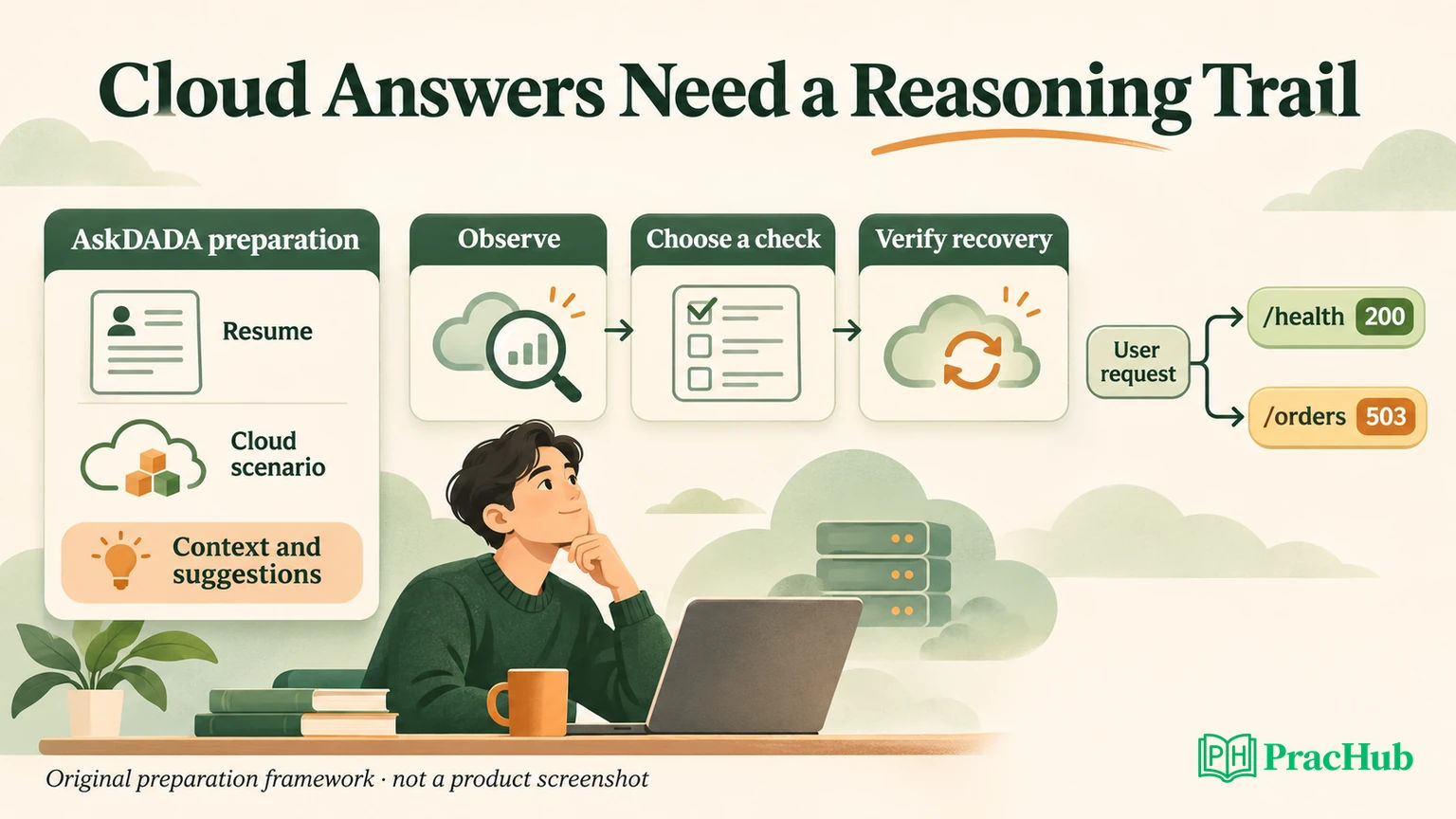
Provider guidance, checked November 3, 2026: the AskDADA cloud-engineer page offers six preparation scenarios. They include unreachable services, deployment errors, cost changes, access failures, database latency and explaining a rollback. The guide asks learners to identify initial checks, a risky action to avoid and a way to verify recovery.
The same page gives an illustrative investigation of an unreachable web service. It separates possible DNS, network-control, listener and application issues. Its follow-up prompts ask what to do when logs look normal, which changes can be reversed and how to establish that user impact has ended.
These prompts and the illustrative answer were readable without signing in. We did not establish how an authenticated session selects follow-ups or whether generated suggestions consistently follow that guide. No independent candidate reports or measured hiring outcomes support this review.
Our assessment: the most useful part of the public material is its insistence on an investigation rather than a list of cloud services. Use that distinction to check each suggestion: does it narrow uncertainty, or merely name another component?
Understand what the current product promises
The provider’s current product-facts page describes answer suggestions shaped by a resume, job description, question and conversation context. It also describes English captions, session history and metered access. It explicitly does not promise an autonomous mock interviewer or perfect answers.
Keep three activities separate. A published scenario is a prompt you can rehearse independently. A contextual suggestion is generated help based on supplied information. An autonomous interview would need to drive a conversation and evaluate your responses; that capability was not established here.
The current workflow guide tells users to review extracted resume text, use facts they can support and correct unsupported suggestions. It says the current audio workflow transcribes shared interviewer audio and does not capture the user’s microphone. We inspected those public instructions without granting audio permissions or testing a session.
| Surface | Evidence available in this review | Practical boundary |
|---|---|---|
| Cloud scenario guide | Public prompts and illustrative reasoning | Does not establish personalized question selection |
| Product facts | Provider description of contextual suggestions | Does not prove technical accuracy |
| Workflow guide | Setup and review instructions | No audio compatibility test performed |
| Account workspace | Not exercised | No measured feedback quality, latency or timer behavior |
For independent preparation, you can answer a scenario yourself before reading any assistance. Keep that unaided answer as your comparison. Otherwise, a fluent suggested answer can make it difficult to tell which diagnostic choices you could explain unaided.
Original experiment: a healthy check can miss the failing route
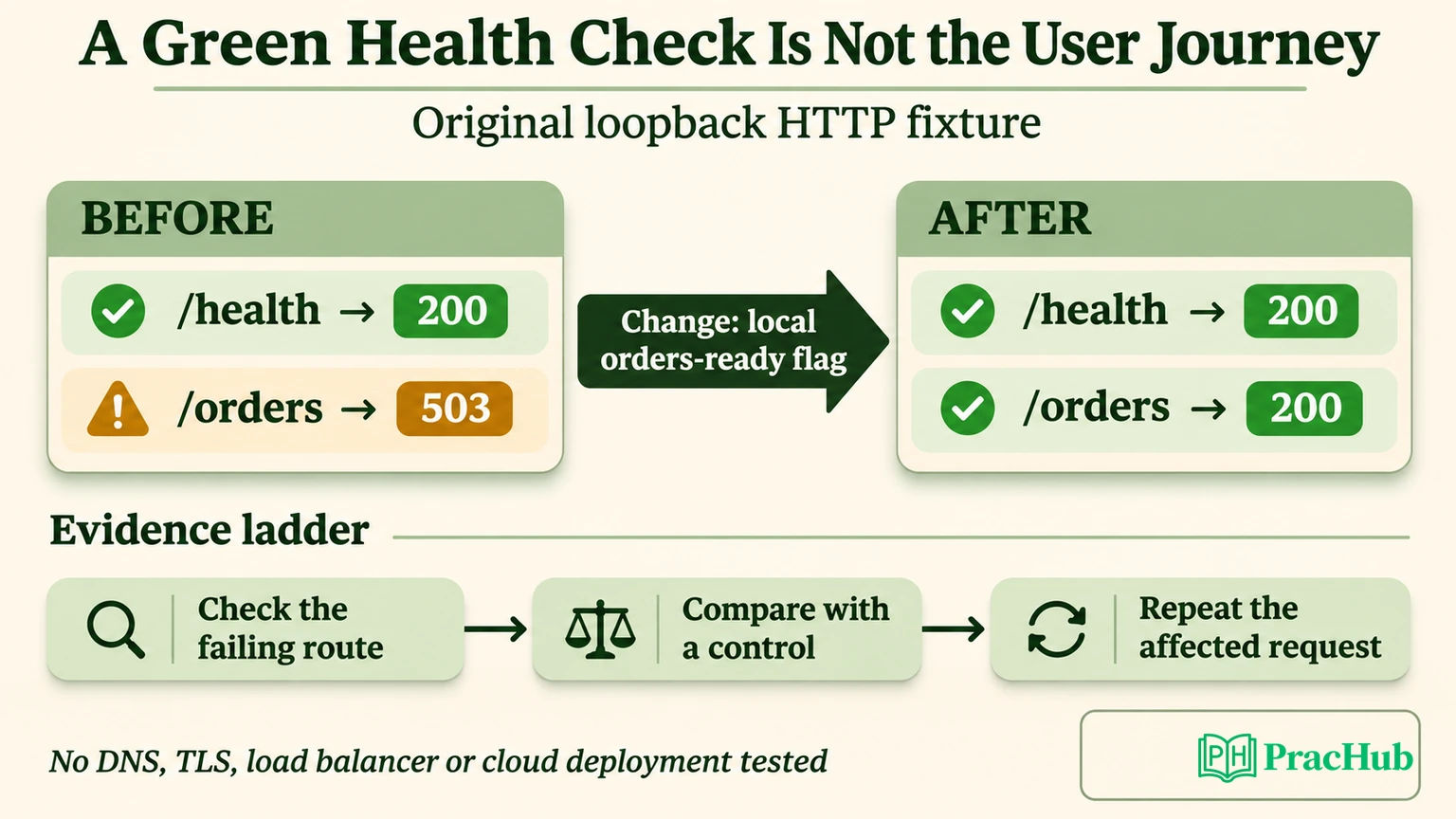
To test a common reasoning shortcut, we built a small local HTTP service. It exposes two paths: /health always reports success, while /orders initially returns a temporary failure. This is our invented fixture, not AskDADA’s example implementation or an AWS deployment.
The fixture binds only to the local loopback interface and uses an available temporary port. We requested both paths, changed one explicit fixture flag and requested them again. The results were:
| Request | Before the fixture change | After the fixture change |
|---|---|---|
| Health path | HTTP 200 | HTTP 200 |
| Orders path | HTTP 503 | HTTP 200 |
The test passed checks for both pairs of statuses. It demonstrates a narrow point: success on one endpoint does not establish success on another. It does not identify a real database, network or deployment failure. The change simply enabled the invented orders route; it was not a production rollback.
The status code narrows the observation without identifying the cause. RFC 9110 defines 503 as a temporary inability to handle the request. Receiving that response alone does not establish which component generated it or why. A service, proxy or another layer may be involved in a real request path.
AWS’s Application Load Balancer health-check documentation describes configurable paths and response-code matchers. In a real environment, inspect what the health check actually requests. Do not assume that a green target indicator exercised the same route, identity and dependencies as the failing user action.
In our local fixture, the process is listening and serving HTTP while the orders request fails. “Restart the instance” would be an unsupported first conclusion. A better answer identifies the failed route, compares it with the successful control and asks what differs between their code paths.
A local success also leaves major conditions untested. We did not exercise DNS, TLS, a load balancer, external routing, access policies, authentication or concurrent traffic. In an interview, state which vantage point produced each result. A localhost response cannot prove that an external user can reach the service.
Use follow-ups to test the reasoning, not the vocabulary
The experiment gives you a way to assess an answer without assigning it an invented AI accuracy score. Ask whether each proposed action follows from an observation and whether the recovery check reaches the affected path.
Here is an original follow-up sequence for the invented orders failure. It is a preparation rubric, not a transcript from AskDADA or a company interview.
| Follow-up | A defensible answer should add | Unsupported leap to challenge |
|---|---|---|
| “The health check is green. What next?” | Compare its path with the failed user request | Conclude that the whole application is healthy |
| “The usual logs look normal.” | Check coverage, time window and correlation with the request | Treat absent log entries as proof of no failure |
| “Would you change the firewall?” | Establish whether the failing path is blocked and which rule applies | Open broad access because the service is unavailable |
| “How do you verify recovery?” | Repeat the affected operation from the relevant user path | Rely only on a restarted process or green dashboard |
A good follow-up can also change an assumption. Suppose only authenticated orders fail. The next comparison should preserve the affected identity or authorization conditions. Testing an anonymous health endpoint again would add little information about that narrower symptom.
Suppose the failure started after a release. That establishes a temporal relationship, not the faulty line of code. Explain which deployment or configuration evidence would justify a rollback and which risks the rollback introduces. Avoid converting an attractive operational action into a diagnosis.
When reviewing a generated suggestion, underline every statement that claims a cause, personal action or measured outcome. For each one, identify the supporting observation. If the evidence is missing, turn the claim into a hypothesis or remove it. Replace any unsupported result with the observation you actually have.
Check time allowances against the current page
Direct browser observation on November 3: the pricing page advertised 15 free minutes for eligible new accounts and Starter at ₹199 for 60 minutes. It also displayed larger minute packs and prepaid calendar plans with no automatic renewal. These are advertised terms; we did not verify a grant, purchase or timer deduction.
The live product-facts and workflow pages agreed with that allowance during our inspection. The search crawler’s retrieved text still showed an older five-minute offer and different prices. We used the current rendered pages for this dated review. That difference is a reason to check the current account offer, not evidence that a user will receive both allowances.
Minute packs and calendar access answer different questions. A paused minute session may preserve unused minutes under the advertised terms, while a calendar plan has an expiry date. Confirm the actual start, pause and expiry rules before choosing a plan. We did not proceed to checkout.
For a first trial, define one small outcome: for example, improve the explanation of why a successful health path does not resolve the failed orders request. Choose the answer to improve before spending more session time.
Prepare context that supports the answer
AskDADA’s contextual approach makes the input important. A resume line that says “owned cloud reliability” can invite claims far broader than a small personal lab. Write the scope so that a suggested answer has a defensible foundation.
This original review sheet helps separate context from evidence:
| Context field | Useful input | Check before rehearsing a suggestion |
|---|---|---|
| Environment | Personal lab, coursework or commercial system | The answer names the correct setting |
| Responsibility | Actions you personally performed | Team work is not rewritten as sole ownership |
| Decision | Alternatives and the constraint you faced | The explanation preserves your actual reason |
| Outcome | Observed result and its measurement | No invented latency, scale or business impact appears |
| Remaining limit | What you did not test | Uncertainty remains visible after rewriting |
The provider’s privacy notice says saved document text, transcripts and suggestions are processed and retained as account content. It distinguishes local PDF text extraction from sending the reviewed text to the service. It also explains that stopping capture does not erase previously transmitted content. These are policy statements, not a security audit we performed.
Use a fictional or appropriately cleared project for an initial evaluation. Review extracted text before saving it and check which material a session will use. We did not upload a resume or job description, submit private information, create an account or test export and deletion controls.
The public workflow also requires permission for live assistance. This review evaluates preparation: answering independently, examining suggestions and correcting unsupported claims. A preparation tool’s availability does not establish permission to use assistance during a particular employer’s assessment.
Practice the gaps the product leaves open
These PracHub prompts extend the public scenario topics into explanations you can check independently. They are separate from AskDADA’s question suggestions and feedback.
| PracHub question | What to examine |
|---|---|
| Troubleshoot a production incident end-to-end | Choose the next check from the evidence and explain recovery verification. |
| Troubleshoot CPU, latency, and DNS issues | Keep DNS, CPU and latency hypotheses separate until a measurement connects them. |
| Troubleshoot a Host That Rejects SSH Connections | Distinguish a refused SSH connection from application-route health. |
| Kubernetes request path: pods vs nodes, Service types, DNS TTLs and 5xx debugging | Follow the user request through Kubernetes before blaming a healthy Pod. |
| Discuss Terraform, Infrastructure as Code, and AWS Experience | Separate personally demonstrated infrastructure work from service-name recall. |
Who should try AskDADA for cloud preparation
Consider it if you want contextual suggestions around a cloud scenario and are willing to verify the resulting technical claims. The public guide provides a useful direction for that review. We cannot recommend it on the basis of measured mock quality, voice compatibility or improvement in interview outcomes, because none was tested.
For the next practice attempt, use the production-incident exercise. Give an unaided answer, identify one observation supporting each next step and specify a user-path recovery check. Then compare any suggested revision with that baseline. Keep the explanation that you can defend under follow-up.
Comments (0)