Atlassian Values Interview Guide 2026: Questions, Signals, and Story Preparation
Quick Overview
This Atlassian values interview guide explains the official 45-minute format, the company's five values, likely behavioral questions, and the evidence interviewers may look for. It distinguishes values alignment from culture fit, provides practical STAR story frameworks and examples, and includes a focused 48-hour preparation plan using PracHub.
Many candidates prepare for Atlassian's values interview by memorizing five slogans. That is the wrong level of preparation. The harder question is whether you can show how those values shaped a real decision when transparency was uncomfortable, customer needs conflicted, or speed competed with quality.
Atlassian describes this as a 45-minute, relaxed, conversational interview, usually with someone from another part of the organization. The interviewer is trying to understand how you think and work with others, not whether your personality resembles the team.
Before you polish stories, use PracHub's company-specific interview prep to map the full Atlassian loop, then practice real interview questions with written solutions. A strong values answer still needs specific decisions, credible trade-offs, and calm follow-up reasoning.
The Atlassian values interview rewards evidence and judgment, not slogan matching.
Quick Answer: What Is the Atlassian Values Interview?
The Atlassian values interview is a behavioral conversation about how your past choices align with the company's five values. Atlassian's official design guide says every candidate has a 45-minute session, likely with an interviewer from a different part of the organization. Questions are tailored for individual contributors and managers.
The format is conversational but structured. Atlassian recommends STAR, allows examples from work or elsewhere, and says the interviewer has a prepared question set.
| Format detail | What Atlassian says | Preparation implication |
|---|---|---|
| Length | 45 minutes | Prepare concise stories with room for follow-ups |
| Interviewer | Likely from another function or organization area | Avoid unexplained role-specific jargon |
| Style | Relaxed and conversational | Know your evidence without memorizing a script |
| Examples | Work and non-work experiences are acceptable | Choose the clearest evidence, not only the biggest project |
| Answer method | STAR is encouraged | Make your action and result unmistakable |
Your recruiter and invitation remain the source of truth for your loop. The interviewer may explore only a subset of the values through deeper follow-ups.
Values Alignment Is Not Culture Fit
Atlassian explicitly distinguishes values from culture. Culture changes and varies across locations; values are intended to remain constant. The interview is not supposed to reward shared hobbies or simple likability.
In its article on values alignment versus culture fit, Atlassian explains that values questions should explore boundaries, conflicts between values, and moments when a value was difficult to uphold. The company even gives examples such as making an unpopular decision or incorporating difficult feedback.
The strongest answer is rarely, "I always put the customer first." Explain which customers, what evidence you had, what the decision cost, and how you handled competing obligations.
The Five Atlassian Values and the Evidence to Prepare
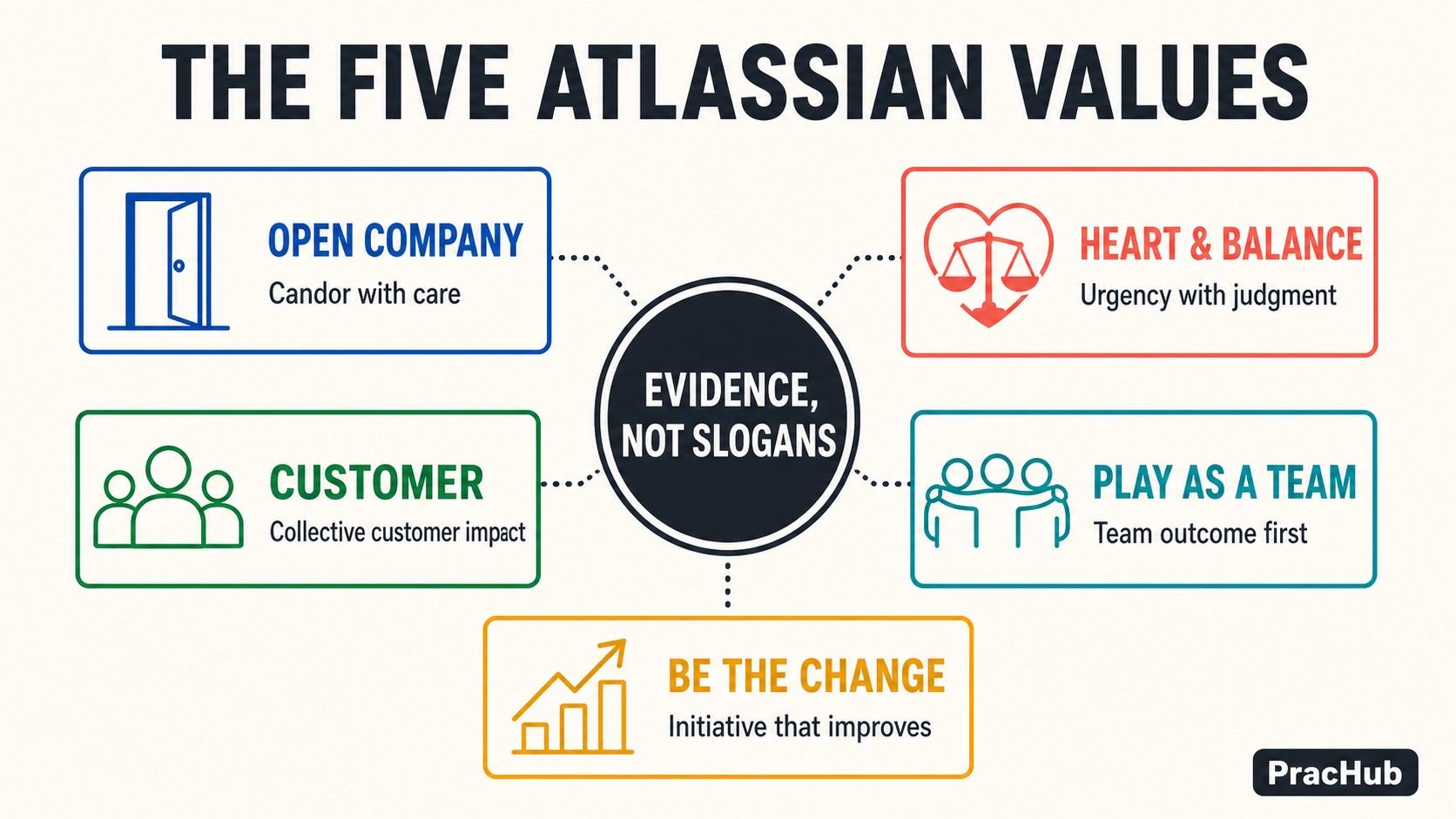
Translate each value into observable decisions, not rehearsed definitions.
The following meanings come from Atlassian's current official values page. The evidence column is PracHub's preparation guidance, not a disclosed Atlassian scoring rubric.
| Value | Official emphasis | Evidence worth preparing |
|---|---|---|
| Open company, no bullshit | Information is open by default; candor requires thoughtfulness and care | A difficult truth shared constructively, including audience, timing, and outcome |
| Build with heart and balance | Passion and urgency alongside careful consideration of options | A decision balancing quality, speed, risk, and diminishing returns |
| Don't #@!% the customer | Consider the customer perspective collectively, not only a vocal few | A trade-off grounded in broad customer evidence and long-term trust |
| Play, as a team | Put what is right for the team first | Shared credit, productive conflict, help across boundaries, or a team-first sacrifice |
| Be the change you seek | Use courage and resourcefulness to improve products, people, or the workplace | A problem you owned without waiting for perfect authority or conditions |
Open Company, No Bullshit
Do not confuse candor with bluntness. Show that you surfaced important information while considering timing, delivery, and how the listener could act on it.
Build With Heart and Balance
This value contains a deliberate tension: urgency plus judgment. Prepare a story in which you compared options, recognized diminishing returns, and still decided on time.
Don't #@!% the Customer
Avoid treating one loud request as universal truth. Use support trends, research, usage data, accessibility needs, or a decision that protected long-term trust over a short-term metric.
Play, as a Team
Teamwork is not simply agreement. Show how you improved the result through productive conflict, context sharing, mentoring, or unglamorous ownership.
Be the Change You Seek
Choose a story with initiative and follow-through. Explain how you earned support, handled resistance, and made the improvement durable.
Likely Atlassian Values Interview Questions
Atlassian does not publish a complete question bank. The questions below combine the company's public examples with practical variants that probe the same behaviors. Treat them as practice prompts, not leaked or guaranteed questions.
| Practice question | Likely signal | Strong evidence includes |
|---|---|---|
| Tell me about a decision you made that proved unpopular. | Courage plus balanced judgment | Alternatives, dissent, decision logic, and later evidence |
| How have you processed feedback that was difficult to hear? | Openness and learning | Your initial reaction, changed behavior, and a concrete result |
| When did customer needs conflict with a business or technical goal? | Customer judgment | Customer segment, evidence, trade-off, and guardrail |
| Describe a conflict that made your team better. | Team-first collaboration | The other view represented fairly and a stronger shared outcome |
| What broken process did you improve without being asked? | Initiative | Root cause, influence, adoption, and lasting change |
| When did you stop polishing and ship? | Heart and balance | Quality bar, opportunity cost, risk control, and learning plan |
| Tell me about a time you withheld or delayed information. | Boundaries of openness | Reason, stakeholders, ethical constraint, and communication plan |
Build a Six-Story Evidence Bank
You do not need one isolated story per slogan. Values often overlap or conflict, and follow-ups may explore why you prioritized one value in that moment.
Prepare six stories: an unpopular decision, difficult feedback, a customer trade-off, a team conflict, a self-initiated improvement, and a quality-versus-speed decision. For each, write the stakes, people affected, options, your action, measurable result, and what you would change now.
Use "we" for shared context and "I" for your contribution. Otherwise the answer may sound like a project summary rather than evidence.
Use STAR, Then Add Reflection
Atlassian officially recommends STAR: Situation, Task, Action, Result. Keep Situation and Task brief. Most of your time should go to Action because that is where the interviewer can see your judgment, communication, and ownership.
PracHub recommends adding a short Reflection after the result: what you learned, what assumption changed, or how your behavior evolved. Reflection is not an official Atlassian acronym. It simply makes growth visible and gives a natural answer to the common follow-up, "What would you do differently?"
Example Answer: An Unpopular Decision
Imagine a team planned to release an administrative feature before quarter-end. During testing, you discovered that audit logs omitted some permission changes. Product wanted to launch to meet a customer commitment; support believed the missing history would create trust and investigation problems.
A weak answer says, "I refused to ship because customers come first." A stronger answer explains that you brought engineering, product, and support together, quantified the affected actions, compared a full delay with a limited rollout, and recommended enabling the feature only for internal accounts while the audit gap was fixed.
The team missed the original external date by four days, but avoided exposing incomplete records. Afterward, you added audit-event coverage to the release checklist. This answer can demonstrate customer responsibility, candor, teamwork, change ownership, and balanced urgency without forcing the five value names into every sentence.
How Follow-Ups Test Whether the Story Is Real
Expect questions about dissent, missing data, your exact words, customer impact, and results. The interviewer may also change a constraint: What if the deadline were contractual or your manager rejected the proposal?
Do not defend the original story at all costs. State uncertainty, revise when the new constraint matters, and explain what evidence would change your decision. Values alignment is better demonstrated through consistent reasoning than through a heroic ending.
Individual Contributor vs. Manager Signals
For an IC, strong evidence shows ownership, constructive disagreement, and influence without authority. Senior ICs should add systemic risk, reusable mechanisms, and multi-team scope.
Managers need stories about the environment they create: feedback, equitable decisions, information sharing, team health, and sustainable execution. Do not answer only as the person who fixed everything.
A 48-Hour Atlassian Values Prep Plan
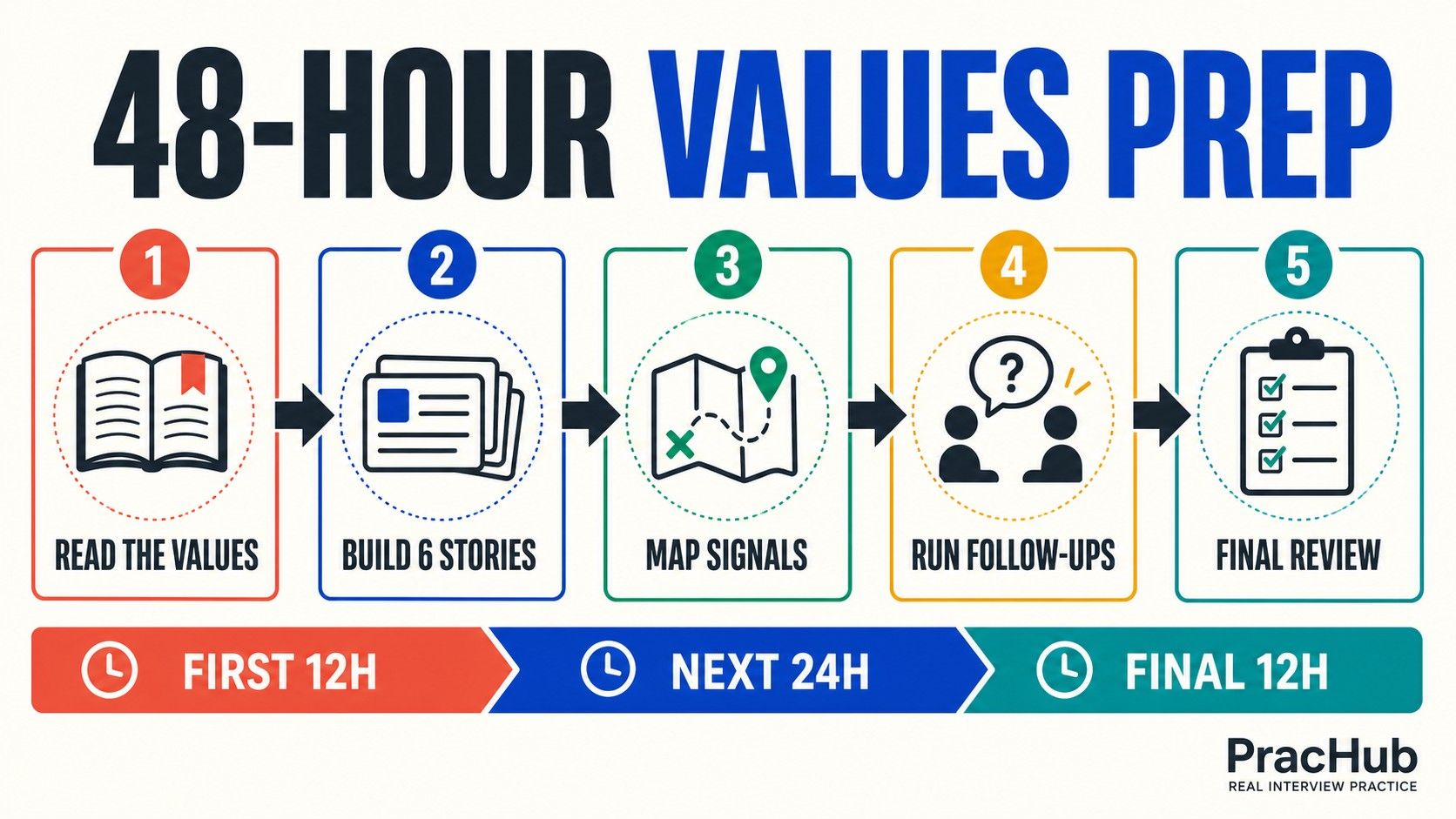
Move from official definitions to evidence, follow-ups, and a final conversational rehearsal.
First 12 hours: read Atlassian's official values and the role-specific interview guide. Map the full loop with the Atlassian Software Engineer Interview Guide, then select six stories with different stakes and outcomes.
Next 24 hours: turn each story into a one-page evidence outline, not a script. Practice with PracHub's behavioral and leadership questions. Ask a partner to interrupt, challenge your decision, and test whether you can explain the other person's position fairly.
Final 12 hours: run one 45-minute mock. Review outcomes, names, dates, and metrics for accuracy; prepare three questions for the interviewer; then stop editing. Conversational recall is more useful than a perfectly memorized paragraph.
Common Mistakes
The biggest mistake is naming the value before supplying evidence. Other weak patterns include portraying teammates as irrational, claiming every disagreement ended in consensus, hiding failure, giving a customer story with no customer evidence, or describing initiative that nobody adopted.
Do not invent a numerical rubric or try to reverse-engineer which answer "belongs" to each value. Atlassian says interview feedback is consolidated and reviewed holistically. Your task is to make your actual behavior legible, not to perform a keyword-matching exercise.
Questions to Ask the Values Interviewer
Because the interview is two-way, ask how a value shows up when teams disagree, which value is hardest to practice under deadline pressure, or how distributed teams maintain openness across time zones. A cross-functional interviewer can often offer a more independent view of the company than someone on your prospective team.
Frequently Asked Questions
How long is the Atlassian values interview?
Atlassian's current design and role-specific engineering materials describe a 45-minute values interview. The session is usually conversational, so your stories should leave enough time for several follow-ups and your own questions. Confirm the exact schedule with your recruiter.
Who conducts the Atlassian values interview?
Atlassian says the interviewer is likely to come from a different part of the organization and may not be on the target team. That reduces dependence on role-specific expertise and lets the conversation focus on how your mindset guides action.
Do I need one story for every Atlassian value?
No. Prepare broad story coverage, but do not force a one-to-one mapping. Strong examples often involve several values in tension. The interviewer can learn more from how you balance openness, customers, teamwork, and urgency than from five isolated slogans.
Can I use a non-work example?
Yes. Atlassian explicitly says candidates can draw from any experience, not only work. Choose a non-work example when it provides clearer personal ownership, stakes, and learning than a professional story. Technical candidates should still include enough workplace evidence for role relevance.
Is the Atlassian values interview a culture-fit interview?
Atlassian says no: values are not the same as culture. Values alignment focuses on decisions and behaviors, while culture changes and varies across the company. The intent is not to select candidates who share the interviewer's personality or background.
Final Takeaway
Passing the Atlassian values interview is not about reciting five definitions. It is about proving that you can be candid with care, move urgently without losing judgment, protect customers, strengthen the team, and improve what is broken.
Use PracHub to combine Atlassian company research with realistic technical and behavioral practice. Build six evidence-rich stories, rehearse uncomfortable follow-ups, and walk into the interview ready for a real conversation rather than a slogan quiz.
Sources and Methodology
This guide was researched on August 6, 2026. Official format and preparation claims were checked against Atlassian's Design Interview Guide, Engineering Interview Guide, Core Values page, and article on values alignment versus culture fit. Atlassian does not publish its complete question set or scoring rubric. Likely questions, signal interpretations, story frameworks, and preparation advice are PracHub editorial analysis.
Comments (0)