Aurora Software Engineering Intern Interview 2027: C++, Robotics, and System Design
Quick Overview
Aurora internship preparation across C++ ownership, sensor timing, and reproducible autonomy testing, with historical interview reports separated from unverified 2027 recruiting details.
Preparing for an Aurora software engineering internship means connecting correct code to a moving vehicle: who owns a sensor frame, whether that frame is still useful, and how a failure can be reproduced. C++ practice matters, but a solution that processes an outdated view of the road perfectly still has a timing problem.
2027 evidence check: As of September 7, 2026, this review did not locate an official Aurora 2027 software engineering internship posting or a confirmed recruiting schedule. This article concerns Aurora Innovation, the autonomous-driving company at aurora.tech. It separates historical candidate reports from original preparation exercises; it does not promise a particular OA or interview sequence.
Start with Aurora Software Engineer questions on PracHub to identify gaps in algorithms and C++ ownership. Then use the sensor and replay exercises below to practice explaining a system’s assumptions, not merely drawing its components.
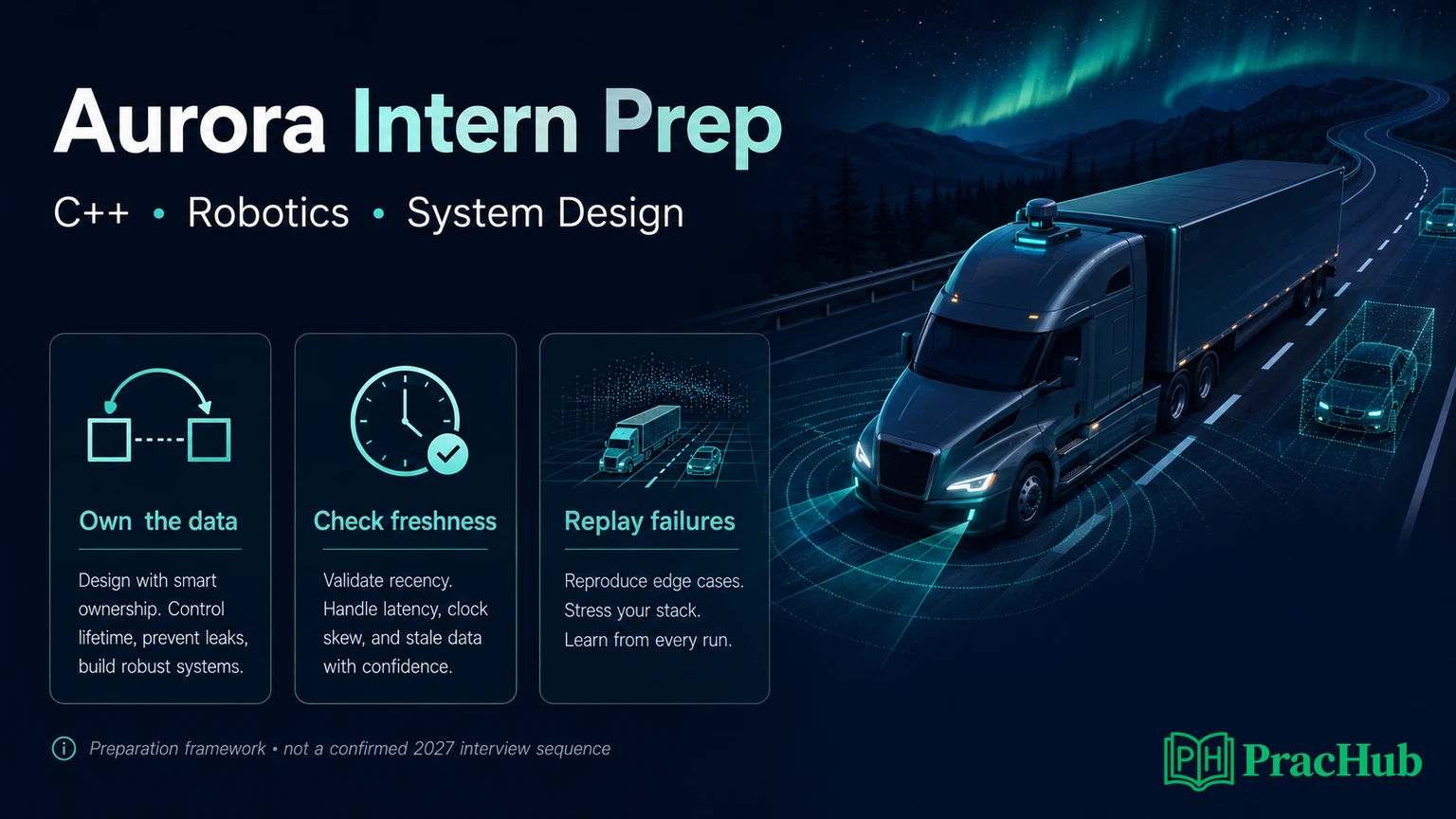
What is known about Aurora’s internship process?
Official engineering context: Aurora’s September 2018 development article describes unit tests, module tests, and full-system simulation before road testing. Its February 2022 business-review update describes using virtual worlds to vary driving events and test sensor performance and actor behavior. These explain why testing and reproducibility are relevant preparation themes; neither documents an intern interview loop.
Historical role context, from a secondary source: A mirrored Summer 2026 internship listing describes platform work involving C++, Linux, processors, and sensor data, alongside infrastructure-oriented work. The mirror is incomplete and contains inconsistent job metadata. Use it as a limited signal about possible team interests, not as current eligibility, location, or application guidance.
Historical candidate reports: A Mountain View intern report posted October 10, 2024, describes an online screen followed by one-hour and two-hour technical interviews, with math and graphs mentioned. Another, posted September 18, 2023, describes an OA, coding, and a robotics-oriented system-design discussion. These are separate anonymous accounts on Glassdoor; their posting dates do not establish the interview dates.
Neither account is evidence of a fixed 2027 process. No two independent same-cycle 2027 reports were verified. The useful preparation inference is to keep coding, project discussion, and a team-relevant design explanation ready, while letting your invitation determine the actual format.
Check the team before choosing your preparation emphasis
Do not infer eligibility from the company name or from an expired internship. When a matching opening appears on Aurora’s careers page, record its requisition, degree requirements, graduation window if stated, location, work authorization language, and availability requirements. Distinguish required qualifications from preferred experience.
Preparation inference: For a platform or sensor-facing role, spend more time on object lifetime, concurrency, Linux debugging, and bounded resource use. For autonomy or simulation work, add geometry, coordinate frames, testing assumptions, and reproducible experiments. For infrastructure work, emphasize scheduling, data integrity, storage, and failure recovery. These are ways to interpret a role description, not verified Aurora team assignments for 2027.
A strong project example can come from coursework. Explain one concrete constraint: a memory limit, dropped messages, inconsistent timestamps, or a test that passed locally but failed under load. Describe what you measured and changed. A small project with a defensible failure analysis gives an interviewer more to discuss than a broad claim that you “built an autonomous system.”
Before a technical round, confirm the permitted language, whether code runs in an editor, and whether “design” means a class interface, a robotics subsystem, or a distributed service. Those distinctions should change your practice session.
C++ preparation: ownership across asynchronous work
Original practice scenario: A sensor callback receives a frame and sends work to two consumers: perception and logging. The callback returns before either consumer finishes. What keeps the bytes alive?
Begin with a lifetime diagram. A pointer into a callback-local buffer becomes invalid after that buffer is destroyed. A pointer into a reusable driver buffer may still point to allocated memory while referring to a newer frame. The second failure can be harder to recognize because the program may not crash.
Choose the ownership contract explicitly. One consumer can receive an owning object through a move. Multiple consumers may share immutable data, with each retaining ownership until finished. A pool can reduce allocation churn, but the buffer cannot return to the pool while a consumer still uses it. Explain how cancellation and shutdown release outstanding work.
The C++ working draft’s shared-pointer specification defines shared ownership and destruction when the final owner releases the resource. It does not make arbitrary accesses to the pointed-to object race-free. Sharing a frame’s lifetime and synchronizing mutations to its contents are separate obligations.
For an interview implementation, clarify scope before building a reference-counted pointer. Is the exercise single-threaded? Must it support moves, self-assignment, custom deleters, or weak references? A deliberately limited implementation is easier to reason about than an unfinished imitation of the entire standard library.
Useful tests include copying an empty owner, destroying owners in different orders, moving an owner, and assigning an object to itself. Track destruction with a small instrumented object and verify it occurs exactly once. For the sensor scenario, also test a slow consumer and shutdown while a frame remains queued.
Robotics exercise: fresh data is a contract
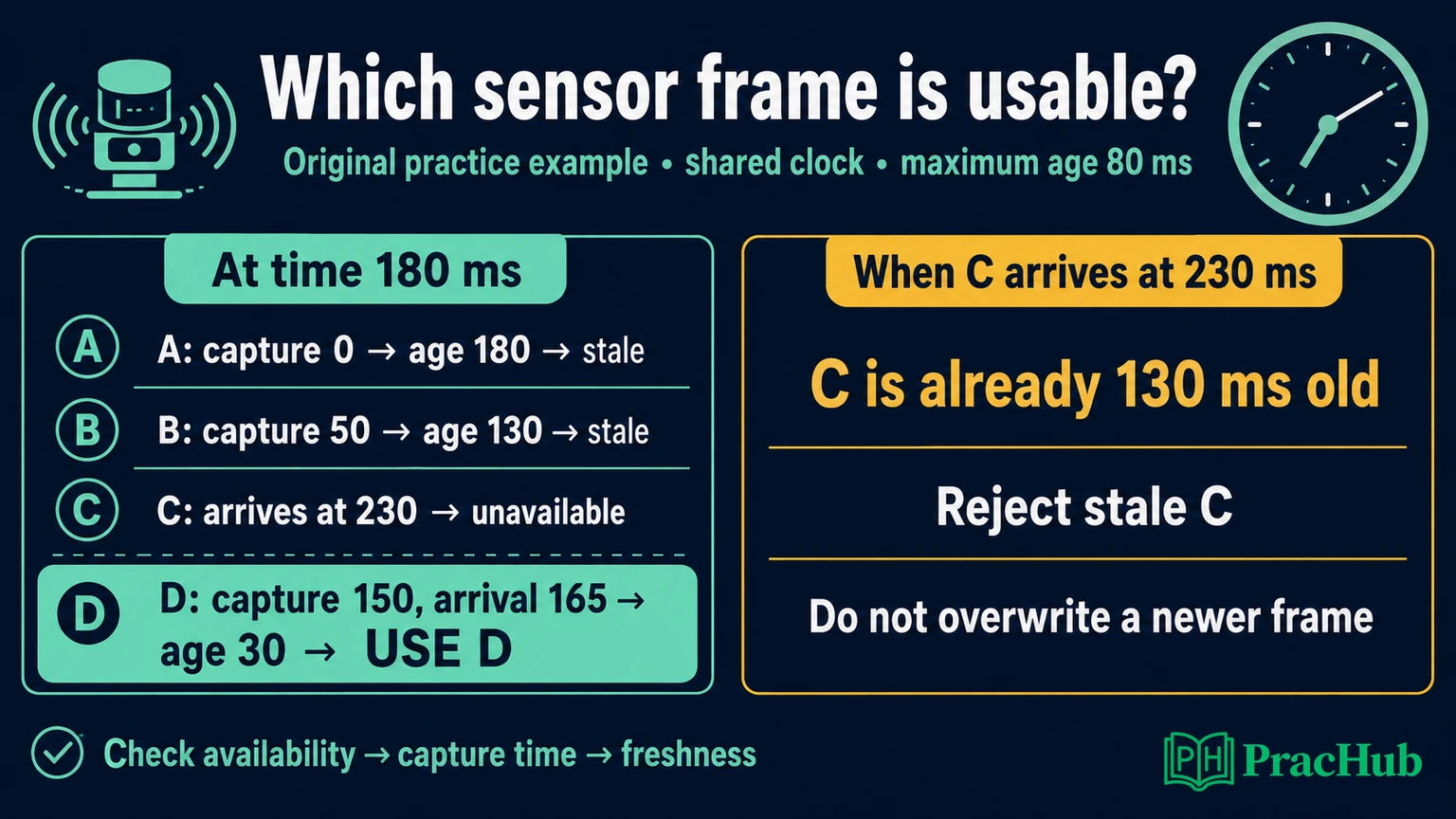
Original worked example, not an Aurora question or production specification: A sensor produces frames every 50 milliseconds. For this exercise, capture and arrival timestamps use the same clock, frames are immutable, and a consumer may use only frames at most 80 milliseconds old. Evaluate the available data at time 180 milliseconds.
| Frame | Capture time | Arrival time | Decision at time 180 |
|---|---|---|---|
| A | 0 ms | 15 ms | Age 180 ms: stale |
| B | 50 ms | 65 ms | Age 130 ms: stale |
| C | 100 ms | 230 ms | Not yet available |
| D | 150 ms | 165 ms | Age 30 ms: usable |
The correct choice under this contract is D. A consumer cannot select C simply because its capture time precedes D’s; C has not arrived. When C eventually arrives at time 230, its age is 130 milliseconds, so it fails the freshness check. In a newest-valid-frame cache, it must also never replace the newer D merely because its arrival was later.
Separate three checks: has the frame arrived, is its capture time trustworthy, and is its age within the allowed bound? A future timestamp should trigger the defined clock-error policy rather than producing a negative age that accidentally passes validation. Real multi-sensor systems require a clock-alignment strategy; the shared clock here is a stated simplification.
Now add overload. An unbounded queue can accumulate frames faster than they are processed. A finite queue limits memory, but capacity alone does not guarantee freshness. Recheck age when consuming, and define whether overflow drops an old frame, rejects a new frame, or applies backpressure.
For a latest-state visualization, discarding obsolete frames may be appropriate. A recorder intended for debugging has different completeness needs and should expose gaps. Separating the consumers lets you discuss both requirements without claiming one queue policy fits every purpose.
Finally, say what happens when no frame is usable. Return an explicit unavailable or degraded result to the caller. Do not silently treat a cached observation as current, and do not invent a vehicle maneuver as the answer. The behavior of a real vehicle belongs to its validated system-level safety requirements.
System design: make a failure reproducible
Original design exercise: Build an offline service that reruns an autonomy scenario after a software change and explains why the result changed. Keep this separate from the vehicle’s immediate execution path: a delayed analysis job and a delayed driving decision have different consequences.
Start with a run manifest. Record the input-log identity and checksum, software version, model version, calibration, map version where applicable, configuration, and random seeds. Also record the runtime environment. A seed alone does not guarantee determinism when scheduling or numerical behavior varies.
An immutable manifest lets two engineers determine whether they actually tested the same scenario. Have workers write attempt-specific outputs, then publish a completed result only after required artifacts are present. If a worker crashes, a retry should not make a half-written attempt appear successful. Use the run identity to associate attempts without discarding evidence from a failed attempt.
Define the evaluation question before choosing metrics. A perception regression might compare detections against labeled observations. A timing regression might examine missed deadlines or frame-age distributions. Aggregate pass counts need examples of changed failures; otherwise an improvement on easy scenarios can hide a new failure on a difficult one.
Distinguish replay from closed-loop simulation. Replaying a recorded sensor stream is useful for comparing software against the same observations. Once a new planner chooses a different trajectory, however, those recorded observations may no longer describe the world it would encounter. A closed-loop simulation can generate subsequent observations from the simulated trajectory, but then its environment and sensor models become assumptions to validate.
This distinction gives your design a meaningful limit. You are not claiming that passing replay proves safe road behavior. You are explaining which experiment answers which question, what it cannot establish, and what additional testing would be needed.
A concise design walkthrough should therefore connect inputs, versioned execution, result integrity, evaluation, and failure diagnosis. Name one bottleneck and one recovery path. Drawing more services is less useful than explaining why two runs disagree.
Five questions that connect algorithms to autonomy preparation
The first four entries below are listed in PracHub’s Aurora Software Engineer collection. They are practice records, not proof that an intern will receive them in 2027. The fifth is a cross-company system-design exercise selected for sensor and latency trade-offs.
| Practice question | What to explain while solving |
|---|---|
| Evaluate an Arithmetic Expression | Operator precedence, token handling, and the supported input grammar before implementation. |
| Compute streaming sliding-window minimums | A monotonic deque, index expiration, partial initial windows, and why total deque work is linear. |
| Find viewing direction that sees most points | Angular wraparound, coincident points, boundary inclusion, and numerical assumptions. |
| Implement a reference-counted smart pointer | Ownership invariants, copy/move behavior, destruction, and the agreed concurrency scope. |
| Design a Real-Time Sensor Intelligence System | Latency, sensor choices, data collection, evaluation, and resource limits. |
For sliding-window practice, distinguish an index window from a time window. “Last three samples” and “last 100 milliseconds” are different when arrivals are irregular. For geometry, explain the coordinate convention before using a trigonometric function. These small clarifications show that you can translate a statement into an implementation contract.
Do one complete rehearsal rather than several unfinished solutions: state assumptions, implement the core, test boundaries, and explain complexity. Then change one requirement and discuss which invariant survives.
Timeline: organize around verified recruiting events
No official 2027 opening date, application deadline, OA vendor, cutoff, or response-time commitment was verified for this article. A search result for an internship in Aurora, Colorado, can belong to another employer; check the organization and application destination before treating it as a match.
Use an event-based preparation sequence. When you find the official role, save its requirements and align one project example to them. When an assessment invitation arrives, record its actual deadline and permitted tools. When interviews are scheduled, confirm the topic scope and prepare a short technical project walkthrough alongside coding practice.
After each round, note the next step and any response date the recruiter supplied. If that date passes, follow up in the existing conversation. Historical reports of fast communication are not a service guarantee, and silence does not establish a rejection or a particular team-matching stage.
For your next practice session, choose a weak area from Aurora Software Engineer questions, solve it with explicit assumptions, then explain how delayed data or asynchronous ownership would change your design. That combination prepares you to reason about both code and the system around it.
Sources and Further Reading
- Aurora careers — current official openings
- Aurora’s Approach to Development — September 2018 engineering context
- Aurora business review — February 2022 simulation context
- Summer 2026 software internship — incomplete secondary listing mirror
- Glassdoor Aurora internship reports — historical 2023 and 2024 posts
- C++ working draft — shared ownership pointers
Comments (0)