AWS Cloud Support Engineer Interview: Linux, Networking, and Troubleshooting
Quick Overview
Prepare for AWS Cloud Support Engineer interviews with official role context, a bounded 2026 intern report, and an original EC2-to-S3 troubleshooting case. Practice Linux and networking diagnosis, read an endpoint restriction policy, distinguish explicit deny from missing allow, and write evidence-based customer updates with clear recovery checks.
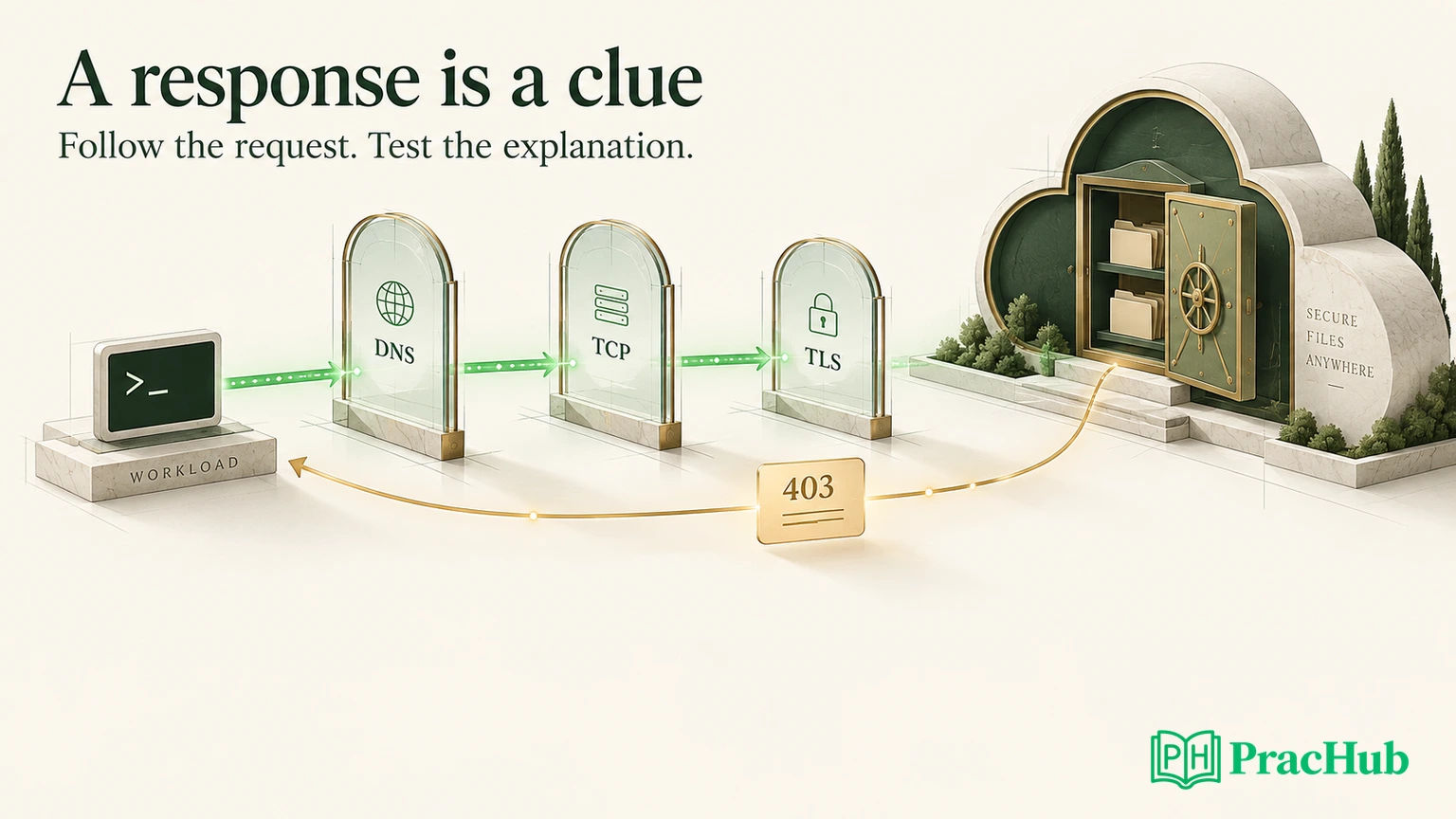
A customer says their EC2 application “cannot reach S3.” The application log shows 403 AccessDenied. Do you start with security groups, change an IAM role, or ask for the exact request that failed?
For an AWS Cloud Support Engineer interview, that choice is a useful preparation target. You need Linux and networking knowledge, but you also need to decide what an observation establishes, choose the next test, and explain the result to a customer. This guide builds those skills through one original troubleshooting case. Use PracHub’s Amazon interview questions for adjacent technical and behavioral practice; they are not a confirmed Cloud Support question bank.
What the evidence says about the role and interview
Official role information: AWS describes Support Engineers as helping customers solve technical problems and working with service teams. Its support specialties span areas including operating systems, networking, and databases. That supports preparing for customer-facing diagnosis, but the page does not establish a universal interview sequence. AWS Support Engineer careers.
Candidate report: One May 2026 Reddit account describes April interviews for an AWS Cloud Support Engineer internship, including behavioral discussion, Linux/networking basics, and project questions. It is one intern’s experience, not evidence that every full-time role follows the same format. The post also appends preparation material; that material should not all be treated as questions the candidate actually received. Candidate’s internship report.
We did not establish two independent, comparable current-cycle accounts. Consequently, this article offers preparation guidance rather than a claimed current interview loop. Confirm your specialization, interview format, permitted tools, and any coding component with your recruiter.
Editorial inference: A productive mock interview should test how you move from a customer’s description to evidence, not how many commands you can recite. The case below is an original exercise, not a reported Amazon question.
Start by turning the complaint into a testable request
First, clarify the operation and impact. “Cannot reach S3” could mean name resolution failed, a connection timed out, a TLS handshake failed, or an authenticated API request was rejected. Those observations lead to different investigations.
Ask for the failing API action, approximate timestamps, affected workload, expected behavior, exact error, and last known success. Establish whether all requests fail or only one bucket, object prefix, subnet, or application version. Request relevant identifiers through the approved support channel, without collecting credentials.
Then state your first branch aloud: “I’ll identify the layer where this request fails, compare it with a known-good request, and choose a test that distinguishes the leading explanations.” This makes your reasoning visible before you know the answer.
A strong Linux answer follows the same discipline. If resolution fails, inspect the hostname and the workload’s resolver context. If a connection stalls, examine the destination and route before blaming the application. If the process is missing, inspect its state and relevant service logs. A successful check from your laptop does not establish that the application’s container, host, or credentials behave identically.
Worked case: EC2 reaches S3, but the request is denied
Here is the interview fixture. All names and identifiers are illustrative.
An EC2 batch job reads reports/daily.csv from a same-account S3 bucket called support-lab-example. It uses the intended ReportReader role. The object exists, uses SSE-S3 encryption, and the bucket has Bucket owner enforced Object Ownership. For this exercise, endpoint policies permit the request and there are no additional applicable restrictions. These assumptions keep the investigation focused; a real case would need to verify them.
| Evidence | Observation | What it changes |
|---|---|---|
| Last known success | The exact GetObject succeeded at 14:00 through endpoint A | Provides a concrete comparison |
| Change record | The workload’s route changed at 14:03 | Supplies a hypothesis, not proof |
| Failing request | At 14:05, the client received an S3 HTTPS 403 AccessDenied with request identifiers | Investigate the rejected operation and its context |
| Workload identity | The application’s credential context resolves to the expected role | Reduces the likelihood of an unintended principal |
| Request context | The failing request uses endpoint B | Makes the endpoint condition worth evaluating |
The response matters. Once you establish that this is an authentic S3 response for the failing operation, the client has received an application-layer rejection. “No network connectivity” is too broad an explanation. That does not prove every network path is healthy, and a proxy-generated 403 would require different interpretation.
Do not stop at “403 means IAM.” AWS documents several causes of S3 access denial, and the message may not expose every relevant policy restriction. Identify the principal, action, resource, and request context before selecting a remedy. AWS S3 403 troubleshooting.
Explain why another Allow does not fix this case
The role already permits s3:GetObject for the report objects. The bucket also contains this illustrative statement:
{
  "Effect": "Deny",
  "Principal": "*",
  "Action": "s3:GetObject",
  "Resource": "arn:aws:s3:::support-lab-example/reports/*",
  "Condition": {
    "StringNotEquals": {
      "aws:SourceVpce": "vpce-0123456789abcdef0"
    }
  }
}
Endpoint A is vpce-0123456789abcdef0; endpoint B has a different ID. This is a policy-reading exercise, not a complete production policy to paste into a bucket.
Official policy behavior: An applicable explicit deny overrides an allow. Giving the role another allow for the same object does not remove this deny. IAM policy evaluation logic.
The condition compares the request’s endpoint ID with the approved ID. AWS’s endpoint-restriction documentation uses aws:SourceVpce for this purpose; the value is an endpoint ID, not an ARN. S3 policies for VPC endpoints.
For a matching action and resource, reason through three inputs:
| Request context | StringNotEquals result | Effect of this statement |
|---|---|---|
| Approved endpoint A | False | This statement does not deny; other permissions still decide access |
| Different endpoint B | True | Explicit deny applies |
| Endpoint key absent | True | Explicit deny applies |
The missing-key case is easy to overlook. AWS documents that a negated condition operator such as StringNotEquals evaluates true when the relevant key is absent. IAM condition operators.
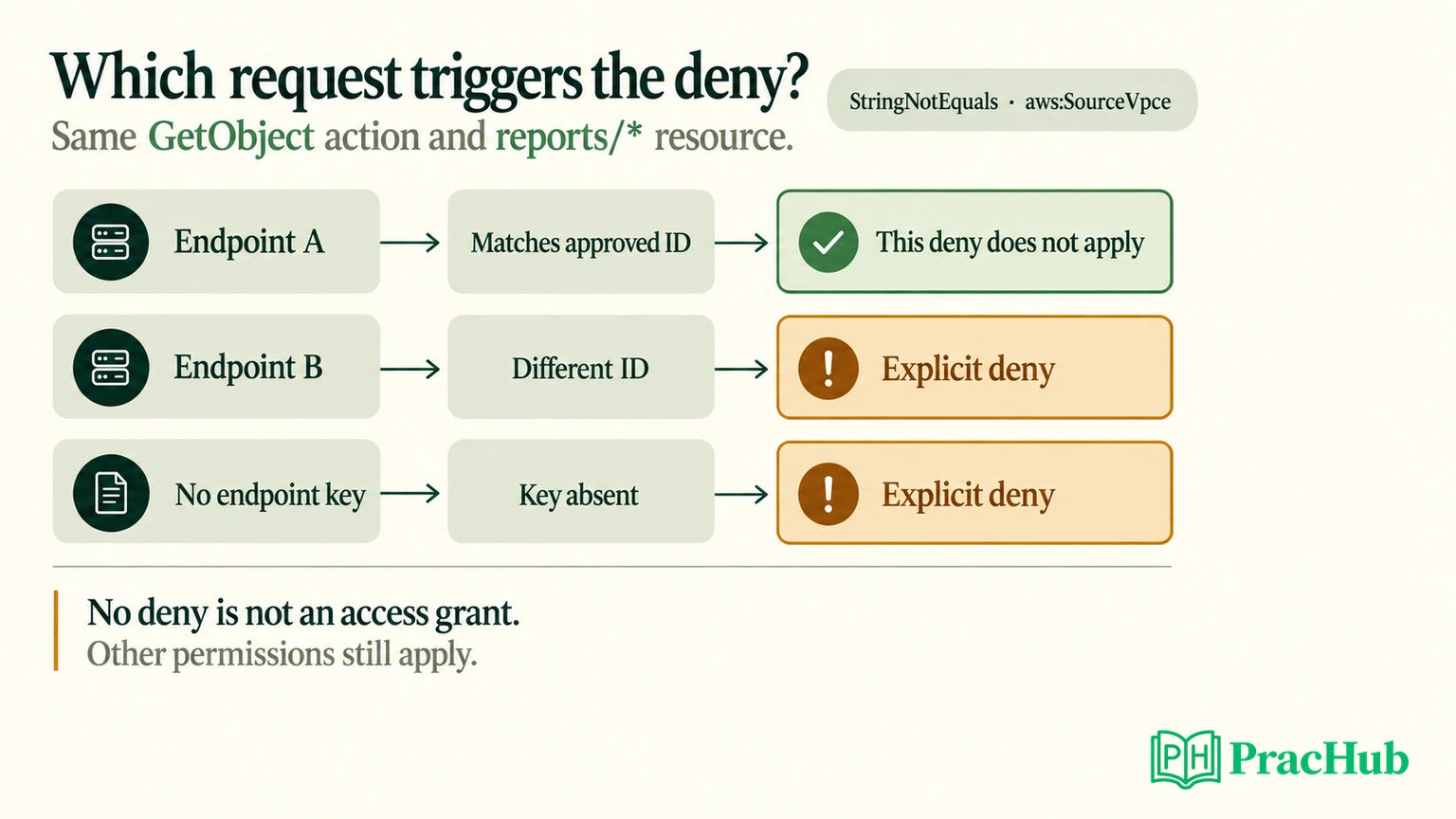
Notice the wording in the first row: “does not deny” is not “grants access.” That distinction keeps your explanation correct when the interviewer introduces another policy or removes the identity allow.
Choose verification that could disprove your explanation
First, confirm identity from the credentials actually used by the workload. AWS STS GetCallerIdentity identifies the user or role associated with the credentials making that call. Running it from an administrator’s interactive shell does not establish the batch job’s identity. STS GetCallerIdentity reference.
Next, compare the successful and failing request paths and the relevant policy condition. In this fixture, the route change and endpoint B explain why an otherwise permitted operation now matches the deny. In a real incident, proximity in time alone would not prove that relationship.
Propose restoring the approved route through endpoint A under the system owner’s change process. If endpoint B is intentional, the network and security owners need to decide whether the approved access design should change. Removing the restriction merely to obtain a successful response would not verify the intended design.
Define acceptance criteria before declaring recovery:
- Repeat the exact read from the affected workload and verify the expected object content.
- Confirm the restored request uses endpoint A and the intended role.
- Confirm a request through endpoint B remains denied.
- Confirm an object outside the role’s allowed prefix remains inaccessible under the fixture’s permission assumptions.
A successful browser download or a bucket listing is a different operation. It cannot substitute for the failing workload’s GetObject. Likewise, “the error disappeared once” is weaker than repeated success across the affected job’s normal execution conditions.
The policy fragment and endpoint truth table in this article were checked offline. No AWS account execution or live policy-engine test is claimed. During practice, distinguish a logically supported diagnosis from a remedy you have actually deployed and verified.
Handle follow-ups without losing the original evidence
An interviewer may change one assumption. Explain what must be reopened instead of defending the first diagnosis at all costs.
If the principal differs, revisit the workload’s credential source. If the response becomes a timeout, return to the request path and identify where progress stops. If endpoint A still receives a denial, the example condition no longer explains the complete outcome: review the remaining applicable permissions and confirm the operation and resource are unchanged.
For Linux follow-ups, explain what each command would establish. getent hosts can help examine resolution through the host’s configured mechanisms; ip route get can help inspect a Linux route decision; ss can help inspect sockets. Their availability and meaning depend on the environment. None, alone, proves that a private S3 object is authorized for the workload. See the Linux manuals for route lookup and socket inspection.
A useful practice variation is to remove the error code from the initial prompt. Ask your partner what evidence they need before choosing between DNS, TCP, TLS, application state, and authorization. Award credit for narrowing uncertainty, not for reaching the prepared answer immediately.
Write a technical handoff and a customer update
Your technical handoff should let another engineer reproduce the reasoning. Include the affected operation and resource, timestamps, verified principal, request identifiers, endpoint comparison, relevant policy condition, proposed change, and verification results. Mark unverified assumptions explicitly.
Your customer update should emphasize impact, findings, and the next step. For example:
We confirmed that the report job receives an S3 access-denied response. The failing requests use a different endpoint from the one permitted by the bucket’s restriction. We are coordinating restoration of the approved path. We will then retest the job’s report read and confirm the access restriction still works before calling the issue resolved.
That update does not invent an ETA or claim recovery before testing. If restoration is blocked, explain the dependency and when the customer can expect the next update, using an actual agreed time.
For behavioral preparation, choose a real example where you clarified an ambiguous problem, helped a frustrated customer, or changed your hypothesis after new evidence. Describe your own actions and how you verified the outcome. Do not turn this fictional S3 exercise into a personal work story.
Practice these five adjacent questions
These verified PracHub questions exercise relevant skills across several companies. They are practice selections, not predictions of AWS Cloud Support interview content.
| Practice question | How to use it for this preparation |
|---|---|
| Explain OS and networking basics | Explain which layer an observation tests and what remains unknown. |
| Explain Linux Command Execution, Filesystems, and Isolation | Account for the process environment when a shell check differs from application behavior. |
| Fetch Public S3 Object Metadata | Distinguish public metadata retrieval from the private authenticated object read in this case. |
| Assess Culture Fit Through Behavioral Interview Questions | Practice a concrete customer or collaboration story with your own contribution. |
| Make a Difficult Decision Under Competing Constraints | Explain why restoring service must preserve the agreed access boundary. |
Continue with Amazon interview practice on PracHub. For each mock scenario, finish with three statements: the evidence supporting your diagnosis, the observation that would challenge it, and the verification required before you tell the customer it is resolved.
Comments (0)