Big Interview Review 2026: Is AI Video Practice Useful for Technical Candidates?
Quick Overview
Big Interview can improve delivery, behavioral stories, and confidence, but it cannot validate code or architecture. This evidence-led 2026 review explains current pricing, VideoAI and PracticeAI limits, and a practical workflow that pairs communication rehearsal with PracHub's real company questions.
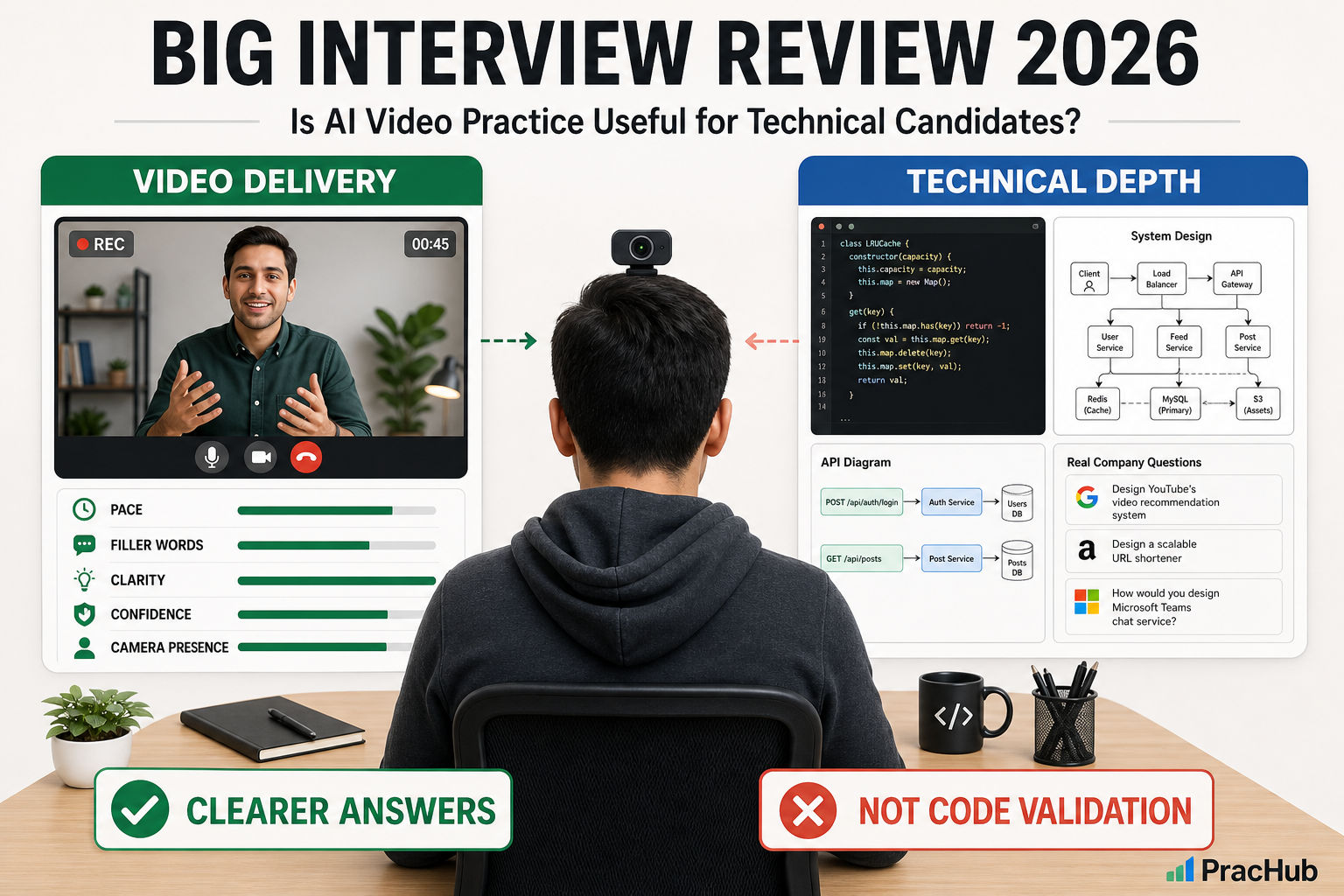
An AI mock interview can count your filler words and flag a rushed answer. But can it tell you that your cache invalidation strategy is unsafe or that your code misses an empty-input case?
That distinction drives this Big Interview review for 2026. For software engineers and other technical candidates, Big Interview can be genuinely useful for delivery, behavioral stories, and video confidence. It is not a substitute for validating code, architecture, debugging, or the questions your target company actually asks.
Before paying, map your real loop with PracHub's company-specific interview prep and attempt a few real interview questions with written solutions. This reveals whether your biggest gap is technical coverage or communication.
Quick Verdict
Big Interview is worth considering when your technical knowledge is stronger than your delivery. Recorded practice and AI feedback can expose rambling, weak structure, hesitant pacing, and generic answers.
It is not a primary technical interview platform. Big Interview's own 2026 guide for coding academies describes the product as serving the behavioral and communication side and says candidates still need a separate technical-prep tool.
At $39 for 30 days, it makes the most sense as a focused pre-interview sprint. First check whether a university, bootcamp, library, or workforce program already provides access.
What Is Big Interview in 2026?
Big Interview is a broad interview-training platform, not a technical question bank. It combines lessons, practice sets, an Answer Builder, recorded responses, and AI-assisted feedback.
Two AI features matter most for this review:
VideoAI reviews recorded answers
You record a response on a desktop or laptop, save it, and receive feedback. The current VideoAI guide requires at least 30 seconds and reports pace, tone, filler words, vocabulary, clarity, role alignment, confidence, volume, and lighting.
Scores are summarized as bronze, silver, or gold. As of July 24, 2026, Big Interview says eye contact may still generate feedback, but it no longer affects the score and eye-tracking calibration is no longer required.
PracticeAI creates a conversational mock
PracticeAI uses a job description and optional resume to generate audio questions and follow-ups. It scores role alignment, clarity, and confidence, then shows answer-level feedback and a sample answer.
This is closer to a recruiter conversation than a fixed prompt. Institutional access varies; Big Interview says most organizations include five PracticeAI interviews.
Big Interview Pricing in 2026
Big Interview's personal pricing page listed three plans when checked on August 5, 2026:
| Plan and current price | Best fit |
|---|---|
| BootCamp: $39 for 30 days | Interviews already scheduled |
| Accelerator: $99 for three months | A longer search with resume and LinkedIn work |
| Pro: $299 lifetime | Reusing the broader career toolkit |
The company advertises a 30-day refund policy. AI availability can differ across personal and institutional accounts, so confirm the included features before purchasing.
Where AI Video Practice Helps Technical Candidates
Interviewers judge both correctness and whether you can organize a messy problem, explain assumptions, and defend a trade-off.
Big Interview is useful when you need to rehearse:
Your opening narrative
"Tell me about yourself" shapes what the interviewer explores next. Recording makes vague transitions and excessive detail easier to notice than silent rehearsal.
Behavioral and leadership stories
A strong engineering story needs a clear constraint, your decision, the trade-off, and a result. Big Interview helps reveal when the setup consumes two minutes and the decision gets twenty seconds.
Project and architecture explanations
Video practice can improve how you explain a migration, incident, API decision, or scaling bottleneck. It can test coherence, but not whether the design is robust.
One-way video screens
For HireVue-style recorded screens, camera practice has direct value. You learn to start without conversational cues and finish within a limit.
What Big Interview Cannot Validate
Technical candidates have two needs: communicating technical work and proving technical skill. Big Interview serves primarily the first.
Its AI cannot verify algorithm complexity, SQL output, or whether a distributed system handles retries and consistency. It also does not reproduce a shared editor, whiteboard negotiation, or code execution.
That limitation is not a hidden gotcha. Big Interview's own 2026 bootcamp-tool comparison says it is built for behavioral and communication training and does not replace technical prep tools.
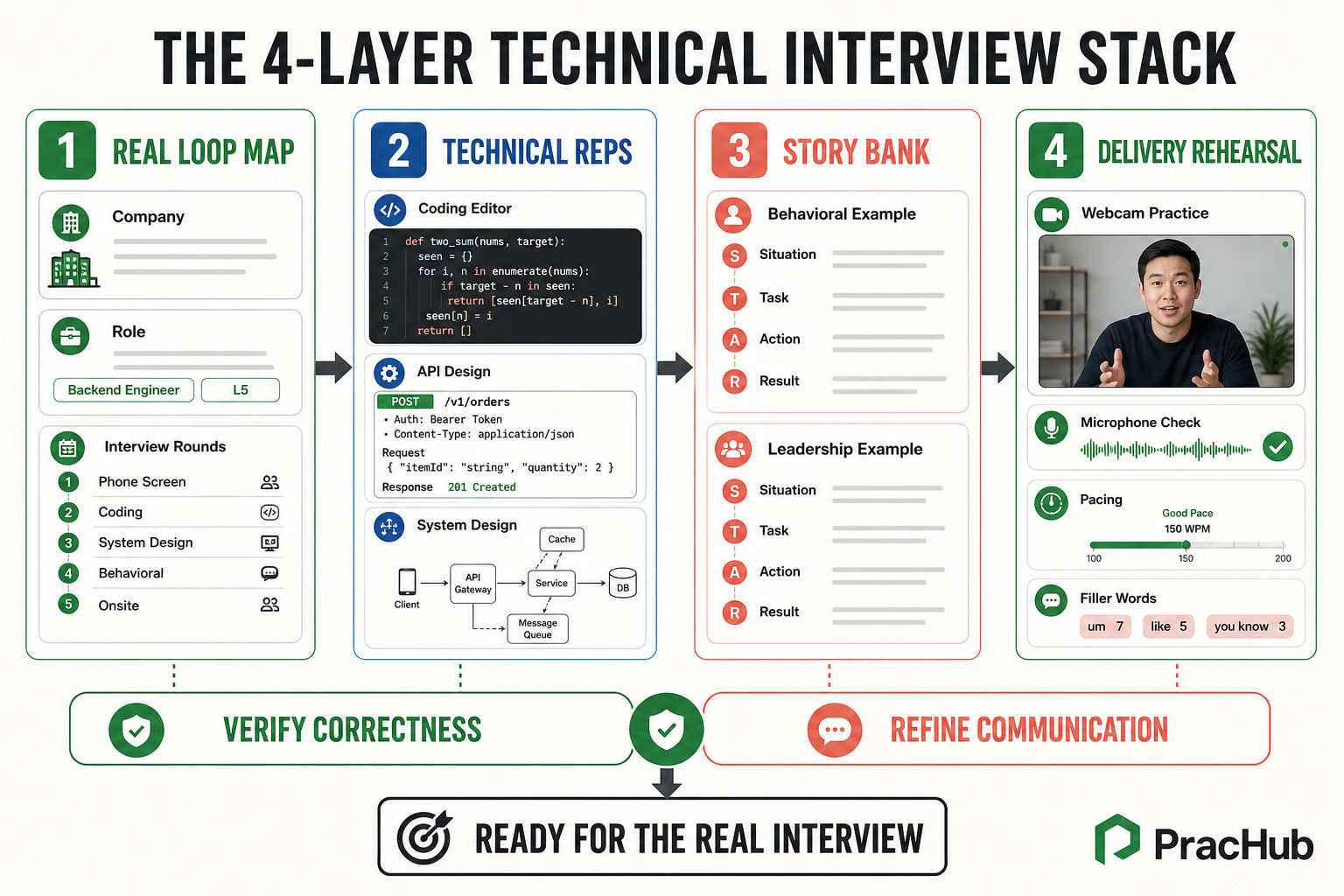
Which Interview Rounds Does Big Interview Cover Well?
Recruiter screen — High value. It improves concision, motivation, and role alignment. Research the company separately.
Behavioral interview — High value. It improves story structure, pacing, and confidence. Use human feedback for credibility and seniority.
Hiring manager — Good supplement. It sharpens the project narrative but cannot reproduce team-specific follow-ups.
Project deep dive — Good supplement. It improves sequencing. An experienced engineer must still judge technical accuracy.
Coding interview — Limited. It helps thinking aloud, but not executable code, tests, complexity, or debugging.
System design — Limited. It helps presentation, but not architecture quality, capacity reasoning, or follow-ups.
The practical conclusion is simple: use Big Interview to improve the interface between your knowledge and the interviewer, not to create the knowledge itself.
Big Interview vs PracHub for Technical Prep
Big Interview refines delivery. PracHub helps identify what a target company may ask and practice the substance of that loop.
| Big Interview is strongest for | PracHub is strongest for |
|---|---|
| Video delivery and camera practice | Real company questions and written solutions |
| Resume and job-description prompts | Company, role, category, and interview context |
| Rehearsing a system design presentation | Practicing system design questions |
| Recorded behavioral answers | Behavioral and leadership question practice |
Start by diagnosing the real loop. A polished story will not rescue a failed coding screen, while another graph problem will not fix a rambling leadership answer.
A Better Seven-Day Technical Interview Workflow
Use the two products in sequence:
- Map the loop. Use PracHub company pages and the job description to list the likely coding, design, behavioral, and project rounds.
- Run technical diagnostics. Attempt one coding question and one role-relevant design or debugging prompt without hints.
- Build a story bank. Prepare examples covering impact, conflict, failure, and leadership. Include the engineering decision, not just the workplace drama.
- Record targeted answers. Use Big Interview for the introduction, two behavioral stories, and one technical project explanation. Change one variable per replay: structure, pace, or specificity.
- Finish with a mixed mock. Combine an unseen technical question, follow-ups, and a behavioral answer.
This keeps delivery attached to actual interview content and prevents a high AI medal from becoming a false technical signal.
How to Use AI Feedback Without Gaming It
Track trends, not one score
Scores can move with question difficulty or microphone quality. Compare similar responses and watch for recurring rushed conclusions or filler words.
Review the transcript before the medal
Check for a clear claim, concrete evidence, your contribution, and a relevant result. Smooth but generic is not strong.
Keep human judgment in the loop
Share one recording with an experienced engineer. Ask them to judge technical credibility, level calibration, and whether the story sounds like your own work.
Who Should Pay for Big Interview?
The $39 plan is reasonable for a candidate interviewing within a month who freezes on camera or rambles through behavioral answers. Free school or workforce-program access makes the decision easier.
Postpone it when your main gaps are coding, SQL, debugging, ML depth, or system design. Use targeted questions first, then record final answers on your phone or laptop.
Lifetime access is hard to justify for one loop. It fits better if you will also use the resume, LinkedIn, negotiation, and career curriculum.
Frequently Asked Questions
Does Big Interview have technical interview questions?
Big Interview includes role-oriented practice sets, and PracticeAI can tailor conversational questions to a job description. Treat technical prompts as communication rehearsal, not proof that the answer is correct.
Can Big Interview evaluate my coding answer?
No. Its feedback focuses on delivery, clarity, confidence, and role alignment. Use technical practice to validate implementation, tests, complexity, and architecture.
Is Big Interview free for students?
It can be when a university or organization subscribes. Check your career center, alumni portal, bootcamp, workforce program, or library before buying.
Is Big Interview AI feedback accurate?
Treat it as a coaching signal, not a hiring verdict. Big Interview's terms say AI outputs may be inaccurate or incomplete; use it to find repeated patterns across several attempts.
Final Recommendation
Big Interview is useful for technical candidates, but only for a specific layer of preparation. It can make your stories tighter, your project explanations clearer, and your camera presence less distracting. It cannot confirm that your code, SQL, debugging, or system design would pass.
Start with the substance. Use PracHub's real interview question bank to identify and practice the questions your target role is likely to involve, then use Big Interview or simple video recording to sharpen how you deliver those answers. The strongest candidate is not merely polished or technically correct. They can do both under pressure.
Editorial note: PracHub publishes this review and is recommended here for real company questions and full-loop technical interview practice. This documentation-led review was not sponsored by Big Interview. Product features, help-center guidance, and prices were checked against Big Interview's public pages on August 5, 2026.
Comments (0)