BriefRoom Review: Voice and Video Mocks, Practice Tracks, and Feedback Limits
Quick Overview
Review BriefRoom’s two-question text demo and its returned STAR dimensions, with a specific existing-counts feedback limitation. Original story-evidence and track-specific rubrics distinguish structure, technical correctness and supported outcomes; full-session, voice, video and billing checks remain open.
BriefRoom combines interview-track browsing with advertised text, voice and video practice. Its public two-question text demo returned STAR scores for our explicitly fictional answers. The second response contained counts and a bounded test outcome, yet the feedback still asked for numbers. Inspect the demo’s feedback style, then verify full sessions and technical grading separately.
PracHub publishes this review and owns the complementary practice links. Our project-story question offers an independent exercise. The evidence ledger and track-specific rubric below are original practice tools, separate from BriefRoom’s evaluator or any employer’s scoring.
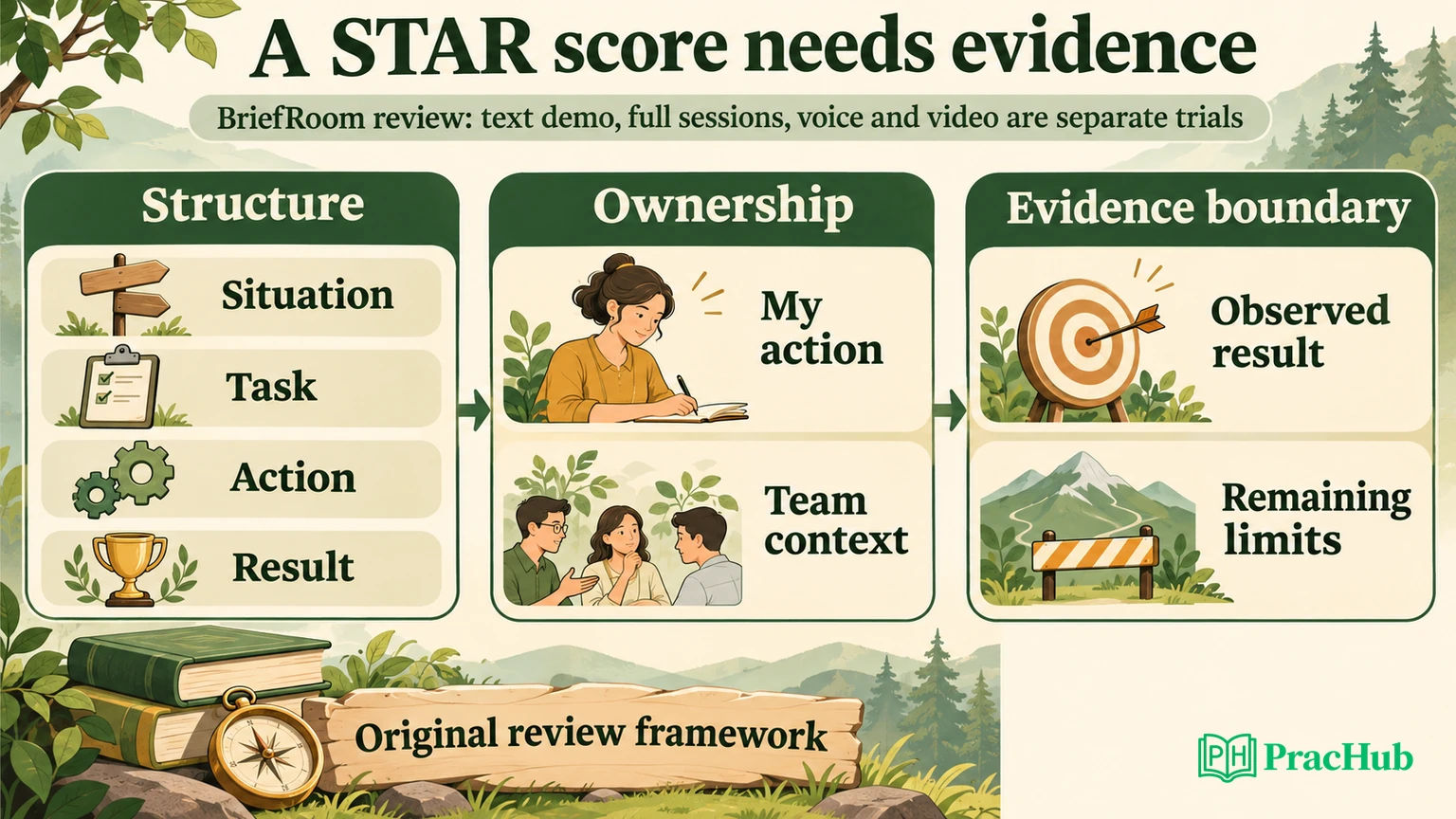
What the product advertises across tracks
Provider description, checked November 3, 2026: BriefRoom promotes behavioral, coding, system-design and other interview tracks. It describes voice modes, recorded video analysis, answer quotations and resume-based personalization. We did not test the full catalog or verify the advertised company and school associations.
The homepage also advertises offer-rate improvement. We did not review independent study evidence establishing that outcome. Company labels, customer counts and a broad track list do not independently establish current employer formats or a learner’s likely result.
This review focuses on behavioral and technical-preparation use. We did not assess clinical, medical-admissions or legal-admissions expertise. An interview-type label is not evidence that the associated specialist reasoning has been validated.
Our direct interaction included the unsigned homepage’s text demo and browsing the practice setup. The latter opened a company-or-job-posting input; we stopped without entering anything. We did not create an account, use a real resume, link GitHub, record voice or video, run code or complete a system-design evaluation.
First demo answer: vague teamwork returned four out of ten
Direct observation: selecting Start demo opened a teamwork question and a text input. We submitted an original twenty-two-word answer clearly labeled as fictional. It described working on a difficult team project and a happy outcome, without a specific personal action or measurable result.
The demo returned four out of ten overall. Its displayed Situation, Task, Action and Result values were two, six, four and three. It advised adding a metric and said the answer lacked numbers. That is the response this one attempt produced, not a calibrated human judgment.
The suggestion identifies one possible weakness, but a number alone would not explain the speaker’s contribution. A statement about a team’s success still needs to explain what the speaker did, what changed and how the outcome is known.
We did not repeat the same answer, inspect the scoring implementation or compare it with trained reviewers. The demo’s returned dimensions cannot establish how the full product would evaluate the same response.
Second demo answer: existing counts were not acknowledged
The next question concerned learning something new quickly. Our second original answer again began by identifying itself as fictional. It described a four-person class project, three failing empty-input tests, a personal responsibility to learn a parser library, a teammate review and explicit input handling.
The answer said all three tests then passed locally and explicitly limited that result: it did not establish production reliability. These are constructed story details for testing the demo, not claims about our real employment or an actual executed parser experiment.
The returned overall score was seven out of ten, with Situation nine, Task eight, Action eight and Result three. The feedback still stated that there were no numbers in the answer. It did not acknowledge the supplied team count or three-test outcome in that suggestion.
The generic advice did not acknowledge counts already present in this answer. We do not infer a hidden keyword rule, a particular model failure or the quality of the real-session evaluator. The page itself distinguishes its quick sample from the personalized experience.
The two scores also came from different questions and different answers. Their difference is not a controlled improvement estimate. We did not test voice transcription, video analysis, repeated-score stability or actual account-side feedback.
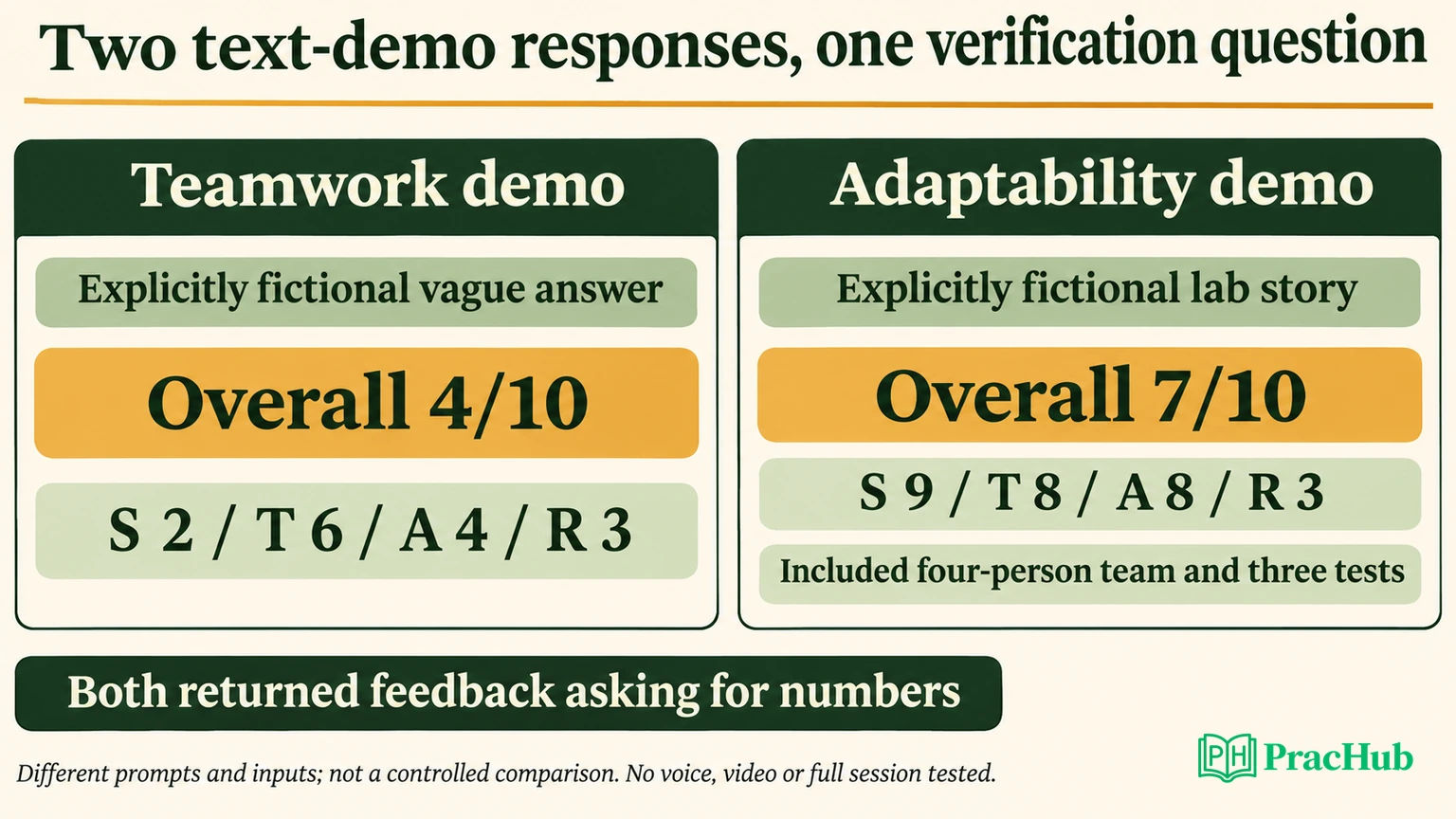
Check the evidence behind a requested metric
Our interpretation is practical: when feedback asks for numbers, check what quantity is missing. A team size gives context. A test count describes a bounded check. Neither automatically establishes business impact, and adding an invented percentage would make the answer less trustworthy.
For a real interview, use numbers you can defend or state the outcome qualitatively. If the measurement is unavailable, explain what was observed and what remains unknown. A suggestion to quantify does not authorize inventing revenue, latency or time savings.
In the fictional parser story, three tests passing supports only those tests in the stated local context. It does not establish that every input works or that production incidents declined. Keeping that limitation is part of an accurate result, even if a concise score does not reward it.
A useful follow-up asks which inputs were tested, how the failures were reproduced and what the speaker changed. That develops technical evidence behind the story. We did not observe such a follow-up in the two-question demo.
Original story-to-evidence ledger
Use this ledger before putting a real project story into any practice product. It is our independent preparation asset, not a BriefRoom feature or a claim that private work artifacts should be uploaded. You can describe the evidence without exposing confidential material.
| Story claim | Evidence to recall or verify | Limit to preserve |
|---|---|---|
| I owned the fix | The decision and change you personally made | Distinguish your work from teammates’ work |
| Three tests passed | Inputs, expectations and before/after behavior | Test coverage is bounded |
| The team shipped | Your contribution to the release sequence | Completion alone does not prove product impact |
| The change saved time | Comparable measurements and a time window | Do not invent a baseline |
| I learned quickly | What you learned and applied under a constraint | Reading documentation is different from mastery |
For the demo story, the ledger remains hypothetical. No real repository, test output or release was supplied. Its purpose is to show what evidence a genuine project answer would need, rather than make fictional details sound like credentials.
Then remove one supporting fact and see how the answer changes. Without a before/after fixture, say that you added a check rather than claiming a measured reliability gain. Without a time baseline, describe the eliminated manual step without assigning a fabricated percentage.
Use the ledger to revise the claim behind each STAR heading. Structure helps a listener follow the story; traceable evidence helps them evaluate it. Neither a polished rewrite nor a score can verify an experience that the evaluator has not independently observed.
Behavioral, case and coding answers need different rubrics
BriefRoom advertises several tracks, while the public demo we used was behavioral. Do not transfer its STAR result to code correctness or case-analysis competence. A personal story, an executable function and a numerical recommendation require different evidence.
Use the following original track comparison when planning a future trial. These are independent criteria, not observed BriefRoom grading rules. We did not execute the case, coding or system-design rows.
| Track | Core evidence | A useful follow-up |
|---|---|---|
| Behavioral | Personal action, context and supported outcome | What did you change after feedback? |
| Case analysis | Objective, quantities, assumptions and decision | Which assumption changes the recommendation? |
| Coding | Input contract, implementation and tested behavior | Which counterexample breaks the approach? |
| System design | Requirements, invariants and failure behavior | What happens after a timeout or stale update? |
For example, a coding answer can have excellent narration and still return the wrong value on an empty input. A case answer can be clear and still divide by the wrong denominator. An evaluation must address the task’s correctness conditions alongside delivery.
For behavioral practice, a rewritten answer should preserve the speaker’s actual role and uncertainty. Replacing “we investigated” with “I led the whole effort” changes the claim. Inspect a suggested rewrite before adopting stronger ownership language.
Voice and video are additional measurements to verify
The homepage describes text-only, mixed voice/text and voice-only modes, plus recording and body-language analysis. Those are provider claims. We did not authorize a microphone or camera, record a session or inspect a saved recording.
A voice trial should establish whether the transcript preserves technical qualifiers, numbers and negations. If the transcript differs from the spoken answer, feedback may address a different statement. Our text demo does not test that layer.
A video score similarly needs context. Eye contact or posture feedback is different from checking whether an algorithm or business inference is valid. We did not establish measurement accuracy, fairness, retention behavior or an effect on interview outcomes.
Choose the mode for the skill you need to inspect. A text exercise can help revise structure. Speaking aloud adds delivery and transcription. Recording adds another data type and another set of controls to examine in the actual product.
Separate the two-question demo from two free sessions
The public pricing page describes two free practice sessions with STAR feedback and speech analytics. We completed two homepage demo questions, not two account-based sessions. We did not activate an allowance or verify its deduction rules.
Public prices displayed $9 for seven days, $19 for thirty days and $49 for ninety days. These are dated provider offers, not tax-inclusive checkout totals we verified. We did not buy access or test the stated expiry behavior.
There is a billing detail to resolve before purchase. The homepage describes access without subscription or automatic renewal, while the pricing FAQ also refers to cancelling a subscription. We did not complete checkout or establish which billing behavior applies to a selected option.
Direct observation: the Free card marks two practice sessions, STAR scoring, speech analytics and question browsing with check icons. Unlimited sessions, the resume builder and preparation tools have cross icons. An extracted list that omits those indicators would misstate the free offer. We did not activate an account or verify the allowance ledger.
| Surface or mode | Evidence from this review | Remaining check |
|---|---|---|
| Homepage text demo | Two fictional inputs and returned dimensions | Repeated results and relation to full evaluator |
| Free sessions | Public allowance description | Account activation and usage units |
| Voice | Advertised modes | Transcript and actual feedback |
| Video | Advertised recording analysis | Permissions, recording controls and saved data |
| Paid access | Public windows and prices | Current checkout, renewal and expiry terms |
Decide what a trial must demonstrate
A useful next trial would begin with one truthful, bounded project story whose evidence you already understand. Check whether feedback identifies a missing action, preserves the result’s scope and quotes the answer accurately. Do not judge only whether it produces a more impressive rewrite.
Identify a defensible quantity before adding a metric requested by feedback. If it criticizes the Result component, ask whether the missing element is measurement, relevance or the connection to your action. Those problems require different corrections.
Our two demo responses show why this inspection matters. One vague answer and one more specific fictional answer received generic numeric advice. That is enough to define a verification question, but not enough to characterize every BriefRoom session or its advertised technical tracks.
Practice the gaps the product leaves open
These independent PracHub prompts extend project-story reasoning. They are not BriefRoom demo items, its scoring rubric or verified employer interview formats.
| PracHub question | What to examine |
|---|---|
| Project Stories on Teamwork, Conflict and Failure for a New-Grad Behavioral Round | Identify the part you owned and keep the outcome traceable. |
| Describe a challenging project and your role | Separate project context, your decisions and the limits of the result. |
| Discuss Collaboration, Feedback, and Conflict | Explain an actual feedback or conflict sequence without inventing motives. |
| Describe Your Most Impactful Project Experience and Lessons Learned | Choose a meaningful result and the evidence supporting it. |
| Handle teamwork, prioritization, and feedback scenarios | Show how prioritization and feedback changed a concrete action. |
Who should inspect BriefRoom next
BriefRoom is worth a bounded trial if you want a broad interview workspace with advertised voice and video options. The unsigned text demo provides a visible feedback sample, including the existing-counts limitation described here. Full-session quality, technical grading, recording and billing behavior remain unverified in this review.
Start with the project-story prompt. State your action and the evidence for one outcome, then mark the limits explicitly. Use feedback to improve the explanation while preserving what you can truthfully support. Verify the selected mode and current access terms before relying on the broader product.
Voice, video and the data boundary
Provider policy, retrieved November 3: BriefRoom’s Privacy Policy, dated March 30, says extracted resume text and interview answers can be processed for AI personalization. It distinguishes locally stored video from periodic snapshots that may be sent to its AI provider. These are published policy statements, not independently audited data flows.
Read those distinctions before supplying a real project story or enabling recording. Local video storage does not by itself mean every related input stays on the device. Our demo used fictional text only; we did not test recording, deletion, retention or account export.
Comments (0)