BrightHire Screen Interview: Prepare for the AI Conversation and Practice Round
Quick Overview
Prepare for BrightHire Screen by identifying the AI interview format, using the practice round, and rehearsing project evidence and focused follow-up answers. Primary references, original examples and explicit evidence limits support focused preparation.
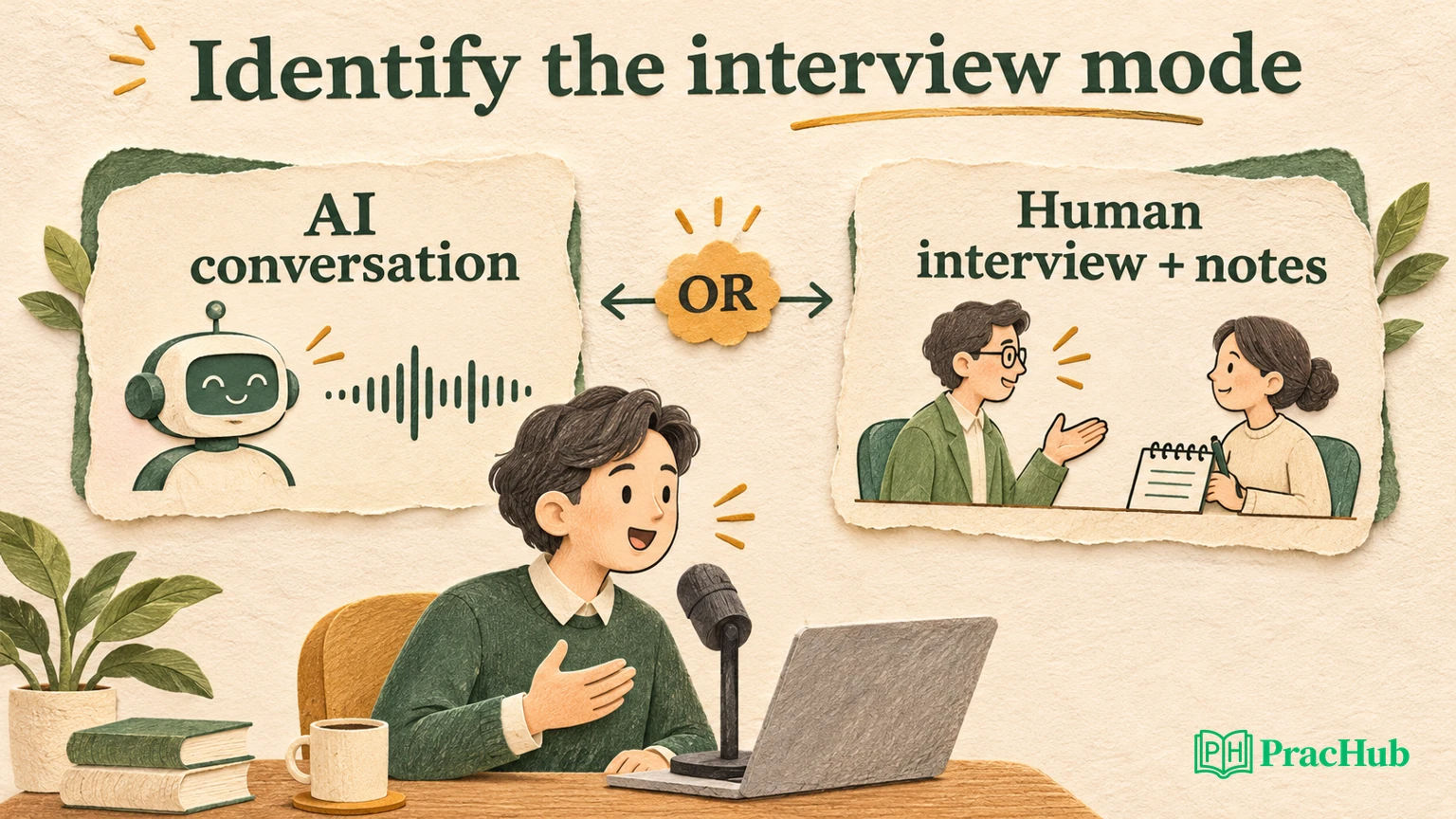
For a BrightHire Screen interview, first confirm that your invitation describes an AI-led conversation. Use the advertised practice round to check the interaction and audio, then rehearse a project example that can withstand specific follow-up questions. A BrightHire mention in a calendar invitation can also refer to recording and notes during a human interview.
That distinction determines what you should practice. For an agent-led session, rehearse clear turn-taking and self-contained answers. For a human-led session, follow the recruiter’s questions. PracHub's project ownership practice can help you prepare the substance of either answer without assuming the employer will ask that exact question.
The product facts below come from BrightHire's public pages checked November 3, 2026. Preparation examples are original editorial exercises. We did not complete an employer assessment, inspect a private scorecard or verify two independent same-cycle candidate reports establishing a standard Screen interview. Your employer's invitation remains the source for its configuration.
Identify which BrightHire experience you have
Official product information: BrightHire describes Screen as a configurable AI interviewer. Its candidate-experience page advertises asynchronous participation, voice-only or video configurations, and a short practice round with audio or video checks. These are provider capabilities; they do not establish which options your employer enabled. BrightHire candidate experience
A different official example illustrates the ambiguity. eBay's BrightHire FAQ describes a tool that records and transcribes interviews so interviewers can focus on the conversation. That employer's FAQ concerns its own recording arrangement, including its own accommodation and data-use statements. It does not describe a universal Screen policy. eBay BrightHire FAQs
Read the verbs in your invitation. “Complete your interview” at a link suggests a task you initiate, while a calendar meeting with a named recruiter suggests a scheduled human conversation. Those clues are preparation inferences, not reliable substitutes for explicit instructions. If the message is ambiguous, ask whether an AI agent conducts the interview or records a human-led one.
| Invitation evidence | What to establish | Preparation consequence |
|---|---|---|
| A link to an AI-led screening conversation | Deadline, permitted device and enabled format | Rehearse speaking independently and handling follow-ups |
| A scheduled human interview mentioning BrightHire | Who conducts the meeting and what is recorded | Prepare a normal two-way conversation |
| A practice or equipment-check step | What it checks and where the assessed session begins | Resolve setup problems before starting the assessment |
| Only a product name, with no clear instructions | Correct contact and intended workflow | Request clarification before assuming a format |
Do not infer that a video requirement, recording choice or opt-out option transfers from one employer to another. A helpful recruiter question names the uncertainty: “Does this link start the assessed interview, or can I inspect the instructions and equipment check first?”
Use the practice round as a setup diagnosis
A practice round is an opportunity to become familiar with the interaction. It does not, by itself, promise unlimited retries, advance access to assessed questions or feedback on your likely score. BrightHire's public description supports checking the experience; it does not disclose your employer's pass threshold.
Before entering the assessed portion, establish whether you can hear the whole prompt and whether your microphone captures normal speech. Follow the actual interface's instructions. If playback or a level indicator is available, use it; do not assume a particular button exists because a preparation article mentions it.
Separate an audio problem from an answer problem. If the beginning of every sentence is missing, investigate microphone activation or noise suppression. If speech is audible but the answer rambles, shorten the answer. Repeating the same rambling explanation into a different microphone will not fix its structure.
Also notice conversational timing. Finish one thought and leave a brief pause rather than filling every silence with another example. That is a rehearsal recommendation for intelligibility, not a claim that a particular pause length improves the vendor's scoring model.
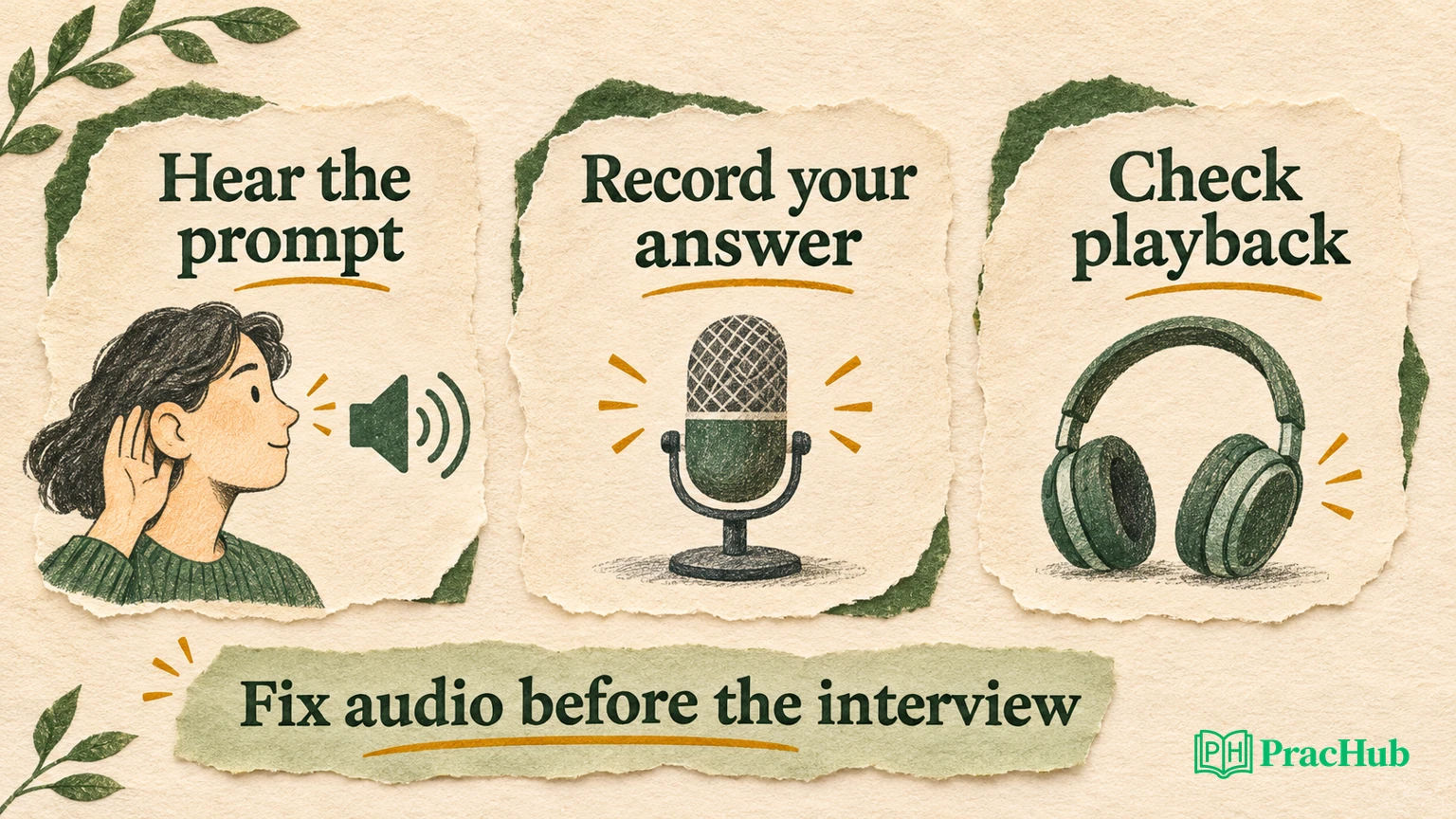
If a check fails, record the visible error and contact the named support route before the deadline. A technical problem needs a factual description: device, browser, failed step and whether the assessed session had begun. Avoid repeatedly starting sessions to discover whether a retry is permitted.
Prepare one project account with a stable evidence trail
Choose a project you can explain accurately. Choose one with a clear user problem, a decision you personally made and evidence of what happened. A long list of technologies gives an interviewer little material for evaluating judgment.
Use this original rehearsal case: a team operated an internal export service. Users sometimes received duplicate files after a timeout, and support could not tell whether a retry had created another job. You owned the API change and the support-facing status page; a colleague owned the storage service. This is a fictional practice setting, not a BrightHire question or a candidate's claimed experience.
Open the rehearsal with the failure mechanism, your ownership and the decision. The request could succeed before the client timed out, so retrying without a stable request identifier could create another job. You proposed reusing an identifier and exposing the job's known state instead of presenting every timeout as a failure.
Then explain what you checked. In rehearsal, describe tests for a repeated identifier, a request still running and a timeout after acceptance. Do not claim that duplicate exports disappeared in production unless you have evidence from your own work. A correct test result and a measured user outcome are different forms of support.
Keep the answer open to follow-up. Naming the colleague's ownership boundary makes it possible to explain which interface you negotiated and which implementation you did not write. It also prevents “we fixed retries” from turning into an unsupported claim of sole ownership.
Practice follow-ups that change the answer
An initial account should create useful questions rather than exhaust every detail. For the export case, rehearse “What did you personally implement?” Answer with the API behavior, persisted identifier and status view, then name the storage work your colleague owned. Do not repeat the entire project history.
Next ask, “What if the same identifier arrives with different parameters?” This changes the contract. An identifier that silently reuses a previous result for a different export can return the wrong data. A defensible answer binds the identifier to the request contents and rejects a conflicting reuse under the stated policy.
A third question might challenge evidence: “How do you know the change helped?” Separate the checks you performed from outcomes you measured. You can explain that integration tests rejected duplicate creation under selected retries while acknowledging that support-ticket volume had not yet been evaluated. That answer is more informative than inventing a percentage improvement.
Now rehearse a correction. Suppose you initially say every retry is safe, then remember the conflicting-parameters case. Correct the scope directly: retries are safe only when they refer to the same logical request and the implementation enforces that relationship. A precise correction makes the final claim clear.
These are original follow-up exercises. They demonstrate how preparation can move from a polished opening into technical reasoning. They do not reveal how BrightHire chooses questions or how a particular employer weighs the answers.
Make spoken answers easy to interpret
An AI conversation still needs understandable content. Define an acronym the first time it matters, identify the subject of “we,” and give a short verbal signpost before a complex sequence. For example, “There were two failures: duplicate creation and unclear status” creates a structure the listener can follow.
Use numbers with a denominator and a time window. If your real project reduced failed exports, explain whether that means failed requests, failed jobs or affected users. Keep the same definition when asked again. An answer that changes denominators under follow-up creates uncertainty even when each individual number sounds plausible.
You do not need to speak continuously while thinking. If the prompt contains two parts, restate them briefly, answer the first and then move to the second. If you did not hear a term, request clarification through whatever interaction the session permits rather than answering an imagined question.
Avoid optimizing for supposed secret keywords. Give the reviewer a truthful decision and the evidence supporting it. Repeating leadership adjectives without explaining a choice does not establish leadership, and no public source here proves that a special phrase improves your result.
Keep employer rules and privacy questions separate
BrightHire says employers can configure questions, rubrics, tone and candidate messaging. That configurability is why a public product description cannot tell you your exact timer, question count, scoring weights or next hiring stage. BrightHire Screen
Ask the employer about permitted notes, external resources and assistance before the interview. An AI interviewer conducting the session does not imply that a candidate may use another AI system to generate answers during it. Practice beforehand under the rules you expect to follow.
For recording, retention, accommodations or an alternative process, use the employer's current notice and recruiting contact. Do not treat another company's FAQ as your own consent policy. You can ask what is captured, who reviews it and how to request support without speculating about undisclosed model behavior.
When discussing a past employer's work, prepare an anonymized account that retains the decision mechanism. Replace a customer name with its role and omit confidential figures you are not allowed to share. Preserve the difference between an approximate illustration and an actual measured result.
Before rehearsal, make a short fact sheet for your real example. Write the user problem, your responsibility, the decision you made and the evidence you can disclose. Record any approximate number as approximate. This gives you a stable reference when a follow-up asks for the same project from another angle.
Afterward, compare your spoken answer with that sheet. If you enlarged your responsibility or changed a metric to make the answer smoother, repair the account. Preparation should improve explanation while preserving the facts, including an unresolved outcome or a result that disappointed you.
Rehearse substance with five focused questions
These cross-company PracHub records support ownership, collaboration and follow-up practice. They are not a BrightHire Screen question bank, predictions of your employer's prompts or evidence that completing them guarantees advancement.
| PracHub question | Rehearsal focus |
|---|---|
| Demonstrate Project Ownership | Identify the decision and result you can substantiate. |
| Walk through project scope, ownership, and decisions | Separate the project scope from your individual work. |
| Explain Project Ownership and Collaboration with Colleagues | Explain a collaboration boundary without claiming the entire team result. |
| Why This Company and Role, Three Traits That Fit, Job Changes, and Project Ownership | Connect role motivation with concrete project evidence. |
| Behavioral Deep Dive: Owned Project Metrics, Fast Decisions, Feedback, and Conflict | Keep metric definitions, feedback and conflict consistent under follow-up. |
Start with the ownership question and give a short answer from your own experience. Ask a practice partner to interrupt once for a definition and once for personal contribution. Afterward, check whether the revised answer still names the same decision, ownership boundary and evidence.
If your setup check succeeds but your follow-up answer becomes vague, spend the next rehearsal on that missing explanation. If the answer is clear but the invitation remains ambiguous, resolve the format with the employer. Each action should address the uncertainty you actually found.
Sources and Further Reading
- BrightHire: candidate experience and practice round
- BrightHire Screen: configurable AI interviewer
- eBay: BrightHire recording and transcription FAQs
Sources checked November 3, 2026. Employer settings and instructions can differ; public product claims are not an independently tested assessment experience.
Comments (0)