Broadcom Software Engineering Intern Interview 2027: C/C++, Networking, and Firmware
Quick Overview
Broadcom intern preparation distinguishes historical OA and phone-screen reports from team-specific firmware work, with original queue and packet-loss exercises.
A Broadcom software internship can put you close to a storage controller, a networking stack, or enterprise software with a very different development environment. Your preparation should start by identifying which of those worlds the job actually belongs to. Solving another array problem helps; explaining why a receive queue loses work under load may reveal a different, equally important skill.
For a Broadcom software engineering intern interview in 2027, build reliable C/C++ fundamentals, then connect them to the target team's product and debugging problems. The useful combination is coding correctness, explicit ownership, and evidence that narrows a failure. PracHub's C++ interview questions guide provides a foundation for the ownership and synchronization topics developed here.
Evidence status, checked September 7, 2026: this review did not identify a confirmed company-wide 2027 internship schedule or interview sequence. Official information, historical candidate reports, and original preparation advice are separated below. The exercises are practice designs, not claimed Broadcom interview questions.
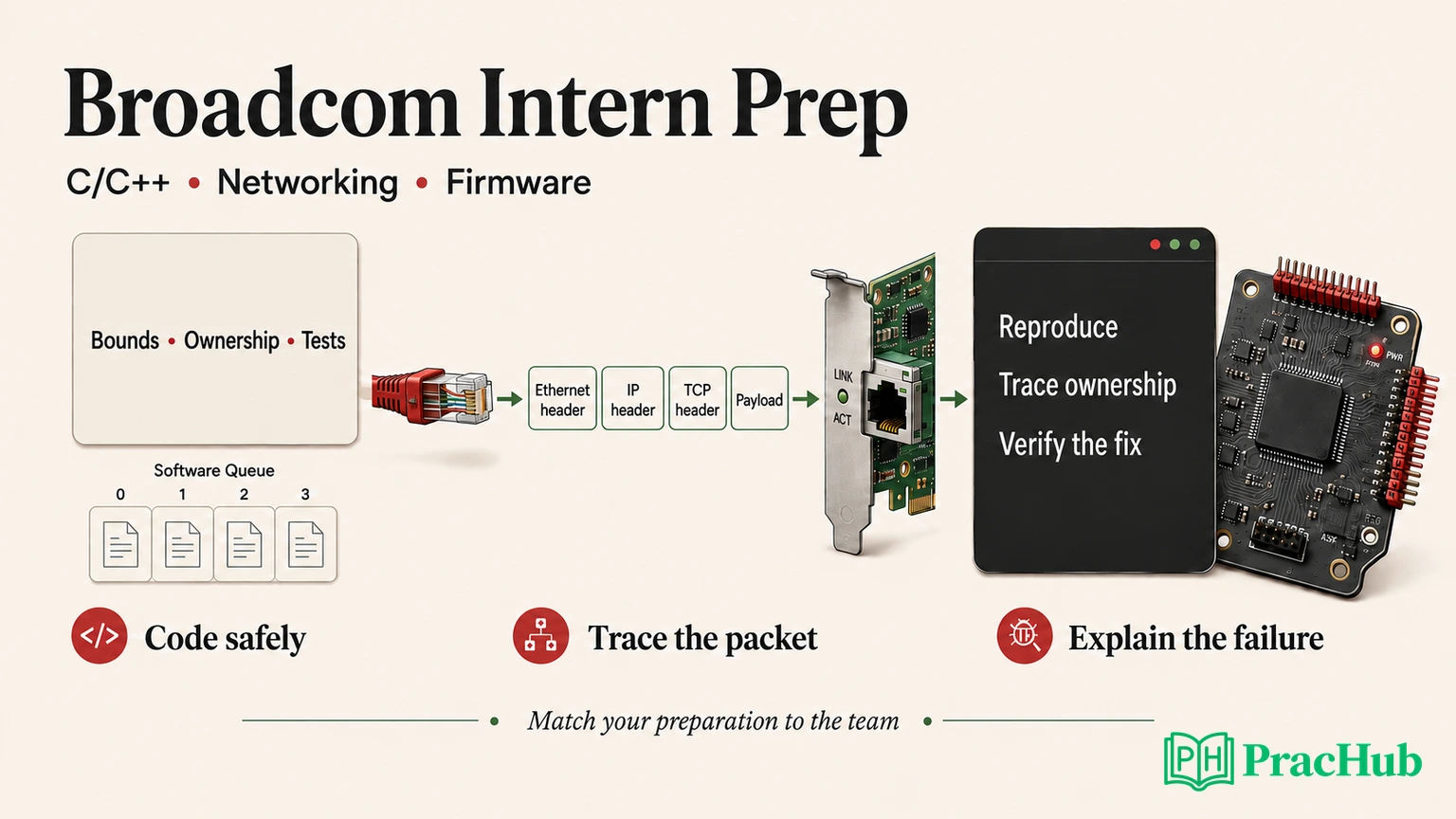
Start with the team behind the Broadcom job title
Official role evidence: Broadcom's live Firmware Engineer requisition R027013 covers Fibre Channel/NVME networked storage, C/Assembly, real-time operating systems, Linux, debugging, and Arm-based firmware. It is a full-time role, so its qualifications must not become internship eligibility requirements. It establishes a relevant engineering domain, not a 2027 intern syllabus. Official firmware role.
First-person internship evidence: in an August 2026 account on Broadcom's community site, intern Yash Saini describes Mainframe Cybersecurity work on Top Secret, including test-suite refactoring, Python automation, Jenkins, and mainframe tooling. That is an employer-hosted intern account, not an official selection policy. It illustrates why “Broadcom software” does not always mean firmware. Intern project account.
Preparation inference: use the requisition's nouns to choose your technical emphasis:
| Wording in your actual job description | Preparation emphasis | Project evidence to bring |
|---|---|---|
| Firmware, controller, RTOS, I/O | C memory safety, interrupt context, bounded queues, device interaction | A failure you reproduced and traced across software and hardware |
| Driver, Linux, Ethernet, networking | Packet movement, buffering, concurrency, protocol boundaries | A measured loss, latency, or throughput investigation |
| Mainframe, enterprise software, test automation | The named language, regression testing, debugging, maintainability | A repeatable test or automation improvement |
These are study branches, not confirmed organizational hiring tracks. Do not spend all your available time on embedded programming if the actual internship centers on Java services or test infrastructure.
Before applying, save the requisition ID, location, degree requirements, availability dates, and named technologies. Use Broadcom's official careers page as the application starting point. A search result may preserve a closed role; the current application page determines whether you can still submit.
What previous intern interview reports actually show
Candidate reports: a Glassdoor post dated January 24, 2026 describes an online assessment followed by two technical phone screens. The author mentions operating systems, basic algorithms, C/C++ primitives, and queue or producer–consumer questions. A separate Plano post dated October 6, 2025 describes a Zoom conversation combining behavioral discussion with two verbally described coding problems, including finding a linked list's middle in one traversal. These are posting dates, not verified recruiting-cycle labels. Historical intern reports.
The accounts support preparing both spoken reasoning and executable code. They do not establish a universal assessment vendor, number of rounds, difficulty, cutoff, or turnaround time. The Plano account also appears on Taro; that mirror is not another independent candidate.
The practical response is to ask what your invitation requires: a timed assessment, live editor, verbal problem solving, or a project discussion. Practice explaining assumptions before writing. If an interviewer changes a constraint, describe which invariant or complexity argument changes with it.
C/C++ preparation: make the queue contract explicit
Original practice exercise: implement a bounded queue of integer work IDs. It has four usable slots, preserves FIFO order, rejects a push when full, and reports failure when popped empty. A rejected operation leaves the queue unchanged. Start with single-threaded execution; concurrency is a separate extension.
A compact C++17 implementation uses a read index and a count:
#include <array>
#include <cstddef>

template <std::size_t N>
class WorkQueue {
    static_assert(N > 0);
    std::array<int, N> data{};
    std::size_t read = 0;
    std::size_t count = 0;
public:
    bool push(int value) {
        if (count == N) return false;
        const auto until_end = N - read;
        const auto write = count >= until_end
            ? count - until_end : read + count;
        data[write] = value;
        ++count;
        return true;
    }
    bool pop(int& value) {
        if (count == 0) return false;
        value = data[read];
        read = (read == N - 1) ? 0 : read + 1;
        --count;
        return true;
    }
};
The write-index calculation avoids overflowing read + count when the logical position wraps. More importantly, the representation makes the invariant easy to state: read is a valid index, count stays between zero and capacity, and the next item is at read whenever the queue is nonempty. Each operation takes constant time and the storage is fixed.
Walk through an observable sequence. Push A, B, C, and D as four integer IDs. Pushing E fails without overwriting A. Pop A and B, then push E and F into the released slots. The remaining pop order must be C, D, E, F. Test empty behavior again after draining, plus a one-slot queue and repeated wraparound.
Tracing the sequence distinguishes logical occupancy from physical position and makes the overflow policy visible. A different design may reserve one unused slot to distinguish full from empty; do not accidentally advertise four usable entries while implementing only three.
For a producer–consumer extension, first identify which execution contexts access the queue. The example has no synchronization. Concurrent calls create data races; adding volatile does not fix that. A thread-based version can protect the compound state with a mutex and use condition-variable predicates for empty, full, and shutdown conditions. An interrupt handler needs primitives permitted by its platform and cannot casually block on that same design.
The Linux circular-buffer documentation explains a different ring representation and the ordering requirements of producer/consumer access. Treat it as a technical reference, not proof that the sample above is lock-free. In an interview, a correct bounded implementation with clearly stated limits is a useful starting point for deeper questions.
Networking preparation: locate the first missing packet
Original diagnostic scenario: a test sender emits 10,000 uniquely numbered UDP datagrams during a controlled run. The receiving application records 8,000 unique IDs. Where did the missing 2,000 go?
Start by defining what was measured. Confirm the same run and observation interval, account for packets still in flight, and distinguish unique messages from duplicates. “The sender called send successfully” is not proof of delivery. Identify the source and destination addresses, interface, packet size, rate, and whether the problem changes with load.
Then trace evidence across boundaries: sender, network path, receiving interface, driver processing, socket buffer, and application consumption. Compare packet captures and relevant counters without assuming every tool counts the same unit. Offloads, aggregation, filtering, and the location of a capture can make two counters differ without locating the loss by themselves.
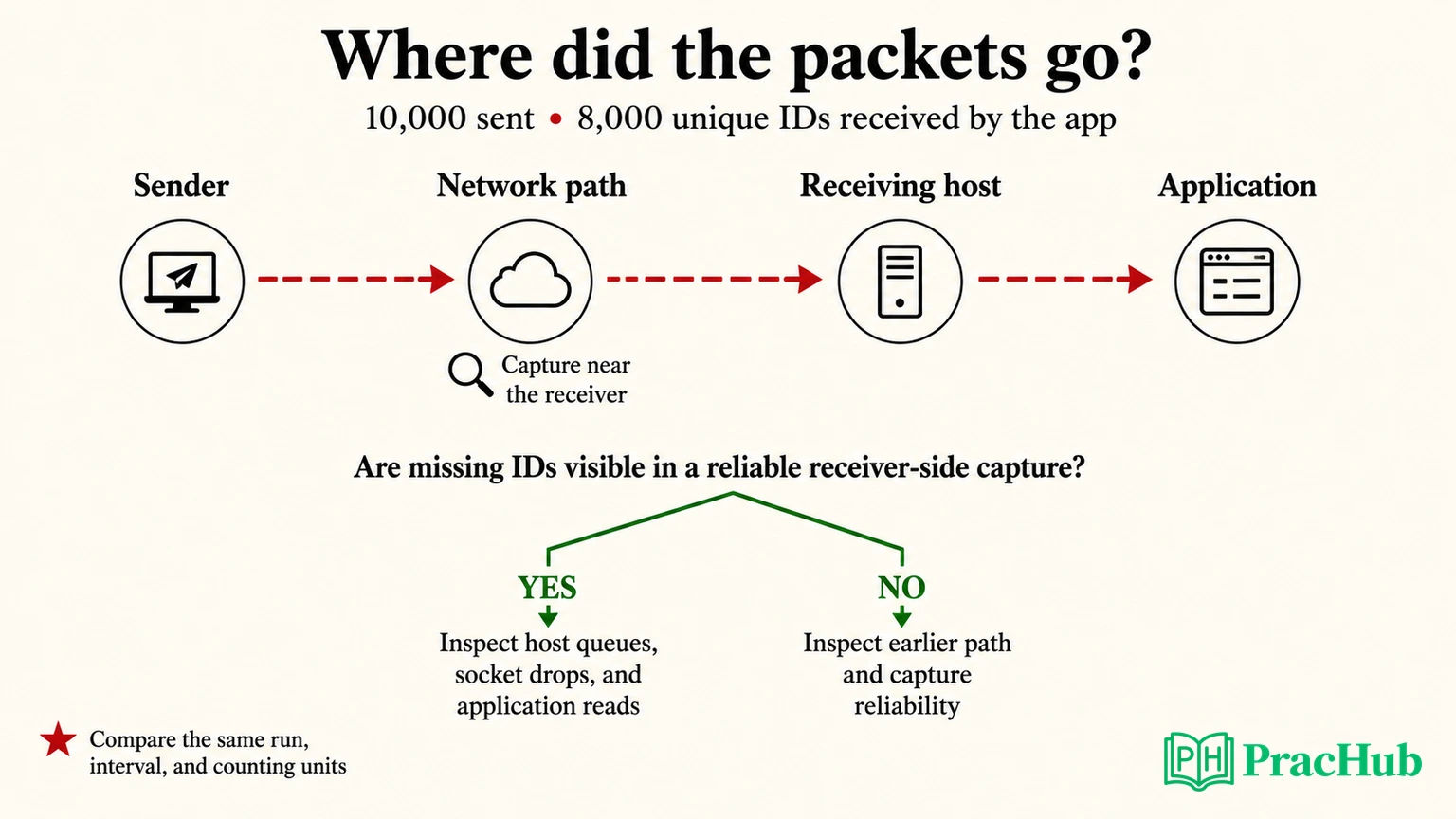
A useful investigation branches on observations. If a validated capture near the receiver sees the missing sequence IDs but the application does not, investigate the receiving host. If the datagrams never reach that capture point, examine the earlier path and the capture's own reliability. If failures appear only during bursts, compare queue occupancy, drop counters, and how quickly consumers drain work.
Technical reference: Linux NAPI can process network events through polling after an interrupt, and its receive budget limits work during a poll. That budget is not the receive queue's storage capacity, and packet processing does not imply one interrupt per packet. Linux NAPI documentation.
Preparation inference: practice explaining the difference between temporarily absorbing a burst and fixing sustained overload. A larger queue may postpone drops while increasing waiting time. If arrivals continually exceed service capacity, added buffering alone cannot keep up indefinitely. Measure throughput, loss, CPU use, and latency together before claiming an improvement.
For TCP, add the distinction between transport retransmission and application behavior. A completed connection or acknowledgement does not prove that business logic finished successfully. For firmware or driver interviews, keep the discussion tied to the boundary named in the prompt instead of drifting into a generic cloud architecture design.
Firmware interviews: explain a failure from symptom to evidence
Original preparation advice: choose one project incident that demonstrates how you debug. A class project, emulator, microcontroller exercise, or Linux utility can work if you can describe your own contribution precisely.
Suppose a command occasionally completes with stale data. Begin with the command lifecycle: who allocates the buffer, who fills it, who submits it, what completion means, and when it can be reused. Draw those events before proposing a fix. A timeout, a status bit, and successful application consumption are different observations.
Next, identify competing explanations. Was the buffer reused too soon? Did an error path skip initialization? Did the consumer read the wrong length? Was the completion associated with an older request? Choose a trace or controlled experiment that separates two explanations, then explain the result that would make you abandon your favorite hypothesis.
If the design involves DMA, memory-mapped registers, or cache maintenance, consult the platform contract. Hardware ownership and device visibility need platform-specific reasoning; ordinary C++ thread synchronization is not a complete device protocol. Name the relevant platform documentation and explain which guarantee you need from it.
Close the story with verification: reproduce the original trigger, test the corrected path, and check a nearby failure case. Explain what the test still cannot prove. “It worked once after a delay” is weaker evidence than a documented ordering fix and repeated stress results under the same workload.
Plan around the actual invitation, not an invented deadline
No company-wide 2027 opening date, assessment cutoff, or guaranteed response interval was confirmed in this review. Keep your application log tied to actual requisitions and recruiter messages. Historical posts from another location should not determine when you assume your own process has stalled.
Before a technical round, confirm the product group, expected language, compiler or editor constraints, and whether networking or firmware knowledge will be discussed. Ask whether you should prepare a project walkthrough. Those answers determine whether your next practice session should focus on coding speed, C memory semantics, packet reasoning, or explaining a design you already built.
If a recruiter provides a response date, follow that date. If none is given, ask when an update would be appropriate. Continue other applications while waiting. Preparation should leave you with reusable skills and a clear account of your work, even when one team's timing changes.
Five practice questions for the relevant skills
These are cross-company practice questions, not a Broadcom question bank. Use the systems exercises selectively; an advanced prompt is a stretch exercise, not an asserted intern requirement.
| PracHub question | What to practice for this article |
|---|---|
| Implement a Stoppable Producer–Consumer System in C++ | Extend queue correctness into waiting, notification, and shutdown |
| Fix and harden an object pool | Explain reuse, ownership, and lifetime before optimizing allocations |
| Optimize C++ Performance with Provided Concurrency | Separate a measured bottleneck from a plausible performance story |
| Optimize a small-string C++ class | Practice storage boundaries and copy/move correctness |
| Design Command Dispatch and Telemetry Reconciliation for Unreliable Devices | Stretch practice: distinguish submission, acknowledgement, and observed device state |
For each answer, state the contract, demonstrate one normal path, and test one failure boundary. Then explain how your answer would change under concurrency or sustained load. Continue with PracHub's C++ interview questions guide to strengthen the ownership and synchronization reasoning behind those answers.
Comments (0)