C Programming Interview Questions: Pointers, Lifetimes, and Defined Behavior
Quick Overview
C interview practice that classifies behavior before predicting output, with pointer bounds, block lifetimes, integer conversions and local diagnostic evidence.
For C programming interview questions, establish whether the program has a defined result before predicting its output. Identify each expression's type, the object a pointer refers to, its valid bounds, and the operations that end its lifetime. Then explain the first failed requirement and a repair you can verify. That approach gives you a usable answer even when an interviewer changes one line.
The questions below are original exercises for software-engineering candidates. They use a C17 compilation baseline and the common C11/C17 rules documented in WG14's public draft. Local compiler observations are identified separately. For a refresher on declarations and array parameters, start with PracHub's C pointer interview questions, then work through these behavior and diagnostic cases. WG14 C11 draft
How should you classify C programming interview questions?
Ask which kind of answer the language permits. An implementation choice, an unspecified order, and undefined behavior require different explanations. A constraint violation also deserves an answer about translation and diagnostics before any discussion of execution.
| Category | Example to investigate | What your answer should establish |
|---|---|---|
| Defined behavior | Reading the last element through a valid pointer | The result follows from the stated inputs and rules |
| Implementation-defined behavior | Whether plain char is signed | The implementation documents its choice |
| Unspecified behavior | Which of two independent function calls runs first | Multiple permitted alternatives exist |
| Constraint violation | Assigning int ** to const int ** | A conforming implementation must issue a diagnostic |
| Undefined behavior | Reading an object after its lifetime ends | C imposes no required execution result |
For example, GCC documents plain char signedness as an ABI choice and provides options that change the default. In the local exercise, compiling CHAR_MIN < 0 with -fsigned-char produced 1, while -funsigned-char produced 0. The compiler option supplies the missing implementation detail. GCC character implementation choices
In a spoken answer, name the category first and explain its decisive condition. If a prompt omits the compiler or language version, state the baseline you are using. Keep that assumption visible when discussing a follow-up.
Can a one-past pointer still access an array?
Consider this fragment inside a function, with <stdio.h> included.
int a[] = {4, 9, 16};
int *end = a + 3;
printf("%td %d\n", end - a, end[-1]);
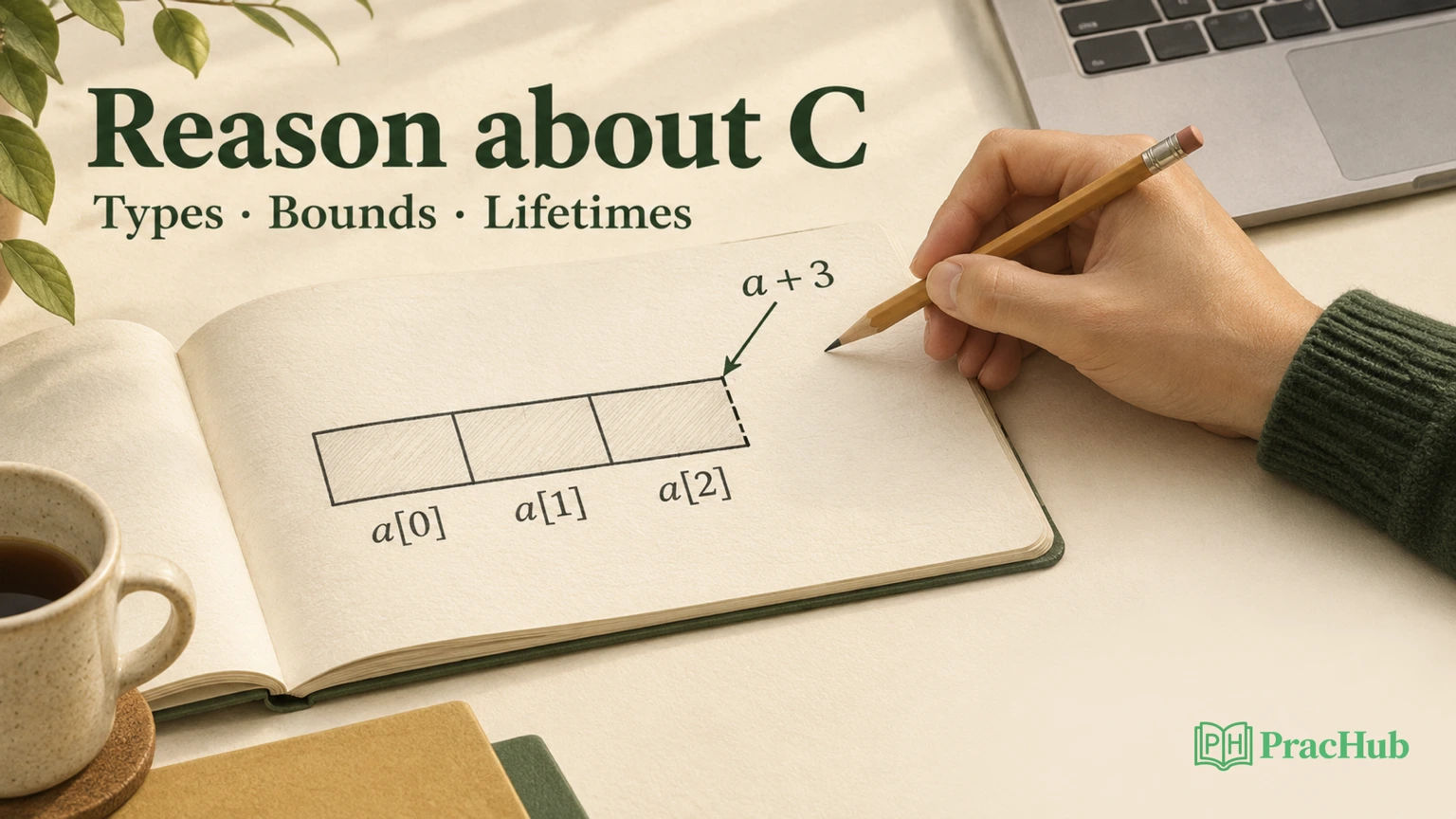
It prints 3 16. Forming the endpoint is permitted, subtraction here counts elements of the same array, and end[-1] reaches the final element. Changing the last expression to end[0] attempts a read beyond the array. The ability to represent the endpoint gives a loop a stopping value. It does not provide an additional element.
An interviewer can change this to a loop that tests cursor != end before reading. Walk through the final iteration and show where the increment leaves the cursor. A loop that reads first and tests afterward needs a separate empty-range argument. Two pointers that happen to have nearby addresses also need an object relationship before you justify subtraction.
Use an element index when the proposed arithmetic is hard to explain. For this three-element array, permitted reads have indices zero through two. Record that range beside the pointer instead of reasoning from a drawing's apparent free space.
When does a compound literal's lifetime end?
This fragment creates an unnamed array in an inner block.
int *p;
{
    p = (int[]){4, 9, 16};
    printf("%d\n", p[1]);
}
printf("%d\n", p[1]);
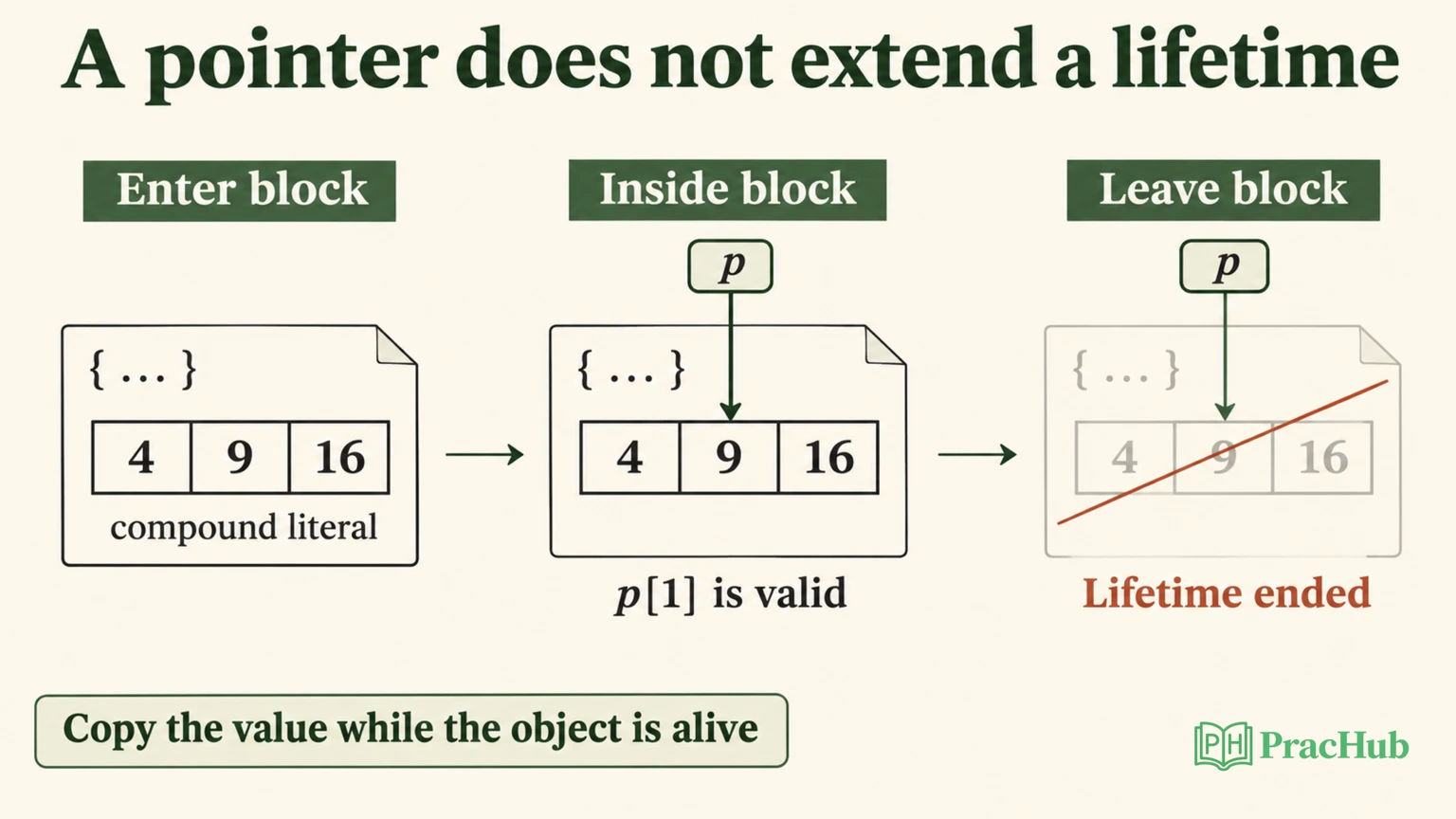
The first read yields 9. Under the baseline used here, the compound literal has automatic storage duration associated with its enclosing block. The final read occurs after that lifetime has ended. The outer pointer variable still exists, but it cannot preserve the array. This is a lifetime violation even if the old bytes remain visible. The relevant language provisions are object storage duration and compound literals, in sections 6.2.4 and 6.5.2.5 of the draft.
For a caller that needs one integer, copy that value while the array is alive. The repaired exercise assigns chosen = p[1] inside the block, then prints chosen afterward. For a caller that needs all three values, use caller-owned storage or a suitable return value with independent storage. Copying a structure containing a pointer requires a further decision about the pointed-to data.
Describe the lifetime boundary explicitly in your answer. “The variable is still in scope” is insufficient unless you also identify which object it denotes.
Why can two increments break an output question?
With <stdio.h> included, classify this expression before choosing numbers.
int n = 1;
printf("%d %d\n", n++, n++);
In C17, these argument evaluations contain unsequenced modifications of the same scalar object, giving undefined behavior. Listing two possible numeric outputs misses the failed sequencing requirement. For a particular Clang build, a warning can expose the issue during translation. GCC also documents warnings for sequence-point problems. GCC warning options
Repair the intended sequence by placing the increments in separate statements, saving their results, then passing those saved values to printf. Say whether the first saved value should be one or two, according to the intended pre-increment or post-increment operation. Merely changing the format string leaves the sequencing problem in place.
Now compare an original exercise where emit writes its argument with putchar and returns zero.
int result = emit('A') + emit('B');
Either call can run first. Both calls execute and result is zero, while the character order can be AB or BA. This is a permitted choice of evaluation order. In the local O0 and O2 builds, both observed runs printed AB. Those two observations establish only which permitted order those builds selected. To require AB, call emit('A') and emit('B') in separate statements.
Does integer overflow always wrap?
Use <limits.h> and <stdio.h> for this defined unsigned example.
unsigned int n = UINT_MAX;
++n;
printf("%u\n", n);
The result is zero. Repeating the idea with an int initialized to INT_MAX makes the increment overflow its signed type, which is undefined under this baseline. In the instrumented local case, UndefinedBehaviorSanitizer reported signed integer overflow. Its documented checks include this fault. Clang UndefinedBehaviorSanitizer
A follow-up may change the comparison to -1 < 1u. That expression is false because the usual arithmetic conversions convert the signed operand to unsigned int, yielding UINT_MAX. Work through the operands' types before applying everyday arithmetic intuition. The exact unsigned limit varies by implementation, while the conversion explains this comparison without assuming a 32-bit integer.
For an allocation-size question, apply the same reasoning before multiplication. With a positive element size, compare the requested count against SIZE_MAX / element_size first. Computing an overflowing product and checking afterward can validate an already-wrapped value. Separately define what a zero-count request means for the interface.
Why does adding const through two pointers require care?
This declaration has an incompatible pointer assignment.
int n = 7;
int *p = &n;
const int **pp = &p;
The initialization requires a diagnostic. Adding a qualifier at a single pointed-to level, as in converting int * to const int *, does not make every nested-pointer conversion valid. A useful follow-up asks what the rejected conversion would allow. If it were accepted, assigning a pointer to a genuinely const integer through *pp could redirect p to that const object. The original int * would then offer a route to a prohibited write.
In the local compilation, -Werror=incompatible-pointer-types made this diagnostic a build failure. Distinguish the language's diagnostic requirement from a compiler configuration's decision to stop compilation. A compiler accepting an extension after a warning supplies no portable justification for the initialization.
For an output parameter, keep the function's pointer types compatible with the caller's storage. For a read-only input, ask whether the function needs one pointer at all. Choose the signature from the operations the function must perform, and test it using an ordinary caller.
What happens when memcpy ranges overlap?
With <string.h> included, this attempt to shift characters violates memcpy's overlap precondition.
char text[] = "abcd";
memcpy(text + 1, text, 3);
The source covers the first three characters and the destination covers positions one through three. Those ranges overlap. Replacing the call with memmove(text + 1, text, 3) gives the repaired array aabc, followed by its existing null terminator. Explain both the byte count and where the terminator remains. An apparent correct result from the original call still leaves its library precondition violated.
For a byte-buffer interface, also establish source and destination capacities and whether zero-length operations accept null pointers. Those are independent contract decisions. A change from memcpy to memmove addresses overlap while leaving capacity mistakes possible.
Casting a byte-buffer address to an integer pointer introduces more requirements, including alignment and permitted access type. A network field also needs an explicit byte-order interpretation. Reading four bytes successfully on one machine establishes little about that full contract. GCC's optimization documentation explains why type-based alias assumptions matter to generated code. GCC optimization options
How should you verify a proposed answer?
For this article, 19 checks ran across 12 C source files using Apple Clang 21.0.0 on arm64 macOS. Five defined or permitted-order programs ran at both O0 and O2. Separate compile-only checks required diagnostics for the unsequenced expression and incompatible double pointer. A comparison build changed plain char signedness explicitly.
Use a complete translation unit with the proper headers and a main function. A useful starting build is clang -std=c17 -O0 -Wall -Wextra -Wpedantic case.c -o case. Save the source, compiler version, options, exit status and diagnostic. For a deliberate memory-fault exercise, add AddressSanitizer and debug information. Its documentation describes covered error classes and additional lifetime options. Clang AddressSanitizer
The local one-past read produced an AddressSanitizer stack-buffer-overflow report at O0. The signed overflow case produced a UBSan report. At O1, the separate one-past, expired compound-literal and overlapping-copy programs completed without a sanitizer report in this environment. The invalid lifetime read still yielded 9, and the overlapping copy yielded aabc. These are recorded observations of invalid programs, with no portable output claim.
Build your interview explanation around the violated rule, then use diagnostics as supporting evidence. Re-run the repaired version with boundary inputs. Agreement across two optimization levels is useful regression evidence for the shown cases, while the language argument remains necessary.
Five PracHub questions for the next rehearsal
These candidate-reported PracHub records provide adjacent C practice, with no prediction of an upcoming interview's exact questions. At the time checked, the public record data marked the declaration and misaligned-copy entries as locked. Access to their details depends on the reader's account.
| PracHub question | What to explain |
|---|---|
| Reason About C Pointer and Array Declarations | State the complete type and identify the referred object. |
| Deep-Copy a Linked List Whose Nodes Carry Random Pointers, in C | Separate copying a pointer from preserving independent data. |
| Implement Copy-To and Copy-From Operations on a Fixed-Capacity Byte Buffer | Defend lengths, capacities and overlap handling. |
| Implement memcpy with misaligned addresses | Explain byte access, alignment and your copy contract. |
| Implement an Aligned malloc and Matching free in C | Track the allocation identity and matching cleanup operation. |
Start with the fixed-capacity byte-buffer question. State the accepted ranges, choose one failing boundary, and explain the repair before running it. Carry that same method into other C programming interview questions so every predicted result has a type, bounds and lifetime argument behind it.
Sources and Further Reading
- WG14 public C11 committee draft N1570
- GCC character implementation choices
- GCC warning options
- GCC optimization options and strict aliasing
- Clang AddressSanitizer documentation
- Clang UndefinedBehaviorSanitizer documentation
Language references, practice access and local compiler observations checked November 19, 2026.
Comments (0)