Calibrd Review: Shortlist Diagnostics, Interview Questions, and Mock Feedback
Quick Overview
Review Calibrd’s job-based diagnostics, read-only sample report, advertised report and mock limits, and current guest-versus-account privacy policy. An original synthetic backend profile and traceability ledger separate lab evidence, transferable reasoning and unsupported experience claims.
Calibrd connects a job posting with shortlist diagnostics, interview questions and mock rehearsal. That can be useful when you need to turn a broad preparation plan into specific evidence for a role. Its public report illustrations are not measurements of our readiness, however. Trace each recommendation to the posting, your work and the limits of its evidence.
PracHub publishes this review and owns the complementary practice links. Our idempotent-consumer question offers an independent backend exercise. The synthetic job profile and evidence ledger below are original educational assets, separate from a Calibrd report or an employer decision.
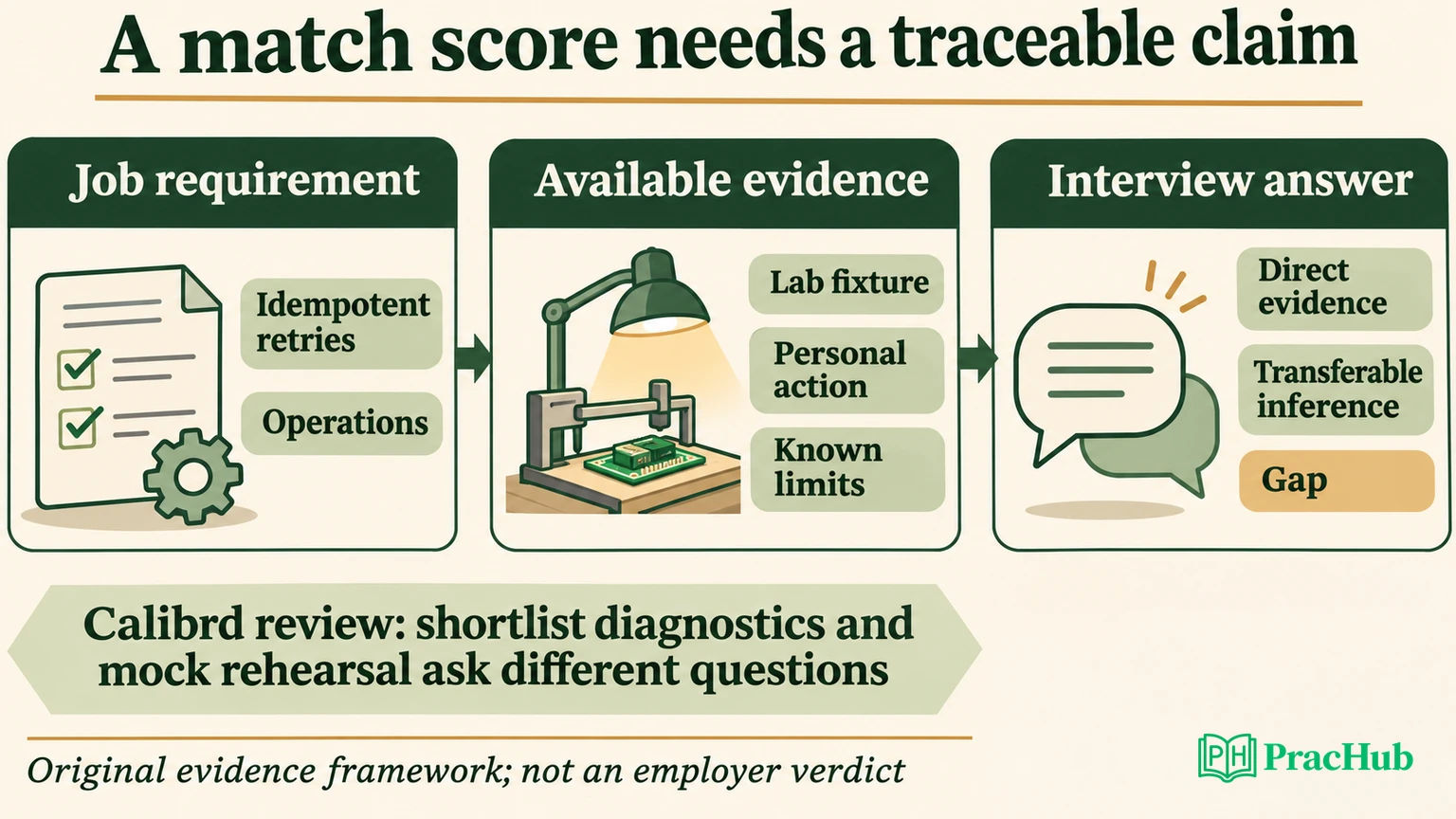
Separate diagnosis from rehearsal
Provider description, reviewed November 3, 2026: Calibrd’s homepage describes job-based reports, CV review, predicted interview questions, graded answers and voice mocks. Its entry accepts job text or a posting link, with a CV described as optional. The extension is presented as optional too.
We reviewed public product and policy material and opened the read-only sample report. We did not upload a CV, job description or recruiter email, generate a personal report, create an account, install the extension or run a mock.
A diagnostic report and an interview answer test different things. A report can point to a requirement you have not demonstrated. Rehearsal asks whether you can explain your decisions and respond to a changed condition. Neither establishes how an actual employer will decide.
We did not independently verify hiring outcomes, founder credentials or the predictive validity of illustrative grades. The marketing score is not our result or a calibrated shortlisting probability.
What the read-only sample actually shows
Direct observation: the public sample report labels itself read-only. Its fictional Northwind example flags large-scale system design as a major gap and cross-team leadership as a minor gap. Opening the scoring explanation showed seniority, scope and core skills as inputs to its fit interpretation. We did not submit an answer or refresh the score.
That display demonstrates how a recommendation can lead into practice. It does not validate the assessment against a real hiring team. For the system-design gap, ask whether the learner has an actual design decision to defend; a suggestion to discuss greater scale cannot create that experience.
A matching score does not verify the underlying claims
Our interpretation: matching the words in a posting is different from supplying evidence for the responsibility. A CV may name a queue, database or cloud service without showing that the candidate operated it, handled failures or made the relevant trade-off.
An evaluator that reads a CV can compare the text it receives with a role. It cannot independently verify every experience behind that text. A stronger rewrite therefore needs to preserve ownership, scale and uncertainty, rather than merely add the job’s preferred vocabulary.
The public CV Review walkthrough describes suggested rewrites with placeholders for missing metrics and user approval before applying a change. We did not execute that workflow or validate its extraction and export behavior. The useful principle is to fill a placeholder only with a defensible figure.
If you do not know the latency baseline or number of users affected, do not invent it to satisfy a suggested bullet. Describe the concrete change and the evidence you have. A fluent claim with an unsupported measurement creates another problem to defend at interview.
Original synthetic role: reliable payment ingestion
Consider our invented backend posting. It asks for duplicate-safe ingestion, SQL correctness, operational ownership and collaboration during incidents. No real company or applicant supplied this material, and we did not send it to Calibrd.
The equally fictional candidate profile contains a small importer project. It has a replay fixture, queries with expected results and a design note describing failure handling. It contains no production on-call record, customer-scale measurement or ownership of a payment service.
That is enough to prepare several technical explanations. It is not enough to claim production experience the profile does not contain. A useful recommendation should distinguish direct lab evidence, potentially transferable reasoning and a genuine experience gap.
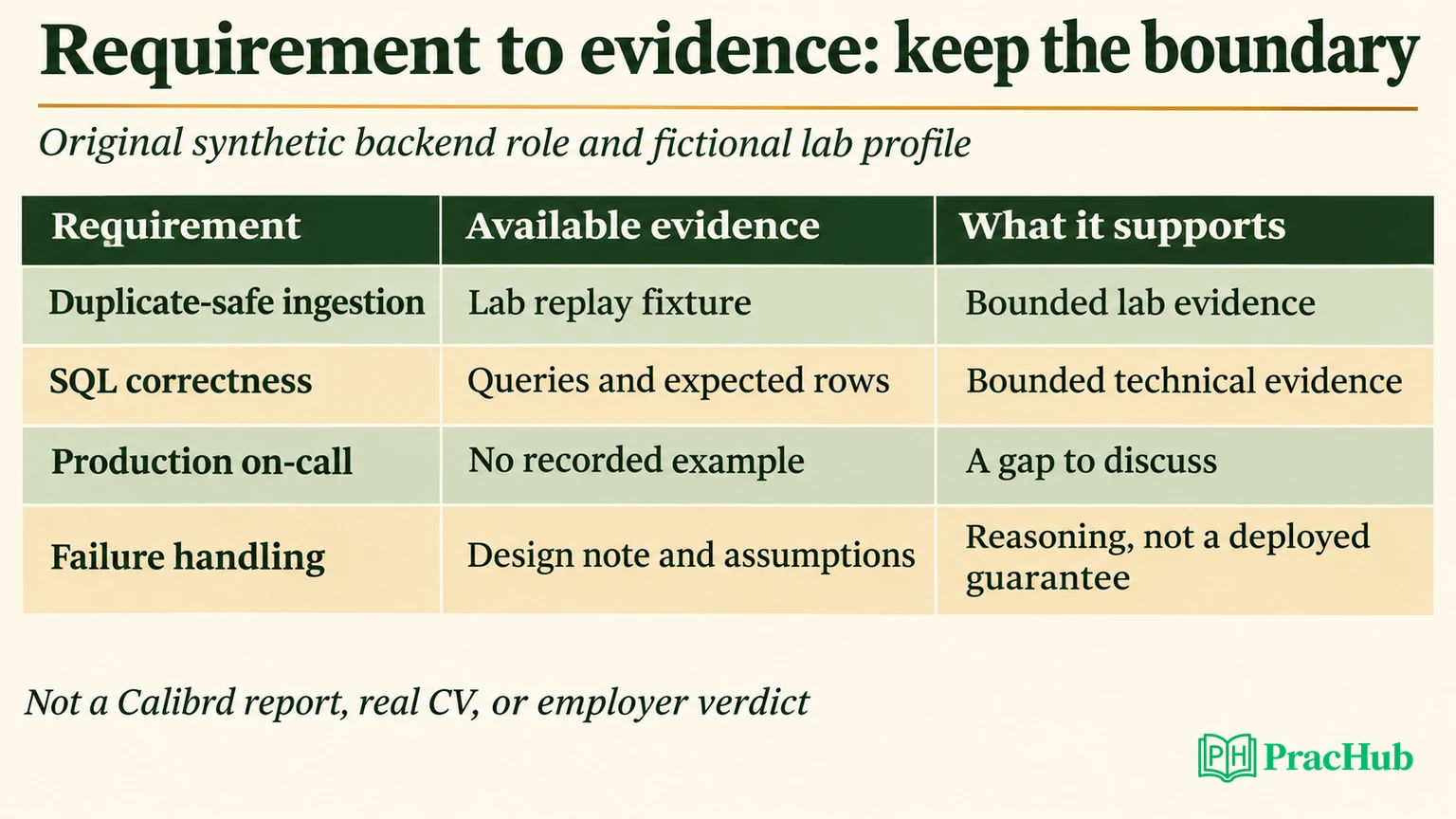
| Synthetic requirement | Evidence available in the invented profile | Defensible interpretation |
|---|---|---|
| Duplicate-safe ingestion | A lab replay fixture and its expected behavior | Bounded evidence of a deduplication approach |
| SQL correctness | Queries, input rows and expected results | Bounded evidence of query reasoning |
| Production operations | No recorded production incident or on-call example | A gap to discuss honestly |
| Failure handling | A design note and explicit assumptions | Reasoning to explain, not a deployed guarantee |
| Collaboration | A documented review discussion | Evidence of that interaction and personal contribution |
The ledger is a paper example, not an executed importer or a real CV assessment. It shows what a candidate should check before adopting a recommendation. We did not obtain a Calibrd score for either the invented role or profile.
Trace each recommendation to a source
Suppose a suggested edit says the candidate owned a production-grade payments pipeline. Ask which artifact supports production ownership. The fictional lab profile does not contain one. Narrow the claim to the experience the profile supports.
A bounded alternative is to describe implementing a duplicate-handling approach in a lab importer and explain the replay fixture. Then identify what would still need testing before deployment. That gives an interviewer a real mechanism to examine without claiming a scale or responsibility that was never established.
If the recommendation asks for stronger SQL evidence, the existing queries and expected rows provide a starting point. Explain duplicate inputs, missing values and the intended grain. The useful answer is not simply that SQL appears on both the CV and posting.
For operational experience, a candidate may have a relevant adjacent example or a genuine gap. Prepare either one truthfully. Transferable reasoning should be labeled as such, and an example from a class or personal project should retain that context.
Predicted questions should remain preparation hypotheses
A job requirement can motivate a plausible interview question. Duplicate-safe ingestion suggests asking about repeated messages, offset commits and the point at which a result is durable. That is our inference from the invented requirement, not a known employer script.
The actual interview schedule and permitted format need another source. A recruiter’s message may confirm a coding round or a system-design session. A generated forecast cannot turn an unconfirmed stage, duration or assessment rule into an official fact.
Calibrd advertises job-specific questions and mock preparation. We did not test those outputs against a current recruiting loop. The provider’s relevance claim should be evaluated by whether the questions follow the supplied role and expose useful gaps, rather than by whether they sound confidently employer-specific.
Use a small source ledger when reviewing a future report. Mark a requirement quoted from the posting, an assumption introduced by the tool and an item confirmed by the recruiter. This makes disagreements easier to resolve without treating every generated line as equally certain.
| Report statement type | Appropriate source | Status until checked |
|---|---|---|
| A role requires ingestion reliability | Actual posting | Requirement if the text supports it |
| A duplicate-handling question is plausible | Inference from that requirement | Preparation hypothesis |
| The next round is system design | Recruiter or official invitation | Unconfirmed without that source |
| A CV proves production ownership | The candidate’s actual work evidence | Unsupported if the evidence is absent |
Mock feedback needs an observable correction
A rehearsal can be valuable when a follow-up changes the answer’s substance. For the synthetic importer, ask what happens if a process fails after writing a record but before acknowledging a message. The candidate should identify the duplicate or loss risk and connect it to the stated guarantee.
A label such as advance, borderline or not yet cannot supply that mechanism by itself. It is feedback within a practice system, not the hiring panel’s decision. We did not run a Calibrd mock or assess the accuracy of its verdicts.
For a future trial, save one answer, the exact feedback and the revised reasoning. Check whether the revision addresses the identified failure case while preserving the example’s limits. A more impressive description that quietly upgrades lab work to production is not an improvement in accuracy.
The same distinction applies to behavioral rehearsal. Explain the disagreement, the decision you personally made and what changed. A tool can help organize those details, but it cannot independently authenticate an event you supplied only as text.
Keep reports, graded answers and mocks as different units
The homepage described free limits of three reports a day and fifteen a month, plus a daily spoken-answer allowance and one mock. Paid passes displayed $9.99 for seven days, $19.99 for thirty and $39.99 for ninety, with mock quotas of five, fifteen and forty-five. These are provider offers, not balances we activated.
The daily and monthly report caps both matter. Under those advertised limits, five days at three reports uses fifteen for the relevant period. That arithmetic does not establish how the app defines its period, counts regeneration or handles failed requests; we did not test those rules.
Likewise, unlimited reports or graded answers should not be described as unlimited full mocks when a separate mock quota is listed. Confirm which action consumes which allowance before planning repeated sessions.
Our current browser check of the CV walkthrough describes free scoring and editing with one free export a month. This supersedes the credit-based description retrieved earlier during research. The illustrated interface is a walkthrough, not our account balance; we did not activate exports or verify how a pass changes account limits.
Read the data boundary for the workflow you use
Current provider policy: the Privacy Policy shown in the browser is effective September 14, 2026. It distinguishes encrypted account storage for signed-in CVs and workspace data from guest processing and browser-local reports. This supersedes the August policy text retrieved earlier in research.
The policy states that account storage is not end-to-end encrypted: the service can read it to provide coaching. That distinction matters when deciding what to supply. We did not independently audit encryption, retention or deletion, and do not present the policy as an implementation test.
The policy also describes audio transcription and model-based grading. We did not record audio, inspect traffic or test deletion. A statement that transcripts or reports are local does not by itself establish that no content is transmitted for processing.
Our review used no personal CV, recruiter correspondence or private job material. The synthetic role ledger is sufficient to explain how to evaluate a recommendation without exposing a real candidate’s history or an employer’s internal details.
What would make a bounded trial useful?
Choose one role requirement and one truthful example whose evidence you already understand. Ask whether a report preserves the distinction between the requirement and what your example proves. Then prepare an answer to a relevant failure or trade-off question.
Inspect a suggested rewrite for added ownership, scale, causality or metrics. If it changes the claim, verify that change before using it. Keep unresolved questions visible instead of interpreting a high score as permission to strengthen the wording.
Finally, evaluate a mock separately from the diagnostic. Test the report’s gap diagnosis and the mock’s follow-ups, transcription and corrections separately. We did not measure those features or long-term learning outcomes in this review.
Practice the gaps the product leaves open
These independent PracHub prompts extend the synthetic backend-role evidence check. They are not Calibrd predictions, mock scripts or verified employer hiring criteria.
| PracHub question | What to examine |
|---|---|
| Idempotent Kafka Consumer: Duplicate Writes, Offset Commits and a Second Database | Explain the duplicate-handling guarantee and what the evidence actually covers. |
| Production-Ready Event Ingestion Handler: Validation, Idempotent Writes, DLQ, Metrics | Turn a reliability claim into validation, failure handling and observable behavior. |
| Design a Shopping Cart Service That Keeps Inventory Consistent Under Concurrency | Separate a lab invariant from a production ownership claim. |
| Project Deep Dive, Collaboration and Project Management, and Conflict Trade-offs | Connect project decisions and personal responsibility to a specific role. |
| Discuss Collaboration, Feedback, and Conflict | Prepare a truthful example of feedback or disagreement, with a clear action. |
Who should inspect Calibrd next
Calibrd merits a focused trial if you want job-specific diagnostics linked to interview rehearsal. The public sample shows that connection, while personal grading, account entitlements and actual mock quality remain untested here. Current policy separates guest and signed-in storage; verify the applicable account controls before supplying real documents.
Start with the idempotent-consumer prompt. State the guarantee, produce a failure trace and identify which part your own evidence supports. Use a report to choose what to investigate and rehearse, rather than as proof of an employer decision or an experience you have not had.
Comments (0)