Can You Delete a Never-Inserted Key From a Cuckoo Filter Safely?
Quick Overview
Deleting a never-inserted Cuckoo-filter key can remove another key’s matching fingerprint and introduce false negatives. Reproduce a deterministic collision in a small Python model, distinguish membership from successful insertion evidence, account for duplicates and ADDNX-style skips, and define receipt and generation boundaries.
No. Deleting a key that was never inserted into a Cuckoo filter is unsafe. A membership query can be a false positive, and deletion can remove a matching fingerprint belonging to another key. Redis explicitly warns that this misuse can introduce false negatives.
Practice the ownership boundary with Design a distributed key-value store. Explain which record is authoritative for key identity and successful insertion before using a compact probabilistic structure to decide what can be removed.
Quick Overview
The Redis CF.DEL contract requires certainty that the item was added. CF.EXISTS supplies probabilistic membership, not that certainty. The executable Python model below finds a fingerprint-and-bucket collision, demonstrates an unsafe deletion and then guards deletion with exact insertion receipts. It also shows why an ADDNX-style membership hit can skip insertion. This is a deliberately tiny model, not Redis's hashing algorithm or a native Redis command test.
Understand what the filter remembers
A Cuckoo filter stores compact fingerprints in candidate buckets rather than retaining every full logical key. Its space savings come with uncertainty: a different key can match a fingerprint in one of its candidate locations.
The Redis Cuckoo filter overview describes this probabilistic membership interface. A positive result means the item may be present. Treating it as an exact insertion history changes the data structure's contract without adding the missing information.
The deletion problem is stronger than an ordinary false positive. If a never-inserted key matches the stored representation of a real key, removing that representation can make the real key appear absent. A caller that normally relies on negative filter results to skip an authoritative lookup can then miss genuine data.
Fingerprint equality alone is not the whole collision condition. The query must also inspect a bucket holding that fingerprint. The exercise therefore finds two different keys with the same fingerprint and the same candidate-bucket pair, making the destructive path explicit.
Construct a collision you can inspect
The model uses eight buckets, two slots per bucket and a deliberately tiny nonzero fingerprint range. It derives a deterministic value from SHA-256, chooses one bucket and calculates a second candidate through an XOR step.
Those choices are teaching controls. They make a collision easy to find and keep the bucket picture readable. They are not Redis's fingerprint width, hash function, expansion policy or production false-positive rate.
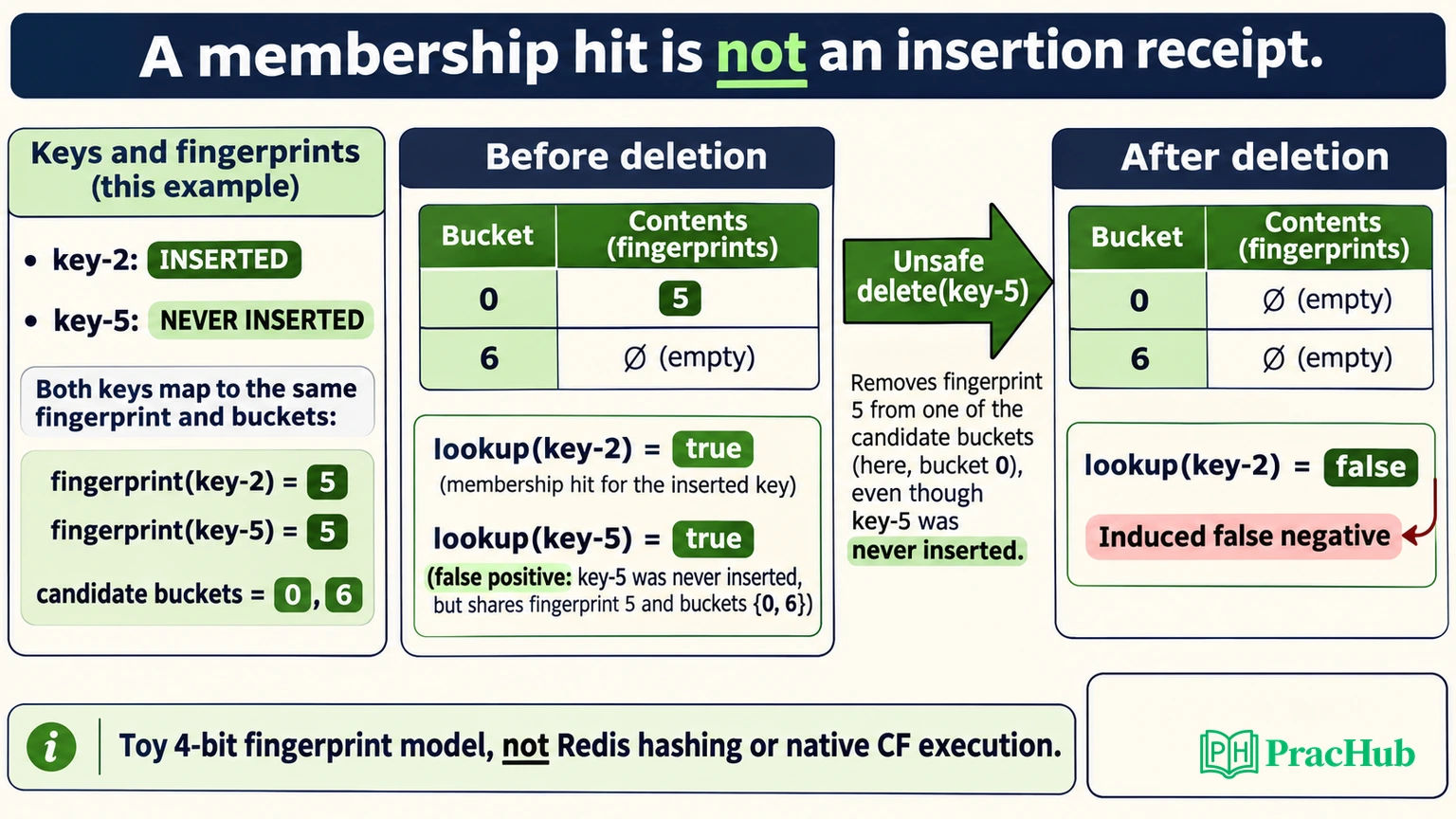
Searching the first thousand generated keys finds key-2 and key-5 with fingerprint five and candidate buckets zero and six. The program inserts key-2 only. Looking up key-5 nevertheless returns true because the stored fingerprint matches.
At that moment the authoritative insertion history contains one key, while the filter answers positively for two logical keys. The gap between those two records is precisely why a positive query cannot authorize deletion.
Run the destructive and guarded paths
Save this program as cuckoo_delete_model.py and run python cuckoo_delete_model.py with assertions enabled. It needs only the Python standard library. The code intentionally excludes relocation and expansion, since neither is needed for this collision counterexample.
"""Tiny fingerprint/bucket deletion model; NOT Redis's hash or CF engine."""
from collections import Counter
import hashlib
import json

BUCKETS, SLOTS = 8, 2

def signature(key):
    h = int.from_bytes(hashlib.sha256(key.encode()).digest()[:4], 'little')
    fingerprint = 1 + (h & 255) % 15  # Deliberately tiny, nonzero fingerprint.
    first = (h >> 8) & (BUCKETS - 1)
    second = first ^ (1 + fingerprint % 7)
    return fingerprint, tuple(sorted((first, second)))

class Filter:
    def __init__(self):
        self.buckets = [[] for _ in range(BUCKETS)]

    def exists(self, key):
        fp, places = signature(key)
        return any(fp in self.buckets[i] for i in places)

    def add(self, key):
        fp, places = signature(key)
        for i in places:
            if len(self.buckets[i]) < SLOTS:
                self.buckets[i].append(fp)
                return True
        raise RuntimeError('model has no relocation or expansion')

    def delete(self, key):
        fp, places = signature(key)
        for i in places:
            if fp in self.buckets[i]:
                self.buckets[i].remove(fp)
                return True
        return False

seen = {}
for n in range(1000):
    candidate = f'key-{n}'
    sig = signature(candidate)
    if sig in seen:
        x, y = seen[sig], candidate
        break
    seen[sig] = candidate
else:
    raise AssertionError('collision not found')
assert x != y and signature(x) == signature(y)
unsafe = Filter()
unsafe.add(x)  # y is never inserted here.
assert unsafe.exists(x) and unsafe.exists(y)
assert unsafe.delete(y)  # Removes the only matching stored fingerprint.
assert not unsafe.exists(x)  # Induced false negative for inserted x.

safe = Filter()
receipts = Counter()
def add_recorded(key):
    assert safe.add(key)
    receipts[key] += 1

def delete_recorded(key):
    # Sequential local model: not a crash-safe distributed transaction.
    if receipts[key] == 0:
        return False
    assert safe.delete(key)
    receipts[key] -= 1
    return True

add_recorded(x)
assert not delete_recorded(y) and safe.exists(x)
add_recorded(x)  # Two physical insertions require two valid deletions.
assert delete_recorded(x) and safe.exists(x)
assert delete_recorded(x) and not safe.exists(x)
assert not delete_recorded(x)  # No extra deletion after both receipts consumed.
nx = Filter()
nx.add(x)
inserted_y = False if nx.exists(y) else nx.add(y)
assert not inserted_y and nx.exists(y)
print(json.dumps(dict(inserted_key=x, never_inserted_collision=y,
                      fingerprint=signature(x)[0], buckets=signature(x)[1],
                      membership_y_before_delete=True,
                      inserted_x_after_unsafe_delete=False,
                      guarded_y_delete=False, guarded_x_preserved=True,
                      two_insertions_two_deletions=True,
                      addnx_style_y_skipped=True,
                      scope='Toy SHA256-derived fingerprint model, NOT native Redis'), indent=2))
The program exited successfully. In the unsafe filter, deleting never-inserted key-5 removed the sole matching fingerprint, and the subsequent lookup for inserted key-2 returned false. In the guarded filter, key-5 had no receipt, so the deletion was denied and key-2 remained discoverable.
The native Redis command behavior is established by the CF.DEL reference, which warns against deleting an item without certainty that it was added. The program demonstrates the underlying failure mechanism in its own simplified representation; it does not claim to have found these exact collisions in Redis.
Read the collision ledger
| Stage | Exact insertion evidence | Filter observation | Interpretation |
|---|---|---|---|
| Insert key-2 | One successful insertion of key-2 | Fingerprint five stored | A represented item exists |
| Query key-5 | No insertion of key-5 | Membership true | False positive |
| Unsafely delete key-5 | Still no insertion of key-5 | Matching fingerprint removed | Another key's representation is lost |
| Query key-2 afterward | Key-2 was not legitimately deleted | Membership false | Induced false negative |
The filter's successful deletion result does not retroactively prove that key-5 was inserted. It proves that the operation found and removed a matching representation under the filter's rules.
Checking membership immediately before deleting does not repair the problem. That check is the false-positive observation in the second row. Repeating the same probabilistic query provides no independent evidence about which logical key originally supplied the fingerprint.
Require an unconsumed successful insertion
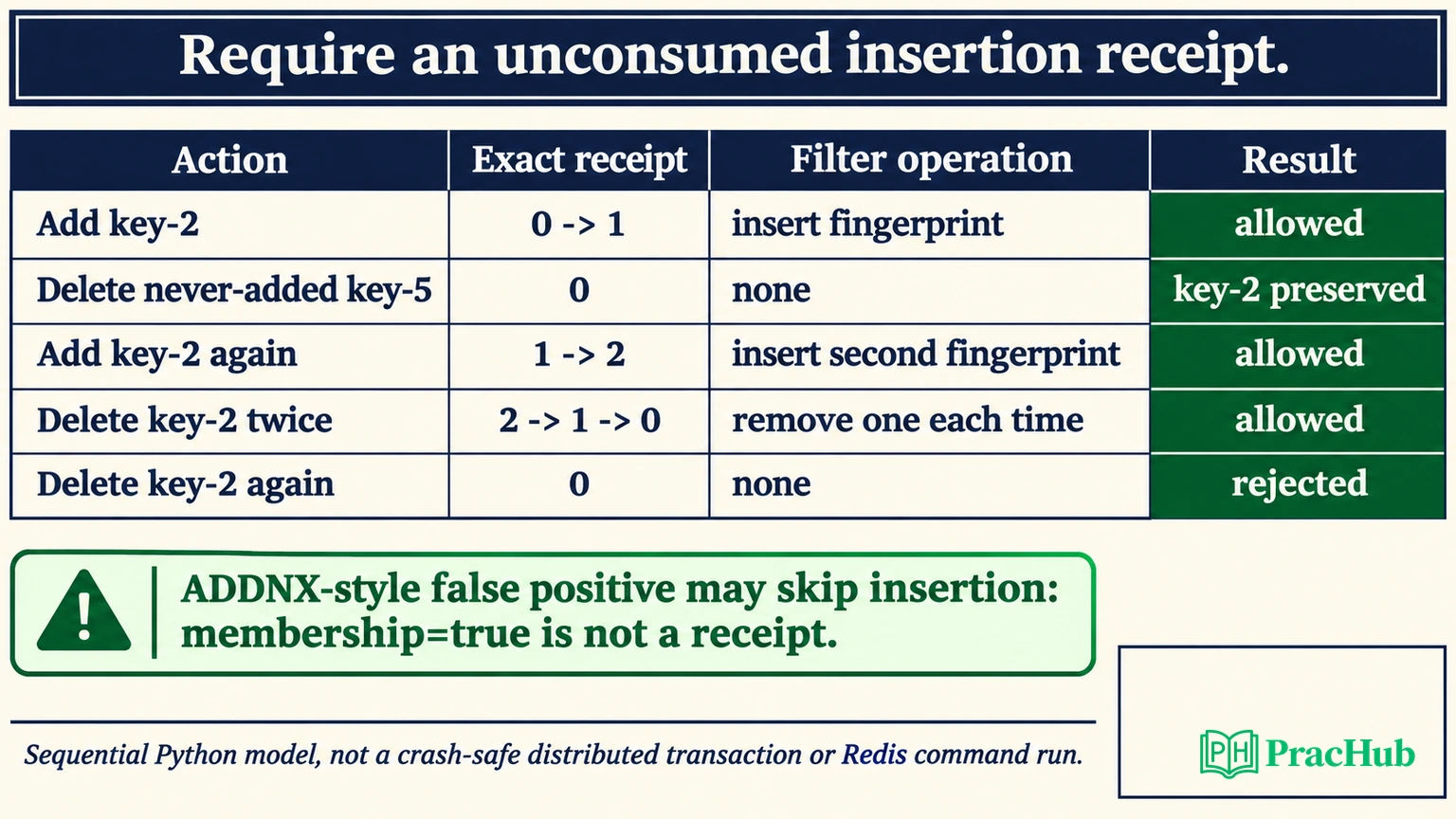
A useful application invariant is that each permitted deletion consumes one known successful insertion for that key in the current filter generation. The model's exact Counter records that history independently of the probabilistic membership result.
The guarded path first checks the receipt count. A zero count prevents calling the filter's deletion operation. A positive count allows one deletion, then decrements the receipt. This is why a request for never-inserted key-5 leaves key-2's fingerprint untouched.
“Added once in the past” is insufficient. If its insertion was already matched by a valid deletion, a later duplicate deletion is again unsupported. Delayed retries and repeated removal events need a consumed-operation record or another exact mechanism that prevents replaying the same deletion.
The receipt also needs a generation boundary. A rebuilt or replaced filter has a different physical insertion history. A receipt for an older instance cannot automatically authorize deletion from the new one, even when both instances use the same Redis key name.
Account for repeated insertion without inventing exact counts
The model inserts key-2 twice into available slots. It then permits two deletions, removing one matching fingerprint each time. After the first deletion the key is still represented; after the second it is absent. A third attempt is denied by the exhausted receipt count.
Redis documents that CF.DEL removes an item once, so multiple successful additions can require multiple valid deletions. The application must decide whether it intends set-like membership or repeated insertion accounting and preserve that decision across retries.
The CF.COUNT reference describes a count of possible occurrences. It does not turn the approximate structure into an exact per-key receipt ledger. Colliding logical keys can still share the representations being counted.
Likewise, a filter's aggregate item statistic does not identify which key owns a slot. Use exact insertion results and operation identities for correctness decisions; use filter counts and capacity observations for their documented approximate or operational purposes.
Handle ADDNX-style skipped insertions carefully
The CF.ADDNX reference states that an existing fingerprint can prevent insertion, including through a false positive. The model reproduces that decision shape: after inserting key-2, key-5's membership hit causes the ADDNX-style path to skip adding it.
A caller must not record that skipped operation as another physical insertion merely because membership is true afterward. Otherwise it manufactures permission to delete a fingerprint that may be the only representation of key-2.
An authoritative database can legitimately contain key-5 while an ADDNX-style optimization skipped its filter insertion. Database existence and filter insertion are therefore separate facts. If key-2 is later removed, the skipped key may no longer be represented as the application expected.
For a design requiring independent deletion, specify how every live logical key gains a valid representation and how duplicate operations are suppressed. Choosing ADD rather than ADDNX changes one aspect of that policy; it does not by itself solve retries, crash consistency or filter-generation management.
Keep the exact ledger and filter synchronized
The Python guard is sequential and local. Updating its Counter and bucket array is not a crash-safe distributed transaction. A process can fail between a real filter mutation and a separately stored receipt update, leaving uncertainty that this example does not resolve.
Define the authoritative record, mutation ordering and recovery procedure for the actual deployment. If the exact source can reconstruct the filter, rebuilding may be simpler than allowing uncertain deletion. If updates span systems, record enough operation identity and progress to reconcile safely.
Concurrency matters too. Two workers must not both consume the same remaining receipt and issue two deletions. A read-then-write check without an atomic condition or serialized owner can violate the intended invariant even though each worker observed a positive count.
These are application design implications of the deletion precondition. The small program tests neither concurrent workers nor persistence failure. Its guarded path demonstrates what evidence is needed, while leaving the mechanism for making that evidence durable to the surrounding system.
Decide how the filter is allowed to influence a lookup
A filter can be a useful accelerator when a negative answer safely avoids expensive work under its maintained invariants. If unsupported deletions have introduced false negatives, that optimization can hide real records rather than merely causing extra lookups.
Treat a positive result as a reason to consult authoritative state when exact identity matters. Treat a negative result according to the confidence justified by the complete update history, not merely the data structure's normal theoretical guarantee.
For an incident involving uncertain removals, stop issuing destructive guesses. Preserve the authoritative keys, identify the filter generation and reconstruct or replace the derived structure through an authorized recovery procedure. This article does not execute a production rebuild or recommend silently deleting a live filter.
A larger fingerprint reduces the frequency of accidental matches but does not supply proof that an arbitrary key was inserted. Collision probability and deletion authorization remain different questions. The counterexample needs only one matching representation to invalidate the proposed rule.
Include failed insertion in the receipt policy. An attempted add that fails because capacity or allocation is exhausted must not create permission for a later deletion. An uncertain network result needs reconciliation rather than being counted automatically as either a successful insertion or a harmless failure.
Also test delayed events across a rebuild: an old deletion request can arrive after a new filter has been populated. Checking the logical key alone may then consume the new representation for an old operation. A generation identifier and exact operation history make that mismatch visible before the destructive command runs.
Practice identity and deletion evidence on PracHub
These questions connect probabilistic acceleration, exact identity, duplicate operations and authoritative cache metadata. The collision exercise is original engineering practice, not a claim that an employer supplies these exact keys or buckets.
| PracHub question | What to defend |
|---|---|
| Design a distributed key-value store | Keep the approximate accelerator separate from the authoritative key store. |
| Explain hash collisions and Java HashMap complexity | Distinguish a hash match from full logical-key equality. |
| Implement an Idempotent Versioned Database Update | Protect exact state transitions with operation identity and atomic conditions. |
| Prevent Duplicate Request Processing | Avoid consuming one insertion receipt through repeated requests. |
| Implement weighted-eviction cache | Maintain exact cache ownership and removal metadata. |
Return to Design a distributed key-value store and place the filter beside its authoritative source. Explain how successful insertions, valid deletions, retries and generation changes preserve the lookup guarantee you depend on.
Sources and Further Reading
- Redis Cuckoo filter overview
- CF.DEL: deletion precondition and false-negative warning
- CF.ADDNX: fingerprint checks can skip insertion
- CF.COUNT: possible occurrence counts
Research and deterministic execution checked November 23, 2026. The example is a tiny SHA-256-derived fingerprint model, not native Redis, RedisBloom hashing, a measured false-positive rate or a concurrent crash-recovery implementation.
Comments (0)