Canonical Written Interview for Software Engineers: Technical Evidence and Clear Answers
Quick Overview
Turn real engineering work into specific written answers, distinguish official guidance from applicant reports, and rehearse the follow-up questions.
A strong Canonical written interview answer makes your engineering contribution easy to understand and difficult to misinterpret. The reader should see what you worked on, which decisions were yours, what evidence supports the result, and where your knowledge stops. A polished paragraph that could describe any applicant does very little of that work.
Start with PracHub's project architecture and technical decision question. Outline one real project before writing full sentences. This guide shows how to turn that outline into specific answers you can defend in a later conversation.
Evidence boundary: Official hiring-lead articles explain the purpose of Canonical's written interview. An applicant discussion illustrates uncertainty about answer depth. The engineering examples and review framework below are original preparation exercises, not Canonical prompts, model answers, or a scoring rubric.
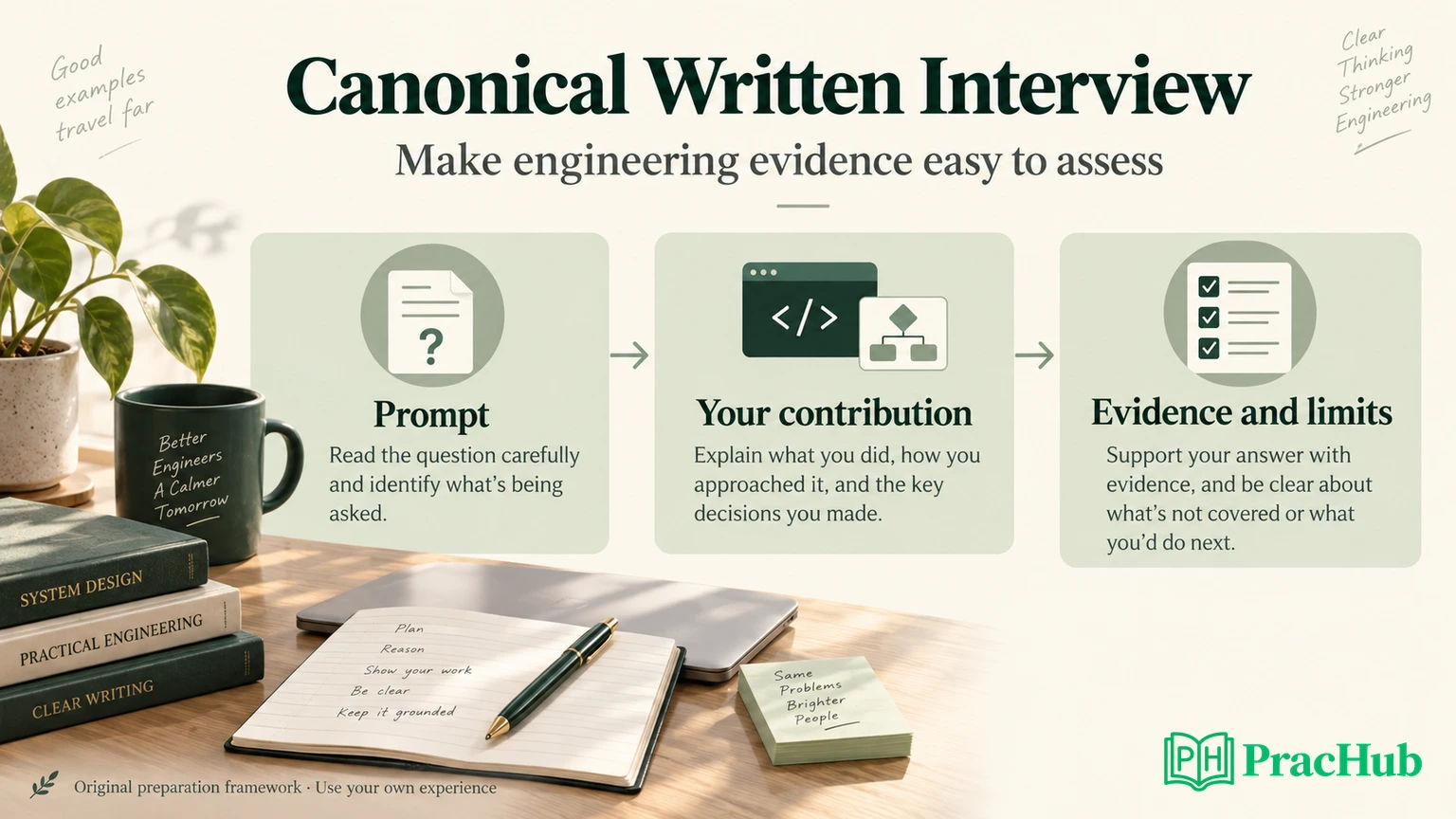
What the written interview is designed to reveal
Official guidance: In a June 2025 article, Canonical hiring lead Daniele Procida describes the written interview as a chance to reflect on what applicants can contribute and prepare for later conversations. He emphasizes concrete achievements over generic claims about enthusiasm or expertise. Canonical hiring guidance
An earlier, August 2023 explanation discusses the written stage through the author's technical-author hiring work. It describes space to explain thinking and experience beyond a CV. That role-specific account is useful context; its reviewer arrangements should not be treated as a guaranteed software-engineer process today. Written interview explanation
For preparation, the implication is straightforward: write material that supports a deeper discussion. If you mention choosing a storage engine, expect to explain alternatives. If you claim ownership, expect questions about the boundary between your work and the team's. The written answer should leave those boundaries visible.
Confirm the instructions before choosing a length
Applicant report: In an April 2026 discussion, a Rust Engineering Lead applicant asked for advice after receiving a written-interview invitation. The applicant questioned another commenter's proposed uniform answer length and clarified that their task concerned their background. This is one person's account, not evidence of a universal deadline or format. Applicant discussion
Use your own invitation to confirm the questions, submission format, deadline, identification requirements, and rules about assistance or AI. If a requirement is unclear, ask the recruiting contact a specific clarification. A public preparation article cannot override those instructions.
Absent an explicit length limit, match depth to the question. A factual question might need a short answer. A request to explain an important technical decision needs enough context to make the reasoning assessable. Do not expand a factual answer to reach an arbitrary quota, or compress a complex decision until the tradeoff disappears.
A useful editing test is whether removing a sentence changes what the reader knows about the answer. Remove repetition and unsupported adjectives first. Preserve the constraint, your action, the evidence, and a material limitation.
Build an evidence inventory from your actual work
Before drafting, list a few experiences you could discuss without inventing details: a production incident, a design choice, a review disagreement, an open-source contribution, or a substantial university project. For each, record your responsibilities and one artifact you are permitted to reference.
The artifact might be a public pull request, a sanitized design note, a test result, or a release record. You do not need to attach everything. The purpose is to check that your memory and your claim agree. Private customer data and confidential code do not belong in an application.
Separate three kinds of statements. A fact describes what happened. An interpretation explains why you think it mattered. A future interest describes what you would like to do next. “I maintained a deployment script” is a fact; “this reduced operational risk” needs supporting evidence; “I want to work on packaging” is an interest.
For an early-career candidate, a carefully explained course project can be more credible than inflated language about industry impact. Name the setting. Explain what you actually implemented, how you checked it, and which production concerns you did not encounter.
Use the inventory selectively. A database incident may fit a debugging question but add little to a question about community participation. Reusing one project is reasonable when it supplies distinct evidence; retelling the same story with different adjectives makes the document repetitive.
Editing example one: explain a technical choice
All three examples below are fictional teaching examples. Their numbers and experiences must not be copied into an application as personal achievements.
Vague version: “I am experienced with databases and chose the best technology for a scalable service.”
More specific version: “In a four-person course project, I owned the event-ingestion component. We needed repeatable reports over a modest dataset, so I proposed PostgreSQL rather than adding a separate document store. I wrote the schema and replay test. The test checked that retrying an input batch did not create duplicate events. We did not benchmark production-scale traffic, so I would not describe the result as proof of scalability.”
The revision supplies a setting, an owned component, an alternative, a requirement, and a check. It also removes a claim the evidence cannot support. The answer is stronger because a reviewer can understand the decision, not because PostgreSQL is always the right choice.
A likely practice follow-up is: “What would change if the ingestion volume increased?” Answer by identifying a measurement and a possible bottleneck before naming a replacement technology. Explain how you would test the assumption that the current design remains adequate.
If this were your experience, you would also need to distinguish the proposed design from the final team decision. Saying “I proposed” is accurate when others reviewed and approved the approach. Saying “I designed everything” would erase their contributions.
Editing example two: describe debugging and responsibility
Vague version: “I solved a critical outage quickly and improved reliability by 50%.”
More specific version: “During a staging rollout, I traced repeated request failures to an incompatible configuration value. I compared the failing deployment with the previous release, reproduced the error, and proposed a rollback. The release owner approved and executed it. I then added configuration validation and a regression test. The next two staging deployments passed that check; I did not measure a production reliability improvement.”
This version corrects several common problems at once. Staging is not production. Diagnosing an issue is not the same as authorizing a rollback. Two successful deployments do not establish a general reliability percentage. The answer still shows useful engineering work after those exaggerations are removed.
To prepare for discussion, identify the evidence that eliminated competing explanations. A log message alone might show the symptom, while a controlled reproduction links the failure to a configuration change. Explain that distinction if it mattered to your investigation.
You should also be ready to describe what you would improve. Perhaps validation belonged earlier in CI, or the deployment record was incomplete. A specific lesson is more informative than saying the incident taught you to communicate better.
Editing example three: make an open-source contribution concrete
Vague version: “I am passionate about open source and actively contribute to the community.”
More specific version: “I encountered a misleading error message while using a command-line tool. I opened an issue with a minimal reproduction, then submitted a patch that clarified the message and added a regression test. A maintainer asked me to preserve the existing exit code for compatibility. I revised the patch and explained the change in the review thread. The patch was merged; I was not a project maintainer.”
The example distinguishes using a project, contributing a patch, and maintaining it. Each can be meaningful, but they are different responsibilities. Mention the actual status: proposed, under review, merged, or released. A submitted pull request is not automatically a shipped feature.
For practice, explain why the review comment changed your implementation. Preserving an exit code can matter to scripts even when a human-facing message improves. That small detail reveals how you reason about compatibility and respond to another engineer's constraints.
If you have not contributed upstream, say so. You can discuss what you learned from using or studying a project, while keeping that experience separate from contribution history. A future contribution plan should be presented as a plan.
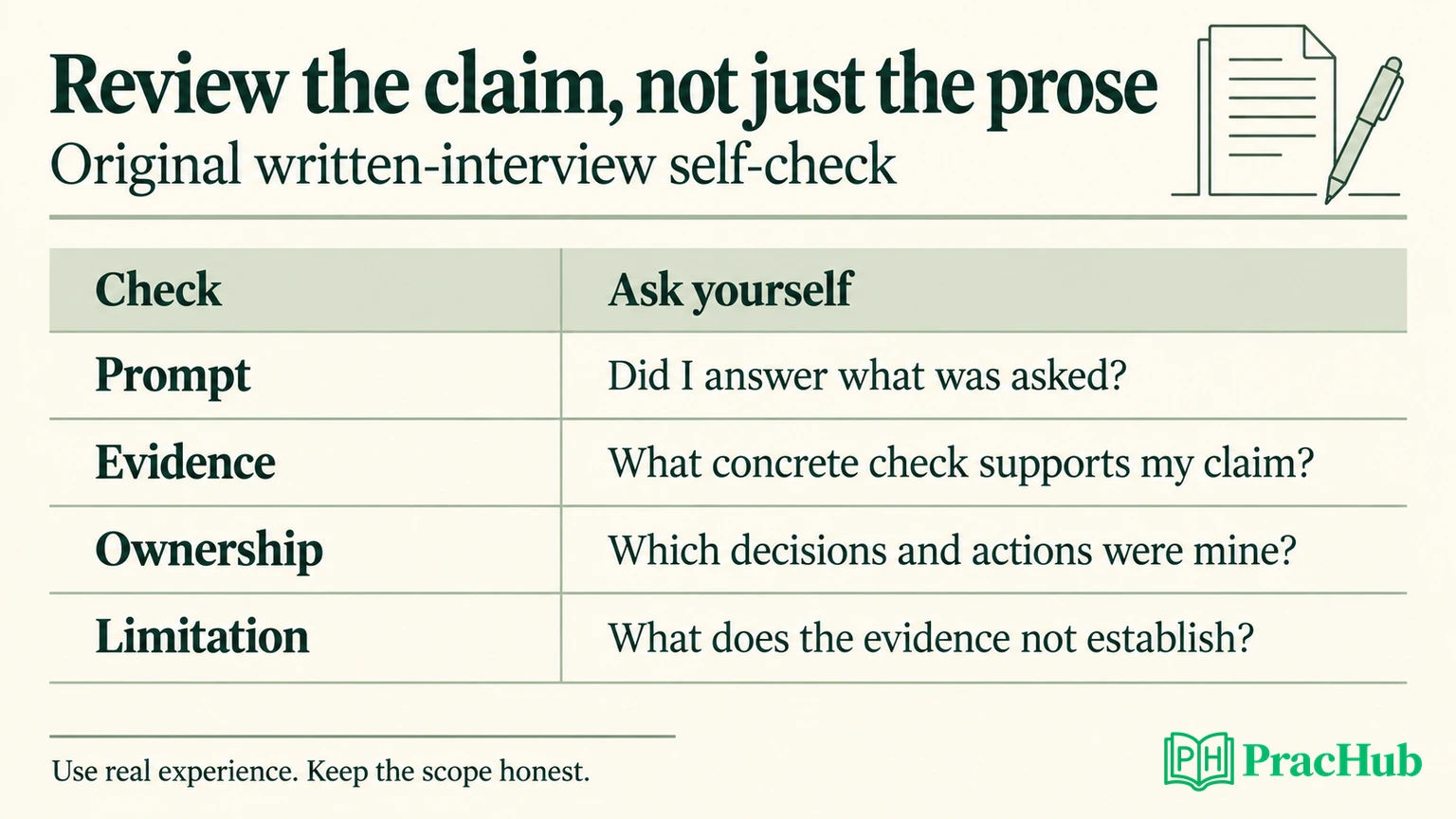
Review each answer for evidence and boundaries
Use this original self-check after drafting, rather than forcing every answer into an identical paragraph structure.
| Review area | Look for |
|---|---|
| Prompt | A direct answer. |
| Evidence | A supporting artifact or check. |
| Your role | Your actions and team boundaries. |
| Limitation | An explicit scope limit. |
For the database example, the evidence is the replay test, not the phrase “scalable service.” For the staging incident, the ownership boundary separates diagnosis from rollback approval. For the contribution example, the status of the patch and the maintainer's role prevent accidental overstatement.
Check quantitative claims especially carefully. State the metric, comparison, population, and measurement period when they matter. If a figure is an estimate, label it. If you cannot reconstruct where a percentage came from, replace it with a narrower statement you can support.
Academic answers need the same care. Use the actual qualification and grading context you know. Do not convert a grade into a percentile without a valid reference population. If a requested historical record is unavailable, explain that limitation rather than inventing precision.
Make the document easy to discuss later
Organize answers in the same order as the supplied questions unless instructed otherwise. Preserve enough of each prompt to make the response easy to locate. Use headings and short paragraphs to separate genuinely different points. An unexplained diagram or a long code listing can create more work for the reader than it saves.
For every substantial claim, rehearse one level deeper: why that approach, what alternative you rejected, how you checked the result, and what you would change now. Keep your submitted document available for preparation so that your later explanation uses consistent facts and scope.
Read the draft aloud once. Replace sentences that sound impressive but do not say anything testable. Then do a separate accuracy pass: names, dates, contribution status, numbers, links, and permissions. Style editing cannot repair a claim that is untrue.
Finally, check the exported file itself. Confirm that text is selectable where required, links open, page breaks do not separate a heading from its answer, and the filename follows the invitation. Submit through the specified route and retain the confirmation. These are practical document checks, not predictions about Canonical's evaluation.
Practice the follow-up with five engineering questions
These PracHub questions are cross-company preparation material, not a verified Canonical question set. Use them to test whether a written claim holds up in a conversation.
| PracHub question | Practice focus |
|---|---|
| Present a Project Architecture and Your Hardest Technical Decision | Explain the constraint behind a design choice. |
| Taking Ownership of a Technically Risky Project | Separate your responsibility from team authority. |
| Give Evidence-Based Strengths, Weaknesses, and Feedback | Replace personality claims with examples. |
| Respond Constructively to Negative Feedback | Explain what changed after review. |
| Explain a Difficult Technical Decision | Defend an alternative and acknowledge its cost. |
Choose the project architecture question, write a short evidence outline from your own experience, and answer a follow-up without adding new achievements. If the explanation becomes clearer while the facts stay stable, your preparation is doing its job.
Sources and Further Reading
- Canonical: How to get a job at Canonical — June 2025 hiring-lead guidance.
- Ubuntu: Not just an annoying list of questions — August 2023 explanation with technical-author hiring context.
- Reddit: Canonical written interview — individual applicant discussion, not a universal process specification.
Comments (0)